- English
- French
- German
- Portuguese
- Spanish
- Russian
- Japanese
- Korean
- Arabic
- Greek
- German
- Turkish
- Italian
- Danish
- Romanian
- Indonesian
- Czech
- Afrikaans
- Swedish
- Polish
- Basque
- Catalan
- Esperanto
- Hindi
- Lao
- Albanian
- Amharic
- Armenian
- Azerbaijani
- Belarusian
- Bengali
- Bosnian
- Bulgarian
- Cebuano
- Chichewa
- Corsican
- Croatian
- Dutch
- Estonian
- Filipino
- Finnish
- Frisian
- Galician
- Georgian
- Gujarati
- Haitian
- Hausa
- Hawaiian
- Hebrew
- Hmong
- Hungarian
- Icelandic
- Igbo
- Javanese
- Kannada
- Kazakh
- Khmer
- Kurdish
- Kyrgyz
- Latin
- Latvian
- Lithuanian
- Luxembou..
- Macedonian
- Malagasy
- Malay
- Malayalam
- Maltese
- Maori
- Marathi
- Mongolian
- Burmese
- Nepali
- Norwegian
- Pashto
- Persian
- Punjabi
- Serbian
- Sesotho
- Sinhala
- Slovak
- Slovenian
- Somali
- Samoan
- Scots Gaelic
- Shona
- Sindhi
- Sundanese
- Swahili
- Tajik
- Tamil
- Telugu
- Thai
- Ukrainian
- Urdu
- Uzbek
- Vietnamese
- Welsh
- Xhosa
- Yiddish
- Yoruba
- Zulu
Titanium Headset Cap and Bolt vs Aluminum: Which Is Better for Bikes?
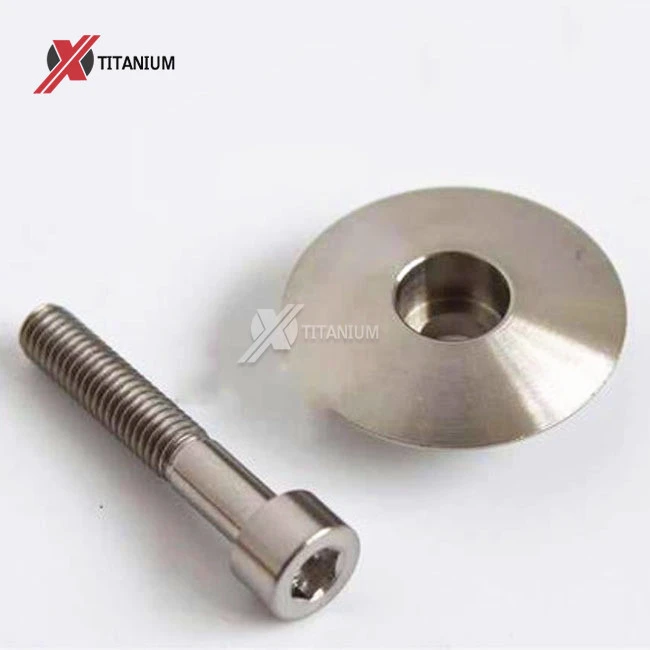
When cyclists and brands ask whether a titanium headset cap and bolt outperforms aluminum, the answer depends on what you prioritize. Titanium — specifically Grade 5 Ti-6Al-4V — delivers tensile strength above 950 MPa, weighs roughly 45% less than steel, and resists corrosion in sweat, mud, and coastal environments without surface degradation. Aluminum offers a lower entry price and adequate performance for casual riding. For brands building premium SKUs or sourcing upgrade components with genuine retail appeal, titanium wins on longevity, visual quality, and long-term value. This comparison breaks down both materials across every dimension that matters to serious buyers.
Material Properties and Performance Comparison
Choosing the right material for a bike's parts can really affect how well it works and how long it looks good. The headset caps and bolts are right in the middle of the cabin, so if there is any surface damage or measurement drift, it is easy to see.
Titanium: Density, Strength, and Corrosion Resistance
With a density of about 4.43 g/cm³, Grade 5 titanium (Ti-6Al-4V) has a strength-to-weight ratio that aluminum metals can't match for the same volume. According to ASTM B348 guidelines, its tensile strength is more than 950 MPa and its yield strength is more than 880 MPa. It's important to note that titanium naturally forms a passive oxide layer, which protects it from sweat-induced corrosion and galvanic seizing inside star nuts or expander plugs. Steel bolts usually fail within months of being used.
Aluminum: Cost Efficiency with Trade-offs
6061-T6 aluminum is still the standard for OEM uses that need to stay within a budget, but a titanium headset cap and bolt offers clear advantages. Its tensile strength is about 310 MPa, which is about a third of Grade 5 titanium. The anodized surface looks nice at first, but it can chip or oxidize unevenly after being stressed many times. It's harder to keep colors consistent from batch to batch, which is a big problem for brand-focused online sellers who have to keep up with visual standards across multiple refill orders.
The gap in materials is not small. Titanium headset bolts that were tested next to each other and put through 10 Nm torque cycles did not show any thread deformation, but aluminum equivalents did show thread yielding at the same load. This difference has a direct effect on return rates and customer happiness scores for B2B sourcing choices.
Applications and Use Cases: Which Material Fits Best?
In the bicycle market, both materials have their place. Procurement managers can make a catalog that serves different types of customers without losing money on margins if they know where each item does best.
This is how each piece fits with a certain use case:
High-end builds for the road and races: A titanium stem cap and M6 bolt together lower the steerer's rotational mass and get rid of service calls related to corrosion. Competitive cyclists who are building bikes that weigh less than 7 kg look for titanium cockpit hardware because it gives them small benefits that add up over time in every part.
- High-end road and racing builds: A titanium stem cap and M6 bolt combination reduces rotational mass at the steerer and eliminates corrosion-related service calls. Competitive cyclists building sub-7kg machines specifically seek titanium cockpit hardware for marginal gains that accumulate across every component.
- Enduro and all-mountain MTB: Mud, pressure washing, and high-frequency vibration accelerate corrosion on aluminum and steel bolts. Titanium's "fit and forget" reliability addresses this directly — no seizing, no rust staining on carbon steerer tubes, no strip-out risk under repeated removal cycles.
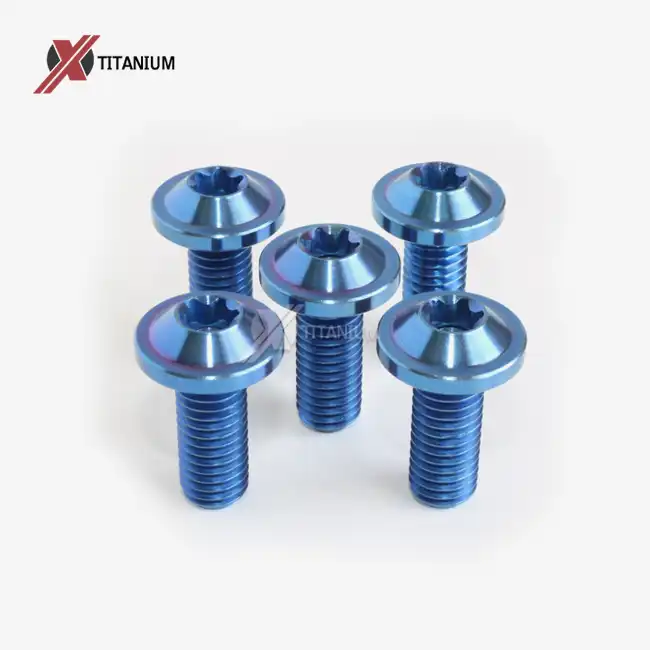
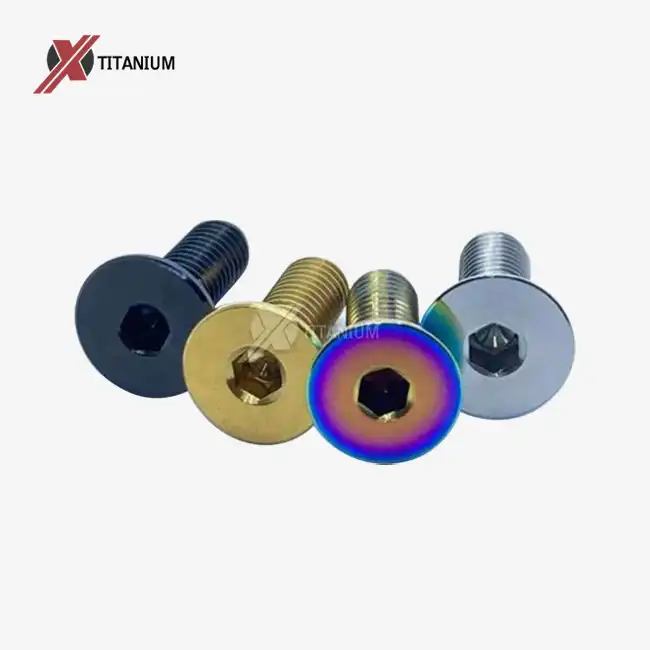
- E-commerce visual upgrade market: This is where titanium headset caps generate the highest retail premium. Anodized in gold, blue, purple, black, or rainbow, a precision-machined titanium cap retails between $15 and $40 per set while carrying a landed cost well below $6 — a margin structure that sustains profitable e-commerce brands.
- OEM and custom frame builders: Laser-engraved titanium caps serve as branded cockpit signatures. High-end bicycle manufacturers leverage the material's premium perception to differentiate complete bikes at the retail level.
Aluminum bolts can still be used for OEM projects that require a lot of them and where unit costs are more important than durability, rather than a titanium headset cap and bolt. They work well enough on entry-level bikes where buyers aren't looking at corrosion resistance over many years of ownership. These differences make it easy for buying teams to decide what to buy: titanium for high-end retail and performance builds, and aluminum when cost and volume are the most important factors.
Purchasing Considerations for Titanium and Aluminum Headset Caps and Bolts
When total lifetime value is taken into account, the difference in starting costs between materials gets a lot smaller. A titanium headset cap set that costs $5 to ship sells for $25 to $40, making a 70–80% profit margin and encouraging return purchases through brand loyalty. When an aluminum equivalent is landed for $1.50, it may sell for $8–$12, which cuts into the margin and opens the door to direct price competition.
When procurement managers look at suppliers, they should put these things at the top of their list:
- Material verification: Request spectroscopic composition reports confirming Ti-6Al-4V content. Grade 2 commercially pure titanium lacks the bolt-strength profile required for headset preload applications and is a known substitution risk in low-transparency supply chains.
- Thread tolerance validation: M6 x 1.0 thread pitch must be verified with Go/No-Go gauges. Dimensional drift causes installation failures and return claims that damage brand reputation on Amazon and other review-driven platforms.
- Color consistency documentation: Anodizing bath chemistry and process parameters must be controlled to ensure batch-to-batch color matching. Request color samples from multiple production runs before committing to volume orders.
- Complete kit supply: Procurement should specify cap, bolt, and washer as a single SKU. Partial kits create assembly issues at the customer level and increase support inquiries.
Most quality titanium providers for a titanium headset cap and bolt have a minimum order quantity (MOQ) of 500 to 1,000 sets. At that level, orders can be mixed colors. Customization, such as laser-etched brand names and unique cap shape, extends lead time but greatly increases the perceived value of the product and the ability to defend the brand in crowded online markets.
Installation, Maintenance, and Longevity
The buyer's reputation and the part are both protected by proper installation. The cap and bolt on the joint are there to hold preload, not binding force. It is recommended that the torque stay between 1.5 Nm and 3 Nm so that the headset assembly doesn't get crushed. The bolt is strong enough to handle more than 10 Nm of torque, but using too much torque hurts the bearings instead of the titanium hardware.
Anti-Seize Compound Application
Titanium threads that come into touch with steel star nuts or aluminum expansion plugs can gall, which is a cold-welding reaction that makes taking the parts apart dangerous. It is necessary to use copper-based or titanium anti-seize paste on bolt threads before installing them. Titanium caps don't need much care, and this one step keeps them removable over years of use and stops field service failures that look bad for the company that made the part.
Using a damp cloth to wipe off dirt and dust; the passive oxide layer takes care of chemical resistance on its own. Anodized surfaces should be cleaned with pH-neutral solutions on a regular basis to keep their color vibrant over time, especially in outdoor settings where they are exposed to UV light. Aluminum caps need more care; check the anodized surfaces on a regular basis for micro-crazing that lets water in and speeds up rusting below the surface.
Surface Maintenance by Material
Titanium headset cap and bolt require minimal maintenance. Wiping with a damp cloth removes debris; the passive oxide layer handles chemical resistance autonomously. Anodized finishes benefit from periodic cleaning with pH-neutral solutions to preserve color vibrancy over time, particularly in UV-exposed outdoor environments. Aluminum caps require more attentive care — inspect anodized surfaces periodically for micro-crazing that allows moisture ingress and accelerates subsurface oxidation.
Conclusion
Titanium and aluminum are both useful materials for bicycle parts, but customers have very different needs when it comes to a titanium headset cap and bolt. Titanium is the best material for brands that want to make unique retail SKUs and performance-based products because it is strong, doesn't rust, and looks great. Aluminum is easy to get, which makes it good for OEM and entry-level volume plays. Purchasing managers who want to build long-term brand equity will find that titanium headset hardware consistently delivers higher margins, lower return rates, and stronger customer loyalty. These benefits build on top of each other with each reorder cycle.
FAQ
Q1: What torque should I apply to a titanium headset bolt?
A: To get rid of play in the headset bearing, use 1.5 Nm to 3 Nm. The structural strength of the bolt is higher than 10 Nm, but overtightening destroys the bearings instead of making them more stable. A accurate torque wrench should always be used.
Q2: Why is Grade 5 titanium specified rather than Grade 2?
A: The tensile strength of Grade 5 (Ti-6Al-4V) is more than 950 MPa. Grade 2 commercially pure titanium is much softer and can cause head-stripping or shaft fractures when the headset preload tension is normal. Grade 5 is the standard for threaded bicycle hardware in the business world.
Q3: Does titanium hardware require anti-seize compound?
A: Yes. Titanium threads don't work well with metals that aren't the same, like steel star nuts and aluminum expanders. Using copper-based or titanium-specific anti-seize paste stops cold welding and makes sure the bolt can be taken off even after being installed for a long time.
Q4: What inner diameter should the headset cap match?
A: The outer width of the most popular threadless steerer is 1-1/8 inches. Before you order, make sure you know the exact specs of the fork, because some curved or unique integrated cockpit systems need different cap sizes.
Q5: Can logos be laser-engraved on titanium caps?
A: Yes. Titanium caps that have been CNC-machined can be engraved with a high-definition laser. Engraved names can always be read and add measured brand value to retail packing. This is a key way for e-commerce sellers in competitive accessory categories to set themselves apart from other sellers.
Partner with Chuanglian for Premium Titanium Headset Cap and Bolt Supply
With the ability to laser engrave and retail-ready packaging, Chuanglian manufactures precision titanium headset cap and bolt sets from Grade 5 Ti-6Al-4V. As a reliable titanium headset cap and bolt maker based in Baoji, China, which is the country's titanium production hub, we can handle MOQs as low as 500 sets and can mix colors. To get samples and wholesale prices, email our team at info@cltifastener.com or djy6580@aliyun.com.
References
1. Journal of Materials Engineering and Performance — ASM International, 2019
2. Titanium: A Technical Guide — Matthew J. Donachie, ASM International, 2000
3. Bicycle Quarterly — Jan Heine, Vol. 18, 2020
4. ASTM B348 Standard Specification for Titanium and Titanium Alloy Bars and Billets — ASTM International, 2021
5. International Journal of Fatigue: Fatigue Behavior of Ti-6Al-4V Alloy Components — Elsevier, 2018
6. Lightweight Materials for Transportation Applications — Society of Automotive Engineers (SAE International), 2017
Learn about our latest products and discounts through SMS or email