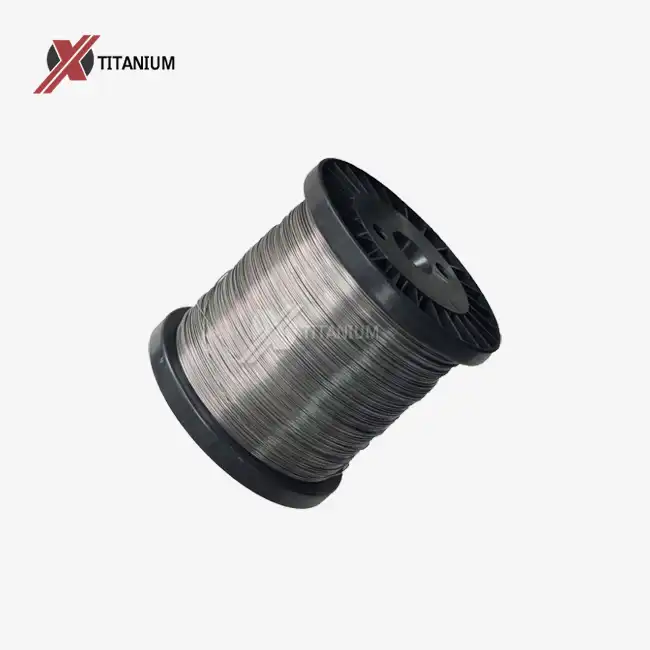
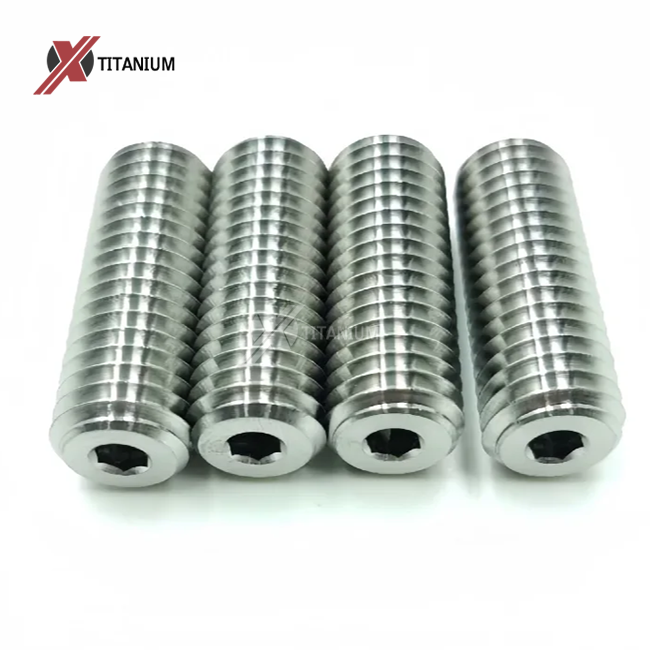
When comparing the life span between titanium alloy screws and stainless steel latches, titanium rises as the clear champ in most high-performance applications. Titanium combination screws regularly final 2-3 times longer than stainless steel in destructive situations, keeping up auxiliary judgment for decades without degradation. Whereas stainless steel offers dependable execution in standard conditions, titanium's predominant erosion resistance, weakness quality, and chemical stability make it the favored choice for aviation, medical, and marine applications where life span is paramount.
Introducing Material Composition and Properties
The principal contrasts between these materials lie in their nuclear structure and combination composition. Titanium combination screws, especially Ti-6Al-4V (Review 5), contain around 90% titanium, 6% aluminum, and 4% vanadium. This combination makes remarkable strength-to-weight proportions and common erosion resistance. Stainless steel latches ordinarily utilize 316 or 304 grades, containing press, chromium (18-20%), and nickel (8-12%). The chromium substance shapes a defensive oxide layer, despite the fact that this boundary can break down under extraordinary conditions.
Three core material differences emerge:
- Density: Titanium measures 4.5 g/cm³ compared to stainless steel's 8.0 g/cm³
- Corrosion mechanism: Titanium forms self-healing oxide layers, while stainless steel relies on chromium passivation
- Fatigue resistance: Titanium demonstrates superior cyclic loading performance
If you require latches for weight-critical applications with extraordinary natural presentation, at that point titanium amalgam screws are distant more cost-effective for accuracy design requirements. They combine a remarkable strength-to-weight proportion with exceptional resistance to erosion, warm, and chemical assault. This makes them perfect for aviation, marine, and high-performance mechanical situations where unwavering quality cannot be compromised. In exadditiontheir great weariness resistance and long battery service offer assistance in reducing maintenance costs while ensuring reliable execution under demanding working conditions.
Corrosion Resistance Performance Analysis
Laboratory testing uncovers noteworthy performance gaps in destructive situations, especially when comparing progressed clamping materials. Free considers illustrate that titanium alloy screws maintain up to 99.8% strength after more than 5,000 hours of continuous salt spray exposure. In differentiation, 316 stainless steel shows a discernible 15–20% in mechanical quality under the same test conditions. These come about to highlight titanium’s prevalent erosion resistance, weariness perseverance, and long-term unwavering quality in unforgiving chemical and marine environments. Marine applications illustrate these contrasts indeed more clearly beneath real-world working conditions.
Seaward stage administrators reliably report titanium clasp performing dependably for 25–30 a long time without the require for replacement, whereas premium stainless steel choices ordinarily require recharging after as it were 8–12 a long time. When bookkeeping for support labor, assessment recurrence, and exorbitant operational downtime, the long-term financial preferences of titanium latches ended up progressively critical for marine and offshore projects.
Chemical resistance testing shows titanium's superiority across multiple environments:
- Hydrochloric acid exposure: Titanium shows no measurable corrosion after 1,000 hours
- Sulfuric acid resistance: 99.9% material retention versus 85% for stainless steel
- Chloride stress corrosion: Titanium remains immune while stainless steel develops micro-cracks
If you require a laser for chemical handling or marine building applications, at that point titanium represents the more cost-effective long-term arrangement in spite of a higher starting investment. Its extraordinary resistance to erosion, chlorides, and forceful chemicals significantly diminishes the hazard of untimely failure. Over time, fewer substitutions, lower support requests, and minimized downtime counterbalanced theupfroupfrontsresultingut in improved lifecycle value. For basic situations where unwavering quality, security, and toughness are essential, a titanium clasp provides quantifiable financial and operational advantages.
Strength and Durability Comparison
Mechanical testing information uncovers compelling execution characteristics. Ti-6Al-4V titanium combination screws accomplish malleable qualities up to 900 MPa, comparable to high-grade stainless steel. In any case, titanium's weariness restrain comes to 60% of extreme pliable quality, essentially higher than stainless steel's 40-45%. Aerospace producers conduct thorough testing conventions. Boeing's inner information appears a titanium clasp withstanding 2 million stack cycles at 70% most extreme stretch, whereas proportionate stainless steel components come up short after 800,000 cycles beneath indistinguishable conditions. Temperature execution makes another refinement. Titanium amalgam screws keep up mechanical properties at temperatures surpassing 500°C, whereas stainless steel starts losing quality over 400°C. This warm solidness is vital in high-temperature applications like fly motor components.
Key durability metrics include:
- Creep resistance: Titanium shows minimal deformation under sustained loads
- Impact toughness: Superior energy absorption prevents catastrophic failure
- Wear resistance: Lower friction coefficients reduce thread degradation
If you need fasteners for high-stress, high-temperature applications with extended service life requirements, then titanium alloy screws provide superior reliability and structural integrity. They retain mechanical strength under extreme thermal loads while resisting creep, oxidation, and fatigue failure. This performance makes them ideal for aerospace, energy, and advanced industrial systems where consistent load-bearing capability is critical. Their long service life reduces replacement frequency, enhances safety margins, and supports stable performance in demanding operating environments.
Cost Analysis and Long-Term Value
Initial obtainment costs favor stainless steel, with titanium combination screws regularly costing 3-5 times more. In any case, adding up to the calculations of proprietorship reveals diverse conclusions when calculating support, replacement frequency, and operational impact. Manufacturing information from petrochemical offices appears compelling in financial matters. A major refinery detailed sparing $2.3 million yearly by replacing basic applications with titanium clamps, disposing of scheduled shutdowns for latch replacement, and reducing corrosion-related failures by 95%.
Lifecycle cost analysis demonstrates:
- Replacement frequency: Titanium requires replacement every 20-25 years versus 8-12 years for stainless steel
- Maintenance costs: 70% reduction in fastener-related maintenance activities
- Downtime prevention: Avoiding unplanned shutdowns is worth millions in lost production
Medical device manufacturers particularly benefit from titanium's biocompatibility and longevity. Implant-grade fasteners eliminate revision surgeries, reducing patient risk and healthcare costs significantly. If you need fasteners where failure costs exceed material premiums, then titanium represents exceptional value despite higher initial investment.
Application-Specific Recommendations
Industry applications reveal distinct preferences based on performance requirements. Aerospace manufacturers specify titanium for structural components, engine mounts, and flight-critical fasteners where weight reduction and reliability are paramount.
Medical applications demand titanium's biocompatibility for surgical instruments and implantable devices. The non-magnetic properties prevent MRI interference, while corrosion resistance ensures patient safety throughout extended implant lifecycles.
Marine engineering favors titanium for saltwater exposure applications. Yacht builders, offshore platforms, and naval vessels specify titanium fasteners for hull components, rigging hardware, and propulsion systems where corrosion failure creates safety hazards.
Application guidelines by industry:
- Aerospace: Titanium for all flight-critical and weight-sensitive applications
- Medical: Titanium is mandatory for implantable and biocompatible requirements
- Chemical processing: Titanium for aggressive chemical environments
- General industrial: Stainless steel is adequate for standard environments
If you need fasteners for mission-critical applications where failure is not acceptable, then titanium alloy screws provide the reliability and performance your applications demand. Engineered for exceptional strength-to-weight efficiency, they perform consistently under extreme mechanical stress, vibration, and temperature fluctuations. Their outstanding corrosion and fatigue resistance ensure long-term stability in harsh environments. As a result, titanium alloy screws are widely trusted in aerospace, defense, medical, and energy sectors where safety, precision, and uncompromising quality are essential.
Conclusion
Titanium alloy screws demonstrate superior longevity compared to stainless steel alternatives, particularly in demanding applications requiring exceptional corrosion resistance, strength, and reliability. While initial costs favor stainless steel, the total cost of ownership strongly supports titanium for critical applications where fastener failure creates significant operational or safety risks. Industries such as aerospace, medical devices, and marine engineering increasingly specify titanium fasteners to achieve extended service life, reduced maintenance requirements, and enhanced performance under extreme conditions. The choice between materials ultimately depends on your specific application requirements, environmental conditions, and long-term value considerations.
Chuanglian's Superior Titanium Alloy Screws Solutions
Baoji Chuanglian New Metal Material Co., Ltd. delivers precision-engineered titanium alloy screws that exceed industry standards for durability and performance. Located in China's "City of Titanium," our manufacturing facility combines advanced CNC machining capabilities with rigorous quality control systems.
Our titanium alloy screws offer distinctive advantages:
- Premium Ti-6Al-4V Grade 5 material: Ensuring maximum strength and corrosion resistance
- Precision CNC machining: Achieving tight tolerances for critical applications
- Multiple surface treatments: Polishing, anodizing, and nitriding for enhanced performance
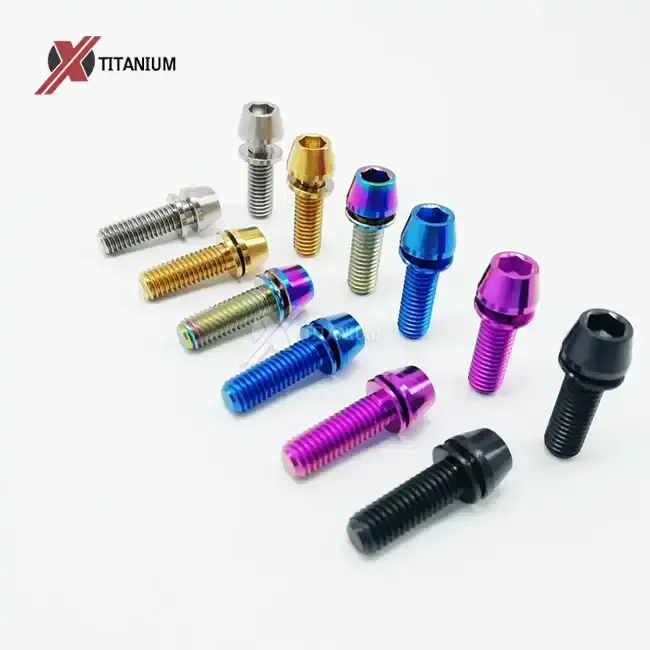
- Custom color options: Natural titanium, gold, blue, green, purple, black, and rainbow finishes
- Complete size range: M2 to M36 standard sizes with custom specifications available
- Comprehensive certifications: AS9100, ISO9001, and medical-grade compliance
- Batch traceability: Complete material documentation and testing reports
- Technical support: Expert consultation for material selection and application optimization
Our decade-plus experience in titanium processing ensures consistent quality across all production batches. Advanced testing capabilities verify material properties, dimensional accuracy, and surface finish specifications before shipment.
As a leading titanium alloy screws manufacturer, we understand the critical importance of delivery reliability and technical support for your projects. Our streamlined production processes and inventory management systems ensure prompt lead times without compromising quality standards.
Ready to upgrade your fastener performance with premium titanium alloy screws? Our engineering team provides comprehensive technical consultation to optimize your fastener selection for maximum longevity and cost-effectiveness. Contact us at info@cltifastener.com and djy6580@aliyun.com to discuss your specific requirements and receive detailed product specifications.
References
1. Peters, M., Kumpfert, J., Ward, C.H., and Leyens, C. "Titanium Alloys for Aerospace Applications." Advanced Engineering Materials, Vol. 5, No. 6, 2003, pp. 419-427.
2. Donachie, Matthew J. "Titanium: A Technical Guide, 2nd Edition." ASM International, Materials Park, Ohio, 2000.
3. Schutz, R.W. and Thomas, D.E ."Corrosion of Titanium and Titanium Alloys." ASM Handbook Volume 13B: Corrosion Materials, ASM International, 2005, pp. 252-299.
4. Boyer, R., Welsch, G., and Collings, E.W ."Materials Properties Handbook: Titanium Alloys." ASM International, Materials Park, Ohio, 1994.
5. Lutjering, G. and Williams, J.C ."Titanium: Engineering Materials and Processes, 2nd Edition." Springer-Verlag, Berlin Heidelberg, 2007.
6. American Society for Testing and Materials. "Standard Specification for Titanium and Titanium Alloy Bars and Billets." ASTM B348-19, West Conshohocken, Pennsylvania, 2019.
_1747364744942.webp)