- English
- French
- German
- Portuguese
- Spanish
- Russian
- Japanese
- Korean
- Arabic
- Greek
- German
- Turkish
- Italian
- Danish
- Romanian
- Indonesian
- Czech
- Afrikaans
- Swedish
- Polish
- Basque
- Catalan
- Esperanto
- Hindi
- Lao
- Albanian
- Amharic
- Armenian
- Azerbaijani
- Belarusian
- Bengali
- Bosnian
- Bulgarian
- Cebuano
- Chichewa
- Corsican
- Croatian
- Dutch
- Estonian
- Filipino
- Finnish
- Frisian
- Galician
- Georgian
- Gujarati
- Haitian
- Hausa
- Hawaiian
- Hebrew
- Hmong
- Hungarian
- Icelandic
- Igbo
- Javanese
- Kannada
- Kazakh
- Khmer
- Kurdish
- Kyrgyz
- Latin
- Latvian
- Lithuanian
- Luxembou..
- Macedonian
- Malagasy
- Malay
- Malayalam
- Maltese
- Maori
- Marathi
- Mongolian
- Burmese
- Nepali
- Norwegian
- Pashto
- Persian
- Punjabi
- Serbian
- Sesotho
- Sinhala
- Slovak
- Slovenian
- Somali
- Samoan
- Scots Gaelic
- Shona
- Sindhi
- Sundanese
- Swahili
- Tajik
- Tamil
- Telugu
- Thai
- Ukrainian
- Urdu
- Uzbek
- Vietnamese
- Welsh
- Xhosa
- Yiddish
- Yoruba
- Zulu
Titanium Shoulder Bolts vs Steel: Strength Comparison Guide
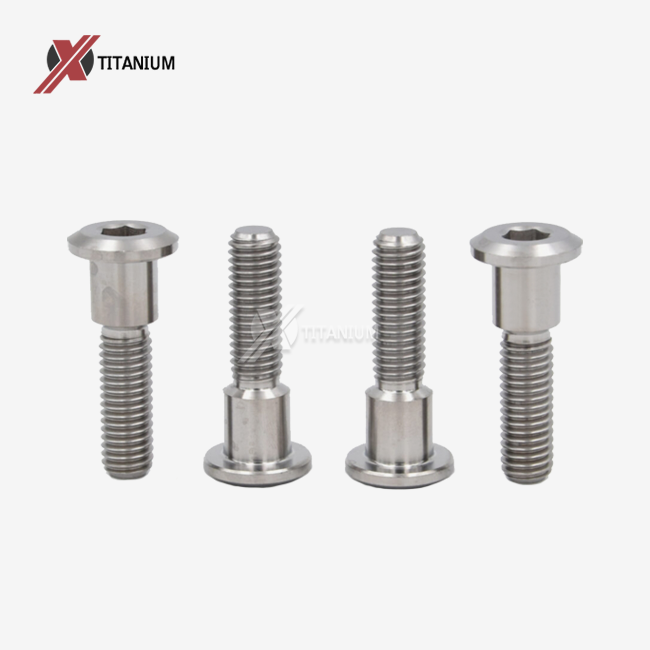
When evaluating fastener options for high-performance applications, the choice between titanium shoulder bolts and steel variants significantly impacts project outcomes. Titanium shoulder bolts offer exceptional strength-to-weight ratios and superior corrosion resistance, making them ideal for aerospace, marine, and medical applications where performance cannot be compromised. Steel shoulder bolts provide cost-effective solutions with proven reliability across general industrial applications, though they require additional surface treatments in corrosive environments.
Introduction
In a lot of different fields, shoulder bolts are important parts because they keep things together and make precise mechanical systems that need to be very reliable. The shoulder piece of these unique screws is not threaded and sits between the head and the threads. They can be used as exact axles, dowels, guides, or points of rotation for items that do move or spin. Titanium and steel shoulder nuts are not the same and can't be used for the same things. Buying managers, engineers, wholesalers, and OEM clients can choose the right material for their needs if they know about these differences.
You shouldn't just compare prices when picking a material. You should also think about its technical strengths, how well it will work in difficult conditions over time, how heavy it is, and how well it will fight corrosion. This in-depth guide looks at both titanium shoulder bolts and steel shoulder bolts, focusing on what makes them different and how they can be used in business, on boats, in planes, and in cars. People who make choices can pick the best fasteners for load-bearing reliability, sturdiness, and cost-effectiveness by planning how they look at these factors. They can also make sure that the fasteners meet industry standards and performance requirements.
Understanding Titanium Shoulder Bolts and Steel Shoulder Bolts
Shoulder bolts made of titanium and steel are made in very different ways and are made of very different materials. They don't work as well in some scenarios because of these differences. Ti-6Al-4V metals, such as Grade 2 or Grade 5, are used to make most titanium shoulder bolts. These metals are very light and don't rust. Grade 5 titanium is harder and better for high-stress and aircraft uses because it has 6% aluminum and 4% vanadium in it. In contrast, Grade 2 titanium is simple to shape and doesn't rust when used in chemical processes or rough seas.
Carbon steel, high-strength alloy steels, and stainless steels are some of the steels that can be used to make steel shoulder nuts. Some alloy steels, like 4140 and 4340, have a higher tensile strength (often over 150,000 PSI). Stainless steels, like 316, are good for mechanics and don't protect too well against rust. There are a lot of different ways to make different things. For instance, titanium needs special ways to be machined because it doesn't conduct heat well and gets harder when it's being worked on.
Material Grade Specifications and Standards
Titanium is cut into different grades depending on what the object needs and what is around it. Grade 2 titanium doesn't rust and has a yield strength of about 40,000 PSI. This means it can be used in chemical and marine settings where weight reduction and corrosion protection are more important than power as a whole. Titanium grade 5 is much harder than titanium grade 4 and has yield strengths close to 120,000 PSI. This makes it the best choice for high-performance uses in airplanes and cars.
If you heat steel in a certain way, the grade and specifications for shoulder nuts can be very different. While carbon steels are a good choice for most industrial settings because they are cheap, precipitation-hardened stainless steels can reach strengths that are close to those of titanium alloys. By knowing these material properties, engineers can make sure that the fasteners' features fit the needs of the job. This keeps prices low while making sure the best results.
Strength Comparison Between Titanium and Steel Shoulder Bolts
It turns out that titanium and steel shoulder bolts are not exactly the same, and the differences are not just in terms of tensile strength. The mechanical properties of grade 5 titanium are very good. When fully stretched, it can hold between 130,000 and 140,000 PSI, and it doesn't break down easily even after being loaded and unloaded many times. Steel shoulder nuts, especially those made of high-strength alloys, can have tensile strengths of more than 180,000 PSI. This makes them better for cases where the load is steady.
Titanium is clearly better than other materials when it is loaded and removed quickly because of how well they handle stress. Titanium has a very high wear strength, which means that buildings made of it won't break after millions of load cycles. This trait is very useful in places where cyclic pressures happen a lot, like in airplane linkage systems, car suspension parts, and military robots.
Weight-to-Strength Performance Analysis
In cases where weight is important, titanium is definitely better when strength to weight is taken into account. Titanium shoulder bolts are about 40–45% heavier than steel shoulder bolts, but they are still about the same strength. This weight advantage directly leads to better fuel economy in planes, better performance in cars, and easier control on platforms for naval robots.
To keep something strong over time, corrosion defense is very important, especially in harsh settings. Titanium forms a strong inactive oxide layer that is very immune to acids, saltwater, and shop chemicals. Another thing is that it stays strong for a long time. Different types of stainless steel or protective coatings need to be used on steel shoulder nuts to get the same amount of corrosion protection. Most of the time, this means they cost more and are heavy.
Measuring and Selecting the Right Titanium Shoulder Bolt
There are certain ways to measure and pick that make sure the best fit and useful performance in key situations. Shoulder width, shoulder length, thread size, and overall bolt length are some of the most important measurements that need to be carefully thought through based on the job. You can get a good idea of these numbers by using standard measuring tools and methods in the field. This is important for making sure that mechanical systems fit and work right.
Titanium shoulder bolts come in sizes M5 to M12, and they can be made to fit shoulder widths from 4mm to 50mm. There are different types of threads, such as metric, UNC, and UNF, so they can be used in the majority of cases. Some surface processes are anodizing, cleaning, and doing custom work. You can choose from different colors, like gold, blue, green, purple, black, and colorful shades, when you anodize something.
Grade Selection and Application Matching
The needs of the product and the factors of the area determine which Grade 2 or Grade 5 titanium to use. It's easy to shape grade 2 titanium into shapes that need light strength, and it doesn't rust. When there is a lot of stress, grade 5 titanium is what you need. For regular use, there are basic carbon grades of steel, and for harsh conditions that need extra strength, there are precipitation-hardened stainless steels.
CNC cutting makes it possible to make sizes that are just right for each purpose. When making things, these skills allow shoulder width tolerances to be set to h8 or f9 norms. For accurate pivot uses, this makes sure that the parts fit right in the H7-reamed holes. OEM users who need certain performance traits have a lot of choices because they can get thread lengths, shoulder shapes, and surface processes that are made just for them.
Practical Applications and Use Cases
High-performance titanium shoulder bolts are mostly used in the airplane industry because they are strong for their weight and don't rust. Manufacturers of airplanes use these screws in wing flap devices, landing gear units, and engine mount systems. All of these parts lose weight, which changes how much fuel the plane uses and how much it can carry. Titanium is very light, which makes it useful for UAVs and drones because it lets them fly longer and go through better terrain.
Titanium shoulder bolts are being used more frequently in high-performance engines, transmission systems, and chassis parts for cars. When racing, these screws are used at pivot points in the suspension because less weight that isn't being sprung around makes the car handle and respond better. Electric car makers use titanium screws to keep the structure strong and free of rust in hard working conditions while also balancing out the weight of the batteries.
Marine and Industrial Applications
Titanium's ability to prevent corrosion is also useful for underwater robots and submarines. Rover-operated vehicles (ROVs) use titanium shoulder bolts as turning points for their control arms and camera systems because the salty environment below would quickly eat away at steel ones. After some time, titanium makes an oxide layer that does nothing and keeps things steady. This lets the repair work be done even after being underwater for a long time.
Biocompatibility and corrosion resistance are very important in the business world when it comes to making medical gadgets, chemical handling tools, and electronics. Heavy chemicals in chemical plants would damage steel parts in places like heat exchangers, pressure tanks, and pipe systems. Instead, titanium screws are used. Biocompatibility is important to medical device makers because titanium is used to make clean tools for surgery and devices that are implanted. These tools must not rust.
Procurement Considerations for Titanium Shoulder Bolts vs Steel
It's not enough to just look at how much the part costs when it's first bought. It also figures out how much it will cost to own over its whole useful life and its overall value. It costs more for titanium shoulder bolts than steel ones, but they last longer, need less maintenance, and work better, so the extra cost is usually worth it. Procurement experts need to think about all of these things together, including how much they will cost the business in the long run and what the needs of each application are.
Titanium screws usually take longer to get because the materials are harder to come by and the making process is different. Custom orders take longer for things like expert study, finding materials, and fine machining. To meet output and project goals, it's important to work with qualified providers who can consistently offer high-quality work on time.
Supplier Selection and Quality Considerations
When picking a provider, you shouldn't just look at price. You should also look at professional skills, quality certifications, and how safe the supply chain is. For aircraft uses, providers need to be certified by AS9100 and show that their products can be tracked. For medical uses, suppliers need to follow ISO 13485 and get material approval. Because titanium is so hard to work with, service providers need to have special tools and expert staff that can meet high standards for measurements and surface finish.
During the whole process of making something, quality control systems have to check the materials to make sure they are the right size and have the right finish on the outside. Batch tracking is very important in fields like medicine and airplanes where a broken part could be very dangerous. In order to meet government standards and customer quality standards, providers should give full test results, material certificates, and inspection records.
Conclusion
If you have to choose between titanium and steel shoulder bolts, you should carefully consider the job, the weather, and how well you want the bolts to last over time. Titanium shoulder bolts work best in situations where weight is important and where resistance to rust and stress are also important. If you need to treat the surface of a steel shoulder bolt, on the other hand, it is a cheaper choice for general industry uses. As the decision comes down to it, you need to weigh the starting costs against the long-term value, taking into account things like how often you need to replace it, how much maintenance it needs, and the performance benefits that are specific to each application sector.
FAQ
What are the key strength differences between titanium and steel shoulder bolts?
Grade 5 titanium shoulder bolts achieve tensile strengths of 130,000-140,000 PSI with exceptional fatigue resistance, while high-strength steel bolts can exceed 180,000 PSI in ultimate tensile strength. However, titanium provides superior strength-to-weight ratios and maintains consistent performance in corrosive environments where steel may degrade over time.
How do I determine the correct size for my application?
Shoulder bolt sizing requires measuring the shoulder diameter, shoulder length, thread size, and overall length requirements. The shoulder should fit precisely in the pivot hole with h8 or f9 tolerance, while thread length must accommodate the clamped thickness plus nut engagement. Professional engineering consultation is recommended for critical applications.
Are titanium shoulder bolts suitable for marine applications?
Yes, titanium shoulder bolts are exceptional for marine applications due to their outstanding corrosion resistance in saltwater environments. Unlike steel bolts that require protective coatings, titanium forms a natural passive oxide layer that prevents corrosion and maintains structural integrity throughout extended saltwater exposure.
What surface treatments are available for titanium shoulder bolts?
Available surface treatments include polishing for smooth finish, anodizing for enhanced corrosion protection and color options, and nitriding for increased surface hardness. Anodizing can produce various colors including gold, blue, green, purple, black, and rainbow finishes while maintaining corrosion resistance.
Partner with Chuanglian for Premium Titanium Shoulder Bolts
Baoji Chuanglian New Metal Material Co., Ltd. stands as your trusted titanium shoulder bolts manufacturer, bringing over ten years of specialized experience in titanium processing and precision machining. Located in Baoji City, renowned as the "City of Titanium," our facility houses advanced CNC tools and quality control systems that make sure our goods are always the best. We know how to make Grade 2 and Grade 5 titanium shoulder bolts very well. Our one-of-a-kind sizes go from M5 to M12, and the shoulder widths run from 4mm to 50mm. Besides that, we can shine, anodize, and nitride the surfaces of your items.
Every step of the way we make something, from checking the raw materials to making sure the finished product meets AS9100 and ISO9001 standards, shows how much we care about quality. Our team of experts can help you with all of your application needs, whether you want basic sets or solutions that were made just for you. To talk about your needs for titanium shoulder bolts, please email our engineers at info@cltifastener.com or djy6580@aliyun.com.
References
1. Boyer, R., Welsch, G., & Collings, E.W. (2007). Materials Properties Handbook: Titanium Alloys. ASM International, Materials Park, Ohio.
2. American Society for Testing and Materials. (2019). ASTM B348-19: Standard Specification for Titanium and Titanium Alloy Bars and Billets. ASTM International, West Conshohocken, Pennsylvania.
3. Lutjering, G. & Williams, J.C. (2003). Titanium: Engineering Materials and Processes. Springer-Verlag, Berlin, Germany.
4. Aerospace Industries Association. (2018). AMS 4928: Titanium Alloy Bars, Wire, Forgings, and Rings 6Al-4V Solution Treated and Aged. SAE International, Warrendale, Pennsylvania.
5. Peters, M., Hemptenmacher, J., Kumpfert, J., & Leyens, C. (2003). Structure and Properties of Titanium and Titanium Alloys. Titanium and Titanium Alloys: Fundamentals and Applications, Wiley-VCH, Weinheim.
6. National Association of Corrosion Engineers. (2017). Corrosion Performance of Titanium Alloys in Marine Environments. NACE International, Houston, Texas.
Learn about our latest products and discounts through SMS or email