- English
- French
- German
- Portuguese
- Spanish
- Russian
- Japanese
- Korean
- Arabic
- Greek
- German
- Turkish
- Italian
- Danish
- Romanian
- Indonesian
- Czech
- Afrikaans
- Swedish
- Polish
- Basque
- Catalan
- Esperanto
- Hindi
- Lao
- Albanian
- Amharic
- Armenian
- Azerbaijani
- Belarusian
- Bengali
- Bosnian
- Bulgarian
- Cebuano
- Chichewa
- Corsican
- Croatian
- Dutch
- Estonian
- Filipino
- Finnish
- Frisian
- Galician
- Georgian
- Gujarati
- Haitian
- Hausa
- Hawaiian
- Hebrew
- Hmong
- Hungarian
- Icelandic
- Igbo
- Javanese
- Kannada
- Kazakh
- Khmer
- Kurdish
- Kyrgyz
- Latin
- Latvian
- Lithuanian
- Luxembou..
- Macedonian
- Malagasy
- Malay
- Malayalam
- Maltese
- Maori
- Marathi
- Mongolian
- Burmese
- Nepali
- Norwegian
- Pashto
- Persian
- Punjabi
- Serbian
- Sesotho
- Sinhala
- Slovak
- Slovenian
- Somali
- Samoan
- Scots Gaelic
- Shona
- Sindhi
- Sundanese
- Swahili
- Tajik
- Tamil
- Telugu
- Thai
- Ukrainian
- Urdu
- Uzbek
- Vietnamese
- Welsh
- Xhosa
- Yiddish
- Yoruba
- Zulu
Titanium Slider Pin vs Steel: Which Fits High-Cycle Machinery?
When selecting guide components for floating brake calipers or repetitive industrial assemblies, material choice directly determines service life, maintenance burden, and total cost. The short answer: a titanium slider pin manufactured from Ti-6Al-4V (Grade 5) outperforms steel in corrosion resistance, weight, and fatigue endurance across high-cycle applications. Steel retains an edge only in upfront cost. For procurement managers sourcing caliper guide pins that endure thousands of brake cycles under road salt, heat, and hydraulic pressure, understanding this trade-off in depth is essential before placing the next order.
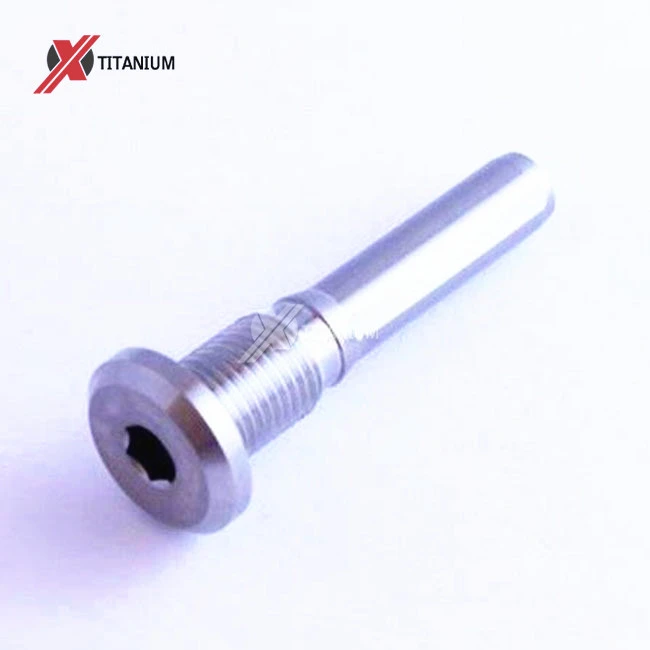
Understanding the Role and Requirements of Slider Pins in High-Cycle Machinery
What Slider Pins Actually Do?
When there is a moving brake caliper, the guide pin, which is also known as a slider pin or caliper bolt, moves the caliper body side to side. Every time the brakes are applied, a linear rolling event happens. During the life of the car, a single caliper can go through well over 100,000 rounds like this. The pin has to stay the same size all the way through because any radial deviation causes uneven pad contact, dragging, or even caliper seizure.
Performance Criteria That Cannot Be Compromised
The functions that caliper guide pins have to do are really tough. The most important thing is that the dimensions stay the same. The outer diameter must stay within ±0.01 mm, the straightness must stay within 0.02 mm, and the sliding shaft's surface finish must be Ra ≤ 0.4 µm to keep friction to a minimum against the rubber boot and caliper hole.
In addition to its shape, a titanium slider pin has to be able to withstand stress cracking at the thread-to-shaft transition, being exposed to road salts and brake cleaning solvents over and over again, and heat spikes that happen every so often as brake energy flows through the caliper body. Steel has been the standard material for a long time. It does, however, have a major flaw: it rusts. It's called "rust jacking" when oxidation forms between the pin and the caliper hole, causing an increasing interference fit that stops the caliper from moving and speeds up uneven pad wear.
Material Comparison: Titanium Slider Pin vs Steel Slider Pin
Mechanical Strength and Wear Resistance
The tensile strength of Ti-6Al-4V is about 950 MPa, which is about the same as medium-grade alloy steel. However, it is only 4.43 g/cm³ dense, which is about 43% lighter. This means that a titanium guide pin has the same structural strength but a lot less mass. This is a clear benefit for motorcycles where unsprung weight directly affects how well the suspension works. Titanium's lower surface hardness compared to hardened steel is known to be one of its flaws. Titanium on metal contact causes adhesive wear, which is also known as galling, if the surface is not treated. This is fixed in high-quality caliper guide pins by PVD nitriding or DLC treatment, which lowers the friction coefficient and makes a hard layer that stops slide wear over the part's lifetime.
Corrosion Resistance and Thermal Behavior
Plates or greases are the only things that keep steel guide pins from rusting. Base metal rust starts right away when those barrier layers break down, which happens faster when road salts and temperature changes happen. Titanium, on the other hand, makes an oxide layer (TiO₂) that reinforces itself and protects it from corrosion forever. Testing with salt spray shows that titanium pins can last longer than 500 hours at 5% NaCl without losing their surface. This is a lot longer than the 72 hours that most OEM brake makers say is acceptable.
Another difference that purchase engineers often miss is thermal conductivity. Ti-6Al-4V only conducts heat at 6.7 W/m·K, while steel conducts heat at about 50 W/m·K. This difference works as a thermal firewall to stop heat from moving from the pad contact to the caliper body and, more importantly, to the hydraulic fluid when the brake system is highly loaded. Lower fluid temperatures directly lower the risk of vapor lock when stopping hard.
Cost Comparison: Upfront Price vs. Lifecycle Value
The single price of steel slider pins is less than that of brass ones. When bought as a part, a titanium slider pin costs more. But titanium is always a better deal over a three- to five-year service period when you look at the total cost of ownership, which includes how often you have to replace it, any guarantee claims for seized calipers, and the work that goes into remedial maintenance. The extra cost per pin is easily justified by the value that customers get from OEM brake brands and aftermarket suppliers who are building a high-end product line.
Analyzing the Benefits of Titanium Slider Pins for High-Cycle Applications
When titanium guide pins are used in a situation where motion needs to happen over and over again while being stressed by the environment, their benefits become clearest. Here are the main things that make titanium stand out in high-cycle situations:
- Corrosion immunity without surface coatings: The self-passivating TiO₂ layer eliminates the primary failure mode of steel pins. Calipers remain free-sliding throughout the component's design life, even in coastal, winter-road, or high-humidity environments.
- 40% weight reduction: Compared to equivalent steel pins, Ti-6Al-4V reduces component mass by approximately 40%. Across a multi-piston caliper assembly with several guide pins, this contributes meaningfully to lower unsprung mass and improved suspension dynamics.
- Thermal insulation effect: With thermal conductivity of 6.7 W/m·K, titanium pins interrupt heat transfer pathways within the caliper, protecting hydraulic fluid integrity under sustained braking loads.
- Surface-hardened variants: Nitrided or PVD-coated titanium pins achieve surface hardness values sufficient for high-cycle sliding applications, resolving the galling concern that arises with untreated titanium.
Because of these features, guarantee returns are less common, replacement times are longer, and brands selling in the performance car and motorcycle aftermarket have a stronger case for why their products are better.
Installation, Maintenance, and Practical Considerations
Fitting Tolerances and Lubrication Protocol
Titanium guide pins must be made to meet H8/f7 standards for clearance fit with the caliper bore. Too much interference leads to stick-slip, and too little clearance causes lateral play that causes judder. When the seller checks with a measured CMM during the production stage, precision CNC machining keeps these limits. When it comes to lubrication, titanium doesn't corrode, but it is still necessary. Before installing, silicone-based or ceramic brake paste must be put on the shaft. Copper antiseize chemicals don't work with other metals because they make a galvanic potential between them, which can speed up corrosion on steel hardware that is close by.
Maintenance Intervals and Common Pitfalls
Titanium is better for upkeep because it needs to be inspected less often. In a mild environment, a steel pin should be checked and oiled again every 20,000 to 30,000 km. If the surface of the titanium slider pin is properly treated and it works within the right tolerance class, that interval can be greatly increased. The most common mistake during installation is not checking and cleaning the caliper hole before putting in a new pin. No matter what kind of pin it is, any corrosion debris left over from a steel pin that has already stopped will score the bore surface and quickly lower the quality of the fit.
Procurement Insights: Selecting and Sourcing the Right Slider Pin
What to Verify Before Placing an Order
Finding a caliper guide pin is not a simple process. Procurement managers and quality engineers should make sure that four important things are met before approving a supplier. For material certification, XRF spectrometry results must show that the titanium is actually made of Ti-6Al-4V and not commercially pure Grade 2 titanium, which isn't strong enough for safety-critical brake hardware because it doesn't have the right shear strength.
In dimensional inspection reports, the outer diameter must be within ±0.01 mm of the true diameter, and the surface must be rougher than 0.4 µm. The approval for the surface treatment, whether it's nitriding or PVD, should say how thick the layer is and how hard it is. Lastly, ask for a dye-penetrant inspection certificate to make sure there are no micro-cracks at the point where the thread meets the shaft.
Customization and SKU Management
Pin geometries need to be different for each caliper platform. Most of the time, they are 10 mm to 200 mm long and 5 mm to 20 mm wide. A good titanium slider pin maker should be able to work with custom models and handle production runs with multiple SKUs without having to meet minimum order amounts that put a lot of stress on the inventory of small to medium-sized suppliers. Aftermarket product lines can also stand out from each other thanks to different surface finishes, such as natural titanium, anodized gold, blue, black, or colorful PVD.
Conclusion
Titanium is clearly the best material for high-cycle, corrosion-prone uses. Steel is still a good choice when price is the most important factor and working conditions are managed. The performance gap is worth the money for titanium slider pin brake caliper guide pins that are hit with road salt, heat cycling, and repeated sliding loads. The most important things are the right material grade (only Ti-6Al-4V), checked dimensions, and a good surface stiffening process. Buying things based on these three factors leads to parts that work better than steel in every way that matters for how reliable a caliper is in the real world.
FAQ
Q1: What grade of titanium is required for brake caliper guide pins?
A: For safety-critical moving parts, only Grade 5 (Ti-6Al-4V) is good enough. Commercially pure titanium grade 2 doesn't have the tensile and yield strengths needed for brakes, so it can't be used instead.
Q2: Does titanium eliminate the need for lubrication?
A: No, titanium doesn't rust, but it still needs to be oiled to make sliding easier and stop dry friction.
Q3: Can titanium guide pins gall inside the caliper bore?
A: Titanium that hasn't been treated tends to stick to metal surfaces and wear away. Quality-made pins have a nitriding or PVD/DLC coating that fixes this problem and makes them work more smoothly than steel that hasn't been coated.
Q4: How does a titanium pin affect brake fade resistance?
A: Titanium only conducts about 6.7 W/m·K of heat, while steel conducts over 50 W/m·K. This makes it much harder for heat to move into the hydraulic fluid, which lowers the risk of vapor lock when heavy stopping is applied over and over again.
Q5: What dimensional tolerances should I specify when ordering?
A: For the sliding shaft, you should specify an outer diameter of ±0.01 mm, a straightness of ≤ 0.02 mm, and a surface roughness of Ra ≤ 0.4 µm. These numbers are in line with the H8/f7 clearance fit standard that is used in floating caliper systems.
Partner with Chuanglian for Precision Titanium Slider Pin Supply
Chuanglian makes Grade 5 titanium slider pins with an accuracy of ±0.01 mm and is fully certified by a CMM. They can also do custom shapes from engineering plans and treat the surfaces with nitriding, anodizing, and PVD. As a well-known provider of titanium slider pins based in Baoji, China, which is the country's titanium manufacturing hub, we can help with OEM approval, small batch samples, and production runs every three months. To get specs and a project price, email our team at info@cltifastener.com or djy6580@aliyun.com.
References
1. ASM International — Titanium: A Technical Guide, 2nd Edition, 2000.
2. SAE International — Brake System Design and Safety, 3rd Edition, 2010.3.
3. ASTM International — ASTM B348: Standard Specification for Titanium and Titanium Alloy Bars and Billets, 2019.
4. Tribology International — "Wear behavior of PVD-coated titanium alloys under reciprocating sliding conditions," Vol. 98, 2016.
5. Journal of Materials Engineering and Performance — "Fatigue and corrosion properties of Ti-6Al-4V in automotive structural applications," Vol. 27, 2018.
6. Wear — "Galling resistance of surface-treated titanium alloys in mechanical contact applications," Vol. 338–339, 2015.
Learn about our latest products and discounts through SMS or email