- English
- French
- German
- Portuguese
- Spanish
- Russian
- Japanese
- Korean
- Arabic
- Greek
- German
- Turkish
- Italian
- Danish
- Romanian
- Indonesian
- Czech
- Afrikaans
- Swedish
- Polish
- Basque
- Catalan
- Esperanto
- Hindi
- Lao
- Albanian
- Amharic
- Armenian
- Azerbaijani
- Belarusian
- Bengali
- Bosnian
- Bulgarian
- Cebuano
- Chichewa
- Corsican
- Croatian
- Dutch
- Estonian
- Filipino
- Finnish
- Frisian
- Galician
- Georgian
- Gujarati
- Haitian
- Hausa
- Hawaiian
- Hebrew
- Hmong
- Hungarian
- Icelandic
- Igbo
- Javanese
- Kannada
- Kazakh
- Khmer
- Kurdish
- Kyrgyz
- Latin
- Latvian
- Lithuanian
- Luxembou..
- Macedonian
- Malagasy
- Malay
- Malayalam
- Maltese
- Maori
- Marathi
- Mongolian
- Burmese
- Nepali
- Norwegian
- Pashto
- Persian
- Punjabi
- Serbian
- Sesotho
- Sinhala
- Slovak
- Slovenian
- Somali
- Samoan
- Scots Gaelic
- Shona
- Sindhi
- Sundanese
- Swahili
- Tajik
- Tamil
- Telugu
- Thai
- Ukrainian
- Urdu
- Uzbek
- Vietnamese
- Welsh
- Xhosa
- Yiddish
- Yoruba
- Zulu
Titanium vs Stainless Steel Bolts: Which Better?
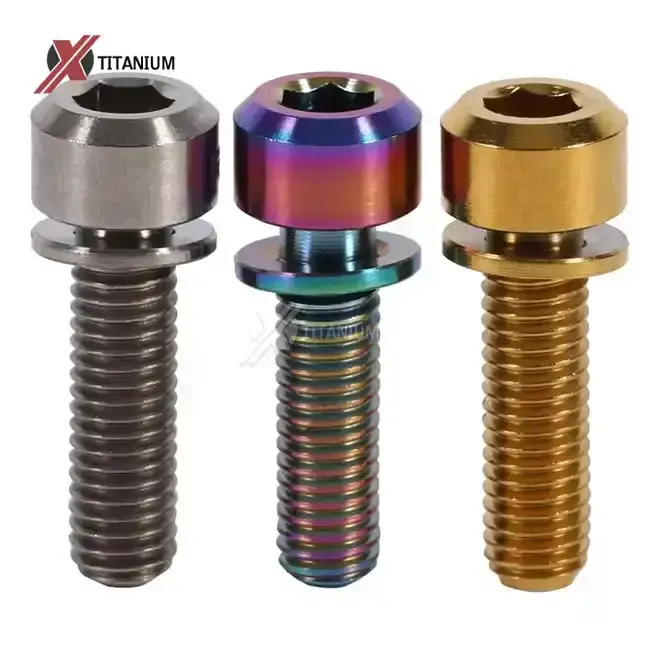
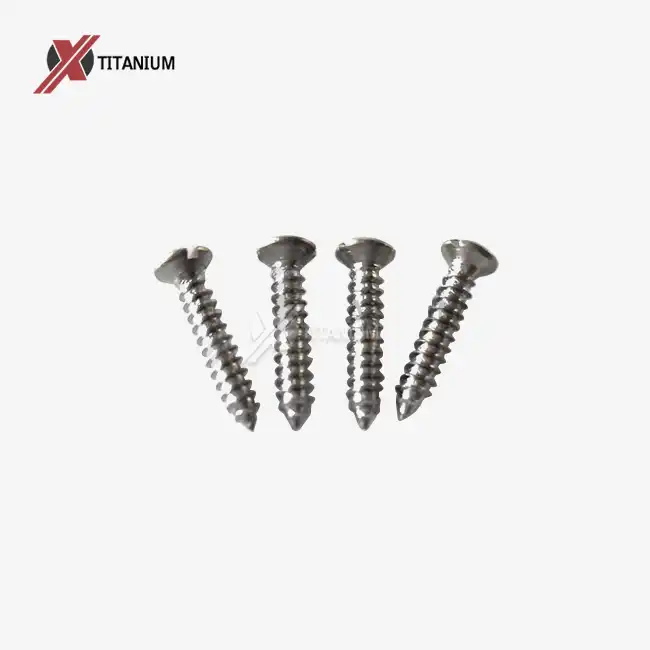
When it comes to high-performance applications, the choice between titanium and stainless steel bolts varies on your unique needs. Gr5 titanium bicycle bolt have a great strength-to-weight ratio and are very resistant to corrosion. This makes them perfect for uses in aircraft, medicine, the marine industry, and professional riding where weight reduction and long-term durability are important. Stainless steel bolts are still a good deal for uses that don't have to worry as much about weight. But in harsh industrial and leisure settings, Gr5 titanium bicycle bolt fasteners always do better than their stainless steel peers when it comes to long-term performance, less upkeep, and material consistency.
Understanding GR5 Titanium and Stainless Steel Bolts
The choice of materials has a big impact on how well a product works, how stable the supply chain is, and how much it costs to run in the long run. Both Gr5 titanium bicycle bolt and stainless steel bolts are used to hold things together in many different businesses, but their different metal compositions make them suitable for different uses.
Chemical Composition and Metallurgical Structure
Ti-6Al-4V is the formal name for Gr5 titanium. It is made up of 90% titanium, 6% aluminum, and 4% vanadium. The heat treatment of this alpha-beta phase metal structure makes its tensile strength range from 950 MPa to 1050 MPa, and its yield strength is around 880 MPa. The aluminum content makes the metal stronger while lowering its bulk. The vanadium content stabilizes the beta phase, which makes it more resistant to heat and easier to work with during production.
Stainless steel bolts are usually made from grades 304 or 316. Grade 304 has 18% chromium and 8% nickel, which is a good amount of rust protection for most uses. The addition of 2% to 3% molybdenum to Grade 316 makes it much more resistant to pitting corrosion caused by chloride. This makes it a better choice for use in coastal and chemical processing settings. Tensile strengths for both grades range from 500 MPa to 700 MPa, based on how they are cold worked and heated.
Core Material Properties
The change in density between these materials is what makes important choices about how to use them. Gr5 titanium weighs about 4.43 g/cm³, which is about 45% less than stainless steel, which weighs 7.85 g/cm³. This lower weight directly leads to better performance in areas like aircraft structural parts, race bicycle assemblies, and portable medical devices, where every gram counts.
The ways that these metals prevent corrosion are very different. Titanium reacts with oxygen to make a solid, self-healing titanium dioxide layer. This layer is very resistant to saltwater, acids, and alkalis. Stainless steel has an inactive layer of chromium oxide that works well in many situations but can still rust in places with a lot of chloride, especially when the temperature is high.
The thermal qualities are also very different. Titanium can withstand temperatures up to 400°C without losing its shape. However, it doesn't conduct heat well (about 7 W/m·K compared to 16 W/m·K for stainless steel), which makes it less useful for thermal cycling uses like brake systems and exhaust parts.
Performance and Durability Comparison: GR5 Titanium vs Stainless Steel Bolts
To understand how well a material works, you need to look at both its mechanical features and how it reacts to its surroundings in real-world situations.
Strength-to-Weight Performance
Because it has the best strength-to-weight ratio, Gr5 titanium bicycle bolt is the best choice for load-bearing tasks where weight reduction is important. A Gr5 titanium M6 bolt that weighs 3.5 grams can be used instead of one made of stainless steel that weighs 6.2 grams and has the same or more gripping force. Manufacturers of airplanes use this ratio to cut down on the weight of the airframe, which directly improves fuel economy and cargo capacity. Gr5 titanium bicycle bolt fasteners are used in handlebar stems, brake calipers, and seatpost clamps by racing bicycle makers because they reduce vibrations and weight, which improves riding performance.
Fatigue Life and Cyclic Load Resistance
What sets good bolts apart from great ones is their fatigue resistance under cyclic loads. When Gr5 titanium bicycle bolt fasteners are made with rolled threads instead of cut threads, the grain structure stays the same. This makes them about 30% more resistant to wear than machined threads. This small detail in the manufacturing process is very important for parts that are constantly vibrating or that are loaded and unloaded many times. This extra fatigue life is good for engine bearings, rotor disc attachments, and suspension links.
Stainless steel bolts work well under mild cyclic loads, but they start to crack faster where stress is concentrated. This is especially true in corrosive settings, where surface pitting speeds up fatigue failure.
Environmental Durability
Applications in marine engineering show how rust works in very different ways. Offshore platform owners who switched from stainless steel bolts to Gr5 titanium bicycle bolt alternatives say that repair intervals have grown from 18 months to more than 60 months. Titanium's natural oxide layer doesn't break down when it comes in contact with saltwater spray. This keeps it from getting crevice corrosion and stress corrosion cracks, which happen a lot with stainless steel in the same conditions.
Titanium's inertness is also useful for chemical processing plants that work with acidic or caustic solutions. When different metals come into touch with electrolytic solutions, galvanic corrosion can happen. However, Gr5 titanium bicycle bolt fasteners can stop this from happening in heat exchangers, pressure tank seals, and pump housings.
Cost and Procurement Considerations for B2B Clients
In businesses with a lot at stake, choices about what to buy go beyond the unit price and include things like total cost of ownership, the reliability of the supply chain, and the level of technical help available.
Initial Investment vs Lifecycle Value
When bought for the first time, Gr5 titanium bicycle bolt fasteners usually cost three to five times more than similar stainless steel bolts. When replacement frequency, repair work, and operational downtime are taken into account, however, this price difference becomes much smaller. When someone runs a petroleum plant and has to replace rusted stainless steel bolts during planned shutdowns, they have to pay for both the parts and the extra costs of the downtime, which are often more than $50,000 per day. Gr5 titanium bicycle bolt fasteners that don't need to be replaced as often give a clear return on investment within 24 to 36 months in harsh working conditions.
Medical device makers have to do different kinds of math. Implant-grade Gr5 titanium bicycle bolt fasteners are used in medical tools and cost more than other grades because they are biocompatible, stable in autoclaves, and don't cause nickel sensitization like some grades of stainless steel do.
Supplier Qualification and Quality Assurance
To lower the danger in the supply chain, suppliers must be carefully evaluated. Procurement teams should check the certifications of manufacturers, such as AS9100 for aircraft uses, ISO 13485 for medical products, and ISO 9001 as proof of a basic quality system. Material traceability through heat lot tracking and mill test records makes sure that each batch is the same, which is very important because the qualities of titanium change depending on how it is processed.
Having the ability to spot fakes is very important. To tell the difference between real Gr5 titanium and lower-grade substitutes or materials that have been misrepresented, sellers must provide third-party proof through X-ray fluorescence (XRF) research that shows the aluminum and vanadium content is within the acceptable ranges.
Sourcing Strategy Recommendations
Direct ties with manufacturers give you more control over customization and access to expert advice. Companies like Baoji Chuanglian New Metal Material Co., Ltd., which is based in Baoji City, also known as the "City of Titanium," process raw materials, machine them using CNC machines, and check the quality of their work all in one step. Standard wholesalers can't handle custom thread forms, coatings, or mechanical testing that is specific to each lot, but this combination can.
Procurement workers who handle project-based sales benefit from suppliers who can check the quality of a sample production run before committing to mass production. The normal validation cycle lasts for 8 to 16 weeks and includes reviewing the material's certification, inspecting its dimensions, trying its torque, and making sure it works well in a particular application.
Application Scenarios and Decision-Making Guide
Frameworks for choosing materials should take into account scientific needs, cost concerns, and the amount of operating risk that can be tolerated.
Scenarios Favoring GR5 Titanium
Wing clamps, engine pylon connections, and landing gear assemblies all use Gr5 titanium bicycle bolt fasteners because they are lightweight, which directly improves the performance and cost-effectiveness of the airplane. The high level of wear resistance makes sure that the structure stays strong even after tens of thousands of rounds of pressurization.
Biking competitively requires both minimizing weight and making sure the bike works well. Gr5 titanium bicycle bolt fasteners are most often used for clamping handlebar stems, fitting brake calipers, and attaching disc brakes. The lower elastic stiffness of the material (113 GPa compared to 210 GPa for steel) allows for a small amount of elastic elongation. This helps keep the thread tension even when the bike is moving back and forth, which lowers the chance that it will come loose during long runs.
More and more, offshore wind turbine owners, desalination plant engineers, and military planners are asking for titanium fasteners to be used on buildings that will be exposed to salt water. Lifecycle costs are much lower when upkeep painting, cathodic protection, and early replacement are not needed. However, purchase costs are higher.
Titanium is the best material for surgery tool kits, implantable device components, and diagnostic equipment that needs to be compatible with MRIs because it is biocompatible and can be sterilized many times.
Decision-Making Criteria Checklist
When engineers and buying teams look at the choice of bolt material, they should assess:
- Load requirements: Does the job involve static loads, moving loads, or situations that cause tiredness over and over?
- Weight sensitivity: Will lowering the mass lead to measurable improvements in performance or lower operating costs?
- Environmental exposure: What corrosive substances, temperatures, or environmental factors will the fastener be exposed to?
- Maintenance access: How hard and expensive is it to change fasteners on time or in an emergency?
- Regulatory needs: Are there business guidelines or licenses that require certain qualities of materials?
- Stability of the supply chain: Is it possible to consistently get the material picked, with consistent quality and acceptable wait times?
Alternative Material Context
Aluminum alloy bolts are lighter than both titanium and steel, but they are not as strong, so they can't be used in high-stress situations. Carbon steel bolts with protective coats are a cheap option for dry, controlled settings, but they break quickly in corrosive conditions when the coatings come off. The difference in performance between these other materials and Gr5 titanium bicycle bolt makes the higher cost worth it in situations where failure would have serious effects.
Installation and Identification of GR5 Titanium Bicycle Bolts
Installing things correctly and stopping fakes protects both performance and financial worth. Proper setup is essential for identifying a genuine Gr5 titanium bicycle bolt.
Authentication and Specification Verification
Genuine Gr5 titanium bolts have features that make them stand out. The material has a shiny sheen that is greenish, a little darker than pure titanium sold in stores (Grade 2). When you test the surface hardness of heat-treated Ti-6Al-4V with calibrated tools, you should get results that are in line with the specs. Material certificates from reputable makers show the chemical makeup (using spectroscopic analysis) and mechanical properties (using tensile tests of sample bolts from each production lot).
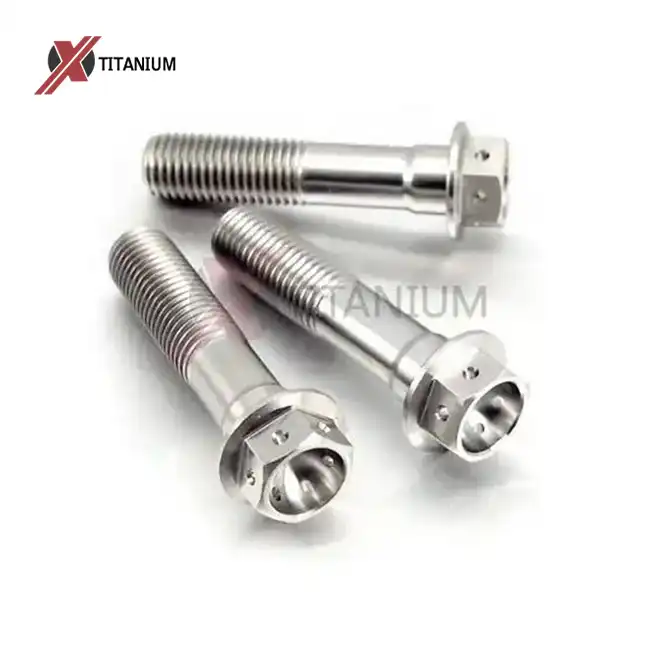
A visual check should prove the strength of the thread. Rolled threads have a smooth surface finish and continuous grain flow, while cut threads have tool lines that can be seen and a broken grain structure. This difference is important because rolled threads offer better wear resistance, which is why titanium costs so much more than other metals.
Installation Best Practices
Thread galling is the main problem that needs to be addressed when installing titanium bolts. The material has a fairly high friction coefficient, which means that when threads are tightened, they wear against each other and stick together. This risk is eliminated by using anti-seize compounds, which are usually copper-based or ceramic formulations. This also makes sure that torque data are correct.
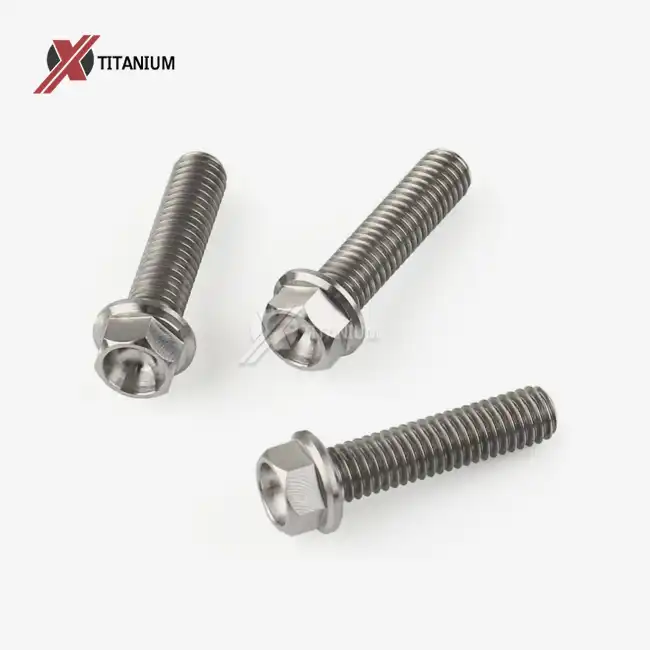
Specifications for torque must be followed exactly. If you over-torque Gr5 titanium bicycle bolt fasteners into aluminum parts, the softer aluminum threads could be stripped before the titanium bolt gives way. Under-torquing lets vibrations cause the bolt to come free. Digital torque tools that are accurate to within ±2% make sure that the right preload is used without going over the limits of the material. Torque numbers from component makers usually range from 4-6 Nm for M5 bolts to 8–10 Nm for M8 bolts, but they can change depending on the needs of the application.
Maintenance and Longevity Optimization
Regular inspections should check the state of the threads and the stability of the fasteners. Titanium doesn't rust, but getting dirty or installing it incorrectly in the past can make it less effective. Using isopropyl alcohol and soft brushes to clean gets rid of dirt without hurting the protective metal layer. If you look closely and see thread damage or deformation, or if the fastener doesn't reach the required pressure values when you reattach it, you need to replace it.
Conclusion
Whether you use Gr5 titanium bicycle bolt or stainless steel bolts depends on what you need them for. Gr5 titanium bicycle bolt fasteners are very expensive, but they pay for themselves in reduced weight, longer service life, and better protection to weather damage. Titanium is always chosen for uses where performance and dependability are more important than starting cost. These include aircraft, medical devices, marine engineering, and competitive cycling. Stainless steel can still be used for things that won't be exposed to harsh environments and don't need to be very heavy. For procurement to go well, suppliers need to be carefully screened, materials need to be checked, and the total cost effects need to be understood in addition to unit prices. Gr5 titanium bicycle bolt fasteners regularly provide better lifecycle value for businesses that value long-term working efficiency over short-term purchase costs.
FAQ
Q1: Can GR5 titanium bolts replace stainless steel bolts directly in existing assemblies?
A: Standard metric sizes (M5, M6, M8) can be used with Gr5 titanium bicycle bolt fasteners instead of stainless steel in most construction uses. But make sure it works with the parts made by other companies, especially for custom designs or systems where the way certain materials behave can change how well they're tuned. Titanium shouldn't be used in places that need to be inspected with a magnet or where bolts are used as failure points on purpose to protect more expensive parts.
Q2: How much weight savings does titanium provide compared to stainless steel?
A: Bolts made of titanium weigh about 45% less than bolts made of stainless steel that are the same size. A Gr5 titanium bicycle bolt M6 x 20mm typically weighs 3.5 grams, while a stainless steel one weighs 6.2 grams. Depending on the number of parts and how they are distributed in size, a bicycle or airplane system with hundreds of bolts can lose anywhere from 200 grams to several kilograms of weight.
Q3: What warranty and certification should I expect from titanium bolt suppliers?
A: Material certifications from reputable producers include mill test records that show the chemical make-up and mechanical properties of each output lot. Industry-specific certifications, like AS9100, ISO 13485, and NADCAP, show that a quality system is working properly. Most warranties cover problems in the material or the way it was made, but not damage caused by poor installation, over-torquing, or contamination. You can expect providers to keep track of things by marking each heat lot, which lets you look into defects if performance problems happen.
Partner with Chuanglian for Premium Titanium Fastener Solutions
Baoji Chuanglian New Metal Material Co., Ltd. has everything that procurement teams looking for reliable Gr5 titanium bicycle bolt suppliers need. We have been handling titanium for over ten years in Baoji City, which is known as China's "City of Titanium." We provide approved fasteners that meet the needs of military, medical, and industrial applications. Our quality control system keeps track of every product from inspecting the raw materials to final testing and CNC cutting. This makes sure that each batch is the same, which takes the guesswork out of your supply chain.
Our engineering team can help you choose the right materials and make the best use of them for your project, whether you need regular metric fasteners or unique thread forms with special coatings. Get in touch with our experts at info@cltifastener.com or djy6580@aliyun.com to talk about your needs. We offer affordable wait times for both prototype sampling and large-scale production, which helps you meet your performance goals while handling procurement risk well.
References
1. Boyer, R., Welsch, G., & Collings, E.W. (1994). Materials Properties Handbook: Titanium Alloys. ASM International.
2. Donachie, M.J. (2000). Titanium: A Technical Guide (2nd ed.). ASM International.
3. Schutz, R.W. & Thomas, D.E. (1987). "Corrosion of Titanium and Titanium Alloys." Metals Handbook (9th ed., Vol. 13), ASM International, pp. 669-706.
4. Lutjering, G. & Williams, J.C. (2007). Titanium (2nd ed.). Springer-Verlag Berlin Heidelberg.
5. ASM International Handbook Committee (1990). Properties and Selection: Nonferrous Alloys and Special-Purpose Materials (Vol. 2). ASM International.
6. Peters, M., Kumpfert, J., Ward, C.H., & Leyens, C. (2003). "Titanium Alloys for Aerospace Applications." Advanced Engineering Materials, 5(6), 419-427.
Learn about our latest products and discounts through SMS or email