- English
- French
- German
- Portuguese
- Spanish
- Russian
- Japanese
- Korean
- Arabic
- Greek
- German
- Turkish
- Italian
- Danish
- Romanian
- Indonesian
- Czech
- Afrikaans
- Swedish
- Polish
- Basque
- Catalan
- Esperanto
- Hindi
- Lao
- Albanian
- Amharic
- Armenian
- Azerbaijani
- Belarusian
- Bengali
- Bosnian
- Bulgarian
- Cebuano
- Chichewa
- Corsican
- Croatian
- Dutch
- Estonian
- Filipino
- Finnish
- Frisian
- Galician
- Georgian
- Gujarati
- Haitian
- Hausa
- Hawaiian
- Hebrew
- Hmong
- Hungarian
- Icelandic
- Igbo
- Javanese
- Kannada
- Kazakh
- Khmer
- Kurdish
- Kyrgyz
- Latin
- Latvian
- Lithuanian
- Luxembou..
- Macedonian
- Malagasy
- Malay
- Malayalam
- Maltese
- Maori
- Marathi
- Mongolian
- Burmese
- Nepali
- Norwegian
- Pashto
- Persian
- Punjabi
- Serbian
- Sesotho
- Sinhala
- Slovak
- Slovenian
- Somali
- Samoan
- Scots Gaelic
- Shona
- Sindhi
- Sundanese
- Swahili
- Tajik
- Tamil
- Telugu
- Thai
- Ukrainian
- Urdu
- Uzbek
- Vietnamese
- Welsh
- Xhosa
- Yiddish
- Yoruba
- Zulu
Why India Imports Titanium Clad Plates from China
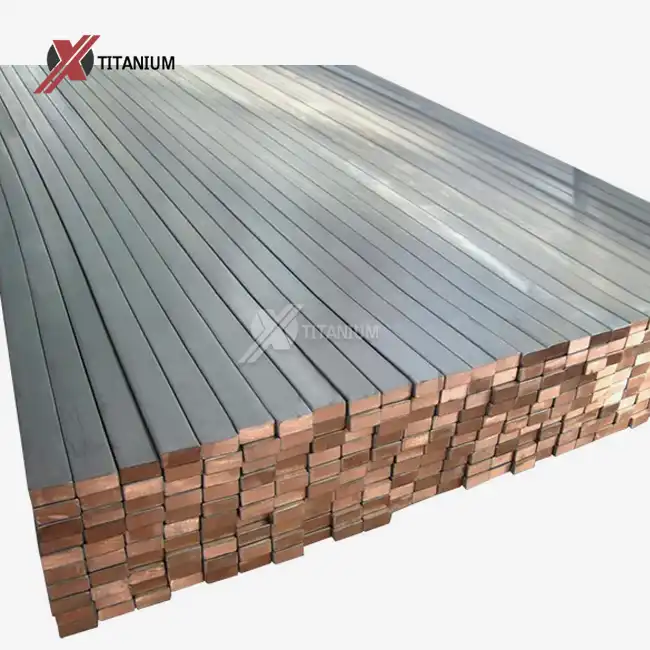
India's growing industries in hydrometallurgy, electroplating, and chemical processing have created a lot of demand for titanium clad copper plates. These plates are made of a special hybrid material that combines the electrical conductivity of copper with the rust resistance of titanium. Chinese makers, especially those in Baoji City, have become the most popular suppliers because they offer stable explosion bonding technology, strict quality certifications, low prices due to economies of scale, and the ability to make changes to meet specific needs. This pattern of sourcing isn't just based on price; it's also a strategy alignment with providers who can provide consistent material performance, traceable quality systems, and solid expert support that is needed for mission-critical industrial uses.
Understanding Titanium Clad Copper Plates and Their Industry Relevance
The titanium clad copper plate is a major step forward in solving a basic engineering puzzle. In the electrochemical industries, engineers need materials that can handle harsh acidic or alkaline conditions and still conduct electricity well. Pure copper is a great conductor, but it rusts quickly in sulfuric acid, chromic acid, or chlorine-containing liquids. Pure titanium is very resistant to rust, but it has an electrical resistance that is about 60 times higher than copper. This means that it can't be used in high-current uses.
The Metallurgical Bond That Changes Everything
Explosion bonding or explosion-rolling can be used to solve this problem with a titanium clad copper plate. These methods, unlike electroplating or mechanical cladding, connect a high-purity copper core (usually Grade T2 or C11000) to a titanium cladding layer (usually ASTM B265 Gr1 or Gr2) at the atomic level. The combination that is made keeps copper's ability to carry current while the titanium layer works as a barrier to keep electrolytes from getting into the structure and damaging it.
Real-World Industrial Applications
Businesses use this combination material when failure would cost a lot of money or put workers in danger. It is used as cathode header bars in hydrometallurgical processes to win copper, zinc, and cobalt. Without it, acid mist would eat away at solid copper bars at the solution line. PCB makers use these plates as flight bars and hanger structures in soldering baths to make sure that the solutions are clean and that the current flows evenly. Chlor-alkali plants use them to make anodes that don't change shape, even when chlorine gas and sodium hydroxide are present. In these conditions, normal materials would be destroyed in months.
The Comparative Advantage: Titanium Clad Copper Plates vs Other Metal Solutions
When buying teams look at material possibilities, they need to know about the performance trade-offs in order to make smart choices. The titanium clad copper plate has benefits that single-metal systems can't match.
Performance Against Pure Copper
When pure copper bars are in acidic conditions, they break down quickly, especially where air and electrolyte meet. This rust makes contact resistance higher, uses more energy per ton of metal made, and adds copper ions to process solutions that make goods dirty. When you switch to composite plates, these problems go away. The equipment lasts longer, from months to years, and the voltage drops stay stable during operating cycles.
Advantages Over Solid Titanium
While solid titanium parts do a good job of resisting rust, they also cause other problems. Their high electrical resistance wastes energy by making too much heat when current flows through them, and they need bigger cross-sections to be conductive enough. The alloy plate protects against rust like titanium does without lowering electrical efficiency. This lowers the cost of buying parts that are too big and the energy used to run the business.
Comparison With Alternative Composites
Copper clad aluminum is lighter than aluminum itself, but it doesn't have the mechanical power that is needed for high-stress structure parts. The titanium-copper mix has higher tensile strength, better thermal stability, and more stable long-term performance in places where temperature changes and mechanical loads happen at the same time.
This balanced performance profile explains why buying teams that care about quality choose composite plates even though they cost more at first. Taking into account how often things need to be replaced, maintenance shutdowns, and energy efficiency, the total cost of ownership estimate always supports the composite option.
Why India Relies on Imports from China for Titanium Clad Plates?
India's industry growth has outpaced its ability to make specialty materials, so the country now has to rely on foreign sources for advanced composite materials. Chinese companies have gotten a big share of this market thanks to strategic benefits that go beyond low prices, including the availability of materials like titanium clad copper plate, which are crucial for high-performance applications.
Manufacturing Ecosystem Maturity
Over many years, Baoji City, also known as the "City of Titanium," has built up a full supply chain environment. Nearby are plants for raw materials, processing mills, centers for explosive bonding, quality testing labs, and transportation networks. This grouping cuts down on wait times, makes rapid prototyping possible, and makes quality control easier, all of which are things that vertically integrated Chinese suppliers can do better than options that are spread out.
Certification and Quality Assurance
Leading Chinese makers keep licenses like ISO9001 and AS9100 for aircraft uses, as well as approvals for chemical processing tools that are special to those industries. These approvals give Indian buying teams peace of mind about the consistency and traceability of the materials they buy. Shipments come with proof of batch tests, material certifications, and compliance with foreign standards (ASTM, GB, DIN). This makes it easier to clear customs and check the quality within the company.
Economic and Logistical Factors
Chinese sellers can offer reasonable prices on both small custom orders and bulk purchases because they can produce a lot of goods at once. The shipping paths between Chinese ports and Indian manufacturing hubs are now well-established, and freight forwarders can offer reliable arrival schedules. Indian buyers tend to buy things based on projects, so the minimum order amounts they can accept are flexible. Orders can be anything from a few prototypes to full production runs that last for several quarters.
Technical Support Infrastructure
Chinese manufacturers have put money into application engineering teams that help with choosing materials, setting up processes, and fixing problems. This technical advice is helpful for Indian buyers who are starting new electrochemical processes or improving tools they already have. Suppliers who know about the needs of a certain business can suggest the best cladding ratios, measurement limits, and surface processes for a given application.
Manufacturing and Technical Insights of Titanium Clad Copper Plates
Understanding how things are made helps people who buy things judge the skills of suppliers and set reasonable quality standards. At several points in the manufacturing process, careful control is needed, especially when handling complex materials like titanium clad copper plate, which require precise techniques to ensure optimal performance and durability.
Explosion Bonding Process
Explosion bonding speeds up a titanium plate into a copper base at more than 200 meters per second by using controlled explosions. The clash causes melting and quick solidification at the contact, creating a wavy bond pattern that holds the metals together mechanically and ensures metallurgical continuity. This process happens very quickly, but it needs a lot of work to get ready for it. The surface needs to be cleaned to get rid of oxides, the range distance needs to be calculated accurately, the explosion parameters need to be chosen based on the thickness of the material, and finally, the bond needs to be heated to remove any remaining stresses.
Quality Control Measures
Ultrasonic testing is used by manufacturers to check the bond strength across the whole plate surface and find any places that aren't bonded or that could delaminate. Peel strength testing measures how well the bond is formed, and minimum values of 140 to 200 MPa are usually needed for most applications. Metallographic study of cross-sections proves the structure of the interface and makes sure that the heat-affected zone stays within accepted limits.
Material Specification Standards
The copper core usually meets the requirements for electrical copper that doesn't contain oxygen and has a conductivity above 100% IACS. The titanium cladding is made from commercially pure types that have set maximum amounts of iron, oxygen, nitrogen, and carbon impurities. The thickness of the cladding can be anywhere from 0.5 mm to 5 mm, based on how bad the corrosion is. For aggressive uses, the ratio of titanium to total thickness is usually kept at least 10%.
Performance Validation Testing
Suppliers screen for increased rusting in settings that are like real-life service situations. They leave samples in heated acid solutions or chlorine atmospheres for long periods of time. Electrical conductivity tests show that the material stays within the desired resistance range. Thermal cycle tests check how stable a bond is when it is heated and cooled many times. Before a material is used in the real world, these proof procedures make sure that its performance meets the needs of the industry.
Strategic Procurement Guide for Titanium Clad Copper Plates
To make sure they have a steady supply of materials, good buying strategies combine technical needs with business concerns and relationship management, especially when sourcing specialized materials like titanium clad copper plate, which require a balance of reliability and cost-effectiveness in the supply chain.
Supplier Evaluation Criteria
Facility audits or inspection reports from a third party should be used to confirm the manufacturing skills as part of the technical review. Inventory of production tools, especially blast bonding tanks and testing instruments, shows the ability to keep quality high. Quality management system certifications are a good starting point for proving that the process is being controlled, but looking at test records from recent production runs is a more solid proof.
A commercial review looks at how prices are set, how payments are made, and how bulk discounts are calculated. Better cost optimization is possible with clear quotes that break down the prices of materials, handling, and shipping separately. Lead times should include getting the raw materials, planning the production schedule, checking the quality, and shipping the goods internationally. For custom specs, the lead times are usually between 6 and 12 weeks.
Building Long-Term Partnerships
Suppliers like working with customers who are clear about what they want, give them decent wait times, and order in regular patterns. Sharing information about future projects helps producers make the best use of their production schedules and might even help them offer better prices. Technical collaboration, in which buyers give comments on how well a material works in real-world service situations, helps sellers improve goods and make variations that are better for certain uses.
Communication equipment is very important. Suppliers that have technology staff that speaks English, responds quickly to emails, and is ready to work with different time zones for video conferences show that they care about their customers. Setting up a main point of contact on both sides makes it easier for information to flow and helps the organization learn more about specific needs.
Risk Mitigation Strategies
When you have qualified secondary providers, you have extra capacity in case your main sources go down. Keeping a strategic stockpile of long-lead things in stock balances the costs of having them against the risks of production delays. The terms of the contract should include how to settle quality disputes, how to return materials, and guarantee coverage for early failures caused by material flaws rather than application mistakes.
Conclusion
India's dependence on Chinese titanium clad copper plate imports is not just a matter of economics; it is a practical matter of business. The electrolytic and chemical processing industries have very specific technical needs that can be met by Chinese makers who have a well-developed production infrastructure, quality control systems, and customer service skills. This sourcing relationship looks like it will get stronger as India's industries continue to grow. This is because Chinese suppliers are continuing to spend in volume, quality, and application engineering. If a procurement worker knows both the scientific basics of the material and the strategic sourcing scene, they can help their companies find the best supply relationships that balance performance, cost, and reliability over long periods of time.
FAQ
Q1: What makes titanium clad copper plates superior for heat exchanger applications?
A: The hybrid structure has heat conductivity that is almost as good as pure copper, and the titanium surface protects it from process fluids that would eat away at copper directly. This combination greatly increases the lifespan of heat exchangers while keeping their ability to move heat efficiently. This lowers the number of replacements needed and the amount of energy used.
Q2: How does the bonding quality affect long-term performance?
A: Delamination can happen when process fluids get into the copper core and cause localized rust and structural failure because of bad bonding. Good explosion bonding makes a solid metal-to-metal contact that keeps fluids out and keeps the bond line's electrical conductivity high. This makes sure the combination works the way it's supposed to for as long as it's used.
Q3: Which certifications should buyers verify when selecting suppliers?
A: ISO9001 provides baseline quality management assurance, while AS9100 indicates aerospace-grade process control. Industry-specific certifications for pressure vessel materials (ASME) or electrochemical equipment demonstrate application expertise. Material certifications documenting alloy composition, mechanical properties, and bond strength testing confirm specification compliance.
Partner With Chuanglian for Reliable Titanium Clad Copper Plate Supply
Baoji Chuanglian New Metal Material Co., Ltd., which is in the center of titanium production in China, has more than ten years of experience making titanium clad copper plate for tough industrial uses. With our explosion bonding facilities and full CNC machining capabilities, we can make unique solutions that meet exact performance and size requirements. We have strict quality control that starts with checking the raw materials and ends with testing the finished product to make sure that every composite plate meets international standards.
As a reputable provider of titanium clad copper plate, we assist international procurement teams by providing expert advice, reasonable pricing, and dependable delivery schedules that are tailored to project-based procurement cycles. Get in touch with our team at info@cltifastener.com or djy6580@aliyun.com to talk about your unique needs and get accurate quotes.
References
1. Davis, J.R., "Copper and Copper Alloys: ASM Specialty Handbook," ASM International Materials Park, 2001.
2. Findik, F., "Recent Developments in Explosive Welding," Materials & Design, Volume 32, 2011, pp. 1081-1093.
3. "Standard Specification for Titanium and Titanium Alloy Strip, Sheet, and Plate," ASTM International, ASTM B265-20, 2020.
4. Zhang, L., and Wang, X., "Interfacial Characteristics of Titanium-Copper Explosive Welding," Journal of Materials Processing Technology, Volume 237, 2016, pp. 324-332.
5. "Corrosion Resistance of Titanium in Chemical Environments," Titanium Information Group Technical Paper, London, 2018.
6. Kumar, R., "Material Selection for Electrochemical Processing Equipment in Indian Chemical Industry," Indian Chemical Engineer Journal, Volume 62, 2020, pp. 145-159.
Learn about our latest products and discounts through SMS or email