- English
- French
- German
- Portuguese
- Spanish
- Russian
- Japanese
- Korean
- Arabic
- Greek
- German
- Turkish
- Italian
- Danish
- Romanian
- Indonesian
- Czech
- Afrikaans
- Swedish
- Polish
- Basque
- Catalan
- Esperanto
- Hindi
- Lao
- Albanian
- Amharic
- Armenian
- Azerbaijani
- Belarusian
- Bengali
- Bosnian
- Bulgarian
- Cebuano
- Chichewa
- Corsican
- Croatian
- Dutch
- Estonian
- Filipino
- Finnish
- Frisian
- Galician
- Georgian
- Gujarati
- Haitian
- Hausa
- Hawaiian
- Hebrew
- Hmong
- Hungarian
- Icelandic
- Igbo
- Javanese
- Kannada
- Kazakh
- Khmer
- Kurdish
- Kyrgyz
- Latin
- Latvian
- Lithuanian
- Luxembou..
- Macedonian
- Malagasy
- Malay
- Malayalam
- Maltese
- Maori
- Marathi
- Mongolian
- Burmese
- Nepali
- Norwegian
- Pashto
- Persian
- Punjabi
- Serbian
- Sesotho
- Sinhala
- Slovak
- Slovenian
- Somali
- Samoan
- Scots Gaelic
- Shona
- Sindhi
- Sundanese
- Swahili
- Tajik
- Tamil
- Telugu
- Thai
- Ukrainian
- Urdu
- Uzbek
- Vietnamese
- Welsh
- Xhosa
- Yiddish
- Yoruba
- Zulu
Why Germany Buyers Prefer China Titanium Forgings
German sourcing experts in high-precision manufacturing sectors depend more and more on Chinese titanium forgings to meet the exact needs of their projects. In real life, this choice comes from a realistic mix of low prices and high quality standards. Chinese companies have put a lot of money into modern infrastructure for forging, foreign certification systems, and quality control methods that are in line with what the European business world expects. This makes it possible to get parts that meet strict requirements for marine engineering, chemical processing, and aerospace engineering. It also gives buyers big benefits in terms of price flexibility, scalable production capacity, and quick expert help throughout the lifecycles of projects.
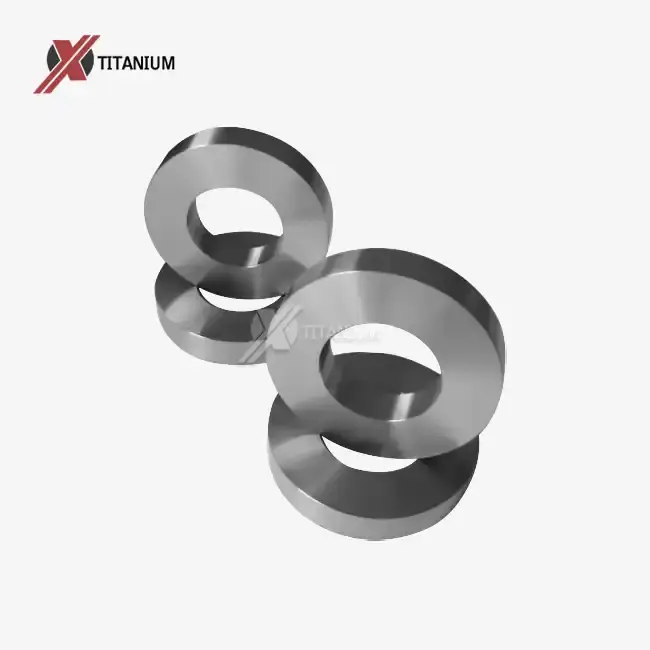
Understanding Titanium Forgings and Their Market Demand
What Makes Titanium Forgings Essential for High-Performance Applications?
Forgings made of titanium are precisely designed parts that are made by controlling the plastic deformation of titanium metals under very high compressive forces. In casting, molten metal is poured into molds. Forging, on the other hand, shapes the metal manually while matching the grain structures inside to fit the shape of the part. This basic difference gets rid of mechanical porosity, makes wear resistance much better, and gives directional strength properties that molds can't provide.
Forging usually includes heating titanium billets to temperatures close to or above the beta transus point. This is the temperature at which the crystalline structure of the material changes. When forging, hydraulic presses or hammers use a lot of force to reshape the hot titanium while also making its substructure better. The controlled deformation makes grain flow patterns that follow the shape of the part, which greatly improves its mechanical qualities in directions that carry stress.
Industries Driving Titanium Forgings Demand
German companies in a number of different industries rely on cast titanium parts for mission-critical tasks. These parts are used by aerospace companies in rotor discs, landing gear cylinders, and structural bulkheads that must have high-cycle wear resistance and thermal stability. The material can handle temperatures ranging from below zero in the stratosphere to the heat from engine fumes without deforming or breaking down.
Forged titanium is used for pressure tanks, heat exchanges, and parts of offshore platforms in chemical processing plants and marine engineering projects. Standard metals break down quickly in high-pressure, high-temperature seawater, but this material doesn't. It avoids crevice corrosion and stress corrosion cracking. Forged titanium is used to make orthopedic implants like hip stems and knee joints because it doesn't have any metallurgical flaws that could cause wear breakdowns in the body. The material is biocompatible and has an elastic elasticity that is about half that of stainless steel. This means that it doesn't protect surrounding bone tissue from stress as well.
Technical Advantages That Define Forged Titanium Components
The forging process solves important technical problems that come up with other ways of making things. Mechanical working gets rid of the closed internal gaps that are common in cast parts. This keeps the part's structure solid all the way through. When compared to cast alternatives, fatigue life improvements often go over 300%. This is a crucial factor in safety-critical applications where a component failure could have disastrous results. Near-net-shape forging methods increase material efficiency by lowering the need for expensive titanium feedstock to be machined. This improves the buy-to-fly ratio, which is the amount of raw material that remains in the final part.
These efficiency qualities are required by German engineering standards. Forged titanium gives project standards the reliability gaps they need when turbine parts go through millions of stress cycles or when subsea equipment has to stay intact under high pressures for decades without being able to be serviced. This technical background explains why, when examining possible partners, procurement teams put a high priority on a supplier's ability to create new technology.
Core Reasons Why German Buyers Prefer China Titanium Forgings
Cost Efficiency Without Quality Compromise
Through economies of scale and integrated supply lines, Chinese producers give the economy strong benefits. Cost structures that are hard for European makers to meet are caused by the fact that most of the factories that make titanium sponge, ingots, and titanium forgings are located in industrial clusters like Baoji City. German purchasing managers say that they can save anywhere from 25% to 40% compared to local options while still meeting foreign standards for materials.
These lower costs come from a number of underlying reasons. Vertical integration is good for China's titanium industry because many providers are in charge of multiple steps of production, from processing raw materials to finishing the work. The vacuum arc remelting method, which is needed to make aerospace-grade titanium bars, still uses less energy than in Western markets. Even though the wages for skilled metallurgists and quality testers are going up, they are still very low compared to Europe. It is important to note that Chinese sellers have been able to achieve these savings without lowering the high standards of quality that German buyers expect. It is this balance that keeps procurement relationships going for a long time.
Advanced Manufacturing Infrastructure and Certification Standards
The best forging shops in China have started using foreign quality control systems that meet the needs of the European metalworking industry. Certifications like ISO 9001, AS9100 for aircraft uses, and ISO 13485 for medical devices show that the product meets established standards. A lot of providers have quality labs with spectrometers, ultrasonic testing gear, and mechanical testing tools that check the composition of materials and the strength of structures batch by batch.
The production scene includes advanced heat treatment options that are needed to make titanium's microstructure work better. The final mechanical qualities depend on how well the temperature is controlled during the casting, solution treatment, and aging processes. Chinese factories have bought vacuum furnaces, controlled atmosphere systems, and automated process tracking to make sure that the results are the same from one production run to the next. This technical infrastructure handles a major worry for German buyers: the consistency of material performance from batch to batch.
Chinese producers who care about quality use traceability systems to keep track of each part from the time they receive the raw materials to the time they are inspected for quality. Material certifications keep track of the chemicals used, the results of mechanical tests, and the parameters of the processes. This is what German quality units need for internal checks and to make sure they are following the rules. When aerospace parts or medical implants need to show full material pedigree, these tools provide the proof that purchase choices count on.
Supply Chain Reliability and Flexible Production Capacity
German project managers like that well-known Chinese suppliers give them a lot of production options. Some Western producers focus on making standardized goods in large quantities. Chinese forging facilities, on the other hand, can often handle smaller batch sizes and custom requirements without having to meet huge minimum order quantities. This adaptability fits with the way parts are bought for projects in aircraft and other specialized industries, where orders may only include a few dozen to a few hundred parts instead of thousands.
As China's transportation networks have grown older, delivery efficiency has gone up a lot. The paths for moving containers from Chinese ports to Hamburg and other European terminals run on set schedules, and the travel time is usually between 30 and 45 days. For urgent needs, air freight choices offer faster arrival, but at a higher cost. Many sellers keep extra supplies of frequently ordered grades and shapes in stock, which cuts down on the time it takes to get repeat orders.
The framework for communication that supports foreign business has changed a lot. More and more, Chinese makers' engineering teams have English-speaking technical staff who can understand complicated specs and work with other designers on projects. Time zone differences can be hard, but they can be dealt with by scheduling work hours to meet and sending quick emails. German procurement teams say that having good relationships with suppliers leads to easy communication that cuts down on misunderstandings and design mistakes.
Quality and Certification – Trusting Chinese Titanium Forgings Suppliers
International Standards Compliance and Material Grade Consistency
Chinese makers of titanium produce materials that exactly match American ASTM standards and German DIN standards. The most common aircraft alloy, Grade 5 titanium (Ti-6Al-4V), is made to chemical composition limits that are the same as Western peers. Titanium forgings are also produced to meet these stringent standards, with material approvals showing that the material meets criteria like ASTM B381 for forged parts, and its mechanical qualities meet or exceed the basic requirements for tensile strength, yield strength, and elongation.
Third-party testing services offer independent confirmation that eases any remaining concerns about the quality of the materials. German buyers often hire inspection companies to test witnesses or do receiving checks when goods are delivered. Chinese sellers are willing to go through these checks because they know that building trust requires being open and willing to have your goods thoroughly checked. As buying relationships get stronger, sellers with a history of reliability lower the need for thorough inspections over time.
Case Evidence from Critical Industrial Applications
German companies that make aerospace parts have successfully certified Chinese-made forged titanium parts for use in business airplanes. Before they can be used in production, these parts go through a lot of tests, such as stress testing, rust resistance testing, and microstructural analysis. The fact that these strict approval processes were passed by parts from China is solid proof of their manufacturing skills.
Chinese-made titanium heat exchangers and reactor parts have been used by chemical processing companies in factories that work in harsh environments. Years of service show that the stability and resistance to rust will last as long as the design expects. When replacement parts work just as well as the ones that were installed in the first place, procurement teams become more confident in plans that include Chinese makers in the supply chain.
Forged titanium parts from Chinese sources have been used in marine engineering projects, especially when building offshore platforms, for structural uses that are exposed to seawater. The fact that the material works well in these difficult conditions—salt spray, changing pressure, and cathodic protection systems—proves the quality of the production process at its core. When German project engineers decide which suppliers to work with, they look at data on service performance. Good experience in the field with Chinese goods also affects how they are bought.
Audit Capabilities and Production Transparency
Before giving a contract, German procurement rules often require checks of the seller, especially for uses that need to be safe. Chinese companies that are on the cutting edge welcome these checks because they give inspectors access to their facilities and let them look over their paperwork. Audit teams look at things like production tools, quality control methods, training programs for employees, and systems for keeping records. When suppliers put money into modern buildings, set up structured quality control systems, and keep their paperwork in order, they always get good audit results.
Production openness includes keeping an eye on the process and talking to people in real time while it's being made. Some providers give customers information on the state of production, inspection results, and photos that show important parts of the manufacturing process. This makes things clearer during the often-long buying cycle, which runs from placing an order to delivery. When project schedules rest on the availability of parts, German buyers can better handle assembly tasks and delivery obligations when they are kept informed about production progress.
Making Informed Procurement Decisions: Choosing the Right Titanium Forgings Partner
Evaluating Supplier Technical Capabilities and Production Technology
A successful procurement process starts with a careful evaluation of the seller in a number of areas. A review of production technology should look at the forging press's capacity, the heat treatment equipment's abilities, and the resources for cutting. Suppliers with hydraulic presses that can hold more than 1000 tons can make bigger parts and get better grain fineness by deforming the material more. Facilities for heat treatment that have vacuum furnaces and accurate temperature control systems show that they can handle tight mechanical property limits, which is especially important for producing high-quality titanium forgings that meet strict performance standards.
The ability to machine determines whether providers can supply finished parts or only rough forgings that need more work. Integrated providers that have CNC machining centers, precise grinding equipment, and coordinate measuring tools can provide complete solutions that make the process of buying things easier. German buyers usually choose wholesalers who can do the whole manufacturing process. This is because it is easier to coordinate and there are fewer chances of quality problems when there are only a few freelancers.
The skills of technical staff show how well they can solve problems and understand how things work. Suppliers who hire metallurgists, quality engineers, and skilled forge techs show that they are dedicated to technical excellence. When there are questions about the specifications or problems with the application, having informed expert contacts is helpful in a way that purely transactional supplier relationships aren't.
Material Performance Comparison and Application Suitability
When used in certain situations, titanium forgings are clearly better than steel and aluminum options. Titanium is 60% lighter than high-strength steels while still having the same level of strength. This is very important in aerospace uses where every kilogram affects fuel economy. In chloride settings, corrosion protection is much higher than that of stainless steel. This means that protected coatings, which are more expensive and need to be maintained, are not needed.
Even though aluminum metals are cheaper and lighter, they can't match titanium's hardness or performance at high temperatures. Titanium is a more expensive material, but its qualities make it useful in situations where temperatures stay above 150°C or where strength-to-weight ratios need to be higher. Lifecycle cost analysis often chooses titanium over other materials in tough situations because it lasts longer and doesn't need to be replaced as often.
German engineers use material selection analysis to compare the initial costs of buying something to the total costs of owning it, which include the costs of installation, upkeep, and repair. When research shows that there will be long-term economic benefits, higher initial prices for titanium parts are okay. When Chinese sellers know how these decisions work and give technical information to back up the cost benefits over the lifecycle, they present themselves as partners instead of just vendors.
Risk Mitigation Through Sample Testing and Qualification Protocols
Structured qualification processes should be part of smart buying strategies before full-scale production agreements. Initial sample sales let testing happen in real-world settings or in the lab, which checks the material's qualities and dimensions. To make sure they meet the requirements, samples are put through chemistry analysis, mechanical testing, metallographic study, and non-destructive testing.
German purchasing teams set acceptance standards that include allowed size differences, required surface finishes, ranges of mechanical properties, and full paperwork. When suppliers regularly meet these criteria during the sample phase, customers believe them, which makes it easier for them to get bigger production orders. Qualification tests can last for several months, which shows how careful German engineering culture is, especially when it comes to safety-critical uses.
Qualification processes should include plans for what to do if there are problems with the supply chain. Single-source dependencies can be less of a problem if you find backup sources or keep safety stock of important parts. While Chinese manufacturers have some benefits in the market, thorough procurement strategies balance lowering costs with making the supply chain more stable by using a wide range of suppliers.
Practical Insights for German Buyers: How to Successfully Procure Titanium Forgings from China?
Understanding Procurement Workflows and Timeline Expectations
Cross-border procurement needs reasonable planning of timelines that take into account many steps of the process. The first round of questions and quotes usually lasts for one to two weeks, during which time providers work to explain requirements and set prices. Once an order is made, sample production usually takes four to eight weeks, based on how complicated the forging is and how busy production schedules are at the time. For example, when ordering titanium forgings, the complexity of the material may add time to production. When you send samples by air freight, it takes an extra week for them to get to you and clear customs.
It usually takes eight to twelve weeks from the time an order is confirmed until it is shipped for production orders for made parts. This time frame covers getting the raw materials, casting, heat treatment, machining, testing, and getting ready to ship. German buyers who are used to shorter lead times in their own country should change their project plans to start the buying process earlier in the project timeline.
Communication during production lets everyone see how things are going and if there are any delays that might happen. Setting up regular update times, like weekly progress calls or emails, makes sure that everyone is still on the same page about what is expected. When problems happen in production, letting everyone know early on lets everyone work together to solve the problem and change the schedule before the delays affect operations further down the line. Chinese suppliers like it when customers talk things out in a constructive way instead of taking only negative stances.
Specification Communication and Technical Requirements Documentation
Being clear about the specifications stops mistakes and extra work that costs a lot of money. There should be clear dimensional limits, surface finish callouts, and material grade labels on technical sketches that are made to international standards. When specifications talk about German DIN standards that Chinese makers don't know, giving them similar ASTM or ISO standards makes it easier for them to understand correctly.
Chemical makeup ranges and mechanical property minimums should both be listed in material property standards. Having clear rules about the tests that need to be done and the standards for acceptance keeps disagreements from happening during inspection. Special needs like grain size requirements, ultrasonic testing standards, or surface treatment needs should be written down so that providers know exactly what is expected before production starts.
Even though language hurdles are getting smaller, they can still make it hard to understand each other. Reviewing critical specs in two languages or checking the translation is a good way to make sure that the meaning is correct. When you can, giving reference pieces or photos that show the qualities you want lowers confusion. German buyers who make an effort to communicate clear specifications have fewer quality problems and approval processes that are shorter.
Negotiation Strategies and Cost Optimization Approaches
When negotiating prices, cost goals and quality needs should be balanced. Even though Chinese sellers have reasonable prices, active bargaining that hurts profits could hurt quality or service levels. Sustainable price lets sellers keep spending on quality control and keep skilled workers, which helps buyers in the long run by making sure the quality of the products they sell stays high.
When you commit to buying a lot of something, you can often get better prices because of economies of scale when buying raw materials and paying off your production setup. If German buyers can see what the forecasts say, they can use the expected yearly numbers to their advantage in negotiations, even if each order is small. When suppliers get blanket buy orders with planned releases, they can plan with confidence, which is why bulk prices are allowed.
Payment terms are another part of negotiations that affects the total cost. When you make an order internationally, you usually have to pay a fee and the rest of the money before the shipment. This can be done through letters of credit or wire transfers. Once a relationship is established, it's possible to move to open account terms that make managing cash flow easier. However, this only happens after the trustworthiness and transaction history of both parties have been proven.
To get the best prices and delivery times, shipping operations need to be carefully planned. Knowing Incoterms makes it clear who is responsible for setting up shipping, getting insurance, and clearing customs. FOB China terms give buyers choice over which carriers to use and how they travel, making logistics their problem. This is what sellers have to do under DDP rules, but it usually costs more in the end. German buyers should weigh trade-offs based on their own risk tolerance and the procedures they can handle in-house.
Conclusion
In conclusion, German buying pros who work in high-performance manufacturing have strong reasons to buy titanium forgings from China. When you combine low costs, modern manufacturing skills, and international quality approval, you get buying benefits that are good for both the economy and technology. Chinese makers have shown that they can meet strict European standards while also being able to offer flexible production and quick expert support.
A good buying strategy includes carefully evaluating suppliers, communicating clear specifications, and setting reasonable deadlines. German buyers who treat their relationships with Chinese suppliers with the same care they use with their domestic suppliers—that is, by auditing facilities, testing samples, and checking on performance—build reliable supply lines that offer consistent quality. As global manufacturing networks continue to change, Chinese makers of titanium forgings play a bigger role in helping Germany's complex industries.
FAQ
Q1: How Does Chinese Titanium Forgings Quality Compare to European Standards?
A: Titanium forgings made by top Chinese makers meet the same international material standards (ASTM, ISO) as European goods. When bought from certified sources, the chemical make-up, mechanical properties, and microstructural features meet the needs of aircraft and industry. Differences in quality are more strongly linked to the skills of each seller than to where the goods come from. When German sellers properly qualify suppliers and keep an eye on things through checks, they can get quality levels that are similar to those from Western sources.
Q2: What Lead Times Should German Buyers Expect for Orders from China?
A: Sample production usually takes six to eight weeks from the time an order is placed until it arrives in Germany. This includes the time it takes to make the samples and ship them internationally. The total wait time for production orders is usually between ten and fourteen weeks, but this can change depending on how complicated the order is and how much capacity the seller is using. Shipping times can be cut down to one week with air freight instead of four to six weeks with ocean freight. Established providers may keep stock of popular specs, which could cut down on delivery times for standard goods.
Q3: Can Chinese Suppliers Meet Aerospace-Grade Specifications and Custom Machining Requirements?
A: Titanium forgings that meet the standards of the AS9100 quality system and the ASTM material specifications are frequently supplied by certified Chinese makers. Facilities that can do advanced machining can make parts with complex shapes and tight standards. Customization for specific uses is common, and technical help is available so that designers can work together on the design. German aircraft companies have qualified Chinese suppliers by putting them through strict testing processes that show they can handle difficult jobs. Before making a production promise, the buyer does their research on each seller by auditing and testing samples.
Partner with Chuanglian for Reliable Titanium Forgings Supply
The Baoji Chuanglian New Metal Material Co., Ltd. makes precise titanium forgings that meet international quality standards and are used in medical, chemical processing, aircraft, and naval engineering. Our factory in Baoji City, which is known around the world as the "City of Titanium," uses cutting-edge forging technology and quality management systems that are approved to ISO 9001 standards. We have strict quality control from checking the raw materials to the final inspection. This makes sure that the stability from batch to batch that German buying teams need.
German buyers looking for a reliable titanium forgings maker can benefit from our commitment to open communication, variable production capacity, and low prices that don't skimp on quality. Get in touch with our team at info@cltifastener.com or djy6580@aliyun.com to talk about the specifics of your project. We're happy to do facility checks, give you thorough quotes, and send you sample parts to look over.
References
1. Peters, M., Kumpfert, J., Ward, C.H., and Leyens, C. (2003). "Titanium Alloys for Aerospace Applications," Advanced Engineering Materials, Vol. 5, Issue 6, pp. 419-427.
2. Lütjering, G. and Williams, J.C. (2007). "Titanium," Second Edition, Springer-Verlag Berlin Heidelberg, Engineering Materials and Processes Series.
3. Boyer, R., Welsch, G., and Collings, E.W. (1994). "Materials Properties Handbook: Titanium Alloys," ASM International, Materials Park, Ohio.
4. Semiatin, S.L. and Seetharaman, V. (2004). "Microstructure Evolution During Alpha-Beta Heat Treatment of Ti-6Al-4V," Materials Science and Engineering A, Vol. 299, Issues 1-2, pp. 225-234.
5. Donachie, M.J. (2000). "Titanium: A Technical Guide," Second Edition, ASM International, Materials Park, Ohio.
6. Fanning, J.C. (2005). "Properties of TIMETAL 555 (Ti-5Al-5Mo-5V-3Cr-0.6Fe)," Journal of Materials Engineering and Performance, Vol. 14, Issue 6, pp. 788-791.
Learn about our latest products and discounts through SMS or email