- English
- French
- German
- Portuguese
- Spanish
- Russian
- Japanese
- Korean
- Arabic
- Greek
- German
- Turkish
- Italian
- Danish
- Romanian
- Indonesian
- Czech
- Afrikaans
- Swedish
- Polish
- Basque
- Catalan
- Esperanto
- Hindi
- Lao
- Albanian
- Amharic
- Armenian
- Azerbaijani
- Belarusian
- Bengali
- Bosnian
- Bulgarian
- Cebuano
- Chichewa
- Corsican
- Croatian
- Dutch
- Estonian
- Filipino
- Finnish
- Frisian
- Galician
- Georgian
- Gujarati
- Haitian
- Hausa
- Hawaiian
- Hebrew
- Hmong
- Hungarian
- Icelandic
- Igbo
- Javanese
- Kannada
- Kazakh
- Khmer
- Kurdish
- Kyrgyz
- Latin
- Latvian
- Lithuanian
- Luxembou..
- Macedonian
- Malagasy
- Malay
- Malayalam
- Maltese
- Maori
- Marathi
- Mongolian
- Burmese
- Nepali
- Norwegian
- Pashto
- Persian
- Punjabi
- Serbian
- Sesotho
- Sinhala
- Slovak
- Slovenian
- Somali
- Samoan
- Scots Gaelic
- Shona
- Sindhi
- Sundanese
- Swahili
- Tajik
- Tamil
- Telugu
- Thai
- Ukrainian
- Urdu
- Uzbek
- Vietnamese
- Welsh
- Xhosa
- Yiddish
- Yoruba
- Zulu
What Are Countersunk Washers Used For?
Countersunk washers are precision-engineered fastening parts with a conical bearing surface that fits perfectly with countersunk screws. This lets you place things smooth or deep so there are no surface protrusions. These special washers spread weight over a larger surface area while keeping shapes that are aerodynamic, which is important for high-performance uses. When made from titanium, especially the Titanium Countersunk Washer M6, these parts solve three main problems: they stop galvanic corrosion when connecting different materials like carbon fiber composites; they reduce the weight of the whole assembly by about 45% compared to steel versions; and they can withstand harsh environments ranging from very cold temperatures to long-term exposure in marine atmospheres. The M6 designation means that these washers are compatible with normal 6mm metric bolts. These washers are essential for use in aircraft structural panels, naval deck hardware, semiconductor processing equipment, and medical device systems where biocompatibility and material purity must be maintained.
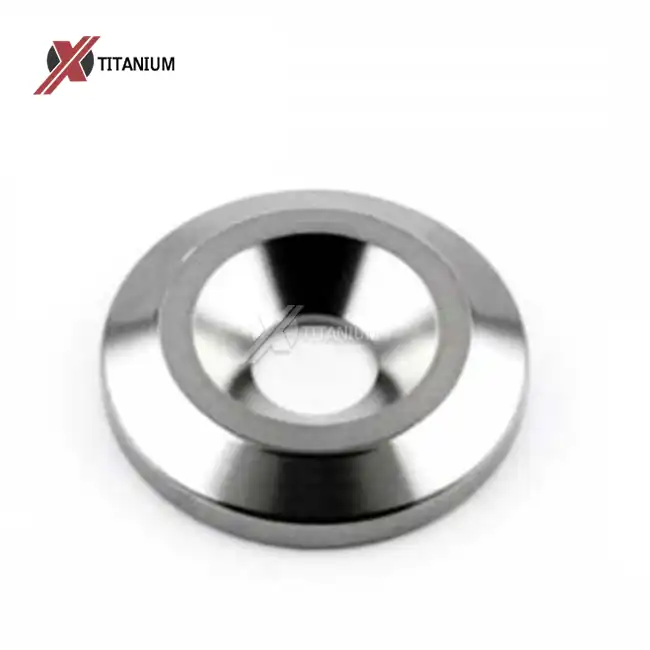
Understanding Countersunk Washers and Their Uses
The Fundamental Design Principle Behind Countersunk Washers
The main difference between countersunk washers and flat washers is that countersunk washers have an angled bearing surface that is usually polished to 90° or 100° military standards. With this geometric shape, the washer can fit into countersunk holes, making setups where the heads of the fasteners are flat with or below the surface of the material. The design solves an ongoing engineering problem: regular flat washers make higher fastening points that block airflow over airplane panels, get in the way of moving mechanical parts, or make marine boats less watertight.
We've seen over many years of working with titanium that this simple angle change turns a simple spacing element into an important load-distribution system that stops stress concentrations that cause composite materials to separate or metal panels to break when loaded and unloaded repeatedly.
Primary Applications Across Critical Industries
Titanium countersunk washers are some of the best on the market because they work well in places where other materials usually fail. These parts are used by aerospace engineers to connect wing skins to internal structures. In this application, every gram counts and the smoothness of the surface has a direct effect on fuel economy. Titanium is used in the marine industry because it doesn't crack when exposed to chloride, a chemical that breaks down 316 stainless steel washers after 18 months of constant saltwater contact.
Titanium countersunk washers are used to hold implanted parts in medical devices because the oxide layer of the material stops ions from leaching, which can cause inflammatory reactions in human tissue. Racing teams use these washers in carbon fiber bodywork and brake caliper systems because they are non-magnetic and don't mess up electrical sensors. They can also handle temps over 400°C during competition.
Material Selection Advantages: Why Titanium Outperforms Alternatives
Titanium was chosen over stainless steel, aluminum, or special plastics because it performs better than those materials, not because of marketing hype. Titanium has a strength-to-weight ratio that is up to 25% higher than aerospace-grade aluminum. It also stays the same size even when temperatures drop, which makes steel and aluminum soften. When testing for rust resistance, titanium forms an oxide layer that heals itself within milliseconds of being scratched.
This is different from passive coatings on stainless steel, which, once broken, let the base be attacked more quickly. We put titanium Grade 2 and Grade 5 washers through 5,000-hour exposure cycles in acidic chemical manufacturing environments that broke down aluminum equivalents totally. The washers stayed the same. Because it lasts longer, it costs less over its lifetime. The original cost of purchase is three to four times higher than that of stainless steel, but the savings on replacement cycles and system downtime pay for themselves within the second year of service in high-vibration or acidic environments.
Technical Specifications and Mechanical Properties of Titanium Countersunk Washer M6
Dimensional Standards and Manufacturing Tolerances
The Titanium Countersunk Washer M6 follows the measurements set by DIN 125 and ISO 7089, with some changes made to account for the shape of the countersunk profile. Standard setups have an inner diameter of 6.4mm and a h11 tolerance, which means they can fit M6 metric nuts and still allow for thermal expansion. For standard load uses, the outer diameter is usually 12 mm. Heavy-duty versions go up to 18 mm to give them more bearing area against composite or soft metal substrates. The thickness can be anywhere from 1.6 mm to 2.5 mm, based on the load.
The countersink angle is carefully machined to match the fastener head shape to within 0.5° of an error. These very close production tolerances make sure that load vectors move smoothly through the washer and into the parent material. This stops point-loading, which is what causes fatigue-sensitive structures to crack.
At Baoji Chuanglian, we can make things using CNC machining centers that have titanium-specific tools that keep the surface finish below Ra 1.6μm. This level of smoothness stops stress risers and makes it easier for parts to sit properly in countersunk holes. Coordinate measure machines are used to check the sizes of each batch, and all the way back to the raw material certifications that meet ASTM B265 standards.
Mechanical Performance Characteristics
Grade 2 economically pure titanium washers have a tensile strength of about 345 MPa and are very flexible, which makes them good for uses where a little deformation during installation pressure helps the washer fit into uneven surfaces. Some types of Grade 5 (Ti-6Al-4V) have a tensile strength of more than 895 MPa, which is about the same as strengthened steel but 56% lighter. Because of their strength, M6 titanium countersunk washers can withstand proof loads of up to 8,000N without permanently deforming. This makes them suitable for high-torque automobile and structural fastening uses in spacecraft.
Stability at different temperatures is another important feature. Titanium can work at temperatures as low as -196°C in liquid nitrogen systems and as high as 400°C for long periods of time in engine rooms or industrial ovens without losing any of its mechanical qualities. This temperature range goes above aluminum's useful limit of 150°C and is on par with austenitic stainless steels, but they don't have the magnetic susceptibility that can be a problem in places with lots of sensors. The low thermal expansion rate (8.6 × 10⁻⁶/°C) of the material is very similar to that of carbon fiber composites. This keeps fasteners from coming loose during thermal cycles.
Installation Guidelines and Torque Specifications
The functional benefits of titanium countersunk washer design are at their best when they are installed correctly. To make sure the washer seats fully, the countersunk holes must be made with the same angle and depth. If they aren't, the washer's edge will take most of the load, which can cut the useful bearing area by up to 60%. We suggest fitting washers so that they are finger-tight before applying pressure. This will let the part center itself and line up with the fastener head shape.
When fitting M6 titanium countersunk washers into aluminum structures, the recommended torque range is 8–10 Nm. For steel or titanium parent materials, the recommended torque range is 12–15 Nm. These values stop galling, which happens when titanium surfaces stick together under pressure and contact during cold welding. Putting molybdenum disulfide-based anti-seize chemicals on fastener threads lowers the risk of galling without affecting the structure of the joint. In buy orders, purchasing managers should include torque ranges and make sure that assembly workers use torque wrenches that have been calibrated. This is because too much torque can crack composite substrates and too little torque can let fasteners come loose when the system vibrates.
Titanium Countersunk Washer M6 vs Other Materials: A Comparative Analysis
Performance Comparison: Titanium Against Stainless Steel
In places where Titanium Countersunk Washer M6 wouldn't work, stainless steel countersunk washers, especially 316-grade ones, are most often used instead. 316 stainless steel is pretty resistant to rust in air and fresh water, but it loses its effectiveness quickly in chloride-rich conditions above 60°C. After only eight months of use on offshore platform equipment, we saw pitting corrosion in steel washers. After five years, titanium washers from the same system showed no measurable degradation. The weight penalty is big: titanium's density is 4.43 g/cm³, while stainless steel's density is 8.0 g/cm³. This is a 45% weight disadvantage that becomes very important in aircraft uses where every kilogram of structural weight lowers payload capability or raises fuel consumption.
When you figure out the total cost of ownership, titanium's original price boost of 300–400% over stainless steel gets a lot smaller. In industrial setups, the costs of replacing parts, system downtime, and repairs caused by rust often add up to 10 to 20 times the value of the original part. Marine owners say that switching to titanium fastening systems gets rid of 70% of the upkeep work that needs to be done on corroded gear. This frees up expert resources to do more value-added work instead of reactive fixes.
Aluminum and Nylon Alternatives: When They Fall Short
Aluminum countersunk washers are specified because they are cheap and easy to machine, but their short useful life means they can only be used in non-critical situations. The galvanic incompatibility of aluminum with carbon fiber composites speeds up corrosion, which weakens joints within 24 to 36 months. This is a failure mode we've looked at in returned automobile and naval parts. Above 150°C, the material softens, which makes washers move when they are loaded for a long time and lose their ability to keep clamp force in engine bay or industrial heating situations.
While nylon and other polymer washers work well as electrical insulators and in low-load indoor uses, they are not strong enough for structural joins. Within two years of being used outside, UV light weakens the mechanical qualities of polymers by 30 to 50 percent. Chemicals in processing equipment can make polymers swell or become less flexible, based on the chemical makeup of the polymer. Because of temperature limits, most engineering plastics can only work at 120°C for long periods of time. This is not good enough for the 200–400°C conditions that are common in power plants, spacecraft propulsion, and heavy industrial equipment.
Lifecycle Cost Analysis and ROI Considerations
Smart buying workers choose fasteners by looking at the total cost of ownership instead of just comparing unit prices. Titanium countersunk washers are more expensive than other options because they need to be bought up front and installed by trained professionals. Other costs that need to be considered are how often they need to be replaced, how long the system has to be shut down for maintenance, and what happens if a fastener fails.
Case studies in aerospace show that switching to titanium fixing systems saves $200 to $500 per pound of weight over the life of an airplane because it uses less fuel. When titanium is used instead of stainless steel in marine uses, upkeep costs drop by 60 to 75 percent for things like deck hardware and underground hull penetrations. Chemical processing plants say that titanium's resistance to rust gets rid of the problems that happen when damaged washers release iron particles into the process streams. These problems can require the whole batch to be thrown away, which costs more than $100,000 per incident.
Procurement Guide for Titanium Countersunk Washer M6
Identifying Qualified Suppliers and Manufacturers
To find Titanium Countersunk Washer M6 components, you have to check sources against technical and quality standards that go beyond price quotes. Manufacturers who are qualified keep certifications like AS9100D for aircraft use, ISO 9001 for general quality management, and approvals specific to their business like NORSOK M-650 for marine and offshore use. Material traceability is a must—every output lot should have mill test records showing the chemical makeup according to ASTM B265 standards, mechanical test results showing the tensile and yield strengths, and data showing the sizes of the parts.
Baoji Chuanglian New Metal Material Co., Ltd. is located in China's "Titanium City," which gives customers direct access to production processes that include everything from processing raw materials to precise cutting. We have a dozen CNC machining centers at our plant that are specifically set up to work with titanium. These centers can make M6 countersunk washers with dimensional stability within 0.02mm from batch to batch. We use statistical process control protocols to find changes in dimensions before parts go beyond the limits of the specifications. This makes sure that procurement workers get parts that will fit properly without any changes being made in the field.
Minimum Order Quantities and Customization Options
Due to the cost of materials and the need for setup time for specialized manufacturing, buying titanium components usually requires larger minimum order numbers than buying common screws. Standard minimum order numbers (MOQs) for M6 titanium countersunk washers are 500 to 1,000 pieces. However, makers that work with the medical and aerospace industries can often handle smaller orders of 100 to 250 units at a higher cost for testing and development. When you buy in bulk for production projects, you can arrange volume pricing at quantities of 5,000 or more pieces. At these levels, the cost per unit drops by 20 to 35 percent compared to small-batch pricing.
Different providers offer a wide range of customization options. Standard changes include changing the outer diameter to make the bearing area bigger, changing the thickness to fit different load profiles, and choosing the material grade from widely pure Grade 2 alloy to high-strength Grade 5 alloy. Advanced customization includes surface treatments like Type II or Type III anodizing for color-coding and better rust protection, DLC coats to stop galling, and special lubricant applications for installs that will be exposed to high temperatures.
Lead Times, Logistics, and Quality Assurance Protocols
Expecting realistic wait times keeps the supply chain from breaking down, which can throw off production plans. Standard M6 titanium countersunk washers from stock usually ship within two to three weeks. Custom designs, on the other hand, need six to eight weeks for machine preparation, production, and quality control. It may take 10 to 12 weeks to get aerospace-grade parts with full material traceability and measurement reports, and that's not counting the time needed for third-party approval.
It takes 3–4 weeks for ocean freight from makers in China's titanium production area to get to the U.S. West Coast ports, with extra time for clearing customs and distributing goods in the interior. Air freight cuts travel time to 5–7 days, but it also costs 300–600% more to ship, so it's only a good idea for urgent needs or high-value sample projects. Procurement teams that are good at what they do place blanket orders with set release dates to keep stock levels steady while lowering holding costs and financial commitments.
Applications of Titanium Countersunk Washer M6 in Key Industries
Aerospace and Aviation Structural Applications
The aerospace industry is the toughest place for Titanium Countersunk Washer M6 components to be used. Parts have to work perfectly for decades of thermal cycling, vibration, and aerodynamic loads while adding very little weight. Manufacturers of airplanes use M6 titanium countersunk washers in all of the systems that connect the fuselage skin to the frames and stringers. These keep aluminum or composite panels in place. The countersunk profile keeps the smooth outside shape that is needed for laminar airflow, and titanium's fatigue resistance can handle the more than 30,000 pressurization cycles that are usual for a business aircraft's service life.
Marine and Offshore Engineering Environments
Immersion in saltwater is where titanium really shines compared to other materials in terms of performance. Marine builders use M6 titanium countersunk washers to secure underwater sensor mounts, through-hull fittings, and deck gear. Stainless steel parts usually break after 2 to 5 years due to stress corrosion cracking and crevice corrosion. More and more, superyacht makers are using titanium fastening systems for all of the topside structures. These systems get rid of the unsightly rust stains that make boats look bad and need constant upkeep.
Offshore oil platforms and underwater production equipment are exposed to some of the most damaging conditions in engineering. These conditions include high-salinity water, high temperature and pressure, and hydrogen sulfide, which breaks down common structural metals more quickly. Titanium countersunk washers in these situations usually last 20 years or more without showing any signs of corrosion. This supports the move in the industry toward longer check gaps and lower upkeep costs. Remotely operated vehicles (ROVs) and autonomous underwater vehicles (AUVs) use titanium fastening systems to keep the weight down and make sure that sensor housings and structural parts are always reliable.
Medical Device and Pharmaceutical Equipment
Medical device makers have to follow strict biocompatibility rules that mean most fastener materials can't be used. M6 titanium countersunk washers made from Grade 23 (Ti-6Al-4V ELI—Extra Low Interstitial) meet FDA and ISO 10993 biocompatibility standards for implanted devices. They don't release any harmful ions that can cause allergic or inflammatory responses. Titanium countersunk washers are used to make mechanical parts safe in surgical tool systems, orthopedic implants, and oral prosthetics. They do this while keeping the material pure, which is important for touching human flesh.
For pharmaceutical processing equipment, the fastening systems need to be able to handle harsh cleaning methods like high-temperature steam treatment and harsh chemical cleaners. Titanium doesn't react with these environments, so it doesn't get contaminated when rusted stainless steel parts release bits into drug production streams. This can cause whole batch recalls that cost millions of dollars and lead to fines from the government. Similar purity standards apply to tools used to make semiconductors. Even a small amount of metallic contamination can ruin chip yields.
High-Performance Automotive and Racing Applications
Extreme thermal cycles, vibration, and mechanical loads in motorsport engineering push the physical limits of how well materials work. When racing teams use M6 titanium countersunk washers in brake caliper systems, temps regularly rise above 300°C. This heat can anneal aluminum washers but oxidize and seize stainless steel. It's important to lose weight in unsprung suspension parts—every gram taken off of brake systems and wheel hubs makes the suspension respond better and lowers the spinning inertia, which makes the car go faster.
Performance cars with carbon fiber frame structures and body panels need fastening systems that stop galvanic corrosion and spread loads so the material doesn't delaminate. When carbon fiber and aluminum fasteners come into contact, electrochemical reactions kill the metal. Titanium countersunk washers work perfectly as an interface because they match the thermal expansion properties of carbon fiber. These solutions come from race development and are now used in high-performance street cars. For example, Porsche, Ferrari, and McLaren use titanium fastening systems in their production supercars because the parts last longer and perform better, so they can afford to use more expensive materials.
Emerging Applications in Electronics and Renewable Energy
Precision magnetic fields are used in ion implantation and thin-film deposition processes, and semiconductor manufacturing equipment needs materials that aren't magnetic so they don't get in the way of them. M6 titanium countersunk washers keep chamber parts and vacuum system hardware in place in places where stainless steel's magnetic permeability would change processing parameters and lower product yield. Because the material is resistant to process chemicals like hydrofluoric acid, sulfuric acid, and plasma cleaning environments, equipment doesn't break down, which would cost a lot of money in 24/7 production centers.
When wind turbines are installed offshore, where saltwater spray attacks nacelle parts and rotor sections, makers have to deal with corrosion problems. When you switch to titanium fastening systems in important structural parts, maintenance times go from two to three years to eight to ten years. Titanium is resistant to dust and high temperatures, which makes it a good material for solar tracking systems in deserts. It stays precisely aligned over decades of outdoor use, while other materials rust or stop.
Conclusion
Titanium Countersunk Washer M6 components provide measured performance benefits in situations where traditional materials would make upkeep too hard, add too much weight, or pose reliability risks that are too high. The conical bearing surface of the part makes it possible for flush installations that keep aerodynamic efficiency and load distribution that keeps the base from getting damaged. These are very important skills in aircraft, marine, medical, and high-performance industrial settings. Selecting between economically pure Grade 2 and high-strength Grade 5 alloy lets engineers choose the best material for either corrosion protection or mechanical strength, based on the loading conditions.
Initial purchase costs for titanium are 300–400% higher than those for regular fasteners, but lifetime cost analysis shows that titanium's longevity and resistance to corrosion make up for the higher costs within two to three years by eliminating the need for replacements and lowering system downtime. For successful specification, it's important to work with qualified manufacturers who keep up with the right certifications and quality systems. Knowing about tolerances for dimensions, installation methods, and application-specific needs also helps make sure that these precision parts work the way that engineering calculations say they should.
FAQ
Q1: Can titanium countersunk washers be reused after disassembly?
A: Reuse rests on how the work was done and the results of the check. After checking the dimensions and looking at the surface to make sure there is no damage, parts that haven't been galling, over-torqued, or mechanically deformed can still be used. Before they are used again, washers that have been in places with a lot of shaking or corrosion should be hardness tested to see if the material has changed. In safety-critical aircraft and medical uses, we suggest replacing titanium countersunk washers during routine maintenance, even if they look like they are in good shape.
Q2: How do I prevent galling when installing titanium countersunk washers with titanium fasteners?
A: Galling occurs when titanium surfaces cold-weld under pressure and contact, which can cause galling. Some ways to stop this from happening are to use molybdenum disulfide or copper-based anti-seize compounds on the threads of fasteners, slow down the installation process to avoid frictional heating, and choose surface treatments like DLC coating or Type II anodizing that create a barrier layer between titanium parts that are mating. When you handle the force correctly, you can avoid the too much pressure that causes galling.
Q3: What angle specifications should I specify for countersunk washers?
A: Standard countersunk angles match common fastener head profiles. The most common is 90°, the standard in aircraft for many uses is 100°, and sometimes 82° is used for certain fastening systems. To make sure full contact and even load distribution, the washer angle must exactly match the fastener head. If the angles aren't the same, stress builds up on the washer edge, which reduces the effective bearing area and could crack weak surfaces.
Partner with Chuanglian for Precision Titanium Countersunk Washer M6 Solutions
Baoji Chuanglian New Metal Material Co., Ltd. is ready to be your reliable Titanium Countersunk Washer M6 provider. They have been handling titanium for over ten years and can make a wide range of products. Our factory in Baoji, China's famous "Titanium City," has direct access to high-quality raw materials and state-of-the-art CNC machine centers that make precise fixing parts that meet the strictest requirements in aerospace, marine, and medical fields. We follow strict quality control procedures that are in line with international standards like AS9100 and ISO 9001. This makes sure that every M6 titanium countersunk washer has the same level of mechanical performance and accuracy in size.
Our engineering team works with customers from the first specification to production, giving them expert advice on how to choose the right material grade, how to install it, and how to make it fit their unique needs. We provide dependable supply chain performance backed by full material traceability and thorough inspection paperwork, whether you require a small number of prototypes for qualification programs or a large number of production units with planned releases. Contact our team at info@cltifastener.com or djy6580@aliyun.com to discuss your requirements.
References
1. Boyer, R., Welsch, G., & Collings, E.W. (1994). Materials Properties Handbook: Titanium Alloys. ASM International, Materials Park, Ohio.
2. Donachie, M.J. (2000). Titanium: A Technical Guide, 2nd Edition. ASM International, Materials Park, Ohio.
3. Schutz, R.W. & Watkins, H.B. (1998). "Recent developments in titanium alloy application in the energy industry." Materials Science and Engineering: A, 243(1-2), 305-315.
4. Veiga, C., Davim, J.P., & Loureiro, A.J.R. (2012). "Properties and applications of titanium alloys: A brief review." Reviews on Advanced Materials Science, 32(2), 133-148.
5. Lutjering, G. & Williams, J.C. (2007). Titanium, 2nd Edition. Springer-Verlag, Berlin Heidelberg.
6. Bai, Y., Chaudhari, A., & Wang, H. (2021). "Investigation of corrosion behavior of titanium alloys in marine environments." Journal of Materials Engineering and Performance, 30(3), 1845-1856.
Learn about our latest products and discounts through SMS or email