- English
- French
- German
- Portuguese
- Spanish
- Russian
- Japanese
- Korean
- Arabic
- Greek
- German
- Turkish
- Italian
- Danish
- Romanian
- Indonesian
- Czech
- Afrikaans
- Swedish
- Polish
- Basque
- Catalan
- Esperanto
- Hindi
- Lao
- Albanian
- Amharic
- Armenian
- Azerbaijani
- Belarusian
- Bengali
- Bosnian
- Bulgarian
- Cebuano
- Chichewa
- Corsican
- Croatian
- Dutch
- Estonian
- Filipino
- Finnish
- Frisian
- Galician
- Georgian
- Gujarati
- Haitian
- Hausa
- Hawaiian
- Hebrew
- Hmong
- Hungarian
- Icelandic
- Igbo
- Javanese
- Kannada
- Kazakh
- Khmer
- Kurdish
- Kyrgyz
- Latin
- Latvian
- Lithuanian
- Luxembou..
- Macedonian
- Malagasy
- Malay
- Malayalam
- Maltese
- Maori
- Marathi
- Mongolian
- Burmese
- Nepali
- Norwegian
- Pashto
- Persian
- Punjabi
- Serbian
- Sesotho
- Sinhala
- Slovak
- Slovenian
- Somali
- Samoan
- Scots Gaelic
- Shona
- Sindhi
- Sundanese
- Swahili
- Tajik
- Tamil
- Telugu
- Thai
- Ukrainian
- Urdu
- Uzbek
- Vietnamese
- Welsh
- Xhosa
- Yiddish
- Yoruba
- Zulu
What Makes Gr5 Titanium So Strong?
Gr5 titanium, also known as Ti-6Al-4V, derives its exceptional strength from its carefully engineered alloy composition—6% aluminum and 4% vanadium combined with titanium. This precise metallurgical balance creates a microstructure that delivers tensile strengths exceeding 895 MPa while maintaining only 60% of steel's weight. When applied to critical fastening components like Gr5 Titanium Alloy Yoke Nuts, this strength translates into unmatched performance under extreme mechanical loads, thermal stress, and corrosive environments—attributes essential for aerospace assemblies, marine equipment, and high-performance automotive systems.
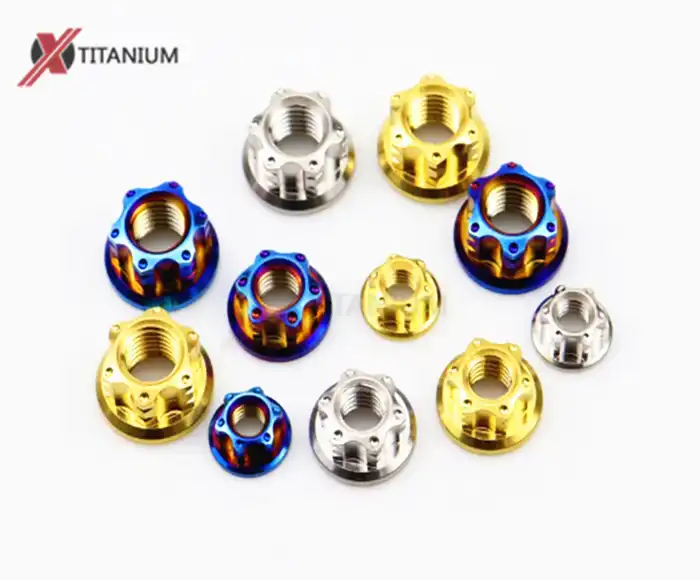
Understanding Gr5 Titanium Alloy Yoke Nut
Gr5 titanium alloy is the best high-performance material because it combines the natural benefits of titanium with aluminum and vanadium, which change the way it behaves mechanically in a basic way. Metallurgists call this type of combination a "alpha-beta titanium structure." The aluminum stabilizes the "alpha phase," and the vanadium makes the "beta phase" stronger. The result is a material that stays structurally sound at temperatures ranging from very cold to 400°C. This makes it perfect for parts that need to work reliably in harsh circumstances.
Composition and Core Properties
The chemicals that make up Gr5 titanium are very specific and must meet the strict requirements set by ASTM B348 and AMS 4928. Aluminum levels run from 5.5 to 6.75%, vanadium levels from 3.5 to 4.5%, iron levels at 0.40%, and oxygen levels at 0.20%. This exact mix gives it a density of about 4.43 g/cm³, which is much lighter than stainless steel options while still being as strong as or stronger than stainless steel. The peak strength is usually 828 MPa, and the hardness is between 30 and 34 HRC. This makes it very resistant to wear during operation and assembly.
Manufacturing Process and Quality Assurance
There are several steps that are taken to make sure that the Gr5 Titanium Alloy Yoke Nut are the right size and made of the same material. Hot forging, which happens at temperatures between 900°C and 1000°C, smooths out the grain structure and gets rid of any flaws inside the block. Then, precise CNC machining makes thread shapes that are very close to the specs, usually within ±0.05mm. Solution cleaning and aging are two types of heat treatment that improve mechanical qualities by making the alpha-beta phase distribution better throughout the part.
Measures for quality control go beyond checking the sizes. Spectroscopy is used to look at the chemical makeup of each production batch. The tensile and yield strengths are checked mechanically, and non-destructive testing methods like ultrasound inspection are used to find problems below the surface. ISO 9001 certification makes sure that the process is always the same, and industry-specific standards like AS9100 for aerospace uses add extra layers of verification that buying teams need when they are looking at sellers.
Application Environments and Performance Requirements
The operating needs of yoke nuts in important parts make the investment in Gr5 titanium material worthwhile. In aircraft uses, these fasteners hold down control surfaces, landing gear systems, and engine mounting points, all of which are very important and could fail very badly. The wear strength of the material is especially useful in cyclic loading situations, where parts are stressed millions of times over the course of their service life. The results of tests show that Gr5 titanium keeps its shape after more than 10^7 rounds of stress levels that would cause similar steel screws to crack.
Different problems come up in marine and underwater uses that Gr5 titanium can handle well. When standard screws are exposed to saltwater, they rust faster, which causes crevice corrosion, pitting, and eventually mechanical failure. Titanium's inactive oxide layer protects it from corrosion caused by chloride. This layer is made up of a thin, stable TiO2 film that forms quickly when oxygen hits it. This feature gets rid of the maintenance hassle of replacing fasteners on a regular basis and stops the pollution problems that happen when rusted fasteners leave iron oxides on nearby parts.
Comparing Gr5 Titanium Alloy Yoke Nuts with Alternative Materials
When choosing a material for important fixing jobs, you have to balance a lot of performance factors against cost limits and supply chain issues. When procurement teams compare Gr5 Titanium Alloy Yoke Nut to other options, they need to know how the qualities of the material affect how well the part works and how much it costs to own over its whole life.
Gr5 Titanium versus Stainless Steel
Grades of stainless steel like 316 and 17-4PH have been used for a long time to make corrosion-resistant screws. Direct comparison, on the other hand, shows big gaps in ability. In moderate settings, 316 stainless steel is good at resisting corrosion, but it weighs about 75% more than Gr5 titanium at the same amount of strength. This extra weight makes things heavier when there are a lot of fasteners, which can hurt fuel economy in aerospace uses and dynamic response in high-performance car systems.
When you look at individual strength numbers, the strength-to-weight ratio advantage becomes very clear. Gr5 titanium has a strength of about 215 kN·m/kg, which is a lot more than the 140 kN·m/kg that most high-strength steel metals have. Because of this difference, engineers can use fewer fasteners or smaller ones while still keeping structural safety gaps. This is an example of a design optimization that works its way through whole structures, lowering the weight of the whole system and making it perform better.
Performance in Extreme Environments
Extreme temperatures make it hard for many common fixing materials to work. Aluminum metals quickly lose their strength above 150°C, and some types of stainless steel become weak at very low temperatures. Gr5 titanium's mechanical qualities stay the same at temperatures ranging from -253°C to 400°C. This means it can be used in a wide range of situations, from turbine housings to systems for liquid natural gas. Because of this thermal stability, there is no need to switch out materials for different working situations. This makes managing supplies easier and lowers the need for engineering validation.
Another thing that sets them apart is their chemical protection. Stainless steel relies on chromium oxide passivation, but this layer breaks down in chloride-rich settings, which starts localized rust. Titanium's oxide layer stays steady from pH 2 to 12 and most organic acids, alkalis, and salt solutions can't damage it. This broad-spectrum corrosion resistance is very helpful for industries that work in marine, desalination, and chemical processing settings because it increases the time between upkeep and cuts down on unexpected downtime.
Cost Analysis and Total Ownership Considerations
The initial costs of materials for Gr5 titanium yoke nuts are usually three to five times higher than those for stainless steel versions. Lifecycle cost study, on the other hand, shows a different economic picture. Longer service life—often more than twenty years in toxic settings where stainless steel needs to be replaced every five to seven years—lowers long-term costs of acquisition. Avoiding maintenance costs can save you even more money, especially in situations where getting to a bolt involves shutting down equipment or taking apart parts that are nearby.
When purchasing managers look at a supplier's skills, they should check not only the unit price but also the level of expert support, the systems for tracking materials, and the accuracy of the quality documents. Reliable makers give mill test results that show the chemical make-up and mechanical properties of each output lot. They also give certifications that show the materials meet ASTM and AMS standards. This paperwork is very important for quality checks and gives the tracking that is needed for nuclear, medical, and aerospace uses.
Benefits and Advantages of Gr5 Titanium Alloy Yoke Nuts
The technical benefits that Gr5 titanium offers directly translate into practical benefits in a number of areas. Knowing these benefits helps procurement teams and expert reviewers explain why they chose certain materials and share value ideas with finance and top management.
Unmatched Strength-to-Weight Performance
Materials are chosen based on efforts to reduce weight in a wide range of fields, from aerospace to automobile performance uses. Every kilogram that is taken away from spinning assemblies makes them faster, uses less energy, and has better dynamic reaction properties. Gr5 Titanium Alloy Yoke Nut have the same level of fastening strength as high-grade steel but weigh 45% less. This means that system-level weight optimization is possible that wouldn't be possible with regular materials.
This weight advantage gets bigger when more than one clip is used. Titanium replacement can cut the weight of an airplane wing assembly with over 500 fixing points by more than 50 kilograms. This saves weight, which directly leads to more carrying capacity or longer range. Similar benefits can be seen in automotive uses, where less unsprung mass improves the performance of the suspension and the way the car handles.
Superior Corrosion Resistance and Longevity
Corrosion's effects on the economy go beyond the cost of replacing parts. They also include the cost of downtime, the risk of safety incidents, and damage to a brand's image. These worries are completely taken care of by Gr5 titanium's resistance to rust. Titanium surfaces have a solid oxide layer that protects them and grows back right away if it gets broken. This is different from organic coatings that break down over time and leave spots where they are weak.
This benefit is clearly shown by real-world performance results from marine uses. Offshore platform managers say that titanium fasteners that were used during building are still working after twenty years of being exposed to saltwater, but stainless steel fasteners that are close by need to be replaced every seven to ten years. Getting rid of maintenance tasks that involve fasteners lowers operational risk and frees up maintenance staff to work on other parts of the system.
Fatigue Resistance and Reliability Under Cyclic Loading
When parts are loaded and unloaded many times, they get tiny damage that finally causes cracks to start and spread. Fatigue failure is one of the sneakiest types of failure because it can happen at stress levels much lower than the material's steady strength. Gr5 titanium has great fatigue qualities, with a durability limit of about 50% of its tensile strength. This gives a lot of safety cushion in situations where there is vibration, thermal cycle, or changing mechanical loads.
This gain is shown by engineering data from rotating machinery uses. Fasteners are put through millions of stress cycles every year by turbomachinery that spins at high speeds. Parts made from Gr5 titanium work without cracks for longer than the expected design life, while parts made from other materials start to show wear cracks at expected times. This edge in dependability cuts down on unplanned maintenance and raises the general availability of the system, both of which have a direct effect on how profitable the business is.
Procurement Considerations for Gr5 Titanium Alloy Yoke Nut
A strategy that goes beyond price research is needed to find high-performance titanium screws. Technical procurement teams have to look at a supplier's skills in a number of areas to make sure the quality of the materials, the dependability of delivery, and the availability of technical help throughout the lifecycle of a product.
Supplier Qualification and Certification Requirements
Manufacturers of Gr5 Titanium Alloy Yoke Nut who are known for their quality keep full quality management systems that are approved to meet international standards. Getting ISO 9001 certification shows that you know how to control processes in a basic way. Certifications specific to your business, like AS9100 for aerospace uses or ISO 13485 for medical devices, show that you know more about how to work in regulated fields. Suppliers that work with more than one industry usually have more than one license, which gives you options when parts are used in different areas.
The ability to track materials is an absolute must for mission-critical uses. Lot tracking systems are used by qualified providers to connect finished parts with the heat numbers of the raw materials, the processing settings, and the inspection results. This paper trail makes it easy to quickly figure out what went wrong if problems happen in the field and meets the rules for medical and aircraft uses. When evaluating a supplier, procurement teams should ask to see sample paperwork packages to make sure they are full and to see how mature the supplier's quality system is.
Technical Collaboration and Customization Capabilities
Off-the-shelf fastener specs work well for many uses, but for more complicated systems, they often need to be resized or have special features added. If a supplier lets engineers work together, they can make sure that the designs of yoke nuts are best for the loading conditions at hand and suggest changes that will either make them work better or lower the cost of production. This way of working together technically is especially helpful when making a new product, because fastener specs change at the same time as the general design of the assembly.
Manufacturing freedom lets you make changes to a lot of different factors. Thread standards can be changed to fit different types of shafts, locking features can be added to stop spinning when the machine is vibrating, and surface treatments can be used to make the machine even more resistant to corrosion or lower friction. Suppliers with a wide range of machining tools, such as multi-axis CNC machines, thread rolling machines, and heat treatment facilities, can meet these customization needs without having to hire multiple subcontractors. This makes managing the supply chain easier and ensures more consistent deliveries.
Logistics, Lead Times, and Inventory Management
Global supply lines add a level of complication that buying teams need to be aware of and plan for. Knowing the minimum order amounts helps you make the best buying choices by balancing the costs of keeping inventory with the benefits of volume prices. Many companies that make specialized titanium fasteners set minimum order quantities (MOQs) based on the amount of work that needs to be done to set up the production line. For bigger orders that support dedicated production runs, the cost per unit is lower.
Lead times depend on how complicated the product is and how busy the factory is right now. Standard versions that are kept in stock may be shipped within days, but special specs that need dedicated production runs usually take eight to twelve weeks from the time the order is confirmed until it is delivered. When you work with collaborative suppliers, you can see the plan for production, which helps buying teams line up the deliveries of parts with the times for putting them together and keep inventory levels as low as possible.
When planning, international shipping issues add another layer. Titanium screws are usually shipped by air freight because they are very valuable for how heavy they are. It usually takes three to seven days for them to get from the factories that make them to the places where they are used. The right packaging keeps thread profiles and finished surfaces safe while they're being shipped, and having all the paperwork you need, like business invoices, packing lists, and material certifications, makes the customs clearing and receiving inspection processes go more smoothly.
What Makes Gr5 Titanium So Strong? An In-Depth Analysis?
Gr5 titanium has unique mechanical properties that set it apart from other materials. These qualities come from basic metallurgical principles and carefully controlled working methods. Engineers and procurement workers can better understand why this alloy costs more and when the investment is worth it by understanding these basic processes. For example, when sourcing Gr5 Titanium Alloy Yoke Nut, the alloy's strength-to-weight ratio, corrosion resistance, and ability to withstand high temperatures justify its higher cost in applications where performance is critical.
Alloy Composition and Microstructural Effects
Titanium has two solid forms when it is pure: the hexagonal close-packed alpha phase, which stays stable at lower temperatures, and the body-centered cubic beta phase, which stays stable above 882°C. Adding alloys to these stages makes them stable across a wider range of temperatures, which changes how they behave mechanically in a basic way. As an alpha stabilizer, aluminum raises the temperature at which the transition to the beta phase takes place. At the same time, solid solution stiffening makes aluminum stronger.
As a beta stabilizer, vanadium lowers the transformation temperature and at room temperature makes a microstructure that is a mix of alpha and beta. This two-phase structure blends the alpha phase's good resistance to creep and modest strength with the beta phase's better flexibility and toughness when breaking. The finished product has a balanced set of properties that can't be found in single-phase alloys: it's strong without being rigid, it doesn't wear down easily, and it's flexible enough to handle stress concentrations without cracking.
Heat Treatment and Property Enhancement
Through controlled changes to the microstructure, thermal processing processes turn parts that have already been machined into high-performance industrial materials. Solution treatment, which involves heating the parts to temperatures between 900 and 950°C, breaks up the precipitates and evens out the spread of the alpha and beta phases. This architecture freezes quickly, making a metastable state that can be improved by age treatments in the future.
When things are aged at temperatures between 480°C and 620°C for two to eight hours, small alpha phase particles form inside the beta matrix. These precipitates stop dislocation movement, which is the tiny process that causes plastic deformation. This makes the yield strength and stiffness much higher. The processing factors are carefully chosen to get the desired qualities. Small changes in the aging temperature or time can be seen in the mechanical performance.
Corrosion Resistance Mechanisms
The amazing resistance to rust in titanium comes from how strongly it reacts with air, which sounds bad but is actually very helpful. A very thin layer of titanium dioxide (TiO2) appears right away when titanium surfaces come into touch with oxygen or water. This layer is usually only 2–7 nanometers thick. This oxide layer is very solid; it sticks firmly to the metal below and doesn't dissolve in a wide range of pH levels.
Titanium's passive layer can fix itself, which is a level of security that organic coats can't match. If the surface is scratched by mechanical damage, revealing new metal, oxide regeneration happens in milliseconds, restoring security right away. This feature stops the layer from wearing away over time, which happens with painted or plated parts. Over time, small flaws spread until rust weakens large areas of the surface.
Conclusion
Gr5 titanium is strong because its alloy makeup and microstructure have been carefully controlled. It has better tensile qualities than most materials while weighing a lot less. When you add aluminum and vanadium together, you get an alpha-beta phase balance that gives the material high strength, great fatigue resistance, and broad-spectrum corrosion protection. These are the kinds of qualities that make expensive materials worth it because they last longer and need less upkeep. When these qualities are used on important fastening parts like Gr5 Titanium Alloy Yoke Nut, they make them reliable in high-performance industrial, military, and aircraft settings where a broken part would have terrible results. To make sure the supply chain works well in the long term, procurement teams should look at more than just price when reviewing providers. They should also look at technical skills, the maturity of the quality system, and collaborative engineering support.
FAQ
Q1: What distinguishes Gr5 titanium from other titanium grades?
A: Gr5 (Ti-6Al-4V) has 6% aluminum and 4% vanadium, which makes an alpha-beta lattice that is much stronger than pure types like Gr2 that are sold in stores. This metal has tensile forces higher than 895 MPa, compared to 345 MPa for Gr2. It also has great corrosion protection. Because it has better mechanical qualities, Gr5 can be used in structural uses and high-stress fastening places where pure titanium grades aren't strong enough.
Q2: How does heat treatment affect Gr5 titanium yoke nut performance?
A: Solution treatment and age processes improve the spread of the alpha-beta phase in Gr5 titanium, making it much stronger and harder. When heat is applied correctly, the hardness rises from about 30 HRC when it is heated to 34–36 HRC after aging. This makes it more resistant to wear during installation and service. These thermal processes also improve wear qualities by leaving behind beneficial stress patterns and smoothing out the grain structure all over the part. A properly heat treated Gr5 Titanium Alloy Yoke Nut provides significantly higher reliability in cyclic loading scenarios.
Q3: What quality certifications should buyers verify when sourcing titanium fasteners?
A: Reliable providers keep their ISO 9001 quality management approval as a minimum. Standards specific to the industry, like AS9100 for aircraft uses, give even more peace of mind. Complete chemical composition analysis, mechanical property verification, and lot tracking paperwork that connects finished parts to raw material heat numbers should all be part of material certificates. For medical uses, ISO 13485 approval is needed. For marine and pressure vessel uses, extra third-party review paperwork may be needed.
Partner with Chuanglian for Superior Gr5 Titanium Solutions
With more than ten years of experience making titanium parts, Baoji Chuanglian New Metal Material Co., Ltd. has become a reliable company that makes Gr5 Titanium Alloy Yoke Nut. Our factory in Baoji, which is known as the "City of Titanium" in China, has advanced CNC cutting equipment and strict quality control systems that meet AS9100 and ISO 9001 standards. We keep full records of all materials, from the raw billet to the final review of each component. This gives buying teams in aerospace, marine, and medicine the faith that their paperwork is correct.
During the design process, our expert team works with customers to make sure that the fastener specifications are best for the loading conditions and that they get application advice that goes beyond what is in the catalog. Contact our engineering team at info@cltifastener.com or djy6580@aliyun.com to talk about your Gr5 Titanium Alloy Yoke Nut needs and find out how our production skills can help you make your supply chain more reliable.
References
1. Boyer, R., Welsch, G., & Collings, E.W. (1994). Materials Properties Handbook: Titanium Alloys. ASM International.
2. Donachie, M.J. (2000). Titanium: A Technical Guide, 2nd Edition. ASM International.
3. Lutjering, G., & Williams, J.C. (2007). Titanium, 2nd Edition. Springer-Verlag Berlin Heidelberg.
4. Peters, M., Kumpfert, J., Ward, C.H., & Leyens, C. (2003). "Titanium Alloys for Aerospace Applications." Advanced Engineering Materials, 5(6), 419-427.
5. Schutz, R.W., & Watkins, H.B. (1998). "Recent Developments in Titanium Alloy Application in the Energy Industry." Materials Science and Engineering: A, 243(1-2), 305-315.
6. Veiga, C., Davim, J.P., & Loureiro, A.J.R. (2012). "Properties and Applications of Titanium Alloys: A Brief Review." Reviews on Advanced Materials Science, 32(2), 133-148.
Learn about our latest products and discounts through SMS or email