- English
- French
- German
- Portuguese
- Spanish
- Russian
- Japanese
- Korean
- Arabic
- Greek
- German
- Turkish
- Italian
- Danish
- Romanian
- Indonesian
- Czech
- Afrikaans
- Swedish
- Polish
- Basque
- Catalan
- Esperanto
- Hindi
- Lao
- Albanian
- Amharic
- Armenian
- Azerbaijani
- Belarusian
- Bengali
- Bosnian
- Bulgarian
- Cebuano
- Chichewa
- Corsican
- Croatian
- Dutch
- Estonian
- Filipino
- Finnish
- Frisian
- Galician
- Georgian
- Gujarati
- Haitian
- Hausa
- Hawaiian
- Hebrew
- Hmong
- Hungarian
- Icelandic
- Igbo
- Javanese
- Kannada
- Kazakh
- Khmer
- Kurdish
- Kyrgyz
- Latin
- Latvian
- Lithuanian
- Luxembou..
- Macedonian
- Malagasy
- Malay
- Malayalam
- Maltese
- Maori
- Marathi
- Mongolian
- Burmese
- Nepali
- Norwegian
- Pashto
- Persian
- Punjabi
- Serbian
- Sesotho
- Sinhala
- Slovak
- Slovenian
- Somali
- Samoan
- Scots Gaelic
- Shona
- Sindhi
- Sundanese
- Swahili
- Tajik
- Tamil
- Telugu
- Thai
- Ukrainian
- Urdu
- Uzbek
- Vietnamese
- Welsh
- Xhosa
- Yiddish
- Yoruba
- Zulu
Uses of Titanium Dowel Pins in Precision Machinery
Titanium dowel pins serve as critical precision alignment components in high-performance machinery, offering exceptional strength-to-weight ratios and superior corrosion resistance that traditional steel alternatives cannot match. These specialized fasteners are engineered to exact tolerances, typically maintaining m6, h6, or h7 ISO limits while delivering uncompromising performance in demanding industrial applications. From aerospace assemblies to medical equipment, these pins solve complex engineering challenges where precision, durability, and material compatibility are paramount for operational success.
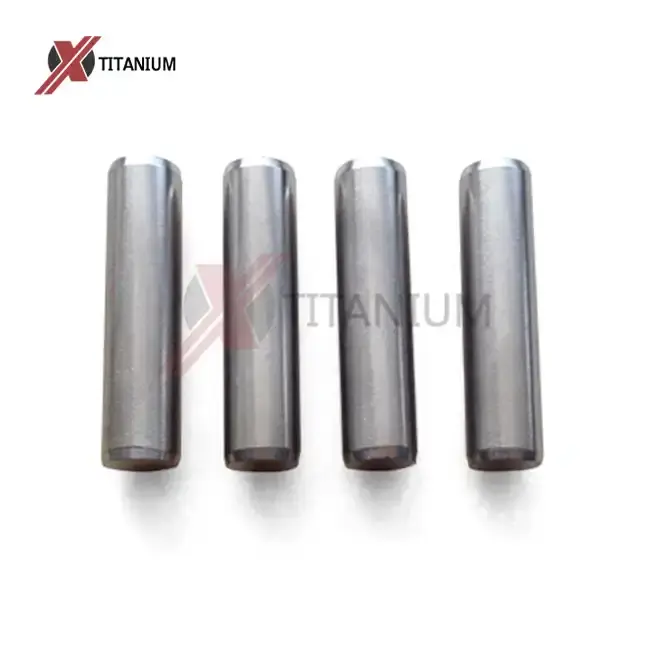
Understanding Titanium Dowel Pins in Precision Machinery
The engineering excellence behind titanium dowel pins stems from their unique material composition and precision manufacturing processes. These cylindrical fasteners represent a sophisticated solution for industries requiring exceptional performance under extreme conditions.
Material Composition and Grades
The most commonly utilized grades incorporate Ti-6Al-4V (Review 5) and Commercially Immaculate Titanium (Review 2), each advertising particular preferences for particular applications. Review 5 titanium conveys an extreme malleable quality of roughly 895 MPa with fabulous warm resistance, making it perfect for aviation and car applications. Review 2 titanium gives predominant erosion resistance and biocompatibility, especially esteemed in therapeutic gadget fabricating and marine environments.
Precision Manufacturing Standards
Manufacturing these components requires adherence to exacting resilience details, with accuracy centerless pounding accomplishing surface harshness values ordinarily way better than Ra 0.8µm. This level of accuracy guarantees steady obstructions fits and solid execution over temperature varieties. The moo coefficient of warm extension (8.6 µm/m·K) keeps up dimensional solidness all through operational temperature ranges, basic for motor components and high-precision assemblies.
Unique Performance Characteristics
At roughly 4.43 g/cm³, titanium offers noteworthy weight diminishment compared to steel options whereas keeping up predominant mechanical properties. The unconstrained arrangement of a detached oxide film (TiO2) gives remarkable resistance to chloride push erosion breaking, assembly NACE MR0175 measures for subsea applications.
Applications of Titanium Dowel Pins in Precision Machinery
The versatility of titanium dowel pins extends across multiple high-performance industries, where their unique properties address specific engineering challenges that conventional materials cannot resolve effectively.
Aerospace and Aviation Applications
In aviation fabricating, these pins play vital parts in adjusting composite structures on air ship wings and fuselages. Not at all like aluminum or steel choices, titanium kills galvanic erosion dangers when in contact with Carbon Fiber Fortified Polymers (CFRP), whereas contributing specifically to fuel proficiency objectives through weight diminishment. The pins withstand extraordinary temperature varieties and keep up basic keenness beneath high-stress conditions commonplace in flying environments.
Medical Device and Surgical Equipment
The restorative industry depends intensely on titanium's biocompatibility and non-magnetic properties for accuracy applications. These pins are utilized in orthopedic outside fixators, surgical arrangement dances, and MRI gear where attractive obstructions must be dispensed with. The bio-inert nature permits for long-term implantation without metallosis or tissue dismissal, whereas keeping up exact situating precision required for surgical instruments.
High-Performance Automotive and Racing
Racing applications in Equation 1 and World Perseverance Championship vehicles utilize these pins for adjusting gearbox casings, barrel heads, and differential lodgings. The diminished mass contributes to lower centers of gravity and quicker rotational speeding up properties, whereas withstanding the strongly warm cycles of high-performance powertrain environments.
Marine and Offshore Engineering
Subsea applications benefit from titanium's exceptional corrosion resistance in hypersaline environments. These pins secure critical components in desalination plants, remotely operated vehicles (ROVs), and offshore platform structures where chloride pitting would compromise steel alternatives.
How to Choose the Right Titanium Dowel Pins for Your Machinery?
Selecting optimal titanium dowel pins requires careful evaluation of multiple technical parameters and application-specific requirements to ensure maximum performance and cost-effectiveness.
Material Grade Selection Criteria
The choice between Review 2 and Review 5 titanium depends on particular application requests. Review 2 offers prevalent erosion resistance with a surrender quality of roughly 275 MPa, making it appropriate for marine and chemical preparing situations. Review 5 gives higher quality capabilities with a abdicate quality of 828 MPa, favored for basic aviation and high-stress car applications.
Dimensional Specifications and Tolerances
Proper measuring includes considering both dimensional exactness and warm development characteristics. Stick distance across, length, and resilience details must adjust with mating component necessities whereas bookkeeping for warm cycling impacts. Custom machining capabilities empower custom fitted arrangements for special geometric necessities or specialized surface treatments.
Performance Comparison with Alternative Materials
When assessing titanium against stainless steel, aluminum, or ceramic choices, consider the add up to fetched of possession counting life span, upkeep necessities, and operational effectiveness. Titanium's prevalent weariness resistance and erosion insusceptibility frequently legitimize higher beginning costs through amplified benefit life and decreased support intervals.
Purchasing Titanium Dowel Pins: What B2B Buyers Need to Know?
Procurement strategies for precision titanium components require understanding market dynamics, supplier capabilities, and quality assurance protocols to ensure successful project outcomes.
Market Pricing and Cost Optimization
Titanium estimating reflects fabric review complexity, fabricating resistances, and arrange volumes. Bulk requesting methodologies can accomplish critical taken a toll diminishments, whereas custom determinations may require premium estimating. Understanding these estimating drivers empowers buyers to optimize obtainment timing and arrange amounts for greatest cost-effectiveness.
Supplier Selection and Quality Assurance
Reputable suppliers maintain certifications including AS9100 for aerospace applications, ISO 13485 for medical devices, and ISO 9001 for general manufacturing quality systems. These certifications ensure consistent material properties, traceability, and manufacturing process controls essential for critical applications.
Supply Chain Management Considerations
International coordinations require cautious arranging for shipping strategies, traditions documentation, and conveyance planning. Setting up connections with providers advertising comprehensive specialized bolster and dependable conveyance execution minimizes supply chain dangers and generation delays.
Maintenance and Best Practices for Using Titanium Dowel Pins
Proper installation and maintenance protocols maximize the operational lifespan and performance reliability of precision titanium components in demanding applications.
Installation Techniques and Best Practices
Accurate fitting requires suitable gathering strategies to avoid bothering, a common concern with titanium materials. Anti-galling coatings such as Diamond-Like Carbon (DLC) or specialized greases containing Molybdenum Disulfide (MoS2) encourage legitimate establishment whereas avoiding cold welding between surfaces.
Preventive Maintenance Protocols
Regular inspection routines should focus on dimensional stability, surface condition, and alignment accuracy. Titanium's inherent corrosion resistance simplifies maintenance requirements compared to steel alternatives, though periodic verification ensures continued performance within specification limits.
Troubleshooting Common Issues
Addressing misalignment or premature wear requires systematic evaluation of installation procedures, operating conditions, and material compatibility. The non-magnetic nature of titanium necessitates specialized removal techniques when replacement becomes necessary, including thermal expansion methods or electrical discharge machining for seized components.
Conclusion
Titanium dowel pins represent a critical advancement in precision machinery components, offering unmatched performance characteristics for demanding industrial applications. Their unique combination of strength, corrosion resistance, and lightweight properties addresses specific engineering challenges across aerospace, medical, automotive, and marine industries. The investment in titanium technology delivers long-term value through extended service life, reduced maintenance requirements, and superior operational reliability in applications where precision and durability cannot be compromised.
FAQ
What makes titanium dowel pins superior to steel alternatives?
Titanium offers approximately 45% weight reduction compared to steel while maintaining superior corrosion resistance and eliminating magnetic interference. The material's passive oxide film provides exceptional protection against chloride stress corrosion cracking, particularly valuable in marine and chemical processing environments.
Can titanium dowel pins replace hardened steel in high-wear applications?
While Grade 5 titanium provides excellent strength properties, it may not match the surface hardness of heat-treated alloy steel in extreme wear applications. Specialized hard coatings such as Titanium Nitride can enhance wear resistance when required for specific applications.
How do you prevent galling during installation of titanium dowel pins?
Professional installation involves applying anti-galling coatings like DLC or using assembly lubricants containing MoS2. Proper installation techniques and appropriate surface treatments effectively prevent cold welding and ensure smooth assembly processes.
What is the difference between Grade 2 and Grade 5 titanium for dowel pin applications?
Grade 2 offers superior corrosion resistance and ductility with lower strength properties, ideal for marine and chemical applications. Grade 5 provides higher strength capabilities and heat resistance, preferred for structural aerospace and high-stress automotive applications.
Are titanium dowel pins compatible with MRI equipment?
Yes, titanium's non-magnetic properties make these pins ideal for MRI equipment and medical devices where magnetic interference must be eliminated. The material's biocompatibility also allows for safe use in medical implant applications.
Partner with Chuanglian for Premium Titanium Dowel Pin Solutions
Chuanglian stands as your trusted titanium dowel pins manufacturer, delivering precision-engineered components that meet the most demanding industrial specifications. Located in Baoji, the renowned "City of Titanium," our company combines over ten years of specialized titanium machining expertise with state-of-the-art CNC equipment to produce superior quality pins for aerospace, medical, automotive, and marine applications.
Our comprehensive quality control systems ensure every component meets stringent international standards, from raw material inspection through final product delivery. Contact our technical team at info@cltifastener.com or djy6580@aliyun.com to discuss your specific requirements and discover how our titanium dowel pins for sale can enhance your precision machinery performance.
References
1. American Society for Testing and Materials. "Standard Specification for Titanium and Titanium Alloy Strip, Sheet, and Plate." ASTM B265-20.
2. Boyer, Rodney R. "An Overview on the Use of Titanium in the Aerospace Industry." Materials Science and Engineering: A 213.1-2 (1996): 103-114.
3. International Organization for Standardization. "Geometrical Product Specifications (GPS) - ISO Code System for Tolerances on Linear Sizes." ISO 286-1:2010.
4. Lutjering, Gerd, and James C. Williams. "Titanium: Engineering Materials and Processes." 2nd Edition, Springer-Verlag Berlin Heidelberg, 2007.
5. National Association of Corrosion Engineers. "Petroleum and Natural Gas Industries - Materials for Use in H2S-Containing Environments." NACE MR0175/ISO 15156.
6. Society of Automotive Engineers. "Quality Management Systems - Requirements for Aviation, Space and Defense Organizations." AS9100D:2016.
Learn about our latest products and discounts through SMS or email