- English
- French
- German
- Portuguese
- Spanish
- Russian
- Japanese
- Korean
- Arabic
- Greek
- German
- Turkish
- Italian
- Danish
- Romanian
- Indonesian
- Czech
- Afrikaans
- Swedish
- Polish
- Basque
- Catalan
- Esperanto
- Hindi
- Lao
- Albanian
- Amharic
- Armenian
- Azerbaijani
- Belarusian
- Bengali
- Bosnian
- Bulgarian
- Cebuano
- Chichewa
- Corsican
- Croatian
- Dutch
- Estonian
- Filipino
- Finnish
- Frisian
- Galician
- Georgian
- Gujarati
- Haitian
- Hausa
- Hawaiian
- Hebrew
- Hmong
- Hungarian
- Icelandic
- Igbo
- Javanese
- Kannada
- Kazakh
- Khmer
- Kurdish
- Kyrgyz
- Latin
- Latvian
- Lithuanian
- Luxembou..
- Macedonian
- Malagasy
- Malay
- Malayalam
- Maltese
- Maori
- Marathi
- Mongolian
- Burmese
- Nepali
- Norwegian
- Pashto
- Persian
- Punjabi
- Serbian
- Sesotho
- Sinhala
- Slovak
- Slovenian
- Somali
- Samoan
- Scots Gaelic
- Shona
- Sindhi
- Sundanese
- Swahili
- Tajik
- Tamil
- Telugu
- Thai
- Ukrainian
- Urdu
- Uzbek
- Vietnamese
- Welsh
- Xhosa
- Yiddish
- Yoruba
- Zulu
What are the advantages of titanium bolts for mountain bikes?
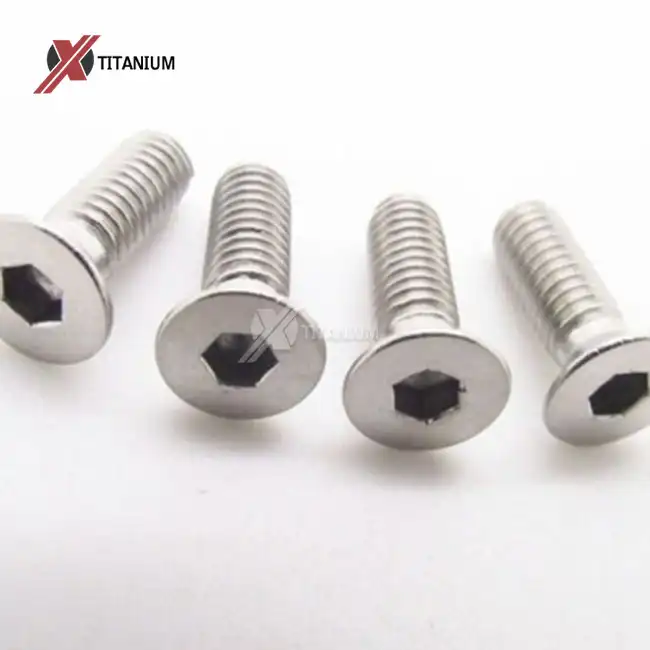
Mountain bike titanium bolt kits represent a decisive upgrade for riders and manufacturers seeking uncompromising performance. Constructed from Grade 5 titanium alloy (Ti-6Al-4V), these fasteners deliver exceptional tensile strength exceeding 900 MPa while weighing approximately 40% less than steel equivalents.
Their inherent corrosion resistance eliminates galvanic degradation common in mixed-material assemblies, extending service life across demanding trail conditions. Beyond weight savings, titanium's superior fatigue resistance withstands cyclical loading during aggressive descents and technical climbs, making these bolt kits indispensable for high-performance applications where reliability cannot be compromised.
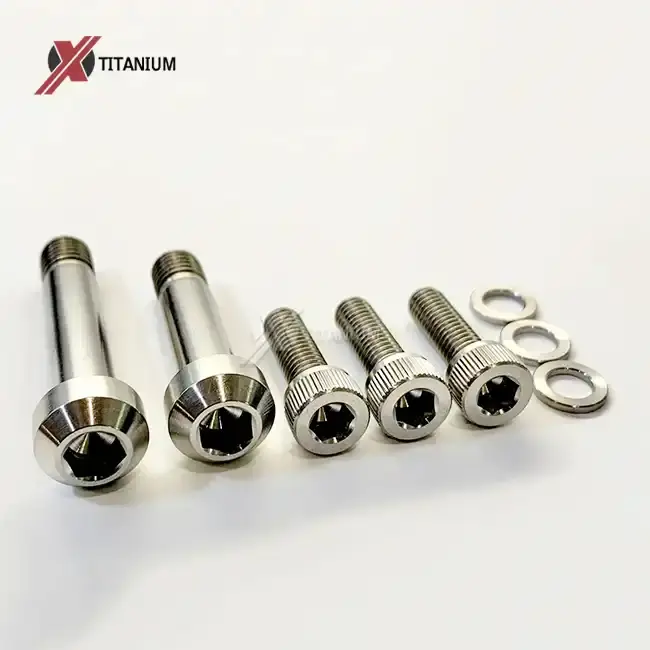
Understanding Titanium Bolts and Their Role in Mountain Bikes
When mountain bikes are put together, titanium fasteners hold parts together that are put under a lot of stress while they are being used. Our factory in Baoji, which is known around the world as the "City of Titanium," makes CNC-machined mountain bike titanium bolt kits that are designed to work with bikes.
Material Composition and Engineering Standards
The Ti-6Al-4V material used in high-end bike bolts has 6% aluminum and 4% vanadium in it, which makes it a good mix between being flexible and tough. This mix has a density of 4.43 g/cm³, which is much lower than steel's 7.85 g/cm³ and directly leads to a measured weight decrease.
Following the rules for DIN 912 socket heads and ISO 7380 button heads makes sure that all international supply chains are accurate in terms of size. When manufacturing mountain bike titanium bolt kits, rolled threading is used instead of cut threading. This keeps the integrity of the grain structure and extends wear life by up to 30% compared to traditional ways.
Application Across Bike Systems
When titanium hardware is used to connect main triangle junctions and rear dropout connections, frame systems look their best. Suspension systems need fasteners that don't come loose when they're vibrated. Titanium's low elastic modulus gives it just the right amount of flexibility to keep the preload tension without deforming the thread.
Rotational stress causes aluminum bolts to wear out too quickly in drivetrain parts like chainring attachments. Brake caliper bolts need parts that won't rust because they are exposed to a lot of water and road salt. Titanium's mix of strength, elasticity, and resistance to weather damage makes it useful in a wide range of application areas.
Key Advantages of Titanium Bolts Over Other Materials
Titanium fasteners were chosen because they have measurable performance characteristics that have a direct effect on both the rider experience and the costs of ownership over time. We have been making titanium parts for the medical and aircraft industries for more than ten years, and we use the same high standards when making cycling goods.
Weight Optimization Without Structural Compromise
When riding, lowering rotational mass leads to uneven performance gains. When compared to steel equivalents, a full mountain bike titanium bolt kits usually save 150-200 grams. This is because the weight is taken away from critical contact points instead of static frame areas. This decrease makes the reaction time for acceleration and the efficiency of climbing better.
Aluminum bolts give up clamping force to be light, but Grade 5 titanium keeps its yield strength of 880 MPa, which means that joints stay tight even when torqued to the manufacturer's specifications. Mountain bike titanium bolt kits extend this advantage across the entire frame and component assembly, ensuring consistent clamp loads on stems, seat clamps, and disc brake rotors. Because the material isn't magnetic, it doesn't interfere with electronic shifting systems or power meters. This makes modern high-tech builds more compatible.
Corrosion Resistance Across Environmental Extremes
Titanium creates a passive oxide layer that heals itself right away when it gets scratched, protecting it from rust. Riders who live near the coast or in cold climates will really appreciate this feature, since salt quickly breaks down steel and even stainless steel fasteners. As required by ASTM B117, our testing procedures include exposing titanium samples to salt spray for 500-hour. After this time, the samples showed no pitting or surface degradation.
This means that there will be no more maintenance times for replacing bolts, and the threads won't seize up like they do with steel hardware when it's wet. Mineral processing plants and underwater platforms both depend on titanium for the same reason: it doesn't rust in water.
Fatigue Resistance Under Cyclical Loading
Mountain biking puts parts through millions of load cycles over the course of their life. Research in journals of materials science shows that titanium has an extremely high endurance limit, which is the stress level below which an infinite number of loads do not cause cracks to spread. When put under the stress that is common in suspension linkages, steel bolts usually break after 10⁶ to 10⁷ cycles. Beyond 10⁸ cycles at similar loads, Titanium Grade 5 keeps its structural integrity. Random sampling is used for cycle load testing, which simulates years of jump landings and difficult descents to make sure that each batch is the same.
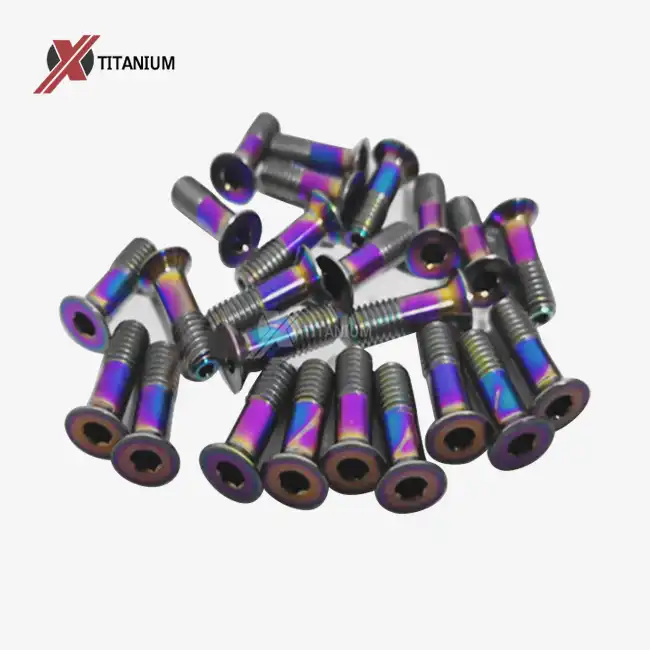
The surface processes we offer are good for more than just looks. Type II anodizing adds a 2–5 micron oxide layer that raises the surface hardness to around 60 HRC. This protects against wear and tear and lets you choose from gold, blue, purple, black, and rainbow finishes. This electrochemical change is very different from paint or powder covering because it turns the metal into a solid part of the metal instead of a separate layer that can chip.
Titanium Bolt Kits vs. Alternative Bolt Materials: A Procurement Perspective
When choosing where to get fastener parts, you need to look at more than just unit prices. When procurement managers look at suppliers, they need to think about the total cost of ownership, which includes the initial cost of buying the goods, the number of times they need to be replaced, the work needed to install them, and the guarantee risk.
Comparative Material Analysis
While A2 and A4 grades of stainless steel are much cheaper per unit, they only have a tensile strength of 500 to 700 MPa. Although aluminum 7075-T6 has good weight measures, it yields at only 505 MPa, which means that bolt sizes have to be bigger, which cancels out the weight savings. Carbon steel is very strong, but it needs layers that cover it that wear off over time. Titanium Grade 5 is the only material that has all of these properties: it is 900+ MPa strong, doesn't rust, and has a density of 4.43 g/cm³.
Total Cost of Ownership Calculations
A company that makes downhill bikes and buys 10,000 mountain bike titanium bolt kits a year might pay $8 for a titanium kit and $2 for a steel kit. But guarantee claims for corroded or broken steel fasteners make up about 3–5 percent of all units sold, which costs money in replacement costs, shipping costs, and damage to the company's image.
Titanium has almost no failures, so these costs are not passed on to later stages. Mountain bike titanium bolt kits further reduce long-term expenses by standardizing hardware across multiple builds, simplifying spare parts management. Longer service intervals lower the cost of keeping inventory because replacement cycles are spread out over the effective component lifespan, which is two to three seasons. When you buy in bulk from makers like Chuanglian, you can often get unique sizing and torque specs at no extra cost for the tools, which makes the deal even better.
Application-Specific Selection Criteria
Cross-country running requires the lightest possible gear, which is why mountain bike titanium bolt kits are necessary, even though they cost a lot. Titanium is the best material for trail bikes because it is both strong and light. In downhill uses, strength and wear resistance are very important. Titanium is great at these things and also protects against corrosion. Titanium has a high strength-to-weight ratio in stress-critical junctions, which helps e-bikes with heavier motors. By knowing these discipline-specific needs, buying teams can make sure that the fasteners they choose meet the needs of the end user and the warranty risk profiles.
How to Select and Install Titanium Bolt Kits on Mountain Bikes
Titanium hardware has performance benefits that can be fully realized when it is properly specified and installed. The technical support team at our company helps OEM partners and distributors match bolt configurations to specific frame shapes and component interfaces.
Specification Matching Process
The thread size and head style must match exactly with the fitting on the frame and the parts. The most common sizes for mountain bike titanium bolt kits are M5, M6, and M8. Lengths range from 12mm to 45mm, based on the clamp thickness and spacer needs. Socket head cap screws work well for routing inside the frame, while button head designs can fit into tight spaces around suspension pivots. Our CNC machining skills allow us to make custom lengths and head profiles for unique frame designs. This helps OEMs with their strategies for differentiation without requiring large minimum orders that hurt smaller manufacturers.
Torque Management and Installation Protocols
Because titanium has a lower friction coefficient than steel, it needs different torque values—usually 10 to 15 percent less than steel specs to get the same gripping force. Thread galling happens when you torque something too much, and titanium's desire to stick together makes the male and female threads join together in certain places.
According to our assembly directions, anti-seize compounds should be used on all threads. Mountain bike titanium bolt kits are particularly well-suited for this practice, as the grade 5 titanium threads resist galling when properly lubricated, ensuring reliable disassembly later. There are also special formulas that keep brake surfaces or bearing interfaces from getting dirty. Good torque wrenches that are accurate to within ±4% stop both under-tightening (which causes loosening) and over-tightening (which causes galling or thread stripping).
Maintenance and Inspection Intervals
Titanium hardware doesn't need as much upkeep as hardware made of other materials. Any tightening can be seen visually every so often, especially after the first 50 to 100 kilometers of riding, when parts settle into their final places. When used in high-stress situations, thread inspection with a borescope can find early signs of galling. Our glossy and anodized finishes keep dirt from sticking to them, which makes cleaning easier. Mountain bike titanium bolt kits don't rust and lose their appearance over time like steel bolts do. This is important for high-end bike builds where the way parts look affects how customers see them.
Where to Buy Titanium Bolt Kits: Procurement Channels and Considerations
B2B buyers of titanium fasteners have to deal with complicated supply lines where the success of a relationship depends on the authenticity of the materials, the accuracy of the making, and the dependability of the delivery. Baoji Chuanglian New Metal Material Co., Ltd. is both a producer and a supplier, so there are no markups for middlemen and there is direct quality control.
Direct Manufacturer Advantages
When you work directly with factories in Baoji, you can get raw material certifications that can be linked to specific batches of titanium sponge. As required by ASTM B348 standards, our mill certificates include tests for chemical composition, mechanical properties, and heat treatment documentation.
For OEM manufacturers who need material data sheets for engineering validation and possible liability documentation, this traceability is very important. Lead times are usually 3–4 weeks for normal configurations and 5–6 weeks for unique specs. For urgent jobs, faster production is possible. Shipping through well-known freight forwarders makes sure that containers are used efficiently and that paperwork is correct for overseas transfers.
Customization Capabilities Supporting Brand Differentiation
Our dozen CNC machines can work with complicated shapes that aren't in our store. Premium bike brands stand out in crowded markets with unique head shapes, special threads, and built-in features like captive washers. Color anodizing in brand-specific colors makes all the parts look like they belong together. Custom tooling is affordable for mid-level makers because they only have to commit to making 500 pieces at a time. Technical collaboration during the design phase stops common mistakes like threads not engaging properly or clearance conflicts, which cuts down on the number of times a prototype needs to be made.
Quality Assurance and Certification Frameworks
Strict checking procedures make sure that all important dimensions are met to within 0.05 mm of accuracy. Dye penetrant inspection can find flaws on the surface that can't be seen with the naked eye. Random sampling is put through damaging testing to make sure that the tensile strength, hardness, and wear properties match the sheets that specify them.
The ISO 9001 license that governs our quality management system makes audits clear, which is something that international distributors value. Customers in the medical and aircraft industries have confirmed our processes through source qualification checks. The same strict standards apply to cycling goods, making sure that mountain bike titanium bolt kits are the same no matter what they are used for.
Conclusion
Titanium fasteners have measurable benefits in terms of weight reduction, resistance to corrosion, and fatigue performance that support their high status as the best mountain bike parts. Grade 5 alloy has tensile strength higher than steel while saving 40% of its weight. This makes it perform better for both competitive riders and casual users. Mountain bike titanium bolt kits encapsulate all these advantages in a complete hardware solution, streamlining upgrades and replacements for entire builds.
Because the material doesn't corrode naturally, it doesn't need to be maintained or backed by a guarantee, which are problems with steel options. When looking at suppliers, people in charge of buying things should give more weight to companies that have quality systems that are up to aerospace standards, the ability to customize products, and the ability to directly track materials. These things make sure that each batch of mountain bike titanium bolt kits is the same and help keep partnerships stable over time, which is important for handling the cycling industry's complicated global supply lines.
FAQ
What makes Grade 5 titanium superior to commercially pure titanium for bike bolts?
The tensile strength of Grade 5 titanium (Ti-6Al-4V) is 900–1050 MPa, which is higher than the 240–550 MPa of commercially pure grades. This is because Grade 5 titanium has aluminum and vanadium added to it. Because the alloying elements make it easier to harden and less likely to wear down, Grade 5 is good for structural uses. Commercially pure grades are only good for accessories that don't carry weight, like bottle cage bolts.
Do titanium bolts require special installation tools?
For mountain bike titanium bolt kits, regular hex keys and torque wrenches work fine. The most important change is that the force requirements are usually 10-15% lower than for steel to keep the threads from galling. Using an anti-seize lubricant stops adhesive wear during installation. Calibrated torque tools make sure that the right preload is applied without going over the lower friction coefficient of titanium.
How does anodizing affect bolt performance?
Type II anodizing uses electricity to create a 2–5 micron oxide layer that makes the surface harder and lets you change the color. This treatment increases protection to wear and tear and helps with separation. Anodizing, on the other hand, blends in with the base metal and doesn't change the size tolerances or thread engagement.
Partner With Chuanglian for Premium Mountain Bike Titanium Bolt Kits
Chuanglian is an expert at making aerospace-grade titanium fasteners that are specifically designed for tough cycling uses. Our CNC machining services can accommodate unique designs, such as proprietary sizes, anodized finishes, and price based on volume. As a company that makes mountain bike titanium bolt kits in Baoji, we have direct material tracking and quality processes that are ISO 9001-certified.
Our technical consulting services, expedited sampling programs, and global logistics coordination help procurement managers find reliable partners. Get in touch with our team at info@cltifastener.com or djy6580@aliyun.com to talk about your unique needs. You can look at our full line of products at cl-titanium.com and ask for material certifications that show our dedication to quality.
References
1. Boyer, R., Welsch, G., & Collings, E.W. (1994). Materials Properties Handbook: Titanium Alloys. ASM International.
2. Donachie, M.J. (2000). Titanium: A Technical Guide (2nd ed.). ASM International.
3. Schutz, R.W. & Watkins, H.B. (1998). Recent developments in titanium alloy application in the energy industry. Materials Science and Engineering: A, 243(1-2), 305-315.
4. Lutjering, G. & Williams, J.C. (2007). Titanium (2nd ed.). Springer-Verlag Berlin Heidelberg.
5. Peters, M., Kumpfert, J., Ward, C.H., & Leyens, C. (2003). Titanium alloys for aerospace applications. Advanced Engineering Materials, 5(6), 419-427.
6. Veiga, C., Navim, J.P., & Loureiro, A.J.R. (2012). Properties and applications of titanium alloys: A brief review. Reviews on Advanced Materials Science, 32(2), 133-148.
Learn about our latest products and discounts through SMS or email