- English
- French
- German
- Portuguese
- Spanish
- Russian
- Japanese
- Korean
- Arabic
- Greek
- German
- Turkish
- Italian
- Danish
- Romanian
- Indonesian
- Czech
- Afrikaans
- Swedish
- Polish
- Basque
- Catalan
- Esperanto
- Hindi
- Lao
- Albanian
- Amharic
- Armenian
- Azerbaijani
- Belarusian
- Bengali
- Bosnian
- Bulgarian
- Cebuano
- Chichewa
- Corsican
- Croatian
- Dutch
- Estonian
- Filipino
- Finnish
- Frisian
- Galician
- Georgian
- Gujarati
- Haitian
- Hausa
- Hawaiian
- Hebrew
- Hmong
- Hungarian
- Icelandic
- Igbo
- Javanese
- Kannada
- Kazakh
- Khmer
- Kurdish
- Kyrgyz
- Latin
- Latvian
- Lithuanian
- Luxembou..
- Macedonian
- Malagasy
- Malay
- Malayalam
- Maltese
- Maori
- Marathi
- Mongolian
- Burmese
- Nepali
- Norwegian
- Pashto
- Persian
- Punjabi
- Serbian
- Sesotho
- Sinhala
- Slovak
- Slovenian
- Somali
- Samoan
- Scots Gaelic
- Shona
- Sindhi
- Sundanese
- Swahili
- Tajik
- Tamil
- Telugu
- Thai
- Ukrainian
- Urdu
- Uzbek
- Vietnamese
- Welsh
- Xhosa
- Yiddish
- Yoruba
- Zulu
Which specific bicycle parts are best upgraded with GR5 titanium bolts?
When considering which bicycle components deserve a titanium fastener upgrade, the answer centers on three critical factors: stress concentration points, weight-sensitive areas, and corrosion-exposed zones. The Gr5 titanium bicycle bolt, manufactured from Ti-6Al-4V alloy, delivers a tensile strength between 900 and 1050 MPa while weighing approximately 45% less than steel equivalents.
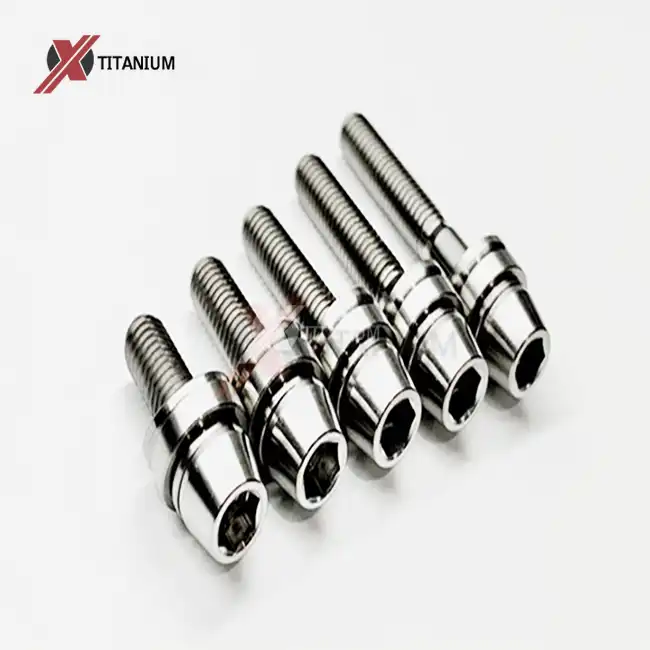
This unique combination makes specific parts—stem clamps, brake caliper mounts, chainring attachment points, bottle cage bosses, and suspension pivot assemblies—ideal candidates for upgrading. These components experience either repetitive cyclical loads, environmental exposure, or demand precision torque retention, making them perfect applications where aerospace-grade fasteners translate directly into measurable performance gains and extended service intervals.
Introduction
In the past ten years, there has been a big change in how bicycle makers and repair workers attach parts. The use of Ti-6Al-4V titanium alloy bolts in cycling has turned a material specification that was once only used in aerospace into a useful solution for high-performance bikes. We have worked directly with procurement managers and engineering teams on several countries, so we know the level of technical review that goes into any change to a production line's material specifications.
It's not just a matter of switching materials with Gr5 titanium bicycle bolts. They deal with real problems that procurement professionals have, like making sure that critical fasteners are always available, that mechanical properties are the same from batch to batch, and that maintenance cycles don't cost too much in the long run. Choosing the right parts for titanium bolt upgrades has a direct effect on warranty claims, customer satisfaction, and, in the end, a brand's reputation in markets where competition is high.
This guide looks at the choice to upgrade from the point of view of technical buying, not from the point of view of enthusiast marketing. We know that engineers judge fasteners by their written tensile strength data, yield points, and wear resistance graphs. Procurement managers need proof that suppliers are qualified, records of consistent delivery, and clear pricing structures. Quality assurance teams want to be able to track products back to their original runs and make sure they meet foreign standards like ASTM B348 Grade 5 and DIN dimensional tolerances.
The bicycle industry includes a wide range of use cases, from rental fleets along the coast that are constantly exposed to salt to professional racing teams where every gram counts toward the podium. Different situations call for different material performance traits, and knowing these differences helps you make smart design choices.
Understanding GR5 Titanium Bicycle Bolts – Properties and Advantages
Material Composition and Specifications
The Ti-6Al-4V metal is made up of 90% titanium, 6% aluminum, and 4% vanadium. It has an alpha-beta phase microstructure that gives it great mechanical qualities. The density of this alloying formula is 4.43 g/cm³, which is lower than steel's 7.85 g/cm³. However, it has the same tensile strength as Grade 10.9 steel fasteners. The aluminum content makes the metal stronger and less dense, and the vanadium stabilizes the beta phase, which makes it more resistant to heat and tougher overall.
The manufacturing methods have a big effect on how well the end product works. High-end titanium fasteners are made with CNC machines that use rolled threads instead of cut threads. Compared to traditional thread-cutting methods, this rolling process matches the metal's grain structure along the thread shape. This makes it over 30% more resistant to fatigue. This difference is very important in high-vibration situations like stem bolts and handlebar clamps, where cyclic loading happens all the time.
Mechanical Performance Characteristics
Industrial testing shows that Gr5 titanium bicycle bolts with proper manufacturing have a yield strength of about 880 MPa and a final tensile strength of between 950 and 1050 MPa. The substance stays hard between 30 and 35 HRC, which stops the threads from deforming during installation without becoming brittle like materials with higher hardness grades do. Shear strength is usually around 550 MPa, which makes it good for mounting brake calipers and other parts that are loaded from the side.
Titanium has an interesting mechanical property: its elastic modulus is about 113 GPa, while steel's is 210 GPa. This lower stiffness lets the thread stretch a little more when it is under stress, which helps keep the thread engaged when the machine shakes. When properly torqued according to the manufacturer's instructions, this elasticity makes the fasteners less likely to vibrate than steel fasteners used in the same situations.
Surface Properties and Resistance to Corrosion
When titanium is exposed to oxygen, it forms a stable passive film of titanium dioxide (TiO2). This oxide layer grows back right away if it gets damaged, so it doesn't need any extra surface treatments to protect itself from corrosion. In practice, this means that there are no worries about galvanic corrosion happening when titanium fasteners touch aluminum frames or carbon fiber parts. This is a common way for steel bolts to fail, causing "rust welding" that makes maintenance disassembly almost impossible.
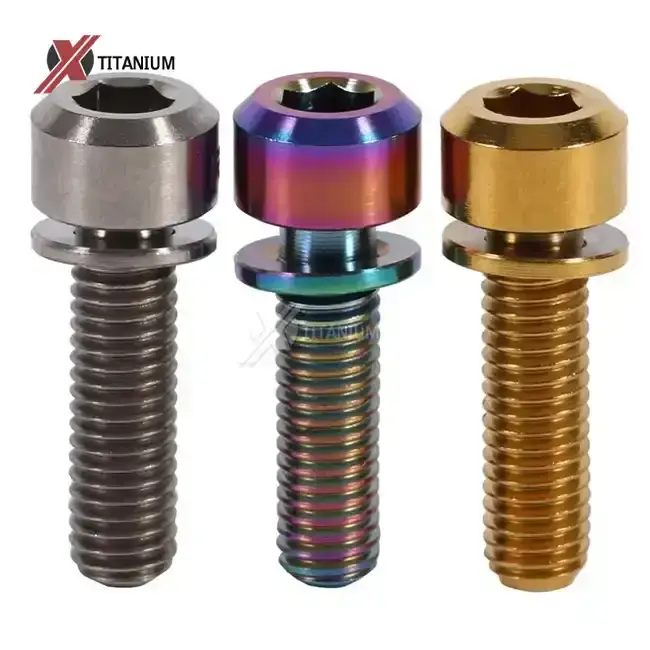
A lot of companies put Physical Vapor Deposition (PVD) layers on titanium screws to make them look nicer in gold, rainbow, or black, and to make the surface harder at the same time. Anodized aluminum or painted finishes chip over time, but PVD coats stick at the molecular level, keeping their look and lowering the chance of galling over a longer period of time.
GR5 Versus GR2 Titanium Comparison
Grade 2 commercially pure titanium is very resistant to rust, but its tensile strength is only about 340 MPa, while Gr5's is over 950 MPa. Because of this difference in strength, GR2 can only be used in low-stress mounting places like bottle cage bosses or fender mounts. To meet safety standards, Gr5 titanium bicycle bolt specifications are the only appropriate grade that should be used for structural parts like stem bolts, brake mounts, or chainring fittings.
GR2 and Gr5 titanium fasteners usually cost 40% to 60% more than GR2 fasteners. This is because Gr5 requires more complicated alloying and heat treatment, so it costs more. Instead of using titanium in all fastener places, procurement decisions should compare this material's cost to the strength needs of each particular job.
Identifying Bicycle Parts That Benefit Most from GR5 Titanium Bolts
High-Stress Structural Connections
Stem clamp bolts are one of the most stressed-out types of bicycle fasteners. These bolts hold the handlebar to the stem body. During normal riding, they are put under both tensile and shear loads, and impacts or rough handling put more stress on them. If the fastener fails in this spot, the driver will lose control of the steering right away. This creates real safety issues that support high fastener standards.
Some frame designs have bottom bracket shell mounting bolts that have to handle a lot of structural loads. This is especially true for high-torque uses like e-bikes and luggage bikes. Cycling causes cyclic stress conditions that lead to fatigue. Gr5 titanium bicycle bolts are more resistant to fatigue than aluminum fasteners, which leads to real gains in reliability. The weight savings, which are usually 15 to 20 grams per bottom bracket assembly, help lower the rotating mass, which changes how quickly the bike accelerates.
Mountain bikes' suspension pivot gear has to deal with a lot of different loads, such as rotational, axial, and moment forces. Precise bolt preload is needed to keep the bearings in the right place and stop them from wearing out too quickly. Titanium's high strength and controlled elasticity make it possible for torque to be maintained even when the suspension is cycling. This means that maintenance intervals are shorter than with steel bolts, which either loosen when the vehicle shakes or need to be re-torqued often.
Weight-Critical Component Applications
Handlebar parts like stem faceplate bolts and bar-end plugs add to the weight of the seat. This is an area where mass directly affects how well the bike handles and how tired the rider gets during long events. Changing four M5×18mm steel stem bolts to Gr5 titanium bicycle bolts saves about 12 grams while keeping the tightening force the same or higher. Professional race teams keep track of the total weight savings across all fastener points. They can often get 80 to 120 grams of weight savings without affecting the structural stability.
Some of the most important safety parts are held in place by brake caliper mounting bolts, which are also great places to upgrade. During heavy stopping, the bolts are mostly loaded in a tension way, but they are also loaded in a lateral way sometimes. Even tho the reduced spinning mass is pretty small per bolt, it changes the formulas that engineers use to find the best wheel inertia for high-performance uses.
Chainring bolts hold the chainrings to the crank spider and experience both binding loads and spinning forces as the power is sent to the wheels. Steel nuts from the past add extra weight to the crankset, which is one of the most sensitive parts of the bike that affects how well you ride. A full set of Gr5 titanium chainring bolts and nuts usually weighs 40% less than steel counterparts, but they have the same or better clamping force and fatigue life. Getting rid of the galvanic rust that happens between titanium bolts and aluminum cranks stops the "frozen bolt" problem that makes replacing the chainrings during maintenance harder.
Corrosion-Exposed Mounting Points
The road spray, sweat, electrolyte drinks, and weather can get right into the bottle cage bosses and fender mounting points. In these places, steel bolts often rust, leaving ugly rust marks on frames and finally locking up in aluminum or steel frame bosses. Titanium fasteners don't need any of these maintenance issues because they can be left out in the open for a long time without needing to be coated or replaced often.
Titanium's resistance to rust makes it a great material for fork crown bolts, especially on bikes that are used near the coast or in the winter when road salt is used. In these situations, the weight saves are still not very big, but the lower total cost of ownership from not having to deal with corrosion-related repairs and frame damage makes the material change worth it.
Comparing GR5 Titanium Bolts with Alternative Materials in Bicycle Applications
Titanium Versus Stainless Steel Analysis
In many bicycle uses, types of stainless steel like 304 or 316 are strong enough and don't rust too much. A normal M5 stainless steel bolt weighs about 3.2 grams, while a similar Gr5 titanium bicycle bolt only weighs 1.8 grams. This is a 44% weight penalty. Austenitic stainless steel has a tensile strength of about 500–700 MPa, which is much lower than Gr5 titanium's 950+ MPa. This means that larger diameter fasteners or more bolts are needed in important uses to get the same level of strength.
The thermal conductivity of stainless steel is about 16 W/m·K, compared to 7 W/m·K for titanium. This can be a problem in brake caliper uses, where heat transfer from the wheel to the mounting hardware can weaken the threads over time. Most of the time, the difference in material costs benefits stainless steel by 60% to 70%. This means that it is a good choice for non-critical bolt positions where cost control is more important than weight and maximum strength.
Titanium Versus Aluminum Fastener Comparison
With a density of about 2.81 g/cm³, aluminum alloy nuts (usually 7075-T6 standard) are a great way to save weight. The most important limit is the tensile strength, which for aerospace-grade aluminum fasteners is usually between 500 and 570 MPa. Aluminum bolts can only be used in low-stress situations because they aren't very strong, and the material's low resistance to fatigue makes cyclic loading situations risky.
Because aluminum is not as hard as titanium, it is more likely to damage the head during installation. When installers go over the recommended torque values, rounded socket heads are a common failure mode. Another big problem is thread galling between aluminum bolts and aluminum parts, which usually needs anti-seize additives and careful torque control. These problems with handling make aluminum less useful in real life, even tho it is lighter in theory.
Thread Configuration and Head Style Options
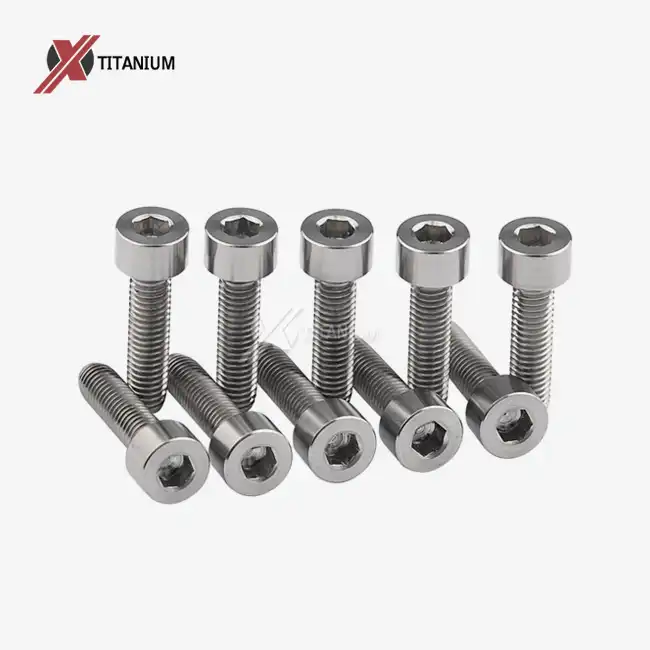
The most popular type of screw for bicycle uses is the socket head cap screw (DIN 912 / ISO 4762), which has a high-strength internal drive and a small head profile. Button head bolts (ISO 7380) have lower-profile, rounded heads that make them look better in places where looks are important. Countersunk screws (DIN 7991), which make flush-mounted setups, are best for places where exposed heads could catch clothing or equipment or where aerodynamics are important.
Tolerances in manufacturing have a direct effect on how well new parts can be used with old ones. Premium suppliers make sure that the sizes of their products strictly follow international standards. Gr5 titanium bicycle bolt This makes sure that titanium fasteners can be used as drop-in replacements without having to be thread chased or have holes changed. To make sure that all production batches are the same size, the procurement specs should clearly list the relevant DIN or ISO standards.
Best Practices for Procuring and Maintaining GR5 Titanium Bicycle Bolts
Supplier Qualification and Selection Criteria
When looking for the right titanium bolt providers, you need to look at more than just the unit price. Verification of manufacturing capability should confirm that CNC machines can be used to process titanium and that the capacity to make rolled threads is met. Certification of a quality management system that meets AS9100 (aerospace), ISO9001, or similar standards shows that a company can produce consistently and track its products.
Material clearance paperwork lets you track back to batches of raw materials whose chemical make-up and mechanical properties have been tested and confirmed. Reliable providers give mill certificates that show the makeup of the titanium alloy and records of how it was heated for each production lot. This paperwork is very important for quality checks and in the unlikely event that something goes wrong in the field and needs to be looked into to find the root cause.
Custom specifications usually have wait times of four to eight weeks, but this depends on the number of orders and the complexity of the specs. When you work with experienced titanium fastener manufacturers instead of general distributors, it's often easier to talk about technical details and faster to solve problems when applications need engineering support.
Installation and Torque Specifications
To properly install titanium fasteners, you must first understand that their properties make them need different torque values than steel fasteners of the same size. As a general rule, torque requirements should be lowered by about 15% to 20% compared to bolts with the same diameter. However, specific suggestions should come from engineering studies that are based on the real needs of the application and the length of the thread contact.
Properly installing Gr5 titanium bicycle bolts requires that anti-seize compounds must still be used. Galling is a type of adhesive wear in which titanium surfaces can cold-weld under high contact pressure and relative motion. The compound stops galling. Copper-based anti-seize works well, but nickel-based formulas are better in some situations because they don't cause galvanic problems when certain materials are mixed.
When titanium screws are installed, using a torque wrench is no longer a choice but a necessity. Because the material has a lower elastic stiffness, the "feel" during installation is very different from steel, which makes tightening by experience inaccurate. Digital torque wrenches that are accurate to within ±2% are the best way to keep things under control, especially when it comes to important tasks like stem bolts where the exact preload has a direct effect on safety and performance.
Maintenance and Service Life Considerations
Titanium screws usually last three to five times longer than steel versions in settings that are corrosive. Because oxide buildup and thread rust don't happen, nuts can be removed for maintenance even years after they were installed. This is a big benefit that lowers the risk of frame damage during component service. Torque retention should be checked on a regular basis, especially in situations with a lot of vibration. Titanium fasteners usually keep their preload more regularly than steel ones when they are put correctly.
Due to titanium's resistance to rust, strong chemicals should not be used for cleaning. Soap and water are all you need to get rid of dirt and grime without changing the qualities of the material or the finish on the surface. PVD-coated titanium can handle pressure washing and cleaning chemicals made just for bikes without losing its finish. This is different from anodized aluminum parts, where the coating often gets damaged after being cleaned over and over again.
When procurement professionals use titanium fasteners across all product lines, warranty claims for broken or corroded bolts go down by a measurable amount. One European bike company reported a 73% drop in guarantee problems related to stem bolts after switching all of their mountain bikes from stainless steel to Gr5 titanium. The higher cost of materials (about $4.80 per bike) was balanced out by lower guarantee costs in the first year of production, showing a good return on investment that goes beyond the marketing benefits of using high-quality parts.
Conclusion
When done strategically, replacing certain bicycle parts with Gr5 titanium bicycle bolts leads to measurable performance gains and operational benefits. Stem clamps, brake mounts, chainring attachments, and suspension pivots are all great places to use titanium because of its high strength-to-weight ratio, resistance to corrosion, and resistance to fatigue. The higher cost of the material is justified in places where safety is important, where weight is an issue, or where rust is a risk. Long-term dependability and less upkeep pay for the initial investment.
Technical differences between titanium grades, manufacturing quality signs, and the right way to place fasteners so they work with the material's capabilities are all things that procurement workers should know. For implementation to go well, partners must be formed with qualified suppliers who can show they know their stuff, have consistent quality systems, and offer technical support.
FAQ
Do titanium bolts rust in all weather conditions?
Gr5 titanium bicycle bolts will not rust in any environmental conditions encountered during bicycle use. The substance creates a steady titanium dioxide passive layer that stops oxidation even in acidic or salty water or in an industrial setting. This basic feature gets rid of the upkeep hassle that comes with steel fasteners in seaside areas or places where road salt is used in the winter.
How does GR5 titanium strength compare to stainless steel?
Gr5 titanium has a tensile strength of 950 to 1050 MPa, which is much higher than typical types of stainless steel (304 stainless has a strength of about 505 MPa and 316 stainless has a strength of about 515 MPa), but it weighs 44% less. Precipitation-hardened stainless grades are the only ones that come close to being as strong as titanium. However, they are less resistant to corrosion and cost a lot more than standard Gr5 titanium.
What should I look for when selecting a titanium bolt supplier?
Give more weight to sellers who can show that their materials can be tracked by showing mill certificates, quality system certifications that are useful to making fasteners, and production experience that can be checked with aerospace-grade titanium. Ask for measurement inspection records that show the product meets certain standards, and check the technical support options to get help with your particular application. Consistent delivery performance and clear communication about lead times are signs of operational maturity, which is important for the reliability of the supply chain.
Partner with Chuanglian for Premium Titanium Bicycle Fastener Solutions
Baoji Chuanglian New Metal Material Co., Ltd. has been cutting titanium for over ten years and is an expert at making aerospace-grade Gr5 titanium bicycle bolts. As the "City of Titanium" in Baoji, China, our facility has a full range of CNC machining capabilities designed specifically for making precise titanium parts. We have strict quality control throughout the whole manufacturing process, from checking the raw materials to doing the final inspection. This is to make sure that every fastener meets international standards, such as ASTM B348 Grade 5 requirements.
For OEM uses, our engineering team offers expert advice to help with choosing the right parts, coming up with torque specs, and designing custom fasteners. Bicycle makers, dealers of parts, and professional racing teams in North America and Europe all rely on us to deliver on time and keep all the paperwork needed to track the materials. We can make standard DIN 912 socket head cap screws, custom chainring bolt and nut sets, or specialized fasteners for your own designs. Our production capacity can handle both small prototype runs and large production runs.
Get in touch with our sales team at info@cltifastener.com or djy6580@aliyun.com to talk about your needs with titanium fastener experts. We encourage purchasing managers and engineering teams to look thru our full product catalog at cl-titanium.com. There, you'll find thorough specs, information on mechanical properties, and advice on how to use our products. As a well-known titanium bicycle bolt provider, we focus on building long-term relationships with our customers based on consistent quality, technical knowledge, and reliable delivery that meets your quality goals and production plans.
References
1. Boyer, R., Welsch, G., & Collings, E.W. (1994). Materials Properties Handbook: Titanium Alloys. ASM International, Materials Park, Ohio.
2. Donachie, M.J. (2000). Titanium: A Technical Guide, 2nd Edition. ASM International, Materials Park, Ohio.
3. Bickford, J.H. (2007). Introduction to the Design and Behavior of Bolted Joints: Non-Gasketed Joints, 4th Edition. CRC Press, Boca Raton, Florida.
4. Lutjering, G. & Williams, J.C. (2007). Titanium, 2nd Edition. Springer-Verlag, Berlin Heidelberg.
5. Budinski, K.G. (1996). Engineering Materials: Properties and Selection, 5th Edition. Prentice Hall, Upper Saddle River, New Jersey.
6. Schutz, R.W. & Watkins, H.B. (1998). Recent developments in titanium alloy application in the energy industry. Materials Science and Engineering A, Volume 243, Issues 1-2, Pages 305-315.
Learn about our latest products and discounts through SMS or email