- English
- French
- German
- Portuguese
- Spanish
- Russian
- Japanese
- Korean
- Arabic
- Greek
- German
- Turkish
- Italian
- Danish
- Romanian
- Indonesian
- Czech
- Afrikaans
- Swedish
- Polish
- Basque
- Catalan
- Esperanto
- Hindi
- Lao
- Albanian
- Amharic
- Armenian
- Azerbaijani
- Belarusian
- Bengali
- Bosnian
- Bulgarian
- Cebuano
- Chichewa
- Corsican
- Croatian
- Dutch
- Estonian
- Filipino
- Finnish
- Frisian
- Galician
- Georgian
- Gujarati
- Haitian
- Hausa
- Hawaiian
- Hebrew
- Hmong
- Hungarian
- Icelandic
- Igbo
- Javanese
- Kannada
- Kazakh
- Khmer
- Kurdish
- Kyrgyz
- Latin
- Latvian
- Lithuanian
- Luxembou..
- Macedonian
- Malagasy
- Malay
- Malayalam
- Maltese
- Maori
- Marathi
- Mongolian
- Burmese
- Nepali
- Norwegian
- Pashto
- Persian
- Punjabi
- Serbian
- Sesotho
- Sinhala
- Slovak
- Slovenian
- Somali
- Samoan
- Scots Gaelic
- Shona
- Sindhi
- Sundanese
- Swahili
- Tajik
- Tamil
- Telugu
- Thai
- Ukrainian
- Urdu
- Uzbek
- Vietnamese
- Welsh
- Xhosa
- Yiddish
- Yoruba
- Zulu
What are the benefits of using aerospace-grade materials for vehicle components?
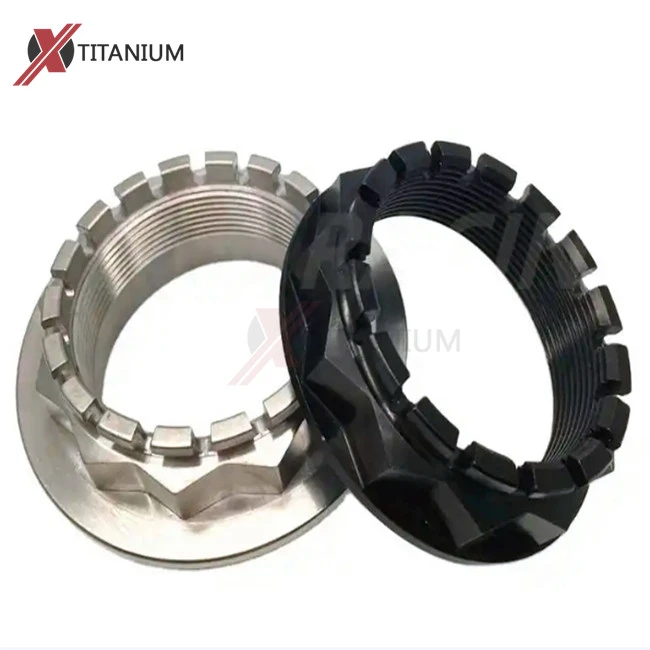
Aerospace materials are stronger for their weight, don't rust, and work better after being used for a long time than many common metals. A Gr5 titanium rear axle nut has all of these benefits that are clear. It's made of Ti-6Al-4V and weighs 4.43 g/cm³, which is 44% less than regular steel, which weighs 7.85 g/cm³. It can also be pulled apart at least 895 MPa. Water, chemicals, and road salt don't hurt it, so it's still easy to take off after a long time of use. These changes are most important for high-end cars, race cars, and motorcycles, where every gram of rotating mass counts.
Why Material Selection Matters in Vehicle Components?
Rear Axle Nuts Are Safety-Critical Parts
The axle, wheel, and other parts that go with it are held together by a rear axle nut. Things could go wrong with the wheel alignment and bearing preload if the threads break or the nut comes loose. This could put the rider's safety at risk. Some of the things that affect performance are having the right threads, the right material strength, the right amount of torque, and strong retention against vibration and repeated use. The nut gets wet, muddy, brake dusty, and salty from the road because it is close to the wheel. Customers often ask me to treat this small part with the same care as a bigger structural part. This is because one failure can ruin a race or ride.
Why Aerospace-Grade Materials Attract Attention
The engineers who work in space pick materials that are strong but don't weigh a lot. This is because extra weight means using more gas and carrying less. An overview of titanium by Boyer in aerospace and other industries says that Ti-6Al-4V is the most common titanium alloy. People who design cars now use the same line of thought. To be sure, this needs to be tested. A suspension can follow the road better if it has less mass that isn't sprung or spinning. People who ride motorcycles, race cars, and high-end custom cars are the first to use these materials. This is because builders and riders notice small changes in how the cars handle and rust over time.
Aerospace-Grade Material vs. Aerospace-Certified Component
They're not equal. Space-grade Grade 5 titanium means that the alloy is the same Ti-6Al-4V that is used for hard work in space. If a finished part is aerospace-certified, it means it went through a set of steps to make sure it was safe and good. A car fan can use the first one without having to claim the second one. When people buy something, I tell them not to just believe what it says on the package. They should also look at the material's certificates, inspection records, relevant standards (like ASTM B348 for titanium bars), and the quality system of the supplier. When paperwork is kept clear, everyone is safer: engineers, quality teams, and purchasing managers.
What Is a Gr5 Titanium Rear Axle Nut, and What Are Its Benefits?
Material and Specifications
It is made of Grade 5 titanium, which is also called Ti-6Al-4V. A Gr5 titanium rear axle nut is a well-made fastener. They use CNC to make it, and you can change the threads from metric to imperial to suit your needs. Please make sure that the minimum yield strength is 830 MPa, the minimum tensile strength is 895 MPa, the minimum density is 4.43 g/cm³, and the minimum hardness is 36 HRC. To make the surface look different, you can polish, anodize, or nitride it. The surface can also be natural titanium, gold, blue, green, purple, black, or rainbow. How well it works will still depend on the thread design, size, quality of the machine work, and how well it fits with the rest of the axle assembly.
Lower Weight and Better Handling Potential
The density of steel is 7.85 g/cm³, which means that titanium is about 44% lighter than steel. In other words, a titanium part of the same size weighs 44% less. Since the nut is on the wheel, it doesn't have any springs and has a mass that moves around. The rotational inertia will go down if you cut that mass. This will help the suspension react faster to bumps. To be clear, one nut saves grams, not kilograms, and the real weight savings come from making the whole car handle better. Teams that race cars often add up these savings for a lot of fasteners and then check the answer on the track to make sure it's correct.
Corrosion and Fatigue Resistance
TiO2 forms a thin, stable oxide film when it comes in contact with air. Tin doesn't rust like steel does, and this film keeps water, road salt, and many acids and bases away. When steel nuts get wet or salty, they can rust and lock up. This makes it harder to fix things in a pit or on the side of the road. There is also a high resistance to fatigue in Gr5. This means that a fastener can be loaded and slid many times. Metal can still crack even if the design is good if the thread geometry or machining marks are wrong. With careful machining and surface inspection, that risk goes down.
Gr5 Titanium vs. Steel and Aluminum: Choosing the Right Nut
Titanium Compared with Steel
Steel is hard to beat when it comes to price, availability, and comfort, especially for standard commuter cars and making a lot of them. It's possible for threads to stick together when they slide under pressure without being oiled. This is called thread galling. Titanium costs more and needs to be handled with care to stay away from it. Gr5 on the other hand has a density that is 44% lower, doesn't rust naturally, and has strong mechanical properties. Because titanium is not as elastic as steel, engineers need to check how the clamp-load works in a real joint. The more important question is whether the extra weight and resistance to corrosion are worth the higher price per unit over the life of the part.
Titanium Compared with Aluminum
Aluminum is lighter than titanium (about 2.7 g/cm³) and can save weight and money in some designs compared to a Gr5 titanium rear axle nut. The answer depends on the alloy, the clamp load that needs to be met, the thread's strength, how often the nut is put on and taken off, and the states of fatigue. Soft aluminum threads can wear out faster than titanium threads after a while of use. Gr5 titanium is stronger, so it works better for axle loads where long thread life is important. Aluminum can still be used for light-duty or short-term tasks as long as an engineer first checks the numbers.
How to Choose the Right Specification
Read the whole thing before you decide, not just the diameter. Check the length of engagement, thread size, pitch, hand direction, and tolerance. Then check the height, the spaces between the flats, the shape of the flange, where the washer goes, how easy it is to get to the tool, and any nearby clearances. The way the door locks has to be right for the car, whether it's standard, flanged, castellated, ready for a safety wire, or washer-integrated. Plan the installation as well, making sure you know the recommended torque, anti-seize or lubricant, how to reuse the parts, and when to check in. Because titanium doesn't stick to steel as well as steel does, the engineer who made the vehicle or part should give the final torque values. If you look at the drawing before you place your order, you can avoid most fit problems.
Quality, Custom Manufacturing, and Procurement for B2B Buyers
Documentation and Inspection
When you buy from a business, a titanium axle nut should be seen as a safety part that was engineered, not just something nice to look at. Ask for a certificate of conformity, the lot number, the chemical make-up, the mechanical properties, and proof that the material is Grade 5 or Ti-6Al-4V. To find out how big something is, you can use a thread gage, a micrometer, an optical system, or a coordinate measuring machine. Based on the situation, tests such as proof-load, torque-tension, fatigue, and corrosion may be needed. Here at Chuanglian, we follow all national, international, and industry standards. We also check each step of the way, from the raw materials to the finished product. When the same order is placed more than once, these records also help the procurement team figure out how consistent the batches are.
Our Custom Manufacturing Process
As soon as the customer orders something, a technical review is done of the drawing, sample, axle specifications, thread needs, loading conditions, and locking arrangement. After checking the Grade 5 titanium, the nut is CNC turned or milled, threaded, cleaned up, finished, checked again, and packed. Titanium needs to be cut with the right tools, under the right conditions, and with the right amount of heat. From Baoji, which is known as the "City of Titanium," where we do this work, we've been working with titanium for more than ten years. Twelve CNC machines are also here to help. There is a good way to go from quote to prototype, sample approval, pilot order, and full production. We can also make custom part numbers, private-label packaging, and mark your logo on things.
Preparing an RFQ and Comparing Quotes
It takes less time to get accurate prices and technical help for a Gr5 titanium rear axle nut with a full RFQ. Include the type of material, the number that is needed, a drawing or sample, the brand name, the surface finish, the number that is needed, the delivery date, and the certification needs. Don't just compare the unit price when the quotes come in. Things you should think about are the ability to track, the minimum order quantity, the sampling policy, the ability to customize, the experience with exporting, and the support for replacements. Prices often vary because of the cost of raw materials, how hard the job is, tolerances, finishing, inspection, and the number of orders. Each titanium order is small and unique, so a supplier who can quickly answer technical questions will speed up the project.
Applications, Common Mistakes, and the Final Decision
Where Gr5 Titanium Rear Axle Nuts Fit Best
Heavy parts that can be used more than once and safety wires that can be used are good for racing and track motorcycles. Premium street motorcycles care about how they look, how well they finish, and how well they don't rust. The oxide film on titanium threads keeps them useful even when they are in mud, water, and road salt. When doing OEM development, it's important to keep a close eye on drawings and make sure they are correct. You should also keep track of batches and make sure they are all the same. But distributors and aftermarket brands pay attention to M12, M14, and M16 sizes, as well as private labeling and wrapping for stores. Gr5 titanium isn't just used in car parts. Marine engineering, medical equipment, industrial machinery, and aerospace and aviation are some of the other fields that use them.
Mistakes to Avoid
For a number of reasons, the fit, safety, or cost are not right. And if you only pick by M12, M14, or M16 diameter, you don't think about pitch, height, flange size, tool clearance, or the need to lock. You will pick the wrong materials if you think that all types of titanium work the same. Make sure the documents have the right grade written on them. If you don't properly oil or torque titanium threads, they can get stuck, so do what the engineer says and use anti-seize. What a part is colored doesn't tell you anything about how well it works; color only shows how thick the oxide layer is. When you only rank suppliers by price, you might not see things like missing certificates, threads that don't match, late deliveries, or bad customer service after the sale.
Making the Final Decision
When it comes to performance, positioning at the top of the market, reducing weight, and resistance to corrosion, Gr5 titanium is a great choice. Steel is still useful for heavy work that doesn't have weight limits and for everyday cars. Do not even think about aluminum until you know for sure the alloy, the clamp-load capacity, the thread wear, and the way the material acts when it gets old. Long-term production needs, supplier stability, total cost of ownership, and documentation are some of the things I think you should look at. Talking to a titanium manufacturer about the specs is the fastest way to find out if the idea will work for your car if there is already a drawing.
Conclusion
Aerospace-grade materials help car parts by making them lighter, less likely to rust, and better able to handle normal wear and tear. This can be seen in the Gr5 titanium rear axle nut. Ti-6Al-4V is about 44% less dense than steel, at 4.43 g/cm³. It can be pulled apart at least 895 MPa and must not break more than 830 MPa. Its oxide film protects against water, salt, and chemicals, and its lower mass makes it easier to spin. However, it needs to be tested to see if it really does make it easier to handle. Iron and steel can still be used to make cheap or light-duty cases. If the locking method, torque, lubrication, and documentation are all done right, the part should work as it should. Buyers can get the right materials for the job if they look at the inspection records and certificates and think about how much it will cost to own everything.
FAQ
Q1: What is a Gr5 titanium rear axle nut?
A: These are very precise fasteners made from Ti-6Al-4V that were cut with a CNC machine. They hold the back wheel on an axle. It isn't heavy, doesn't rust, and has good mechanical properties. You can also pick out different threads, finishes, and colors.
Q2: Is it stronger than a steel nut?
A: The shape, the load, the validation, and the alloy all affect the strength. The material our Gr5 nut is made of is 895 MPa strong and 4.43 g/cm³ dense, which means it is not as heavy as steel. Ask the engineer who works on the car to make sure it fits.
Q3: Do I need anti-seize on titanium threads?
A: Yes. If you install titanium threads without oil, they can gall. To avoid this, use anti-seize or another good lubricant and make sure you follow the torque specs set by the vehicle engineer. In addition, we can make custom washers and locks, and we can also private label, logo mark, and approve samples.
Request a Gr5 Titanium Rear Axle Nut Specification Review from Chuanglian
Chinglian, a titanium company in Baoji, can look at your thread size, pitch, drawing, target quantity, finish, and certification needs. Since we make Gr5 titanium rear axle nuts, we can provide samples, do custom CNC machining, keep track of batches, and supply under your own brand name. Simply click on "Get a Quote" or "Send Your Drawing," or send an email to info@cltifastener.com or djy6580@aliyun.com.
References
1. An Overview on the Use of Titanium in the Aerospace Industry, Materials Science and Engineering A, 1996
2. Titanium: A Technical Guide, ASM International, 2000
3. Titanium and Titanium Alloys: Fundamentals and Applications, Wiley-VCH, 2003
4. ASM Handbook, Volume 2: Properties and Selection: Nonferrous Alloys and Special-Purpose Materials, ASM International, 1990
5. Materials Properties Handbook: Titanium Alloys, ASM International, 1994
6. ASTM B348/B348M, Standard Specification for Titanium and Titanium Alloy Bars and Billets, ASTM International, 2019
Learn about our latest products and discounts through SMS or email