- English
- French
- German
- Portuguese
- Spanish
- Russian
- Japanese
- Korean
- Arabic
- Greek
- German
- Turkish
- Italian
- Danish
- Romanian
- Indonesian
- Czech
- Afrikaans
- Swedish
- Polish
- Basque
- Catalan
- Esperanto
- Hindi
- Lao
- Albanian
- Amharic
- Armenian
- Azerbaijani
- Belarusian
- Bengali
- Bosnian
- Bulgarian
- Cebuano
- Chichewa
- Corsican
- Croatian
- Dutch
- Estonian
- Filipino
- Finnish
- Frisian
- Galician
- Georgian
- Gujarati
- Haitian
- Hausa
- Hawaiian
- Hebrew
- Hmong
- Hungarian
- Icelandic
- Igbo
- Javanese
- Kannada
- Kazakh
- Khmer
- Kurdish
- Kyrgyz
- Latin
- Latvian
- Lithuanian
- Luxembou..
- Macedonian
- Malagasy
- Malay
- Malayalam
- Maltese
- Maori
- Marathi
- Mongolian
- Burmese
- Nepali
- Norwegian
- Pashto
- Persian
- Punjabi
- Serbian
- Sesotho
- Sinhala
- Slovak
- Slovenian
- Somali
- Samoan
- Scots Gaelic
- Shona
- Sindhi
- Sundanese
- Swahili
- Tajik
- Tamil
- Telugu
- Thai
- Ukrainian
- Urdu
- Uzbek
- Vietnamese
- Welsh
- Xhosa
- Yiddish
- Yoruba
- Zulu
What are the benefits of using GR5 titanium rear axle nuts on mountain bikes?
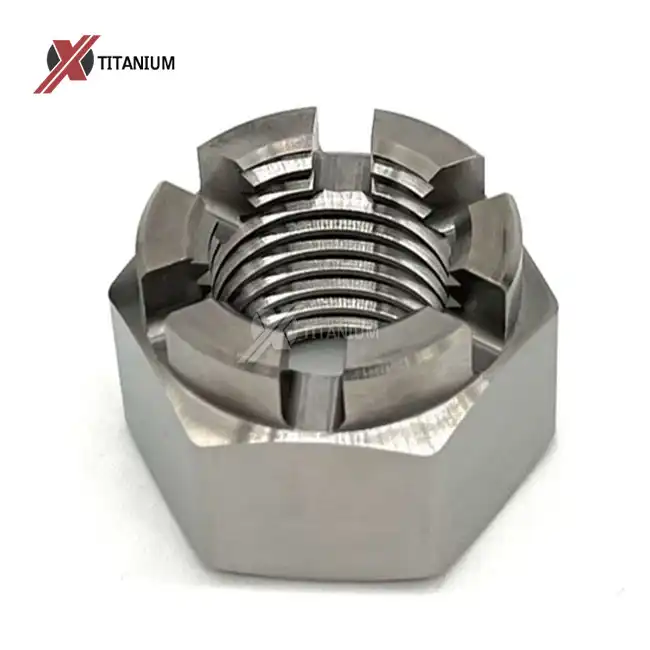
The benefits of using a Gr5 Titanium Rear Axle Nut on mountain bikes center on weight reduction, enhanced corrosion resistance, and superior mechanical strength. Made from Ti-6Al-4V alloy, these fasteners offer approximately 45% less mass than steel equivalents while maintaining tensile strength exceeding 895 MPa. This reduction in unsprung weight directly improves suspension response and handling dynamics during aggressive trail riding. Their inherent resistance to moisture, mud, and salt ensures the nut won't seize onto axle threads after prolonged exposure, simplifying maintenance and preventing roadside failures during critical rides.
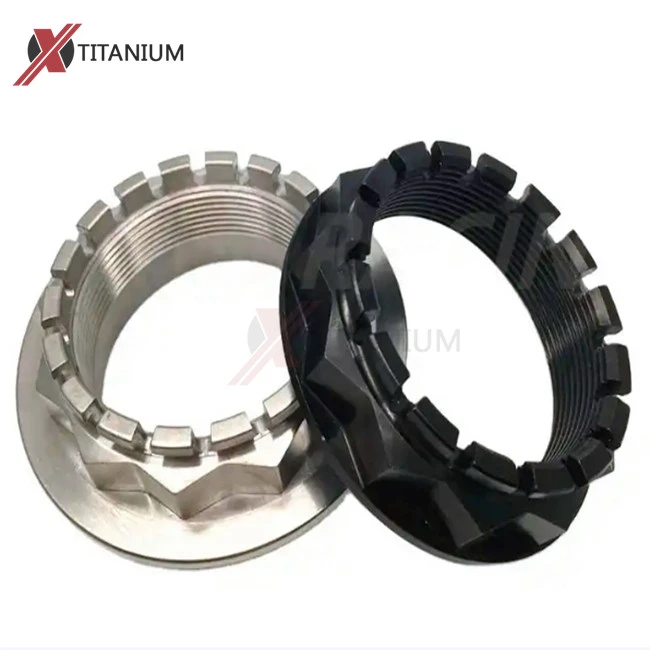
Understanding GR5 Titanium Rear Axle Nuts
Material Composition and Metallurgical Properties
Ti-6Al-4V, which is another name for Gr5 Titanium, is the most common titanium metal used in high-performance settings. This substance is made up of 90% titanium, 6% aluminum, and 4% vanadium. Its microstructure mixes alpha and beta phases to make it stronger and more flexible. The aluminum part makes the metal stronger and denser, and the vanadium part stabilizes the beta phase, which makes it easier to heat treat and machine.
According to the specifications of precisely machined Gr5 Titanium Rear Axle Nuts, the material has a density of 4.43 g/cm³, which is much lower than steel's density of 7.85 g/cm³. It has a minimum tensile strength of 895 MPa and a yield strength of 830 MPa, which is about the same as Grade 8.8 steel fasteners but a lot lighter. Because it is so strong for how light it is, Gr5 Titanium is often used in engineering for parts where weight savings are important without sacrificing strength.
Advantages Over Alternative Materials
Gr5 Titanium performs very differently than other materials when compared to them. Steel axle nuts are strong enough, but they add a lot of rotating mass, which slows down the suspension and makes riders tired after long descents. Aluminum options are lighter, but they are less resistant to wear and are more likely to strip threads when force is high.
While Grade 2 Titanium is very resistant to corrosion, it is not strong enough for high-stress tasks like fastening the rear axle. For a middle ground, GR9 Titanium (Ti-3Al-2.5V) works, but it's not as strong or easy to find as Gr5 Titanium. Even though carbon fiber parts are very light, they are hard to use in threaded applications because they are fragile and hard to get to the right torque specifications.
Gr5 Titanium doesn't rust because it can create a solid layer of titanium dioxide when it comes in contact with air. If this oxide film gets scratched, it heals itself on its own, protecting you from saltwater, mud, and industrial chemicals that you might come across while mountain biking. This ability to heal itself is very helpful for riders who often wash their bikes or ride near the coast.
Manufacturing and Surface Treatment Options
For proper torque retention and axle alignment, CNC machining makes it possible to make thread shapes that are very accurate and meet very tight limits for size. When we make things, we use fully rolled threads instead of cut threads. This makes the material stronger and gets rid of stress points at the thread roots. Compared to cut threads, this process makes wear resistance up to 30% better.
Surface treatments make things work in ways that go beyond the properties of the raw material. When you polish something, you make it smooth, which makes it easier to install and looks better. Anodizing adds a hard ceramic layer to the surface, making it harder to gall when it's threaded onto an aluminum or steel axle. With colors like titanium natural, gold, blue, green, purple, black, and rainbow, OEMs can match the look of their brands while still getting the functional benefits. Physical Vapor Deposition coatings make things even more resistant to wear in harsh conditions.
Performance and Durability Advantages Over Other Materials
Weight Reduction Impact on Riding Dynamics
One of the best ways to improve mountain bike speed is to reduce the amount of unsprung weight. Every gram that is taken away from the Gr5 Titanium Rear Axle Nut assembly makes the suspension parts respond more quickly to changes in the trail. When the back wheel hits a rock or root, lighter axle hardware lets the tire follow the shape of the ground better, keeping traction when it matters the most.
Professional downhill racers put this edge at the top of their list when choosing gear. Losing about 30 to 40 grams per wheel through Gr5 Titanium Rear Axle Nuts makes it possible to measurably speed up and use less energy during multi-hour endurance races. Components like axle nuts, chainring bolts, gear lockrings, and rotor bolts can save more than 200 grams of weight all together when converted to titanium.
Corrosion Resistance in Demanding Environments
Some parts of mountain biking have to go through rough terrain, like crossing streams, mud bogs, and winter roads that have been treated with salt. When steel bolts are in these conditions, they rust, which forms a link between the nut and the axle threads through oxidation. This rust-welding problem usually needs destructive removal methods that damage threads and mean an axle needs to be replaced.
Because Gr5 Titanium doesn't corrode when exposed to chloride, the part will work reliably for its entire life. Gr5 Titanium Rear Axle Nut can be taken off easily with standard tools, even after years of being in salt water or marine environments. They keep their exact torque specifications when they are put back together. This dependability is very important for adventure travel riders who might need to fix their bikes in a pinch in a remote area without the right tools.
When paired with aluminum or carbon fiber frames, the material's resistance to galvanic corrosion gets rid of another way it can fail. When two different metals come into electrical contact, rust speeds up. But titanium's ability to withstand the galvanic series slows down this electrochemical reaction, protecting both the bolt and the parts around it.
Long-Term Durability and Lifecycle Economics
Looking at the total costs of owning a Gr5 Titanium Rear Axle Nut shows that it has a bigger economic benefit than just the initial purchase price. If you ride your bike hard, you might need to replace your steel axle nuts every 12 to 18 months because they rust and damage the threads. Titanium fasteners usually last longer than multiple frame lifetimes and can be used on different bikes without breaking down.
The higher resistance to fatigue takes into account the cyclic loading patterns that are common in mountain biking. Every time you pedal, land, or turn, you create a stress cycle that builds up over thousands of miles. Because Gr5 Titanium has a higher wear limit, the material will keep its structural integrity for a long time after normal service intervals. Gr5 Titanium Rear Axle Nuts can resist over 10 million load cycles at normal stress levels, which is a lot more than steel fasteners can.
Maintenance that is easy to do means less downtime and lower labor costs. It takes mechanics less time to deal with stuck screws, and there is a much lower chance of damaging expensive carbon fiber frames while they are being taken apart. These things are very important to fleet managers who are in charge of rental bikes or professional teams that are in charge of maintaining a lot of competition bikes.
Installation and Practical Considerations for Procurement
Proper Installation Procedures and Torque Specifications
When installing Gr5 Titanium Rear Axle Nuts, you need to follow different steps than when installing steel bolts. Titanium tends to gall, which is a type of adhesive wear where metal moves between mating surfaces under pressure. This makes thread lubrication very important. This doesn't happen with anti-seize compounds made for titanium uses, and exact torque readings are still possible.
For Gr5 Titanium Rear Axle Nuts, the torque range for these bolts is usually between 30 and 50 Nm, but this depends on the thread pitch and axle diameter. Because titanium has a different friction coefficient than steel, these values are not the same. Using a measured torque wrench makes sure that the right amount of pressure is applied without going over the yield strength, which could damage the thread. Over-torquing is a common fitting mistake that shortens the life of fasteners and can cause threads to bend.
When fixing wheel parts, the order in which they are installed is important. If you fully seat the wheel in the dropout slots before applying torque, you can keep it from becoming misaligned, which could damage the bearing races or cause lateral play. Checking the alignment of the brake calipers after tightening them makes sure they are spaced correctly and stops rotor rub, which wastes energy and speeds up pad wear.
Thread Compatibility and Customization Options
When it comes to mountain bikes, thread standards change from brand to brand, and metric and imperial choices need to be carefully matched. Our flexible threading works with M12x1.0, M12x1.5, and 3/8"-24 configurations that are popular on through-axle and quick-release systems. Giving correct thread specifications when ordering keeps costly compatibility issues and installation delays at bay.
Custom sizes include more than just thread pitch; they also include overall length, hex or Torx drive profiles, and flange diameters. OEMs who are adding Gr5 Titanium Rear Axle Nuts to new frame designs can benefit from engineering advice during the specification phase. Our technical team works with design engineers to make sure that fastener geometry is optimized for specific applications, making sure that it works with proprietary axle systems while still meeting structural requirements.
The surface finish you choose affects both how the product works and how your brand looks. Polished finishes are best for high-end builds where looks are important, while anodized colors make it possible for parts to match colors across product lines. Some manufacturers ask for specific Pantone matches or logos to be laser-etched onto flange surfaces, which we can do because we can customize our products. For critical fasteners like the Gr5 Titanium Rear Axle Nut, the finish not only enhances corrosion resistance and torque retention but also allows for consistent branding across your entire axle assembly.
Quality Assurance and Compliance Standards
Professionals who buy from other businesses look for suppliers with strong quality management systems and well-known certifications. Our factory has ISO 9001:2015 certification, which makes sure that the whole process is controlled, from inspecting the raw materials to packaging the finished goods. Every production batch is checked for dimensions using coordinate measuring machines (CMMs) and thread gages that are set to international standards.
Every shipment comes with material certifications that show the alloy composition through spectroscopic analysis and the mechanical properties of sample lots through destructive testing. These mill test reports provide the traceability that customers in the aerospace and medical industries need when using similar Gr5 Titanium Rear Axle Nuts in regulated applications. While mountain bike applications don't require this kind of documentation, having certified material provenance helps with warranty claims and quality audits.
As part of testing fasteners, proof load testing is done by applying 85–90% of the minimum tensile strength to make sure there is no permanent deformation. Torque-tension relationship testing makes sure that installation instructions are correct, taking into account differences in friction between surface treatments. Salt spray testing according to ASTM B117 proves that corrosion resistance lasts for more than 1000 hours without breaking down, supporting performance claims for marine and winter riding environments.
Market Comparison and Buying Guide for B2B Clients
Evaluating Supplier Capabilities and Manufacturing Quality
When choosing a Gr5 Titanium Rear Axle Nut supplier, it's important to look at more than just the price quotes. A supplier's manufacturing capabilities show whether they can meet specific requirements and keep quality consistent across production runs. Companies with dedicated CNC machining centers for titanium processing show they have the right tools and know-how to work with this difficult material.
The Chinese city of Baoji is known as the "City of Titanium" because it has a lot of titanium processing expertise that has been built up over decades of aerospace and industrial manufacturing. Suppliers in this area benefit from established supply chains for raw materials, easy access to skilled machinists trained in titanium-specific techniques, and closeness to metallurgical testing facilities. This geographic clustering gives them advantages in quality, lead times, and cost efficiency.
When orders go from prototype quantities to full production volumes, production capacity is important. Suppliers with multiple CNC machines can handle rapid volume increases without lengthening lead times. Our facility's dozen CNC machine tools allow processing of different component specifications at the same time, which helps OEMs launch multiple product lines concurrently.
Pricing Structure and Volume Considerations
Gr5 Titanium Rear Axle Nut prices depend on the cost of the raw materials, how hard they are to machine, and how they need to be treated on the outside. Gr5 Titanium bar stock is about 4 to 6 times the price of equivalent steel, which sets the base price difference. Machining time has a big effect on final component costs because titanium's low thermal conductivity and chemical reactivity mean that cutting speeds need to be slowed down and special tools need to be used, which wear out faster than when machining steel.
Volume pricing structures usually offer discounts of varying amounts at levels of 500, 1000, 5000, and 10,000 pieces. Original Equipment Manufacturers (OEMs) who plan to buy a lot of parts every year can negotiate framework agreements that lock in prices for 12 months while allowing flexible release schedules that are in line with their production forecasts. This method balances the costs of keeping inventory with the benefits of price stability, which is especially helpful because titanium prices change a lot.
The choice of surface treatment has a big effect on unit costs. A natural titanium finish is the cheapest option, while multi-color anodizing or PVD coatings add $0.50 to $2.00 per piece, depending on how complicated they are. For high-volume applications where cost is important, choosing simpler finishes for hidden parts and premium treatments for fasteners that can be seen works best without sacrificing technical performance.
Logistics and International Shipping Considerations
When you buy Gr5 Titanium Rear Axle Nuts from other countries, you need to pay attention to the shipping methods, lead times, and customs procedures. Air freight is best for urgent orders or low-volume shipments where speed justifies higher transportation costs. It usually gets to North American destinations within 5 to 7 days. Sea freight is cheaper for container-load quantities, but it takes up to 4 to 6 weeks to cross the Pacific.
Specifications for packaging keep precision-threaded parts safe while they're being shipped internationally. Individual poly bags keep surfaces from getting scratched, and compartmented boxes with foam inserts keep kitted assemblies organized. The right paperwork, like commercial invoices, packing lists, and certificates of origin, makes it easier to clear customs and lowers the risk of delays at ports of entry.
Supply chain reliability and working capital efficiency are balanced by strategic inventory management. Setting minimum stock levels based on lead time variability and demand forecasting stops production interruptions caused by unexpected supply disruptions. Some OEMs keep safety stock equal to 8–12 weeks of consumption for critical parts like Gr5 Titanium Rear Axle Nuts that could stop assembly operations if they run out.
Future Outlook and Industry Trends for Titanium Components in Mountain Bikes
Emerging Manufacturing Technologies
Electron Beam Melting (EBM) and Direct Metal Laser Sintering (DMLS) are two additive manufacturing techniques that are making Gr5 Titanium Rear Axle Nuts more useful. These techniques build parts layer by layer from titanium powder, which lets them have complex geometries that aren't possible with traditional machining. While these techniques are too expensive for simple fasteners right now, they show promise for making integrated axle-nut assemblies with features like built-in torque indicators or self-locking mechanisms.
Near-net-shape forging processes cut down on material waste and machining time. Hot forging titanium blanks into fastener profiles that are close to the final dimensions lowers production costs while keeping the better grain structure that makes the parts more resistant to fatigue. As these techniques get better and the cost of capital equipment goes down, they may make it easier for mid-market bicycle brands to get titanium parts.
Surface engineering improvements like laser texturing and nano-ceramic coatings make Gr5 Titanium's natural properties even better. Micro-patterned surfaces lower the tendency for galling without using chemical anti-seize compounds, which answers questions about whether lubricants will work with carbon fiber parts. These improvements keep titanium's material advantages while getting rid of the problems that come with handling it in the traditional way.
Sustainability and Environmental Considerations
As people become more concerned about the environment, they choose materials that are long-lasting and can be recycled. Gr5 Titanium is very durable, so it doesn't need to be replaced as often as steel alternatives, which uses more resources over its lifetime. At the end of its life, it can be completely recycled, which supports circular economy principles that are becoming more important to environmentally conscious brands and consumers.
Carbon footprint analysis shows that making titanium uses a lot of energy, mostly because of the Kroll process used to get metallic titanium out of ore. But research is still going on into other extraction methods, like the FFC Cambridge Process, which could cut energy use by more than 50%. Once these technologies become commercialized, titanium's environmental profile will get a lot better, making it a more sustainable engineering material.
Consumers want supply chains to be clear, and brands are asking suppliers to document where materials come from, how much energy they use, and how workers are treated during production. Our commitment to ethical manufacturing and environmental stewardship is in line with these expectations, and we provide documentation that supports customers' sustainability reporting requirements.
Strategic Procurement and Supply Chain Management
The way the titanium market works can be both difficult and helpful for strategic buyers. Price changes are caused by geopolitical factors and changes in demand in the aerospace industry, which affects the costs of Gr5 Titanium Rear Axle Nuts. Building relationships with several qualified suppliers can lower the risk of supply disruptions while keeping prices low through balanced allocation strategies.
Long-term partnerships have benefits beyond just buying things. Suppliers who care about their customers' success offer extra services like managing inventory, helping with engineering, and working together to create next-generation parts. These partnerships are especially helpful when new products are being developed because they need manufacturing partners who can respond quickly to rapid prototypes and design changes.
Digital integration between buyer and seller systems makes purchasing easier. Electronic data interchange (EDI) for purchase orders, automated shipping notifications, and online inventory visibility all cut down on paperwork while increasing accuracy. As Industry 4.0 technologies develop, real-time production monitoring and predictive delivery scheduling will make the supply chain even more efficient.
Conclusion
Gr5 Titanium Rear Axle Nuts improve mountain bike performance by reducing weight, being highly resistant to corrosion, and lasting a very long time. The Ti-6Al-4V alloy's high strength-to-weight ratio reduces unsprung mass by a large amount, which directly improves suspension response and rider control on rough trails. Corrosion resistance ensures reliable serviceability over long lifetimes, eliminating common failure modes that happen with steel fasteners that are exposed to moisture and contaminants.
For people who buy things for other businesses, finding qualified suppliers with proven manufacturing skills, quality assurance systems, and quick technical support is just as important as the specifications of the parts themselves. As titanium processing technologies improve and eco-friendly materials become more popular, these parts will become more popular in both high-end and mid-range mountain bike markets.
FAQ
How much weight savings do GR5 titanium axle nuts provide compared to steel?
Gr5 Titanium Rear Axle Nuts usually weigh 45–50% less than steel fasteners of the same size. For example, a standard M12 titanium rear axle nut weighs about 8–10 grams, while a steel one weighs 15–18 grams. This 7–9-gram weight loss per wheel adds up to a big difference when used on multiple titanium parts throughout a bike build, which could save 200–300 grams of total system weight.
Will titanium axle nuts perform reliably in wet and muddy mountain biking conditions?
Gr5 Titanium Rear Axle Nuts work very well in harsh environments because they have a natural oxide layer that protects them from corrosion caused by water, mud, and salt. Unlike steel fasteners that rust and seize up on axle threads after years of wet riding, titanium nuts stay usable, keeping the right torque specifications and making maintenance easier when the wheels need to be taken off.
What customization options are available for bulk titanium axle nut orders?
You can choose from different thread types (metric or imperial), overall sizes, drive profiles (hex, Torx, or custom), surface treatments (polished, anodized, or PVD coated), and color options such as natural titanium, gold, blue, green, purple, black, and rainbow finishes. For custom specifications of Gr5 Titanium Rear Axle Nuts, the minimum order quantity is usually 500 pieces, and engineers can help you come up with the specifications.
Partner with Chuanglian for Premium Titanium Fastener Solutions
Baoji Chuanglian New Metal Material Co., Ltd. has been making titanium parts for over ten years and works with global OEMs and distributors who demand the highest quality. Our factory is in Baoji City, which is known as the center of China's titanium industry, and we use advanced CNC machining and strict quality control systems to make sure that every Gr5 Titanium Rear Axle Nut meets all of our customers' needs.
Our full customization services can handle special threading needs, surface treatments, and dimensional changes needed for proprietary axle systems. Whether you need a few prototypes for testing or over 10,000 units, our manufacturing capacity can be adjusted to meet project deadlines without sacrificing accuracy. We strictly follow ISO 9001:2015 standards and provide full material certifications and traceability documentation to support your quality assurance needs.
Talk to our engineering team at info@cltifastener.com or djy6580@aliyun.com about your specific application needs. As a reliable Gr5 Titanium Rear Axle Nut supplier, we offer competitive pricing, reliable lead times, and technical consultation that turns procurement problems into competitive advantages. Visit cl-titanium.com to see our full selection of titanium fasteners and machined components designed for high-performance uses.
References
1. Boyer, R., Welsch, G., & Collings, E.W. (1994). Materials Properties Handbook: Titanium Alloys. ASM International, Materials Park, Ohio.
2. Donachie, M.J. (2000). Titanium: A Technical Guide, 2nd Edition. ASM International, Materials Park, Ohio.
3. Schutz, R.W. & Watkins, H.B. (1998). Recent developments in titanium alloy application in the energy industry. Materials Science and Engineering A, Volume 243, Issues 1-2, Pages 305-315.
4. Lutjering, G. & Williams, J.C. (2007). Titanium, 2nd Edition. Springer-Verlag, Berlin Heidelberg.
5. Peters, M., Kumpfert, J., Ward, C.H., & Leyens, C. (2003). Titanium Alloys for Aerospace Applications. Advanced Engineering Materials, Volume 5, Issue 6, Pages 419-427.
6. Cotton, J.D., Briggs, R.D., Boyer, R.R., Tamirisakandala, S., Russo, P., Shchetnikov, N., & Fanning, J.C. (2015). State of the Art in Beta Titanium Alloys for Airframe Applications. Journal of Materials, Volume 67, Issue 6, Pages 1281-1303.
Learn about our latest products and discounts through SMS or email