- English
- French
- German
- Portuguese
- Spanish
- Russian
- Japanese
- Korean
- Arabic
- Greek
- German
- Turkish
- Italian
- Danish
- Romanian
- Indonesian
- Czech
- Afrikaans
- Swedish
- Polish
- Basque
- Catalan
- Esperanto
- Hindi
- Lao
- Albanian
- Amharic
- Armenian
- Azerbaijani
- Belarusian
- Bengali
- Bosnian
- Bulgarian
- Cebuano
- Chichewa
- Corsican
- Croatian
- Dutch
- Estonian
- Filipino
- Finnish
- Frisian
- Galician
- Georgian
- Gujarati
- Haitian
- Hausa
- Hawaiian
- Hebrew
- Hmong
- Hungarian
- Icelandic
- Igbo
- Javanese
- Kannada
- Kazakh
- Khmer
- Kurdish
- Kyrgyz
- Latin
- Latvian
- Lithuanian
- Luxembou..
- Macedonian
- Malagasy
- Malay
- Malayalam
- Maltese
- Maori
- Marathi
- Mongolian
- Burmese
- Nepali
- Norwegian
- Pashto
- Persian
- Punjabi
- Serbian
- Sesotho
- Sinhala
- Slovak
- Slovenian
- Somali
- Samoan
- Scots Gaelic
- Shona
- Sindhi
- Sundanese
- Swahili
- Tajik
- Tamil
- Telugu
- Thai
- Ukrainian
- Urdu
- Uzbek
- Vietnamese
- Welsh
- Xhosa
- Yiddish
- Yoruba
- Zulu
How do titanium rear derailleur screws affect shifting performance in road cycling?
Titanium rear derailleur screws significantly enhance shifting performance by maintaining precise derailleur alignment under mechanical stress and environmental exposure. A Rear Derailleur Titanium Screw offers approximately 40% weight reduction compared to steel equivalents while providing superior dimensional stability during gear transitions.
The material's elastic modulus minimizes micro-deformations that cause indexing drift, ensuring consistent cable tension and accurate pulley positioning across thousands of shift cycles. This stability translates directly to faster, crisper shifts and reduced drivetrain noise, particularly valuable for competitive road cycling where every watt counts.
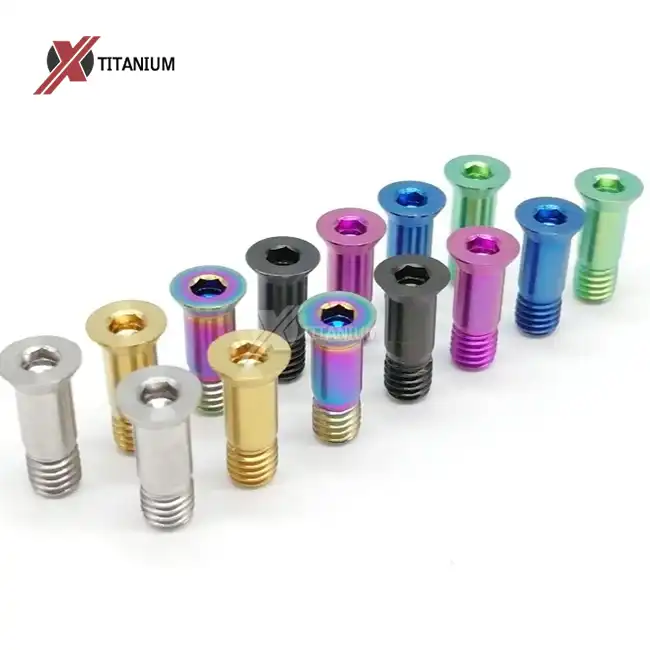
Understanding Titanium Rear Derailleur Screws and Their Impact on Shifting Performance
Shifting accuracy depends a lot on hardware that keeps the derailleur's exact shape even when it's under dynamic loads. When you put some pedal force into a shift, traditional steel fasteners may slightly bend or vibrate loose, which can cause the B-screw and limit screw positions to shift. Over time, these tiny movements add up and cause indexing problems that need to be fixed often.
Titanium hardware addresses these issues by virtue of the way the material itself is made. Grade 5 titanium alloy (Ti-6Al-4V) has a tensile strength of more than 900 MPa and a very high resistance to fatigue. This means that fasteners can withstand repeated stress without permanently changing shape. This stability keeps the derailleur's calibration between service visits.
Material Properties That Enhance Drivetrain Precision
The mechanical qualities of Ti-6Al-4V titanium alloy make it work better in measured ways. Titanium has a controlled flexibility that lets it absorb vibrations without affecting thread contact. Its Young's modulus is about 114 GPa, which is about 60% of steel's. This feature makes it less likely that the torque will be lost due to road noise while still keeping it safe.
Corrosion protection is also very important. Cycling on the road exposes parts to water, salt spray, and chemical cleaners that break down normal fasteners very quickly. When paired with carbon fiber or aluminum derailleur bodies, titanium makes an inactive oxide layer that fixes itself when it gets scratched. This layer protects against galvanic corrosion all the time. This chemical stability makes sure that the dimensions of the part stay correct over time.
Weight Optimization and Rotational Efficiency
Cutting down on spinning mass near the ends of the drivetrain speeds things up in a real way. Using titanium fasteners instead of normal derailleur gear can save between 3 and 5 grams per part. This may not seem like much, but when improving a whole build, it adds up. Professional teams carefully track these small wins because they know that losing weight over time leads to better climbing efficiency and sprint speed.
In addition to its weight, titanium's strength-to-weight ratio lets different types of fasteners be made. With CNC machining, complex features like hollow-core construction and low-profile heads can be made without affecting the structural integrity. This lowers the mass even more while keeping the torque levels needed for a safe fitting.
Comparison of Titanium Rear Derailleur Screws with Other Materials
The choice of material has a big effect on both the performance right away and the reliability in the long run. When procurement managers look at derailleur fasteners, they have to weigh the original cost against the costs over the product's lifetime, the risk of the warranty, and the brand's place in a competitive market area.
Steel is still the most common material for entry-level and mid-range derailleurs because it is cheap and easy to find. Standard carbon steel screws are strong enough, but they are prone to rust and have a fairly high density. Stainless steel versions are better at resisting corrosion, but they are heavier and might get stuck when they are installed.
Aluminum is about the same weight as titanium, but it doesn't have the tensile strength needed for important binding tasks. Aluminum threads aren't good for derailleur mounting bolts and adjustment screws that need to hold torque precisely because they strip more easily under torque and don't resist fatigue well.
Quantitative Performance Analysis
Testing results show that titanium is better in a number of ways. When put thru cycle loads equal to 50,000 shift operations, Ti-6Al-4V fasteners kept their thread integrity with less than 0.01mm of dimensional change. In contrast, aluminum screws showed thread wear and steel fasteners had surface corrosion that made torque consistency worse.
Titanium's dimensional stability was shown by riding temperatures between -40°C and +400°C, which is higher than normal pedaling conditions. The temperature expansion factors of steel screws changed the preload tension by 8–12%, which could lead to indexing drift in harsh settings. Rear Derailleur Titanium Screw benefits from this stability because, since titanium has a lower expansion coefficient, these changes were less noticeable, so the calibration stayed the same over a wider temperature range.
Cost-Benefit Analysis for B2B Procurement
Rear Derailleur Titanium Screws are more expensive than steel ones (usually three to five times as much), but for performance-oriented brands, the value they provide over their lifetime makes the price worth it. ROI can be measured by fewer guarantee claims due to corrosion failure, longer service intervals, and better product difference. OEM brands that sell to professional teams and people who are watching their weight find that titanium hardware helps them stand out in crowded markets.
Distributors that focus on the aftermarket update section can make more money and make customers feel like they're getting a good deal. People who are willing to spend money on ceramic bearings and pulley systems with too many teeth see titanium fasteners as parts that go well with them and finish off a performance-oriented drivetrain package.
Installation, Maintenance, and Optimal Use of Titanium Rear Derailleur Screws
Following the right installation and upkeep procedures is important for getting the most out of titanium hardware's performance benefits. If you use the wrong pressure or oils that don't work well together, they can cancel out the benefits of the material and cause it to fail early.
Proper Installation Procedures
For CNC-machined Rear Derailleur Titanium Screws to have a thread accuracy of ±0.02mm, the surfaces they fit against must be clean and free of dirt. Before installing the derailleur, check the threaded ends and attachment points for dirt or damage. Use a titanium-safe anti-seize substance that was made to work with this material. Stay away from copper-based goods that can cause galvanic reactions.
Because titanium is a different material than steel, its torque requirements are different. Limit screws and B-tension adjusters only need 1.5 to 2 Nm, while derailleur mounting bolts need 4 to 5 Nm. Rear Derailleur Titanium Screws can lose their threads forever if they are over-torqued. It is important to have a good torque wrench that is set to low settings, especially when working with limit screws that control the range of the derailleur.
When fixing derailleurs with titanium gear, you should do it in a methodical way. Make small changes every quarter-turn and check the quality of the shift while it's loaded before moving on. Titanium's physical stability means that changes stay in place, which makes it less tempting to tighten too much.
Maintenance Best Practices
How often routine inspections are done depends on how the rider is feeling. If you ride your bike near the coast or during the winter, you should check the bolts every 500 kilometers for signs of loosening or surface contamination. Titanium has a natural oxide layer that looks like a light gray patina. This protective layer should not be worn off by polishing too hard.
Mild soap and water are all you need to clean Rear Derailleur Titanium Screws. Cleaners with hydrochloric or sulfuric acid should not be used because they damage the inactive layer and speed up rust. After washing the parts, make sure they are completely dry and put a thin layer of the right lubricant on the threaded parts.
Regular retorquing keeps the preload at the right level, especially after the first 100 kilometers of use, when the tires start to settle in. As part of regular engine maintenance, check the torque settings once a year and write down the numbers so that you have a starting point for future comparisons.
Surface Treatment Considerations
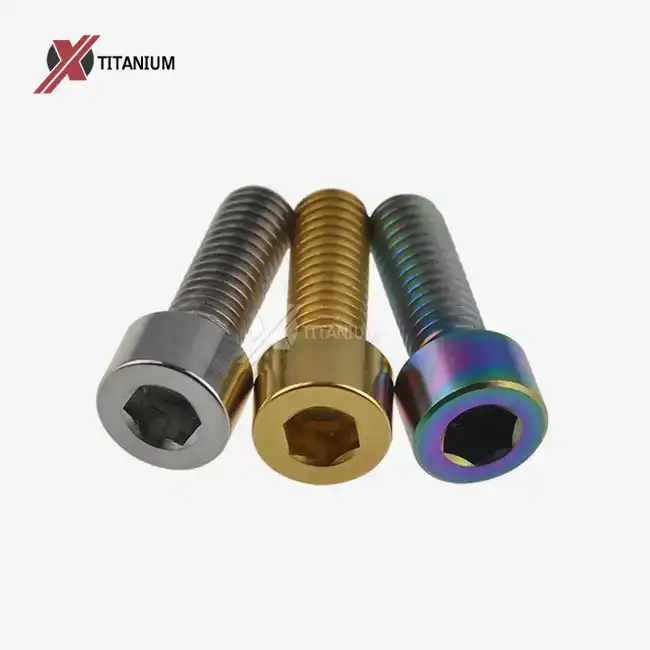
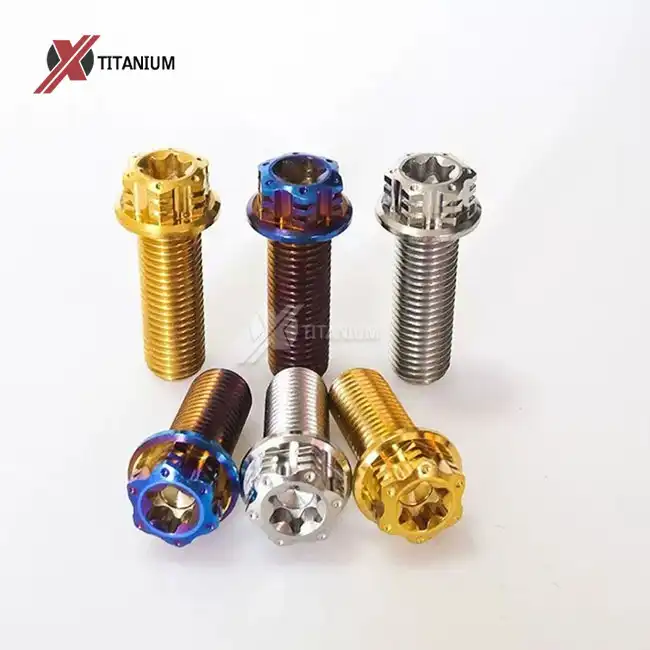
Polishing makes the surface smooth with Ra values between 0.8 and 3.2μm, which makes it easier to clean and reduces friction during fitting. For the Rear Derailleur Titanium Screw, anodizing makes the surface look better and harder, and you can choose from natural titanium, gold, blue, green, purple, black, and rainbow colors. The anodized layers are 2 to 5 microns thick and protect against scratches without changing how the threads contact.
Nitriding processes spread nitrogen into the top layer, making the case harder and less likely to cut and wear threads. This method works especially well for screws that need to be adjusted a lot, like B-tension and limit screws. It makes them last longer in professional settings where mechanics have to make adjustments all the time.
Procurement Strategies for Titanium Rear Derailleur Screws in B2B Markets
To be an effective sourcer, you need to understand how complicated the supply chain is when making titanium parts. Unlike common steel fasteners, which can be found from many suppliers, titanium hardware is mostly made by a few specialized companies that have the right tools and know-how to work with the material.
Supplier Evaluation Criteria
When looking for a titanium fastener supplier, quality certification is the most important thing. As a basic sign of process control, look for makers that have ISO 9001 quality management certification. Companies that work with aircraft often have AS9100 approval, which means they follow strict traceability and paperwork rules that make sure the quality of their products stays the same.
Material approvals prove that fasteners are made of real Ti-6Al-4V metal that meets the requirements of ASTM B348 or AMS 4928. Material test reports (MTRs) from reputable suppliers show the chemical make-up and mechanical properties of each production batch. This ability to track becomes very important when creating supply chain paperwork for high-end bike brands.
Facility visits or detailed capability statements should be part of a manufacturing capacity review. Automatic tool changers and multi-axis CNC machining centers make sure that the threading and surface finishes are precise enough for derailleur applications. A thread accuracy of ±0.02mm needs skilled operators and well-maintained tools.
Customization and Minimum Order Quantities
Baoji Chuanglian New Metal Material Co., Ltd. makes customized titanium fasteners and can work with OEM brands to create their own gear designs, which is a useful option. Changes that can be made to customization choices include thread pitch, head style, and size changes that can be made to fit specific fitting needs.
Different types of products and surface treatments have different minimum order quantities. For standard metric fasteners, the minimum order size is usually 500 to 1000 pieces. For specialized designs with custom sizes, the minimum order size may be 2000 to 3000 pieces to cover the cost of the tools. For surface processes like anodizing, you usually need to order at least 1000 pieces of each color to get the best processing times.
Lead times for titanium parts are longer than those for steel parts because they are harder to get and machine. Standard store items ship in two to three weeks, but unique designs take six to eight weeks, which includes testing the prototype. Strategic buyers keep a backup stock of enough goods to last for 60 to 90 days of production in case the supply changes.
Building Strategic Supplier Relationships
Because titanium fasteners are used in technical situations, it's best to have collaborative relationships with suppliers that go beyond just buying things. Manufacturers like Chuanglian help with engineering during the creation of new products. They give advice on the best bolt specs for different derailleur designs and look for ways to cut costs or make the product lighter.
Sharing quality initiatives makes everyone responsible for their part. Setting clear acceptance criteria for thread gaging, measuring surface finish, and material certification speeds up the receiving inspection process and lowers the number of quality disputes. Larger customers can secure capacity thru supplier-managed inventory programs without having to keep too much stock on hand.
Common Challenges and Solutions with Titanium Rear Derailleur Screws
Even tho Rear Derailleur Titanium Screws have many benefits, they are tricky to handle and need to be handled with care to avoid mistakes and early failure. Understanding these problems helps both producers and end users get the most out of the life of components.
Thread Galling Prevention
Titanium's main fitting problem is that it tends to galle, which is when surfaces of threaded parts stick together when they rub against each other. This happens when layers of titanium oxide break down during assembly, letting metals touch each other and cold-weld their surfaces together. For prevention, the right kind of lubricants and controlled installation speed are needed.
Titanium anti-seize materials have molybdenum disulfide or nickel-based particles that stop adhesion without changing the accuracy of the force. Apply a thin, even coating to the threads before putting them together. Make sure not to use too much, as it could get on the bearing surfaces or get in the way of the adjustment mechanisms.
Instead of using impact drills, slowly install Rear Derailleur Titanium Screws with hand tools. When installation is done quickly, friction heat is created, which speeds up galling. If there is a sudden rise in resistance during installation, stop right away and check for cross-threading or contamination instead of pushing the fastener in.
Compatibility Verification
Not all gear designs can easily accept Rear Derailleur Titanium Screws that are bought separately. Differences in thread pitch between makers, limits on head clearance, and unique tool interfaces can all make it hard to use two tools together. Before you buy something, make sure you know the exact measurements, such as the thread size (M4, M5 are the most common), pitch, length, and head style.
Some companies that make derailleurs list the hardness grades of their fasteners so that they can get the right breakaway torque when the bike is hit. Using titanium hardware instead of steel hardware could change these planned failure modes, shifting the impact loads to more expensive parts like derailleur bolts or frame fixing points. Before making a wholesale substitution, check the manufacturer's instructions or do validation testing.
Emerging Material Technologies
Surface treatments that blend titanium's basic benefits with better performance qualities are still being studied. Physical vapor deposition (PVD) coatings put on very thin layers of ceramic that make the surface harder while keeping the corrosion resistance of the base material. These methods look like they could be useful in situations where weight needs to be saved and sturdiness needs to be at its highest.
Beta-titanium alloys have different properties than regular Ti-6Al-4V. For example, they have better springback properties that could be useful for certain tool uses. As the study of materials progresses, new alloy formulas may be able to get around the problems that currently exist while keeping the main advantages that make titanium a good material for precise bike parts.
Conclusion
For performance-oriented cycling applications, Rear Derailleur Titanium Screws are a big step up. They offer measurable benefits in weight reduction, corrosion resistance, and dimensional stability. All of these benefits directly lead to more precise shifting, less maintenance, and longer component life. When purchasing titanium hardware, procurement professionals should look at the total lifetime costs instead of just the original price. They should know that reliability and performance are worth the extra cost for brands that want to attract picky customers.
By using the right installation methods and surface treatments that work with them, you can get the most out of these benefits and avoid common problems like thread galling. As technology for making materials keeps getting better, titanium fasteners will probably become easier for a wider range of people to buy, but they will still be the best choice for tough jobs.
FAQ
Are titanium derailleur screws compatible with all derailleur brands?
Standard M4 or M5 threads on most Rear Derailleur Titanium Screws make them work with Shimano, SRAM, and Campagnolo derailleurs. It's not just the name that matters; the exact thread size, length, and head style are also important. Before you order, compare the specs to the original equipment. Pay special attention to the stack height and tool interface requirements, as these may be different for each derailleur model.
How much weight do titanium screws save compared to steel alternatives?
Because titanium has a density of 4.43 g/cm³ and steel has a density of 7.85 g/cm³, Grade 5 Rear Derailleur Titanium Screws weigh about 40% less than steel versions. A full set of derailleur hardware, which includes mounting bolts, cage screws, and adjustment screws, can save you 8 to 12 grams. Even tho these savings are small on their own, they add up to big changes in bike weight optimization strategies.
Can titanium screws be reused after derailleur service?
If you handle quality Rear Derailleur Titanium Screws the right way, they can be installed more than once. Before using, carefully check the threads for damage or galling. If a clip shows signs of wear, cross-threading, or trouble during fitting, it should be replaced. Limit screws and B-tension adjusters can usually handle more uses than cage mounting bolts that are put under more stress.
Partner with Chuanglian for Premium Titanium Derailleur Components
Baoji Chuanglian New Metal Material Co., Ltd. has been cutting titanium for over ten years and supplies OEM brands and aftermarket wholesalers around the world from our factory in Baoji City, which is known as China's titanium production center. Our focus on Grade 5 Ti-6Al-4V parts makes sure that the material qualities and dimensions stay the same, which is important for derailleur uses.
We use high-tech CNC machining centers to make Rear Derailleur Titanium Screws. These centers keep the thread accuracy within ±0.02mm tolerances, which guaranties perfect engagement and reliable torque retention. You can customize the surface treatment choices, such as sanding, anodizing, and nitriding, to fit your application needs and personal taste. There are seven color options to choose from.
As a certified producer of Rear Derailleur Titanium Screws with strong quality control systems, we offer material certifications and batch tracking paperwork to meet your supply chain needs. Our engineering team works with clients to come up with custom fastener specifications. They do this by making designs lighter while still meeting strength requirements. You can email us at info@cltifastener.com or djy6580@aliyun.com to talk about your buying needs, get detailed specs, or get quotes for large orders.
References
1. Donachie, Matthew J. "Titanium: A Technical Guide, Second Edition." ASM International, Materials Park, Ohio, 2000.
2. Peters, Manfred, et al. "Titanium Alloys for Aerospace Applications." Advanced Engineering Materials, Volume 5, Issue 6, 2003.
3. Boyer, Rodney, Gerhard Welsch, and E.W. Collings. "Materials Properties Handbook: Titanium Alloys." ASM International, 1994.
4. Schutz, R.W. and Watkins, H.B. "Recent Developments in Titanium Alloy Application in the Energy Industry." Materials Science and Engineering: A, Volume 243, Issues 1-2, 1998.
5. Lutjering, Gerd and James C. Williams. "Titanium: Engineering Materials and Processes, Second Edition." Springer-Verlag Berlin Heidelberg, 2007.
6. Veiga, C., Davim, J.P., and Loureiro, A.J.R. "Properties and Applications of Titanium Alloys: A Brief Review." Reviews on Advanced Materials Science, Volume 32, 2012.
Learn about our latest products and discounts through SMS or email