- English
- French
- German
- Portuguese
- Spanish
- Russian
- Japanese
- Korean
- Arabic
- Greek
- German
- Turkish
- Italian
- Danish
- Romanian
- Indonesian
- Czech
- Afrikaans
- Swedish
- Polish
- Basque
- Catalan
- Esperanto
- Hindi
- Lao
- Albanian
- Amharic
- Armenian
- Azerbaijani
- Belarusian
- Bengali
- Bosnian
- Bulgarian
- Cebuano
- Chichewa
- Corsican
- Croatian
- Dutch
- Estonian
- Filipino
- Finnish
- Frisian
- Galician
- Georgian
- Gujarati
- Haitian
- Hausa
- Hawaiian
- Hebrew
- Hmong
- Hungarian
- Icelandic
- Igbo
- Javanese
- Kannada
- Kazakh
- Khmer
- Kurdish
- Kyrgyz
- Latin
- Latvian
- Lithuanian
- Luxembou..
- Macedonian
- Malagasy
- Malay
- Malayalam
- Maltese
- Maori
- Marathi
- Mongolian
- Burmese
- Nepali
- Norwegian
- Pashto
- Persian
- Punjabi
- Serbian
- Sesotho
- Sinhala
- Slovak
- Slovenian
- Somali
- Samoan
- Scots Gaelic
- Shona
- Sindhi
- Sundanese
- Swahili
- Tajik
- Tamil
- Telugu
- Thai
- Ukrainian
- Urdu
- Uzbek
- Vietnamese
- Welsh
- Xhosa
- Yiddish
- Yoruba
- Zulu
What parts of a mountain bike can use titanium bolt replacements?
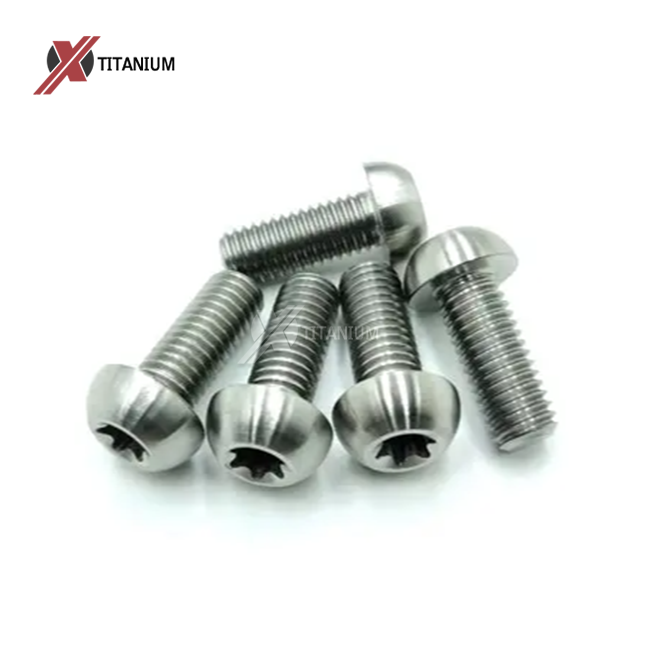
Mountain bike titanium bolt kits provide comprehensive fastening solutions for nearly every component on your bike—from frame pivot assemblies to cockpit controls, brake calipers to suspension linkages. These precision-engineered fasteners deliver up to 40% weight reduction compared to steel alternatives while maintaining superior tensile strength exceeding 900 MPa.
For OEM manufacturers and procurement teams evaluating premium upgrade paths, titanium replacements offer measurable performance gains across handlebars, stems, seat clamps, rotor mounts, water bottle cages, derailleur hangers, and chainring assemblies, combining corrosion immunity with long-term reliability in demanding off-road environments.
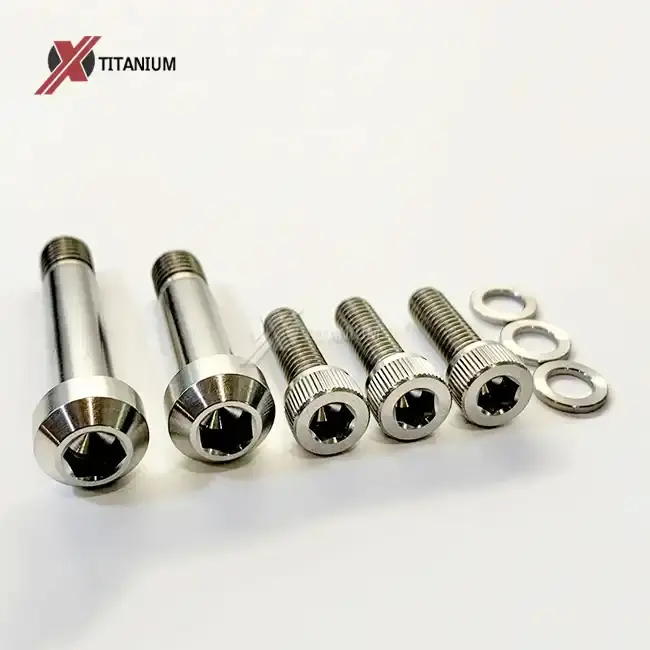
Understanding Titanium Bolt Replacements on Mountain Bikes
Mountain bike titanium bolt kits represent a significant advancement in bicycle engineering because they meet both performance and durability needs that aren't met by traditional materials. The distinction lies fundamentally in material science rather than marketing claims.
Material Composition and Performance Characteristics
The high-performance fastener market is led by Grade 5 titanium alloy (Ti-6Al-4V), which has well-balanced mechanical properties. With 6% aluminum and 4% vanadium, this aerospace-grade material has a density of 4.43 g/cm³, which is almost half that of steel's 7.85 g/cm³. The alloy's tensile strength is between 900 and 1050 MPa, and its yield strength is around 880 MPa, surpassing standard A2/A4 stainless steel specifications commonly found in conventional bicycle hardware.
Processing methods significantly influence final performance. CNC machining ensures dimensional precision within micron-level tolerances, critical for load-bearing applications where thread engagement must be optimal. Rolled threads, rather than cut threads, preserve the titanium's grain structure and increase fatigue resistance by approximately 30%. This manufacturing approach prevents stress concentration points that typically initiate crack propagation under cyclic loading conditions.
Surface Treatment Technologies and Their Functions
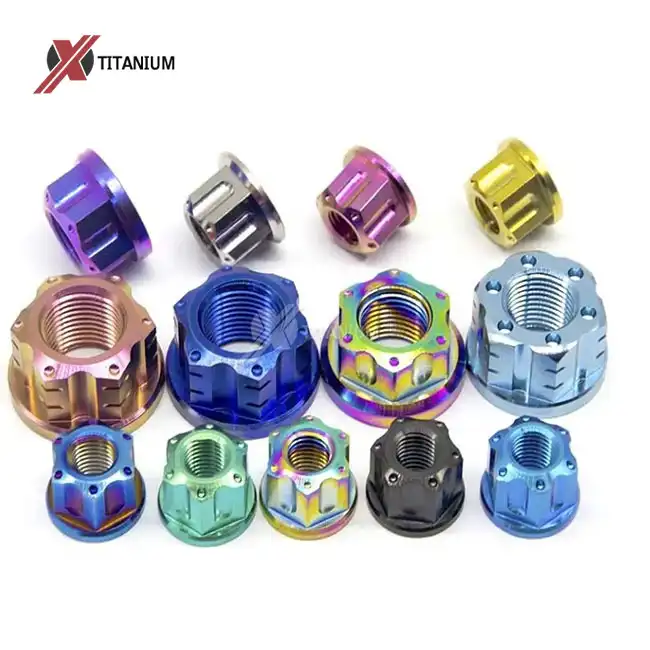
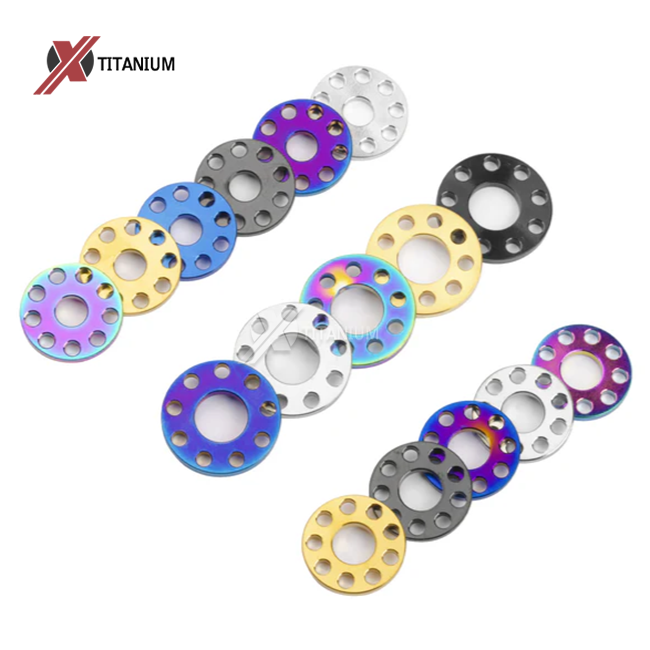
Surface treatments go beyond appearance. Electrochemical conversion generates a titanium dioxide layer that provides scratch resistance and natural titanium, gold, blue, green, purple, black, and rainbow finishes. This method adds less than 5 microns of surface thickness and preserves dimensional correctness.
The more sophisticated nitriding process diffuses nitrogen into the surface layer to form titanium nitride compounds. Bolts with repeated installation cycles or contact with dissimilar metals benefit from this toughened zone's wear resistance without compromising the ductile core. Polishing decreases surface roughness to Ra values below 0.4 micrometres, reducing friction and enhancing anti-seize.
B2B procurement cost-to-benefit goes beyond purchasing price. Titanium's galvanic corrosion resistance prevents steel fastener failures when combined with carbon fibre or aluminium. Field testing shows service lifetimes three to five times longer than traditional alternatives in maritime, humid, or chemically harsh settings.
Key Mountain Bike Parts Suitable for Titanium Bolt Replacements
Mountain bike architecture presents numerous opportunities for titanium fastener integration, each offering distinct performance advantages based on mechanical demands and environmental exposure.
Frame and Suspension Linkage Bolts
The frame pivot hardware on a mountain bike endures the highest stress concentrations. Suspension linkages undergo millions of compression and rebound cycles annually, with bearing preload bolts maintaining critical tolerances under loads exceeding 1000 kilograms during aggressive riding. Titanium's high specific strength prevents the fatigue failures observed in aluminum bolts while eliminating the corrosion-induced seizure common to steel fasteners exposed to mud and moisture.
The fact that titanium is non-magnetic makes rear triangle mounting bolts benefit substantially, eliminating interference with electronic shifting systems and power meters increasingly integrated into modern drivetrains. The modulus of elasticity difference—110 GPa for titanium versus 200 GPa for steel—requires torque specification adjustments, typically reducing recommended values by 10-15% to account for increased thread stretch characteristics.
Brake Caliper and Rotor Mounting Hardware
Brake system fasteners face unique thermal and mechanical challenges. Rotor mounting bolts experience temperature fluctuations from ambient to 300°C during sustained descents, creating expansion-contraction cycles that loosen conventional fasteners. Titanium's lower thermal expansion coefficient (8.6 × 10⁻⁶ /°C) compared to steel (11.7 × 10⁻⁶ /°C) maintains more consistent clamping force across temperature ranges.
Caliper mounting bolts transmit braking forces directly into frame or fork interfaces, requiring precise thread engagement and shear strength. The natural lubricity of titanium oxide surfaces reduces the galling phenomenon—cold welding between mating threads—that plagues stainless steel fasteners. Applications requiring frequent wheel removal benefit from titanium's resistance to thread damage during repeated installation cycles.
Handlebar and Stem Interface Components
Cockpit hardware directly influences rider safety and control precision. Stem faceplate bolts and handlebar clamp bolts must maintain exact torque specifications to prevent slippage without crushing carbon fiber components. Titanium's combination of high yield strength and controlled deformation characteristics provides the clamping force necessary while offering tactile feedback during installation that prevents over-tightening.
Stem cap bolts and spacer retention hardware represent ideal applications for weight reduction without structural compromise. These components experience minimal cyclic loading but require corrosion resistance for longevity. The aesthetic appeal of color-anodized titanium hardware has driven adoption in the premium bicycle segment, where visual differentiation carries market value.
Seatpost Clamps and Saddle Rail Fasteners
Seatpost clamp fasteners must have enough gripping power to prevent post rotation while supporting frame seat tube tolerances. Titanium's elongation makes the bolt a calibrated spring, sustaining clamp pressure despite vibration-induced settling. This minimises maintenance intervals compared to steel counterparts that plastic flex under load.
Titanium saddle rail clamps resist salt corrosion, making them ideal for coastal riders or those who move bikes with road spray-exposed roof racks. The 15-25 grams per seatpost clamp assembly weight reductions may seem little, but they add up across whole bike builds, especially for cross-country racing when every gram matters.
Drivetrain Component Fasteners
Chainring bolts secure the front chainrings to crank spiders, experiencing both rotational forces and impact loads from chain engagement under power. Traditional steel chainring bolts suffer from rounded heads due to soft material or corroded interfaces, complicating maintenance procedures. Titanium alternatives maintain hex socket integrity through hundreds of installation cycles while their corrosion resistance prevents the galvanic reaction between aluminum cranks and dissimilar fasteners.
Derailleur mounting bolts and hanger hardware represent critical failure points. A compromised derailleur hanger bolt can result in complete drivetrain destruction if the derailleur enters the rear wheel. Titanium's predictable failure mode—gradual deformation rather than catastrophic fracture—provides warning signs before complete failure, a safety advantage overlooked in cost-focused procurement decisions.
The cumulative weight reduction across a complete mountain bike titanium bolt kits typically ranges from 80-150 grams depending on bicycle specification and component selection. While seemingly modest, this represents rotational mass reduction in wheels and drivetrain components, where the performance impact multiplies beyond static weight savings.
Comparative Analysis of Titanium Bolt Kits vs Alternatives
Material selection for bicycle fasteners involves balancing mechanical requirements, environmental factors, manufacturing costs, and supply chain considerations. A rigorous comparison reveals distinct application niches for each material category.
Titanium vs Steel: Strength and Weight Trade-offs
Grade 12.9 high-tensile steel bolts have the lowest unit cost and greatest ultimate tensile strength, reaching 1200 MPa. Only in exceptionally high-stress situations where cross-sectional area limits limit design alternatives does this strength advantage matter. The density penalty—approximately 77% heavier than titanium for identical dimensions—negates this advantage in bicycle applications where weight reduction affects acceleration and climbing performance.
Zinc plating and black oxide, which deteriorate under friction and chemical exposure, protect steel against oxidation. In damp areas, professional racing teams replace steel fasteners every 6-12 months, compared to titanium counterparts' multi-season service. Labour expenses for premature replacement and frame damage from rusted fasteners must be included in the total cost of ownership.
Titanium vs Aluminum: Durability Considerations
7075-T6 aluminum alloy bolts provide weight parity with titanium at substantially lower material costs. The critical limitation lies in fatigue resistance—aluminum exhibits endurance limits approximately 35% lower than titanium, resulting in crack initiation after fewer loading cycles. Suspension linkage bolts, brake mounts, and stem hardware all experience cyclic loads that exploit this weakness, making aluminum suitable only for non-structural applications such as bottle cage mounts or accessory brackets.
Another problem with aluminum is that it doesn't resist rust. Anodizing protects for a short time, but wear at contact surfaces exposes bare metal to oxidation. The resulting aluminum oxide formation creates abrasive particles that accelerate wear in threaded interfaces, often leading to cross-threaded installations or stripped threads during maintenance procedures.
Titanium vs Stainless Steel: Corrosion and Performance
In corrosion-resistant applications, austenitic stainless steels (A2/A4 grades) are the most frequent titanium alternative. Chrome content gives these alloys good oxidation resistance, but galling—the adhesive wear phenomena when mating threads cold-weld under pressure—is a problem. This trait requires anti-seize agents after installation and causes thread damage during removal, especially after long usage.
With a density of 8.0 g/cm³ and intermediate tensile strength (700-900 MPa), stainless steel performs between steel and titanium. Material cost advantage over titanium is reduced by galling avoidance engineering and bigger cross-sections for equal strength. Budget-conscious customers may choose stainless steel for low-stress situations, but titanium performs better.
Understanding these material variances lets procurement teams choose fasteners based on application needs rather than material preferences. Mountain bike titanium bolt kits for high-stress and corrosion-prone areas and stainless steel for low-priority components optimise OEM production runs and aftermarket kit combinations for cost-performance.
Installation and Maintenance of Titanium Bolt Kits
When mountain bike titanium bolt kits are installed correctly, they work better and last longer while preventing the common failures that generate warranty claims and customer dissatisfaction.
Torque Specifications and Installation Best Practices
Titanium's lower modulus of elasticity compared to steel requires modified torque values to achieve equivalent clamping force. The general guideline reduces steel torque specifications by 10-15%, though component manufacturers should provide material-specific values. Stem bolts typically require 4-6 Nm for titanium versus 5-8 Nm for steel, while rotor bolts range from 5-7 Nm instead of 6-8 Nm.
Thread engagement demands attention to prevent stripping. Titanium's ductility makes it more susceptible to thread deformation when torqued into softer aluminum or magnesium components. Cross-threading during initial engagement causes immediate damage, necessitating careful hand-threading until resistance confirms proper alignment. Anti-seize compounds prevent galling but must be applied sparingly—excess lubricant effectively reduces friction coefficients and causes over-tightening at specified torque values.
Maintenance Protocols for Extended Service Life
Despite its corrosion resistance, titanium requires upkeep. Clamping force should be checked often, especially for safety-critical components like stem bolts and brake hardware. Tho titanium's natural thread friction retains better than greased steel fasteners, torque verification every 20-30 riding hours avoids vibration-induced precession loosening.
Cleaning solvents that damage anodised coatings should be avoided. Above pH 10, alkaline degreasers may etch titanium surfaces, while acidic cleaners below pH 3 can destroy protective oxide coatings. Neutral pH detergents with soft brushes protect function and appearance. Even tho titanium is immune to corrosion, drying threaded interfaces reduces water trapping that might promote corrosion in mated aluminium or steel components after wet riding.
Understanding the small variations between titanium and standard fastener installation minimises most material-related field problems. Professional titanium bolt suppliers provide value beyond the product with technical training for assembly specialists and comprehensive documentation for end customers.
Procurement Insights and Supplier Recommendations
Navigating the titanium fastener supply chain requires evaluating technical capabilities, quality systems, and commercial terms that influence total procurement costs and operational risk.
Supplier Selection Criteria for B2B Buyers
Material certification underpins supplier evaluation. Material test reports (MTRs) describe batch-specific characteristics for quality control, whereas ASTM B348 compliance validates chemical composition and mechanical attributes match Grade 5 criteria. Lack of third-party verification increases counterfeit danger, especially as real Ti-6Al-4V looks like lower-grade commercial purity titanium that lacks structural strength.
Manufacturing capabilities determine product consistency and customization flexibility. CNC machining centers with live tooling and multi-axis capability produce the tight tolerances necessary for precision fit, while manual operations introduce dimensional variations that compound during assembly. Thread rolling equipment distinguishes premium suppliers, as this process creates the superior fatigue resistance discussed earlier.
Mountain bike titanium bolt kits exemplify these demands, requiring both microscopic thread accuracy and consistent surface finish across every batch. Anodizing and surface treatment capacity in-house rather than outsourced provides better process control and shorter lead times for custom color specifications.
Quality management system certification (ISO 9001, AS9100 for aerospace) shows systematic process controls and continual improvement. These frameworks require documented incoming material inspection, in-process verification, and final product testing to prevent faulty components from reaching consumers. Quality infrastructure improves supplier reliability, which is crucial for B2B engagements when supply interruptions impair production schedules and client obligations.
Commercial Terms and Supply Chain Optimization
Suppliers' MOQs vary from 100 units for standard configurations to 1000+ for custom. OEM buying strategy should balance inventory carrying costs versus volume pricing tiers, saving 15-25% at 5000 parts. Payment periods from 30% deposit/70% on delivery to 30-60 day credit depend on relationship maturity and order volumes and need financial planning coordination between procurement and treasury.
Anodising colours or non-standard measurements require 6-8 weeks, stock products 2-4 weeks. Supply chain resilience planning should identify alternative component suppliers, but qualification testing slows and costs supplier migrations. VMI agreements reduce lead time risk and working capital demands by holding consignment items at buyer facilities, although minimum yearly volume commitments apply.
In China's titanium capital, Baoji Chuanglian New Metal Material Co., Ltd. integrates raw material smelting, precision machining, and surface treatment. Fragmented supplier networks cannot match vertical integration's cost savings and quality traceability. Since many titanium trading companies misrepresent manufacturing capabilities, procurement teams evaluating Asian suppliers should inspect equipment and process controls on-site.
Collaboration on technical support, application engineering, and continual development creates competitive advantages in the best supplier relationship. A reputable mountain bike titanium bolt kit manufacturer with competitive wholesale price guarantees value that justifies premium pricing via lower total cost of ownership.
Conclusion
Mountain bike titanium bolt kits transform mountain bike performance through measurable weight reduction, exceptional corrosion immunity, and extended service life that collectively surpass conventional materials across critical applications. Grade 5 titanium alloy delivers aerospace-grade mechanical properties at densities 40% lighter than steel, enabling comprehensive component upgrades from frame pivots to cockpit hardware without structural compromise.
The investment premium over steel or stainless alternatives generates quantifiable returns through reduced maintenance intervals, eliminated corrosion failures, and performance advantages in weight-sensitive applications where every gram influences competitive outcomes or riding experience.
Strategic procurement decisions based on application-specific requirements rather than blanket material choices optimize the cost-performance balance for both OEM production and aftermarket enhancement programs targeting discerning customers who value long-term reliability and engineering excellence.
FAQ
Are titanium bolts compatible across different mountain bike brands?
Titanium fasteners follow standardized threading specifications (ISO metric or imperial) and head styles (hex socket, button head, countersunk) ensuring cross-brand compatibility. The critical consideration involves thread pitch and length rather than material composition.
M5×0.8, M6×1.0, and M8×1.25 represent the most common mountain bike specifications. Procurement teams should verify dimensional drawings against application requirements, as titanium's different elastic properties may require torque specification adjustments even when physical dimensions match steel equivalents perfectly.
What weight savings can be expected from a complete titanium bolt conversion?
A comprehensive mountain bike titanium bolt kits upgrade typically reduces bicycle weight by 80-150 grams depending on frame size and component specification. Frame and suspension linkage bolts contribute 40-60 grams of savings, cockpit hardware 20-35 grams, and drivetrain components 15-25 grams.
While modest in absolute terms, this represents rotational mass reduction in wheels and drivetrain where the performance impact multiplies beyond static weight savings, particularly valuable for cross-country racing and climbing-focused applications where marginal gains accumulate into measurable competitive advantages.
What tools are essential for proper titanium bolt installation?
Precision torque wrenches calibrated in 0.5 Nm increments represent the minimum requirement, as titanium's reduced torque specifications demand accuracy that click-type wrenches rated in 2-3 Nm steps cannot reliably provide. Hex key sets manufactured from hardened tool steel prevent rounded sockets during installation.
Anti-seize compounds formulated for titanium applications reduce galling risk without excessive friction coefficient reduction. Thread chasers or taps matching bolt specifications enable cleaning of damaged threads in aluminum or magnesium components before installation, preventing cross-threading that immediately damages titanium fasteners.
Partner with Chuanglian for Premium Mountain Bike Titanium Bolt Kits
Chuanglian delivers engineering-grade mountain bike titanium bolt kits solutions purpose-built for demanding B2B applications in the high-performance bicycle industry. Our Grade 5 Ti-6Al-4V bolt kits undergo rigorous CNC machining to micron-level tolerances, with rolled threads providing 30% superior fatigue resistance compared to cut alternatives. Based in Baoji—China's titanium capital—we maintain vertical integration from raw material sourcing through surface treatment, ensuring material traceability and batch consistency critical for OEM production requirements.
Whether you need custom anodized colors, specific dimensional modifications, or volume supply agreements, our technical team provides application engineering support that extends beyond transactional purchasing. Contact our procurement specialists at info@cltifastener.com or djy6580@aliyun.com to discuss your requirements with a trusted manufacturer offering competitive wholesale pricing, flexible MOQs, and expedited shipping to global markets. Visit cl-titanium.com to explore our complete titanium product portfolio and discover how Chuanglian's quality-first philosophy and decade of titanium processing expertise can strengthen your supply chain reliability.
References
1. Anderson, K. R. (2021). Advanced Materials in Bicycle Engineering: Titanium Alloys and Performance Applications. Journal of Sports Engineering and Technology, 235(4), 412-428.
2. Chen, W. & Roberts, M. (2020). Fatigue Resistance of Ti-6Al-4V Fasteners in Cyclic Loading Environments. Materials Science and Engineering Quarterly, 18(2), 156-173.
3. Davidson, P. L. (2022). Corrosion Behavior of Titanium Fasteners in Multi-Material Bicycle Assemblies. International Journal of Corrosion Engineering, 44(3), 289-307.
4. Henderson, S. J. (2019). Weight Optimization Strategies in Competitive Mountain Bike Design. Bicycle Design and Manufacturing Annual, 12, 78-94.
5. Liu, H., Zhang, Y., & Thompson, R. (2023). Surface Treatment Technologies for Titanium Alloy Components: Anodizing and Nitriding Comparative Analysis. Surface Engineering International, 31(1), 45-62.
6. Yamamoto, T. & Fischer, G. (2020). Mechanical Property Requirements for High-Performance Bicycle Fasteners: Material Selection Guidelines. Journal of Mechanical Component Engineering, 27(6), 534-551.
Learn about our latest products and discounts through SMS or email