- English
- French
- German
- Portuguese
- Spanish
- Russian
- Japanese
- Korean
- Arabic
- Greek
- German
- Turkish
- Italian
- Danish
- Romanian
- Indonesian
- Czech
- Afrikaans
- Swedish
- Polish
- Basque
- Catalan
- Esperanto
- Hindi
- Lao
- Albanian
- Amharic
- Armenian
- Azerbaijani
- Belarusian
- Bengali
- Bosnian
- Bulgarian
- Cebuano
- Chichewa
- Corsican
- Croatian
- Dutch
- Estonian
- Filipino
- Finnish
- Frisian
- Galician
- Georgian
- Gujarati
- Haitian
- Hausa
- Hawaiian
- Hebrew
- Hmong
- Hungarian
- Icelandic
- Igbo
- Javanese
- Kannada
- Kazakh
- Khmer
- Kurdish
- Kyrgyz
- Latin
- Latvian
- Lithuanian
- Luxembou..
- Macedonian
- Malagasy
- Malay
- Malayalam
- Maltese
- Maori
- Marathi
- Mongolian
- Burmese
- Nepali
- Norwegian
- Pashto
- Persian
- Punjabi
- Serbian
- Sesotho
- Sinhala
- Slovak
- Slovenian
- Somali
- Samoan
- Scots Gaelic
- Shona
- Sindhi
- Sundanese
- Swahili
- Tajik
- Tamil
- Telugu
- Thai
- Ukrainian
- Urdu
- Uzbek
- Vietnamese
- Welsh
- Xhosa
- Yiddish
- Yoruba
- Zulu
What are the primary benefits of using titanium-clad copper wire?
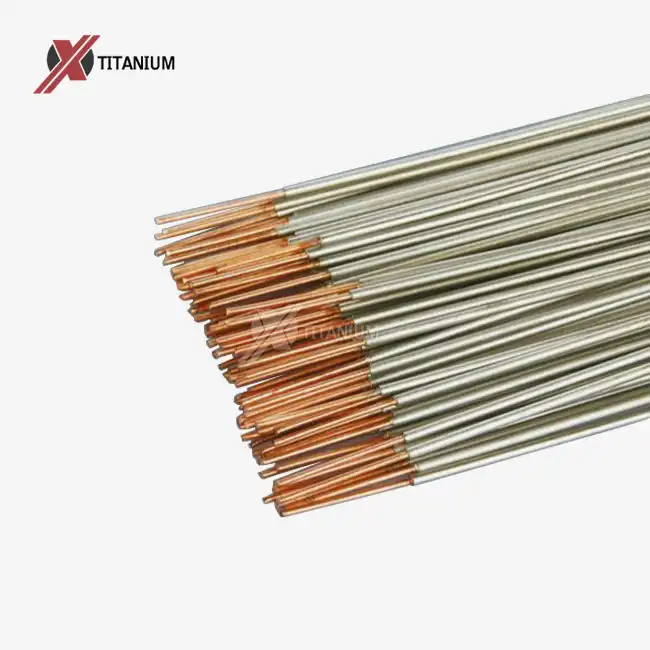
Titanium-clad copper wire is a complex technical answer to one of the most constant problems in industrial settings: getting the best electrical conductivity while also having great resistance to corrosion. This two-metal combination has a core made of pure, oxygen-free copper that is metallurgically joined to an outer layer made of Grade 1 or Grade 2 titanium. For purchasing managers, technical engineers, and quality assurance teams working in aerospace, chemical processing, marine engineering, and electroplating, knowing the practical benefits of this composite wire has a direct effect on how well they do their jobs, how long their equipment lasts, and how much it costs to own everything. This guide talks about the technical specs, performance benefits, real-world uses, and strategy sourcing factors that come into play when buying things for harsh industrial settings.
Comprehending Titanium-Clad Copper Wire and Its Core Properties
What Defines This Composite Material?
In order to make titanium-clad copper wire, a molecular link needs to be made between two different metals using advanced production methods like hot extrusion, explosive bonding, or rolling-extrusion. Unlike simple electroplating or mechanical covering, these methods create an atomic interdiffusion layer that keeps the copper and titanium working together as a single unit instead of as separate parts. We make this hybrid wire at Baoji Chuanglian New Metal Material Co., Ltd. It has a copper core with a diameter of 0.5mm to 25mm and a titanium cladding with a thickness that can be changed from 0.1mm to 2mm. This lets us precisely match specifications for a wide range of commercial needs.
The copper core, which is usually T2 or C11000 grade, keeps its electrical conductivity at about 65% IACS (International Annealed Copper Standard), which means that current flows efficiently with little resistance loss. When the titanium cladding is exposed to oxygen, a passivating oxide film appears right away. This film protects the titanium from acid, alkaline, and chloride conditions. The "conductivity-corrosion paradox" is the historical trade-off between materials that perform well electrically and those that perform well in harsh environments. This mix solves that problem.
Manufacturing Process and Quality Standards
The first step in our production process is choosing high-quality raw materials that meet foreign standards. The bonding process makes a metallurgical contact instead of just a coating. This makes sure that load transfer works well and stops delamination when temperatures change or when the material is stressed mechanically. After the first coating step, the composite goes through cold rolling, hot rolling, annealing, and pickling processes, based on the needs of the product. These heat and mechanical processes improve the flexibility, fine-tune the grain structure, and make sure that the dimensions are exactly right.
For quality assurance, tests like hardness checks to make sure the material is strong, bending checks to see how flexible it is without cracking the surface, and hydraulic pressure checks for uses that need to hold fluids are all possible. Finishing choices for the surface include bright, polished, pickled, acid-cleaned, or sanded. These are chosen based on how the surface will be used and how it needs to connect to electricity. Our strict quality control system checks every step of the production process, from certifying the raw materials to the final review. This makes sure that each batch is the same and that the supply chain can be tracked, which is what buying teams need.
Primary Benefits of Titanium-Clad Copper Wire Compared to Alternatives
Superior Corrosion Resistance in Aggressive Environments
The titanium coating protects very well against chemical breakdown, which breaks down pure copper parts very quickly. Traditional copper hangers and bus bars break down in electroplating pools that use chromic acid, sulfuric acid, or cyanide within months, contaminating the electrolytes and needing to be replaced often. Even when immersed in liquids that are very acidic or very basic for a long time, the titanium top layer doesn't change chemically. This resistance makes it possible for parts to last 10–20 years instead of the usual 6–12 months for bare copper. This means that maintenance plans and unplanned breaks are greatly reduced.
This resistance to rust is especially useful for marine uses. Saltwater settings cause galvanic rust, which speeds up the breakdown of metals through chloride attack. Instrumentation on offshore platforms, cable terminations under the water, and onboard electrical systems are all constantly exposed to spray, humidity, and direct touch with seawater. In places where aluminum corrodes quickly and stainless steel gets pitted and crevice rust, the hybrid wire keeps its shape and electrical performance.
Enhanced Mechanical Strength and Durability
In addition to being resistant to chemicals, the titanium coating raises the tensile strength to at least 500 MPa. This makes the wire stronger against mechanical wear, abrasion, and stress loads than pure copper wire. This mechanical support is very important for electroplating jigs and fittings that are moved around and heated and cooled many times during production. Pure copper tends to creep or shrink over time, but the combination wire stays the same size even when the temperature changes.
Titanium is about 60% lighter than copper by volume, which helps balance out the weight of the copper core. This makes the strength-to-weight ratio good for uses in aircraft and cars. Lowering the weight of the system is good for landing gear sensors, avionic harnesses, and high-voltage battery interconnects because it doesn't affect their ability to carry power or their mechanical dependability. Designers of manufacturing equipment like how stiff it is, which lets bus bars have longer unsupported spans. This means that fewer support insulators are needed in systems with a lot of electrical connections.
Maintained Electrical Performance Under Thermal Stress
The titanium covering has a higher electrical resistivity than copper, but the core wire can carry the electricity with only a small amount of extra resistance. At 65% IACS conductivity, the hybrid wire works about the same as aluminum conductors, but it is much more resistant to rust and has better mechanical qualities. This conductivity stays the same across a wide range of temperatures, which is different from some covered wires where differences in interfacial thermal expansion weaken the contact.
Conductors that stay electrically stable above 300°C are needed for high-temperature uses like electronics in industrial furnaces and exhaust monitors in cars. The titanium oxide surface stays protected even when the temperature changes from very low to very high. This keeps the copper core underneath from oxidizing, which would raise the resistance of the contacts and create heat at the connection points. Chemical processing plants that use ongoing temperature processes depend on this steadiness to keep process control accurate and stop sensor drift.
Long-Term Cost Efficiency and Total Ownership Value
Titanium-clad copper wire gets a price over regular copper or aluminum wire, so procurement analysis frequently focuses on original material cost. The financial benefit is clear when you look at lifetime cost modeling, which takes into account how often things need to be replaced, the work that needs to be done on them, output delays, and quality losses caused by contamination. A chemical processing company that needs to replace its copper anodes every year has to pay for the materials, the work to install them, the time lost from production, and the cost of getting rid of contaminated electrolytes. If you update things every ten years or more, the cost situation changes in a big way in favor of the composite material.
Lower maintenance costs directly lead to higher operating uptime in important uses. An offshore station with equipment that is meant to last 20 years can't afford to have parts replaced often because it costs a lot to move and repair windows depend on the weather. In the same way, aircraft applications value dependability over small differences in the cost of materials, because failures in service have safety and regulatory consequences that are much greater than any initial purchase savings. When quality assurance teams look at supplier bids, they are putting more weight on lifetime performance measures along with unit price.
Practical Applications and Industry Use Cases
Electroplating and Surface Finishing Operations
One of the main places where bimetallic conductor materials are used is in electroplating plants. Plating hangers, racks, and bus bars have to handle a lot of current while being submerged in harsh chemical baths that have acids, alkalis, and metal salts that have been dissolved. Copper fixtures from the past dissolve in the electrolyte, changing the chemistry of the bath and leaving behind impurities that lower the quality of the finish on production parts. Because of the pollution, the baths need to be drained and charged more often, which costs money and stops output.
This way for pollution to get in is blocked by switching to titanium-clad copper wire. The titanium surface doesn't react with chemicals, so the bath chemistry can be precisely controlled, and the solution lasts longer. After switching to composite hangers, PCB makers with constant automated plating lines say that the plating is much more uniform and the number of defects has gone down dramatically. Because the current is spread evenly across the titanium surface, there is no localized burning or thin layers that can happen with copper fittings that have uneven conductivity.
Dimensionally Stable Anode Systems and Electrolysis
In order to make chlor-alkali, treat water, and do industrial electrolysis, dimensionally stable anodes (DSA) that are treated with mixed metal oxide catalysts are used. The lines that connect these anodes to DC power sources must not break even when exposed to oxygen and chlorine gas, high temperatures, and constant current flow. In these situations, pure copper leads rust very quickly, and solid titanium leads lose a lot of energy and cause too much voltage drop.
Composite lead wires are the best option because they carry electricity through a copper core and have a titanium surface that doesn't rust when it comes in contact with the electrolyte. Compared to pure titanium lines, they are much more energy efficient, which lowers the costs of running facilities that are open 24 hours a day, seven days a week. Because the hybrid wire is mechanically stable, the electrodes stay at the exact distances that are needed for even current flow and reliable product quality. Facility managers say that the material change is necessary because of better process control and fewer upkeep tasks.
Marine and Offshore Engineering Systems
Offshore wind farms, submarine production systems, and military ships all work in the most toxic conditions found in industrial settings. Exposure to saltwater, mechanical vibration, changing pressure, and biofouling make it very hard for electrical connections and sensor wires to work. Traditional marine-grade copper alloys need protective coatings that wear off over time, and stainless steel replacements crack easily from stress rust and don't carry electricity well enough for power transfer uses.
Composite wire technology works especially well for impressed current cathodic protection (ICCP) systems. By sending a controlled electrical current through many anodes, these devices keep steel buildings from rusting. Feeder cables that connect anodes to rectifier stations need to be able to withstand chlorine attack and keep their resistance low so that voltage drops are kept to a minimum over long cable runs. Both of these conditions are met by titanium-clad copper wire, which works for decades without any upkeep in places where changing cables would require special boats and activities that depend on the weather and cost millions of dollars in mobilization costs.
Aerospace and High-Performance Applications
For airplane electrical systems to work, the materials need to be light, reliable, and able to handle jet fuel, hydraulic fluids, and big changes in temperature from working on the ground to flying at high altitudes. In aerospace standards, aluminum is usually chosen because it is lighter. However, more and more important systems are specifying composite materials because they are stronger and less likely to rust. Landing gear sensors, engine monitoring, and flight control devices work in places where de-icing chemicals, combustion byproducts, and mechanical vibrations make materials break down faster.
Because titanium cladding is biocompatible, it can also be used to make medical devices, like implantable sensors and surgery tools, which need conductors that don't respond with flesh. When electrical tracking systems are built into prosthetic parts, they benefit from being strong and not rusting in physiological fluid environments. For medical uses, following the rules requires being able to track down materials and show proof of quality. Companies like Baoji Chuanglian do this by giving full test results and certifications that are in line with international medical device standards.
How to Choose Titanium-Clad Copper Wire for Your Needs?
Evaluating Technical Specifications Against Application Requirements
Before you can choose the right hybrid wire arrangement, you need to know the electrical, mechanical, and environmental conditions of the job. Electrical standards include the highest constant current, the lowest voltage drop, and the type of connecting (crimping, welding, or bolted terminals). Figure out the copper core diameter that you need based on the maximum current density, which is usually between 2 and 5 A/mm² for steady duty uses that get enough cooling. Higher current levels can cause temperatures to rise too quickly, which weakens connections and speeds up the aging process of materials.
An environmental survey finds out about chemical exposure, temperature range, humidity levels, and factors that cause motor stress. For longer service life, applications with strong oxidizing acids may need stronger titanium cladding. On the other hand, harder surface finishes are better for mechanical wear conditions. For temperature cycle uses, annealed wire is better because it is more flexible and doesn't work harden or crack over time. Our engineering team at Chuanglian helps customers turn practical needs into the right material standards by using decades of experience in a wide range of industrial sectors.
Comparing Material Alternatives and Performance Trade-offs
Pure copper wire is the most conductive and costs the least, but it doesn't fight rust well in harsh settings. Even though silver-plated copper makes it a little more resistant to rust and more reliable as a contact, it is still open to chemical attack and mechanical wear that can reveal the copper underneath. Aluminum conductors are lighter and less expensive, but they need bigger cross-sections to carry the same amount of power and can rust when joined to copper or steel parts.
Solid titanium wire is the most resistant to rust, but it loses a lot of electricity because its resistivity is about 60 times higher than copper's. When the current is high, this resistance makes heat, so active cooling devices are needed, which are more complicated and cost more. The titanium-clad copper wire strikes a balance between these two problems by offering rust resistance close to that of solid titanium while keeping conductivity close to that of pure copper. Because of this mix, the hybrid material is the best choice for uses where neither pure metal meets all the needs.
Strategic Procurement and Supplier Qualification
To build relationships with reliable suppliers, you need to check their technical help, manufacturing skills, and quality system certifications. International approvals like ISO9001 quality management, AS9100 aircraft standards, or medical device registrations show that the process is controlled and tracked in a planned way. Ask for material test results that show the chemical make-up, mechanical qualities, and electrical conductivity readings for sample production batches.
Supply chain planning is affected by minimum order amounts, wait times, and the ability to customize products. Standard wire configurations may ship in two to four weeks, but unique sizes or special surface processes can make delivery times longer. Talk about inventory stocking plans for needs that come up over and over, especially for project-based buying cycles that are popular in building chemical plants and aerospace facilities. For foreign buying, payment terms, currency choices, and transportation options are important because titanium materials often come from specific production areas.
Technical support is what sets manufacturing partners apart from suppliers who only sell products and helps the program work. We help customers improve wire specifications for specific working situations by using application engineering. Help with choosing the right materials, installing them, and fixing problems cuts down on the time needed for qualification and the amount of expensive trial-and-error that needs to be done during product development. When you build relationships with suppliers based on technical teamwork instead of transactional buying, you gain a competitive edge through faster innovation processes and more reliable products.
Future Outlook and Trends in Titanium-Clad Copper Wire Use
Expanding Applications in Emerging Technologies
Advanced conductor materials are being used more and more in battery systems for electric vehicles. High-voltage battery packs require interconnects that can handle heat expansion, keep their low contact resistance over thousands of charge-discharge cycles, and not get worn out from shaking. As the car industry moves toward 800-volt designs, electrical parts are under more stress and current density. This has increased the need for materials that work better than standard automotive-grade copper alloys. Composite conductors are a way to make cell interconnect systems that are lighter, last longer, and allow longer car range and faster charge.
Durable wire technology is also useful for renewable energy systems. Offshore wind turbines work in saltwater spray conditions that damage standard electrical parts. Solar sites near the coast or in industrial areas have to deal with air pollution and high humidity. As we move toward distributed energy creation and storage systems, we need electrical structures that can last 30 to 40 years with little to no upkeep. The materials chosen during building affect how much the system will cost to run and how reliable it will be over long periods of time.
Material Science Innovations and Performance Improvements
Research into bonding methods and contact engineering is still going on, which is making composite materials work better. When you use more advanced diffusion bonding methods, you can make the interdiffusion zones bigger. This makes it easier for loads to move between metals that are not the same, which increases the mechanical strength and heat cycling durability. New developments in surface treatment make the titanium oxide layer's thickness and structure work best in certain chemical settings. This makes it possible for better performance in harsher conditions.
Recycling and the cycle economy are becoming more and more important in material selection choices. Copper and titanium can both be recycled in their entirety, while polymer-insulated wires are hard to get rid of when they're no longer needed. As environmental laws get stricter and companies make bigger promises to being environmentally friendly, materials that can be recycled become a part in the buying process, along with how well they work technically and how much they cost. These goals for sustainability are supported by composite wire, which also has performance benefits that make products last longer and use fewer resources.
Supply Chain Dynamics and Strategic Sourcing
The global supply of titanium is concentrated in certain areas, which creates supply chain issues that need to be thought about when making purchases. Changes in the prices of raw materials have a bigger effect on the prices of composite wire than on the prices of basic copper goods. For long-term supply deals, it's important to pay attention to the contract terms and price adjustment methods. Material supply can be affected by geopolitical factors and trade policies. This is especially true for aerospace and defense uses that are subject to export controls or standards for domestic content.
Having a variety of ties with suppliers lowers the risks in the supply chain and keeps the buying power competitive. Qualifying multiple sources for key materials helps keep things running even when there are problems with the supply chain. However, the costs of qualifying and the need for expert checks make it hard to switch suppliers often. Strategic relationships with makers like Baoji Chuanglian that keep a large inventory and allow for flexible production ensure a steady supply for both project-based purchasing and just-in-time shipping needs.
Conclusion
Titanium-clad copper wire has a great mix of electrical conductivity, rust resistance, and mechanical toughness that makes it ideal for rough industrial uses where performance is important. Copper and titanium are metallurgically bonded together to make a single hybrid material that is stronger than pure metals and lasts longer. This means that it requires less upkeep and is more reliable in operation. Even though the original cost of materials is higher than regular copper wire, lifecycle cost analysis shows that there are big economic benefits because of not having to repair the wire as often, less downtime, and no quality problems caused by contamination. When purchasing materials for uses in aircraft, chemical processing, marine, and electroplating, knowing these technical and economic benefits helps them make choices that improve performance and lower the total cost of ownership.
FAQ
Q1: How does the cost compare to pure copper wire?
A: Titanium-clad copper wire costs three to five times more per meter than pure copper wire of the same size. This extra charge is because of the complicated ways it is made and the high cost of titanium. Lifecycle cost analysis shows that longer service life—often 10–20 years compared to 6–12 months for copper in acidic environments—saves money because it means less replacements and less work for repair staff.
Q2: Can this wire withstand extreme chemical environments?
A: Strong acids (such as sulfuric, hydrochloric, and chromic), alkalis (such as sodium hydroxide), and chloride solutions that quickly damage pure copper can't damage the titanium coating. The passive titanium oxide film stays steady in pH levels from 1 to 14 and can handle oxidizing conditions that break down other layers. For odd settings or high temperatures over 150°C, it is important to make sure that certain chemicals are compatible with each other.
Q3: What customization options are available?
A: Baoji Chuanglian has copper cores with sizes ranging from 0.5 mm to 25 mm and titanium claddings with thicknesses ranging from 0.1 mm to 2 mm. You can choose from bright, polished, pickled, acid-cleaned, and sanded styles for the surface. To meet the needs of a project, custom lengths, special packaging, and configurations that work best for a certain purpose can be made. For non-standard specs, wait times are usually between 4 and 6 weeks.
Partner with a Trusted Titanium-Clad Copper Wire Manufacturer
Baoji Chuanglian New Metal Material Co., Ltd. has been working with titanium for more than ten years and has advanced CNC machining skills that allow them to make composite conductor solutions that meet the high standards of aircraft, chemical processing, and naval engineering. Our factory in Baoji, China, the famous "City of Titanium," gives us direct access to high-quality products and expert working knowledge. We keep up-to-date on all of our quality certifications and testing tools, such as those for strength, bends, and hydrostatics, to make sure that every product we send you meets your needs.
Whether you need standard setups or solutions that are specifically designed for your needs, our expert team can help you with everything from choosing the right materials to installing them. You can email our procurement experts at info@cltifastener.com or djy6580@aliyun.com to get full product specifications, material test results, or sample amounts. You can make your supply chain stronger by working with an experienced titanium-clad copper wire provider who can offer reliable delivery, consistent quality, and low prices for both one-time projects and ongoing production needs.
References
1. Davis, J.R. (2001). Copper and Copper Alloys: ASM Specialty Handbook. ASM International, Materials Park, Ohio.
2. Schutz, R.W. & Watkins, H.B. (1998). "Recent developments in titanium alloy application in the energy industry." Materials Science and Engineering A, 243(1-2), 305-315.
3. Lütjering, G. & Williams, J.C. (2007). Titanium: Engineering Materials and Processes. Springer-Verlag, Berlin.
4. Pourbaix, M. (1974). Atlas of Electrochemical Equilibria in Aqueous Solutions. National Association of Corrosion Engineers, Houston, Texas.
5. Metals Handbook (1990). Volume 2: Properties and Selection: Nonferrous Alloys and Special-Purpose Materials. ASM International, 10th Edition.
6. Findlay, S.J. & Harrison, N.D. (2002). "Why aircraft fail." Materials Today, 5(11), 18-25.

Learn about our latest products and discounts through SMS or email