- English
- French
- German
- Portuguese
- Spanish
- Russian
- Japanese
- Korean
- Arabic
- Greek
- German
- Turkish
- Italian
- Danish
- Romanian
- Indonesian
- Czech
- Afrikaans
- Swedish
- Polish
- Basque
- Catalan
- Esperanto
- Hindi
- Lao
- Albanian
- Amharic
- Armenian
- Azerbaijani
- Belarusian
- Bengali
- Bosnian
- Bulgarian
- Cebuano
- Chichewa
- Corsican
- Croatian
- Dutch
- Estonian
- Filipino
- Finnish
- Frisian
- Galician
- Georgian
- Gujarati
- Haitian
- Hausa
- Hawaiian
- Hebrew
- Hmong
- Hungarian
- Icelandic
- Igbo
- Javanese
- Kannada
- Kazakh
- Khmer
- Kurdish
- Kyrgyz
- Latin
- Latvian
- Lithuanian
- Luxembou..
- Macedonian
- Malagasy
- Malay
- Malayalam
- Maltese
- Maori
- Marathi
- Mongolian
- Burmese
- Nepali
- Norwegian
- Pashto
- Persian
- Punjabi
- Serbian
- Sesotho
- Sinhala
- Slovak
- Slovenian
- Somali
- Samoan
- Scots Gaelic
- Shona
- Sindhi
- Sundanese
- Swahili
- Tajik
- Tamil
- Telugu
- Thai
- Ukrainian
- Urdu
- Uzbek
- Vietnamese
- Welsh
- Xhosa
- Yiddish
- Yoruba
- Zulu
What are the primary benefits of using titanium countersunk washers?
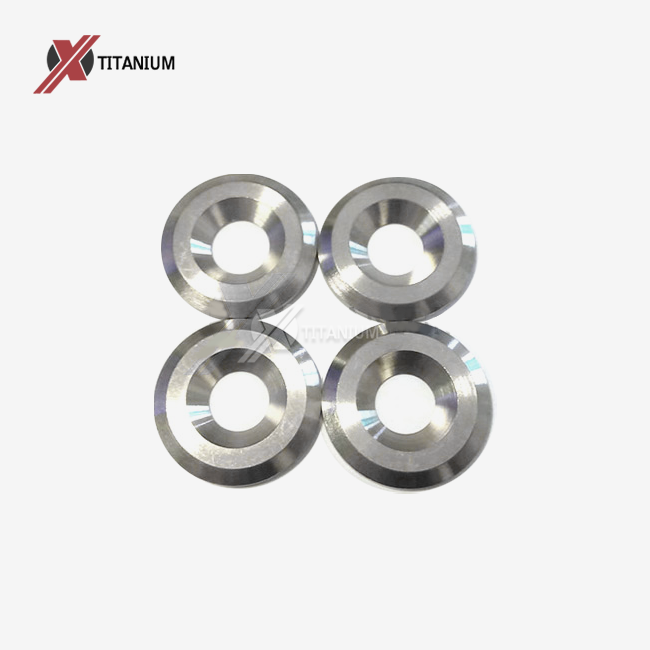
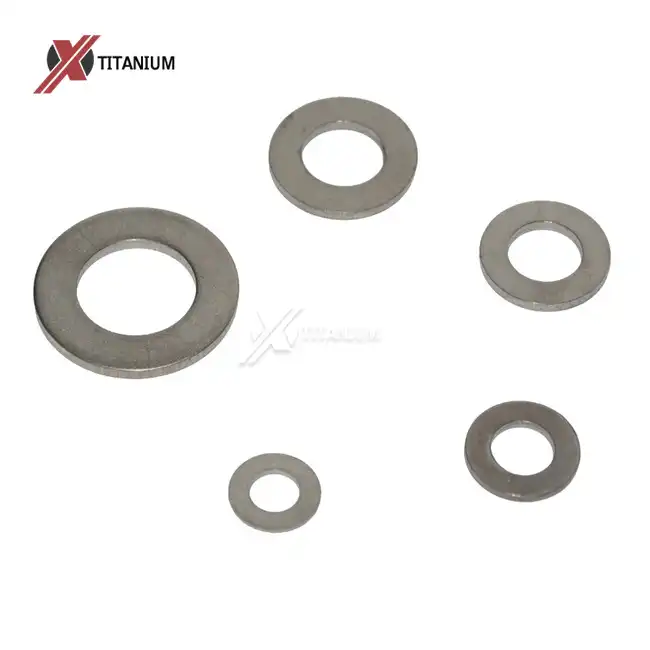
Titanium countersunk washers are a unique way to attach things. They have a conical bearing surface that fits flush with or slightly pushed into materials when they are used with countersunk screws. These precision-machined parts have great strength-to-weight ratios, great resistance to corrosion, and great load spread across key points. These washers, which are made from Grade 2 or Grade 5 titanium alloys, get rid of surface protrusions that get in the way of aerodynamic profiles. They also stop galvanic corrosion in assemblies made of more than one material, which is a problem that keeps coming up in high-reliability manufacturing, aerospace, and marine environments.
Understanding Titanium Countersunk Washers: Key Features and Benefits
What Makes Titanium Countersunk Washers Different?
Titanium countersunk washers are different from regular flat washers because they have a carefully machined angled profile that fits the shape of countersunk bolt heads. This profile is usually 90° or 100° aerospace standards. With this design, the washer can spread binding loads over a larger bearing area while still having a smooth surface. The technical reason is to get rid of stress clusters that happen when screws touch thin panels or composite materials directly.
These parts are made by CNC cutting, which keeps the dimensions within the ranges that are necessary for a good fit. With a tensile strength of 275 MPa and a yield strength of 250 MPa, Grade 2 titanium is very easy to shape and is good for moderate-stress uses. The tensile strength of Grade 5 titanium alloy (Ti-6Al-4V) is 895 MPa, and the yield strength is 828 MPa. This makes it the best choice for structural systems that are subject to changing loads or high temperatures.
Core Performance Advantages
Titanium's natural properties make it a better material for a measured range of demanding uses. Titanium washers are about 40% lighter than stainless steel parts of the same size and shape because they have a density of only 4.51 g/cm³. This directly helps the aircraft and car industries reach their weight reduction goals. This huge mass savings is especially noticeable in parts with hundreds or thousands of fixing points.
Perhaps the most important feature is its resistance to corrosion. Titanium naturally creates a solid, self-healing layer of titanium dioxide that keeps chemicals from attacking the base metal in saltwater, acidic workplaces, and places with a lot of humidity. This passive oxide layer heals itself if it gets damaged, giving long-lasting security that chloride-rich conditions make stainless steel unsuitable. Marine experts always say that underwater uses use parts that last longer than 20 years, while stainless steel parts need to be replaced every 5 to 7 years.
Temperature consistency greatly increases the range of operations that can be done. Grade 5 titanium stays mechanically sound at temperatures close to 400°C and is still strong enough to use at very low temperatures, almost zero degrees Celsius. This temperature range is very important for aircraft uses because parts can go from -180°C in high-altitude flying to 300°C close to engine assemblies.
Enhanced Load Distribution Characteristics
Beyond being aesthetically pleasing, the cylindrical shape is very important for practical reasons. When placed correctly, the curved bearing surface makes a progressive load transfer that keeps point loads to a minimum on structures with thin walls or materials that are easy to break, such as carbon fiber composites. Engineering studies show that when flat washers are used with countersunk screws, peak stress densities are 35–50% higher than when countersunk washers are used. This makes it much less likely that the panel will bend or delaminate.
This way of distributing stress is especially helpful in composite parts, where cutting makes areas with a lot of resin that can break under pressure. The titanium washer protects the interface by spreading the preload on the bolt over a bigger annular area. This stops the bearings from wearing out over time, which shortens the joint's service life.
Comparing Titanium Countersunk Washers with Other Materials
Titanium Versus Stainless Steel
Titanium countersunk washers are often considered as an option by procurement managers because stainless steel is easier to find and costs less. Even though 316-grade stainless steel is pretty resistant to rust in many settings, it doesn't hold up well when exposed to salt. Within 18 to 36 months, crevice corrosion, a localized attack that happens in protected areas under washer surfaces, breaks down stainless steel joints in naval uses. Because titanium doesn't fail in this way, it doesn't need to be maintained or replaced as often as rusted fixing systems do.
Comparing weights shows another important factor. With a mass of 8.0 g/cm³, titanium parts are as strong as stainless steel parts but only 44% as heavy. For plane makers who want to make their planes more fuel-efficient, this mass decrease directly means lower running costs over the life of the vehicle. Lifecycle cost studies done by third parties regularly show that titanium fastening systems break even faster than stainless steel alternatives within three to five years, when you count the total costs of ownership, which include repairs and replacements.
The difference in elastic elasticity also affects how the joint moves. Titanium is not as stiff as stainless steel (193 GPa vs. 114 GPa), which makes bolted parts a little more flexible. This helps with thermal growth mismatches between different materials without creating too many leftover stresses.
Performance Against Aluminum and Other Lightweight Alloys
When reducing weight is important for design, aluminum washers are a good choice. Aerospace-grade aluminum alloys are very strong for how light they are, and they are also a lot cheaper than titanium. In electrical compatibility, the important limit shows up. In the presence of an electrolyte, increased galvanic corrosion quickly breaks down aluminum parts that come into touch with more noble metals, such as stainless steel bolts.
Titanium is in a place in the electrochemical series called "galvanically neutral," which means that it has almost no galvanic potential difference with other structure metals. Because of this, titanium washers can work safely in systems with different materials without needing special coatings to keep them from conducting electricity or complicated methods to stop rusting. Marine engineers often choose titanium contact parts because they don't cause galvanic corrosion problems in metal hulls and superstructures.
Another thing that sets them apart is their ability to keep their strength when exposed to the surroundings. When aluminum is exposed to alkaline solutions for a long time, like in chemical processing areas, its protective oxide layer breaks down. This causes pitting and a loss of strength. Titanium keeps its mechanical qualities even when the pH level changes from 3 to 12. This means it can be used in process equipment that will be exposed to chemicals for a long time.
Practical Applications and Industry Uses of Titanium Countersunk Washers
Aerospace and Aviation Implementation
Titanium countersunk washers are used a lot by aircraft makers on fuselage skin panels, access doors, and aerodynamic fairings, where smooth surfaces are needed to keep airflow smooth. The washer does two things: it spreads out the load on the fasteners to keep thin aluminum skins from dimples, and it also protects against rust, which means that inspections can be put off longer.
Commercial transport planes usually have between two and three million screws, and about forty percent of these are countersunk installs. Using titanium washers in places with a lot of stress, like landing gear doors, wing root fairings, and empennage attaches, fixes parts that are about to fail and should be made of high-quality materials. From service records from major airplane makers, we can see that titanium fastening systems last three to four times longer than traditional steel parts in these situations.
When they make parts for engines, washers have to work in very tough conditions. They have to handle vibrations, changes in temperature, and sometimes being exposed to results of burning. Because Grade 5 titanium alloy (Ti-6Al-4V) stays strong at high temperatures and doesn't vibrate easily, it is the best material for turbine case parts and mounting tools where lowering weight directly raises thrust-to-weight ratios.
Marine and Subsea Engineering Solutions
Yacht makers and marine planners use titanium countersunk washers for installing deck gear like cleats, winch bases, and railing stanchions. The quality of the fastening directly affects the safety of the crew. The flush installation stops snagging risks and gets rid of the rust weeping that makes the building look bad and damages nearby structures. Designers of racing yachts like to save weight on deck gear that is high above the waterline because less mass there means better steadiness and performance.
When subsea equipment is used in deep water, where the hydraulic pressure is over 200 bar and the water is always saturated, the makers face a lot of problems. Titanium fastening systems are used in Remotely Operated Vehicle (ROV) systems, underwater manifolds, and pipeline equipment. These systems are designed to last 20 to 30 years without needing expensive upkeep. When intervention costs for offshore support boats go over $500k per day, it's easy to see the economic benefit.
Chemical Processing and Industrial Equipment
When designing process equipment that will be used with acidic media like sulfuric acid, hydrochloric acid, and sodium hydroxide solutions, it can be hard to choose the right materials because most metals break down quickly. Even high-quality stainless steels corrode at rates that can be measured in places where heat exchanger units, reactor vessel closures, and pipe system flanges are used.
Titanium countersunk washers make gasketed joints reliable for closing, and they don't react with chemicals that would weaken the joint's integrity. The washers stop galvanic rust between titanium flanges and stainless steel bolting, which is a typical way for things to fail that plant engineers try to avoid by carefully choosing the materials. When titanium fastening systems are used instead of regular gear in sour gas service and other highly corrosive situations, refinery owners say their repair costs drop by 60 to 75 percent.
Medical Device and Implantable Systems
Biomedical engineers who make surgery tools and implantable devices need materials that are biocompatible and can withstand being sterilized over and over again. Grade 2 titanium passes the biocompatibility standards set by ISO 10993 and doesn't corrode or pit when sterilized in an autoclave using high-temperature steam and cleaning products that contain chloride.
Orthopedic implant kits, such as spine fixation systems, joint replacement prosthetics, and trauma plates, are using titanium fastening components more and more because they are strong, biocompatible, and radiolucent (can show through X-rays). With the countersunk shape, bone plates can sit flush against skeletal structures, so there are no pressure spots that could irritate soft tissues.
Procurement Considerations for Titanium Countersunk Washers
Specification Development and Dimensional Selection
Creating specifications for titanium countersunk washers requires the design engineering, quality testing, and procurement teams to work together. Important factors include the outer diameter (6mm to 50mm in our normal range), the inner diameter (3mm to 20mm) that matches the fastener shank size, and the thickness (0.5mm to 5mm) that is based on the load study. The countersink angle needs to match the shape of the fastener head. According to aircraft guidelines, the most typical angles are 90° and 100°.
The choice of material grade relies on the needs of the product. Grade 2 pure titanium is the most resistant to corrosion and is also very easy to shape. This makes it a good choice for chemical processing and naval gear where reasonable strength is enough. Grade 5 titanium alloy (Ti-6Al-4V) has much better mechanical properties than Grade 2—349 HV hardness compared to 160 HV for Grade 2—and is needed for structural aircraft uses and high-performance car parts that are subject to large dynamic loads.
Surface cleaning choices make things work better in certain situations. Surfaces that have been polished reduce friction and make exposed parts look better. Anodizing makes a controlled oxide layer that can give Type II wear protection (AMS 2488) or color through interference effects for decoration. Natural titanium, gold, blue, green, purple, black, and rainbow finishes are all anodized colors that can be chosen. Coating thicknesses range from 30nm to 300nm, based on the color depth and longevity needs.
Supplier Evaluation and Quality Verification
To find good suppliers, you need to look at their manufacturing skills, quality control systems, and technical help resources. Certified makers in your field, like AS9100 for aircraft suppliers, ISO 13485 for medical device parts, or ISO 9001 as a general quality standard, should keep their certifications up to date. These certificates show that the manufacturing process has the right rules for measuring accurately, tracking materials, and keeping records.
Due to differences in grade and the presence of fake materials in some supply lines, material proof paperwork is especially important for titanium parts. Reliable providers give mill test records that show the chemical makeup, mechanical properties, and history of heat treatment for each lot of material. Third-party testing options, such as spectroscopic analysis, hardness testing, and physical inspection reports, provide extra assurance for important uses.
When it comes to technical help, sellers who work as strategic partners are different from those who only do business with you. For complicated uses, it's helpful if providers offer engineering advice on choosing materials, finite element analysis of load distribution, and failure analysis support in case problems arise in the field. Baoji Chuanglian New Metal Material Co., Ltd. has its own research staff and testing tools to help customers with all stages of product creation, from making the first prototype to increasing production levels.
Customization Options and Order Quantities
While standard stock sizes work for many common uses, specialized equipment often needs custom sizes or special features. The ability to use CNC machines to make washers with non-standard sizes, custom countersink angles, or features like tabs and keyways to limit movement is possible. For brand branding or code systems, custom anodizing can match specific color needs.
Order number factors balance the costs of keeping goods with the costs of selling each unit and the time needed for delivery. Because titanium is a very expensive material, unit prices go down a lot as more is bought. Usually, when you buy 1,000 or more pieces, the cost goes down by 20 to 30 percent compared to when you buy less. However, minimum order numbers and setup fees for custom specs may make it hard for development projects with limited funds to afford large quantities of prototypes.
We help our customers set up orders in a way that saves them money while still allowing us to handle their supplies well. Blanket purchase orders with planned releases let you get discounts for buying in bulk while keeping your inventory levels low enough to handle. With consignment inventory programs, high-usage things are kept in stock at customer sites. This makes production more flexible without requiring a big investment in capital.
Installation, Maintenance, and Long-Term Performance
Proper Installation Procedures
To get the best performance from titanium countersunk washers, you need to pay attention to the little things during installation that make sure the load is spread out evenly and keep the washer and its surroundings from getting damaged. To make the countersunk hole fit the washer's angular shape, the diameter must be cut to within ±0.1mm of the actual diameter. When holes are too big or too small, they create uneven bearings that can cause the washer to tilt and stress to build up in certain areas.
How the surface of the joining base is prepared affects how well the joint stays together over time. To keep the screw surface from getting scratched during fitting, get rid of any burrs or sharp edges that are in the countersunk holes. Thoroughly clean surfaces to get rid of any dirt, oils, cutting fluids, or corrosion products that might get in the way of proper sitting or create places for pocket corrosion to start.
When applying torque, you should follow the set steps for that particular bolt system. Because titanium doesn't have as much elastic stiffness as steel, joints need to be carefully torque-controlled to get the right preload without going over the fastener's yield strength. Torque wrenches that are set to within ±3% of the true value help keep things the same across multiple joints. When fixing important structural parts, torque-and-angle methods are better at controlling the preload than torque-only specs.
Maintenance Protocols and Inspection Intervals
Titanium doesn't rust, so fixing systems made of it usually don't need as much upkeep as systems made of other materials. Visual inspections should still be done on a regular basis to find problems before they become too big to fix. How often something is inspected depends on how important it is. For example, airplane makers check important structures every 500 to 1,000 flight hours as part of routine maintenance. On the other hand, marine hardware might be inspected once a year during haul-out plans.
Mechanical wear, rust at metal-to-metal surfaces, and proper fastener preload retention should all be part of the inspection criteria. Surface discoloration or stains around fastener heads could mean that water is getting in or that crevice rust is starting to form in the materials nearby. When inspections find loose bolts, they need to be looked into to see if the original torque wasn't enough or if vibrations have caused preload loss.
When cleaning, rough abrasives that could damage the protected oxide layer should not be used. Mild detergents and soft brushes can get rid of built-up dirt and grime without hurting the metal surface. When cleaning parts made of different metals, don't use chlorinated cleaning products because the chlorides that are left behind can speed up galvanic rusting at the edges of the materials.
Quality Assurance and Performance Validation
Strong quality procedures make sure that parts meet the requirements of the specifications before they are put into service. As part of the incoming inspection process, standardized measuring tools like micrometers for thickness, pin gauges for inner diameter, and optical comparators for countersink angle proof should be used to check the accuracy of the dimensions. For big production lots, statistical sample plans balance how thorough the inspections are with how much they cost.
Portable X-ray fluorescence (XRF) analyzers are used to check the material to make sure it is titanium and find any possible material substitutions. This non-destructive testing only takes seconds per part and gives you instant proof that the Grade 5 material you ordered actually has the right Ti-6Al-4V makeup and wasn't just pure titanium to save money.
Performance testing confirms that something will last for a long time in real-life business situations. Testing with salt spray according to ASTM B117 shows that titanium parts that were made correctly can usually go over 1,000 hours without red rust forming. Tensile loading of completed joints to check load distribution and fatigue cycling to model vibration exposure are two types of mechanical testing that give information that helps designers figure out how long something will last and how often it needs to be maintained.
Conclusion
In challenging situations where regular materials don't work well, titanium countersunk washers show significant performance improvements. When you combine excellent corrosion protection, significant weight reduction, and better strength-to-weight ratios, you get solutions to important problems in aerospace, marine, chemical processing, and medical device making. Even though the original prices of the materials are higher than those of other options, lifecycle cost analysis constantly shows that there are economic benefits through longer service lives, less upkeep, and no failures caused by corrosion. These benefits will be effective in the field and meet the high standards of high-performance engineering uses if the right specifications are made, suppliers are chosen, and installation steps are taken.
FAQ
Q1: What industries benefit most from titanium countersunk washers?
A: Titanium fixing systems are most useful for businesses that make aerospace parts, marine engineering work, chemical processing plants, and medical devices. Titanium's special qualities make it worth the extra cost compared to other materials in these areas because they have to work with saltwater, chemicals that eat away at metal, high temperatures, or biocompatibility standards.
Q2: How do I determine the correct size and grade for my application?
A: Make sure that the washer's inner circle is the same size as the fastening shank, leaving about 0.2 to 0.5 mm of space. The outer diameter and thickness rely on the thickness of the base and the load that needs to be carried. In general, thinner panels need bigger bearing areas to keep them from pulling through. For most corrosion-resistant uses, Grade 2 is best, and Grade 5 titanium alloy (Ti-6Al-4V) is best for high-stress structure needs. Talking to experienced providers can help you make the best choice based on these factors.
Q3: Can titanium washers be used with stainless steel fasteners?
A: Titanium works well with stainless steel in most situations because they don't conduct electricity differently. Because these materials have a similar electrochemical potential, galvanic corrosion is less likely to happen. This makes the mix good for use in both maritime and commercial settings. This combination works better than using stainless steel washers with aluminum frames, which causes rusting to happen faster because of the strong galvanic potential.
Partner with a Trusted Titanium Countersunk Washer Manufacturer
Since 2008, Baoji Chuanglian New Metal Material Co., Ltd. has been manufacturing high-quality titanium fastening solutions in Baoji, China, which is known as the "City of Titanium." Our CNC machining capabilities allow us to provide titanium countersunk washers in Grade 2 and Grade 5 titanium in sizes ranging from M3 to M20, and we can also make them to your exact specifications. We have strict quality control throughout the whole production process, from checking the raw materials to doing the final inspection. This makes sure that the dimensions and features of the materials are always the same.
Our expert team helps engineers choose the right materials, specify the right surface treatments, and find the best ways to use them. We provide dependable supply chain performance that meets your quality and delivery standards, no matter if you need a small number of prototypes for a new product or a lot of production materials for a well-established manufacturing program. Get in touch with our engineering team at info@cltifastener.com or djy6580@aliyun.com to talk about your titanium countersunk washer needs and find out how our services can help your project success. You can look at our full line of titanium fastening options at cl-titanium.com and ask for technical paperwork to help you with your evaluation.
References
1. Boyer, R., Welsch, G., & Collings, E.W. (1994). Materials Properties Handbook: Titanium Alloys. ASM International, Materials Park, Ohio.
2. Schutz, R.W. & Watkins, H.B. (1998). Recent developments in titanium alloy application in the energy industry. Materials Science and Engineering: A, 243(1-2), 305-315.
3. Donachie, M.J. (2000). Titanium: A Technical Guide, 2nd Edition. ASM International, Materials Park, Ohio.
4. Peters, M., Kumpfert, J., Ward, C.H., & Leyens, C. (2003). Titanium Alloys for Aerospace Applications. Advanced Engineering Materials, 5(6), 419-427.
5. Cotton, J.D., Briggs, R.D., Boyer, R.R., Tamirisakandala, S., Russo, P., Shchetnikov, N., & Fanning, J.C. (2015). State of the Art in Beta Titanium Alloys for Airframe Applications. Journal of the Minerals, Metals and Materials Society, 67(6), 1281-1303.
6. American Society for Testing and Materials (2021). ASTM B381: Standard Specification for Titanium and Titanium Alloy Forgings. ASTM International, West Conshohocken, Pennsylvania.
Learn about our latest products and discounts through SMS or email