- English
- French
- German
- Portuguese
- Spanish
- Russian
- Japanese
- Korean
- Arabic
- Greek
- German
- Turkish
- Italian
- Danish
- Romanian
- Indonesian
- Czech
- Afrikaans
- Swedish
- Polish
- Basque
- Catalan
- Esperanto
- Hindi
- Lao
- Albanian
- Amharic
- Armenian
- Azerbaijani
- Belarusian
- Bengali
- Bosnian
- Bulgarian
- Cebuano
- Chichewa
- Corsican
- Croatian
- Dutch
- Estonian
- Filipino
- Finnish
- Frisian
- Galician
- Georgian
- Gujarati
- Haitian
- Hausa
- Hawaiian
- Hebrew
- Hmong
- Hungarian
- Icelandic
- Igbo
- Javanese
- Kannada
- Kazakh
- Khmer
- Kurdish
- Kyrgyz
- Latin
- Latvian
- Lithuanian
- Luxembou..
- Macedonian
- Malagasy
- Malay
- Malayalam
- Maltese
- Maori
- Marathi
- Mongolian
- Burmese
- Nepali
- Norwegian
- Pashto
- Persian
- Punjabi
- Serbian
- Sesotho
- Sinhala
- Slovak
- Slovenian
- Somali
- Samoan
- Scots Gaelic
- Shona
- Sindhi
- Sundanese
- Swahili
- Tajik
- Tamil
- Telugu
- Thai
- Ukrainian
- Urdu
- Uzbek
- Vietnamese
- Welsh
- Xhosa
- Yiddish
- Yoruba
- Zulu
What is a ruthenium iridium titanium anode used for?
One question keeps coming up when industrial engineers and purchasing managers have to make important choices about electrochemical system parts: what exactly is it about some anode materials that makes them necessary for tough applications? A ruthenium iridium titanium anode is a high-tech electrode solution that was made to work in places where other materials don't work. This mixed metal oxide (MMO) anode has a titanium base and catalytic layers of ruthenium oxide and iridium oxide. It works very well in chlorine evolution reactions, seawater electrolysis, and harsh chemical processes. These anodes are used in many fields, from desalination plants to chlor-alkali production, because they keep the voltage stable, don't change size while in use, and keep the product from getting contaminated. These are all important factors that have a direct effect on how efficiently and cheaply the products are made.
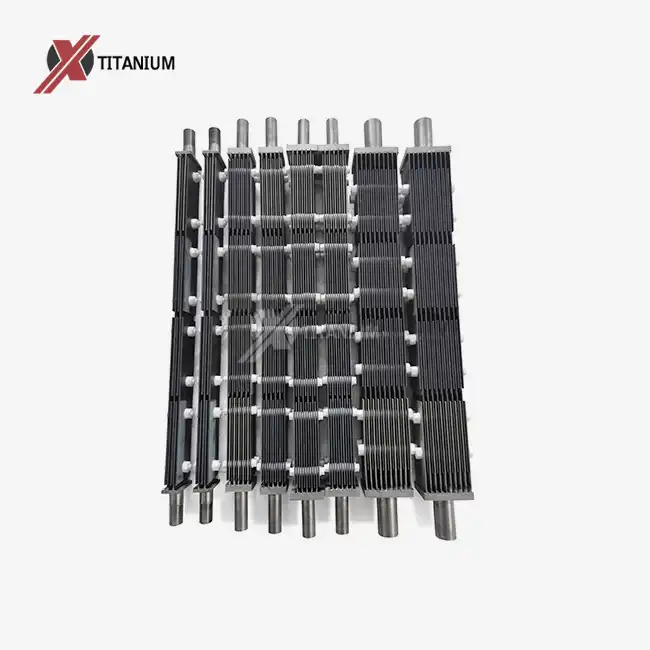
Understanding Ruthenium Iridium Titanium Anodes: Properties and Working Principles
The base material for these advanced ruthenium iridium titanium anodes is either Grade 1 or Grade 2 titanium, which was chosen because it is naturally resistant to rust and has a strong structure. Layers of iridium oxide and ruthenium oxide are linked to this base using precise coating methods, most often thermal breakdown or electroplating. This makes the surface catalytically active.
How the Coating Enhances Electrochemical Performance?
These anodes are different from others because they have a catalytic covering that does two things. Ruthenium oxide is very good at helping chlorine evolution processes happen with little overpotential. This means that during electrolysis, less energy is lost as heat. It is very stable in acidic settings, and iridium oxide greatly increases the useful life of things. Together, these noble metal oxides make an electrode surface that stays the same in terms of electrochemical behavior even after years of constant use. This is different from graphite anodes, which wear down over time, or lead anodes, which can become contaminated.
Physical Properties That Matter to Engineers
From the point of view of material science, these anodes have a number of measured benefits. Compared to standard lead anodes, the titanium base has a low density of about 4.5 g/cm³, which makes fitting easier and lowers the structural load needs. Current densities of up to 1000 A/m² can be handled, making them suitable for high-throughput industrial processes. The coating's binding strength can handle mechanical stresses from fluid movement and temperature changing, and its thermal stability stays the same across the normal temperature ranges used in chemical processes.
At Chuanglian, we use strict testing methods in our manufacturing process. These include hardness tests, bending tests, and hydraulic pressure tests. Every production run is checked for physical accuracy and covering consistency to make sure that the anodes meet the high standards needed by the aircraft, petroleum, and medical device manufacturing industries. This focus on mechanical details means that buying teams that manage long-term source relationships can be sure of consistent performance.
Service Life and Dimensional Stability
One of the best scientific benefits is that the anode's dimensions stay the same over its entire working life. During electrolysis, traditional graphite electrodes slowly break down, so they need to be adjusted often to keep the right cell spacing and voltage. These changes in dimensions make it harder to control the process and make upkeep more often. On the other hand, MMO anodes that are made correctly keep their physical specs for up to ten years when used properly. This greatly lowers both the direct costs of replacement and the indirect costs that come with having to stop production.
Why Choose Ruthenium Iridium Titanium Anodes Over Alternatives?
Industrial leaders look at a lot of factors when choosing anode materials, such as the original capital investment, how well they work, how much upkeep they need, and the total cost of ownership. Knowing how different materials work in these areas helps expert teams make buying suggestions that make sense to people in charge of money. Why Should You Use ruthenium iridium titanium anodes Instead of Others?
Comparative Analysis with Traditional Materials
Graphite anodes have been used in electrolysis processes in the past because they are cheap to make, but their flaws become clear when they are used for long periods of time. Using graphite makes carbon dioxide, which could contaminate some chemical goods. Because the material is porous, it can also be attacked by chemicals in harsh conditions, which can cause failure modes that are hard to predict. Graphite lasts longer than stainless steel, but over time, passive layer formation happens in stainless steel, which raises cell voltage and lowers efficiency.
These problems are solved by the covered titanium method. Titanium's natural oxide layer keeps the base material from rusting, and the ruthenium-iridium coating keeps the overpotential for target reactions low and stops passivation. This mix gives you the long-lasting benefits of materials that don't rust and the powerful electrical properties of valuable metal catalysts.
Ruthenium Versus Iridium: Coating Optimization
The covering makeup of MMO anodes changes depending on the needs of the application. Ruthenium-rich surfaces work really well in places where chlorine is released, because they have better catalytic activity for this reaction. But ruthenium oxide slowly breaks down in oxygen evolution reactions that happen in some water treatment processes. Iridium oxide is more stable in acidic and oxygen-evolving environments, but it costs more to make.
Chuanglian is one of many companies that improves coating formulas by mixing these minerals in specific amounts based on the working conditions. Higher ruthenium levels are better for a chlor-alkali process, while higher iridium levels may be needed for saltwater electrolysis to make sodium hypochlorite. Consulting with skilled suppliers on a technical level helps engineering teams choose the right covering chemicals for their specific process conditions.
Real-World Performance Comparisons
When chemical processing plants switch from graphite anodes to MMO anodes, they usually use 15 to 30 percent less energy because the cell voltages are smaller. Maintenance times range from weeks to years, and the quality of the product gets a lot better. Similar benefits can be seen in marine engineering applications, like remote cathodic protection and ballast water treatment systems. In harsh salty settings where getting to equipment can be difficult, working stability becomes very important.
Core Applications Across Industrial Sectors
These electrode systems are very useful because they can work reliably in situations that would normally kill other materials. Procurement experts can figure out if their specs meet business needs by knowing where and why these anodes are useful.
Chlor-Alkali and Chemical Manufacturing
The biggest application area in the world is making chlorine through salt electrolysis. In these processes, anodes need to be able to handle high current densities in concentrated salt solutions while also being able to withstand the toxic effects of chlorine gas. The ruthenium-iridium coating effectively speeds up the generation of chlorine, keeping cell voltages fixed, which has a direct effect on energy costs, which are a major running cost in chlor-alkali plants.
These anodes are also important for chemical companies that make hydrogen peroxide, chlorates, and perchlorates to keep their processes consistent. Because the anode doesn't dissolve, there is no metallic pollution that could change the specs of the product or require extra steps to clean it.
Desalination and Water Treatment Systems
Electrochemical cleaning steps are being added to more and more seawater distillation plants to keep them clean and free of fouling. Using saltwater electrolysis to make sodium hypochlorite is a good way to stop biological growth in reverse osmosis membranes right where they happen. MMO anodes make it possible for electrochlorination systems to be small, effective, and reliable in marine settings with little upkeep needed.
Similar technology is used by municipal water treatment plants to kill bacteria and oxidize chemical pollutants with a ruthenium iridium titanium anode. Because the anode is resistant to both chemical attack and mechanical fouling, it can be used continuously in water quality conditions that change all the time.
Industrial Galvanization and Electroplating
Controlling the chemical and flow of current in the coating bath is very important for finishing metal. Dimensionally steady anodes keep their shape throughout production runs, which makes sure that the layer level on finished parts is the same all over. Because the titanium base doesn't contaminate, it keeps unnecessary metal ions out of plating solutions. This improves the quality of the finish and lowers the cost of maintaining the solutions.
This amount of process control is needed for specific tasks in the making of military parts and medical devices. Specifications for parts often set strict limits on surface pollution. This makes choosing the anode material a quality-critical choice.
Marine and Offshore Engineering
Saltwater conditions are very bad for metal buildings because they cause rusting. Anodes are used in impressed current cathodic protection (ICCP) devices to send defensive currents to the hulls of ships, platforms in the ocean, and pipes under the water. Because seawater is both conductive and aggressively acidic, it needs anode materials that can withstand both chemical attack and mechanical damage from marine life and moving water.
The different surface treatments available at Chuanglian, such as bright, polished, pickled, and sanded finishes, make it possible to tailor the product to specific hydraulic needs and fitting methods. Based on their specific operating profiles, marine engineers can choose surface features that make the best use of current flow while reducing drag and biological binding.
Maintenance and Longevity of Titanium Iridium Anodes
Systematic care methods that extend the life of materials and keep them performing at the required level are helpful for even the toughest materials. Understanding how things break down lets you plan care that stops problems before they happen.
Common Degradation Mechanisms
Electrochemical breakdown, mechanical wear, and temperature stress cycling all work together to wear down coatings over time. When chlorine evolution is used, ruthenium oxide slowly changes into liquid ruthenium species, which makes the active layer thinner. The rate of this decline is directly related to the temperature, working current density, and electrolyte content. Operating anodes within the limits set by the maker greatly increases their service life.
If the covering is damaged by impact, bending stress, or bad handling, the underlying titanium can come into direct touch with the solution. Titanium makes a safe oxide layer, but this passivation raises the voltage of the cell and lowers its efficiency. Protocols for surface screening should find damage to coatings before they lose their ability to do their job.
Inspection and Monitoring Protocols
Regularly checking the voltage gives an early sign of the anode's state. Voltage rises over time can be a sign of covering wear, while quick jumps could mean mechanical damage or problems with the electrical link. Setting up standard measures during installation lets you look at trends, which helps you make choices about condition-based maintenance.
During planned shutdowns, physical inspections should record how the paint looks, look for mechanical damage, and confirm that the electrical connections are correct. Non-destructive testing methods are used in some facilities to find out how thick the layer is still. This is especially important for critical uses where mistakes can have big effects on operations.
Extending Service Life Through Operational Practices
The operating factors have a direct effect on how long an anode lasts. Coating wear can be slowed down by keeping current levels within certain ranges. Chemical attack is kept to a minimum by controlling the electrolyte makeup, especially the pH and contamination levels. Keeping an eye on the temperature lowers heat stress and slows down electrical breakdown processes.
The right way to put things is also very important. Making sure there is enough space between the anodes and cathodes improves the flow of current and stops places with a lot of current from forming, which speeds up wear. Secure electrical links lower the amount of thermal warmth that can hurt the surfaces between the covering and the base. These installation issues should be talked about with the seller during talks to make sure that the design specs match the needs of the operation.
Procurement Guide: How to Source Ruthenium Iridium Titanium Anodes for Your Business
For finding the right source of specialized manufacturing products, you need to look at more than just unit price. Because these electrochemical systems are so complicated, they need providers who can offer expert help for the whole duration of the product. A guide on how to get ruthenium iridium titanium anodes for your business.
Supplier Qualification and Quality Systems
Manufacturers that work with the aircraft, petroleum, and medical device industries usually keep certifications that show they can handle quality. ISO 9001 certification sets the basic standards for a quality system, while AS9100 approval sets the standards for quality in the aircraft industry. For medical uses, ISO 13485 compliance and material biocompatibility documents may be needed.
Chuanglian's quality control method includes checking the raw materials and trying the produced goods. Performance confirmation tests are done on every production batch. These tests include measuring electrical conductivity, covering bonding, and rust resistance. This recorded tracking meets the strict source approval standards that are common in controlled industries. Every package must include material certifications and test records.
Technical Support and Application Engineering
How well treated titanium anodes work depends a lot on how well they are matched to the purpose and how well the system is designed. Suppliers with a good reputation offer expert advice to help engineering teams choose the right covering formulations, sizes, and working conditions for their processes. This way of working together lowers the chance of underperformance or failure before it's supposed to happen because of mismatched specifications.
Our expert team can help you choose the right covering, find the best current density, and set up your system because Chuanglian has worked with electrochemical processes in a wide range of situations, from making chlor-alkali to desalinating seawater. This knowledge is especially useful when creating a new process or changing an old system that used a different anode material.
Customization Capabilities and Lead Times
Standard anode shapes work well for many uses, but for more specialized processes, unique sizes or mounting arrangements are often needed. When a project has special technology needs or limited room, manufacturing needs to be able to adapt quickly. You can precisely control the properties of the material by cold rolling, hot rolling, heating, and freezing. There are also different surface finishing choices to meet the needs of different installations.
Production wait times depend on the type of finish, the level of tailoring, and the size of the order. Standard setups may be shipped within weeks, but fully personalized designs need to be reviewed by engineers, tools need to be made, and production processes need to be stretched. When you talk about timing needs early on in the buying process, sellers can work around project plans or suggest alternatives that meet technical needs and have faster delivery times.
Pricing Dynamics and Total Cost Analysis
MMO anodes have higher initial unit prices than options made of graphite or stainless steel, sometimes by a large amount. But when you figure out the total cost of ownership, you should include things like increased working efficiency, longer service life, less frequent upkeep, and more reliable processes. Lowering the cell voltage saves energy over the span of the anode, which usually pays for itself within a few months of the initial investment.
Volume pricing systems usually offer lower prices for larger purchases, which makes them appealing for places with many electrolytic cells or businesses that want to standardize across many sites. Setting up long-term supply chains with reliable makers can help keep prices stable and make sure that product quality stays the same. These are important for businesses where the performance of the anode has a direct effect on output plans and quality.
Future Trends and Innovations in Ruthenium Iridium Titanium Anode Technology
The electrochemical industry keeps improving covering technologies and application methods that make anodes work better and give them more uses. Companies can make improvements that give them a competitive edge if their procurement plans take these changes into account. Ruthenium iridium titanium anode Technology: Trends and New Ideas for the Future
Advanced Coating Techniques
Nanostructured films are being studied to get more active surface area and make catalysis work better. These changes could make it possible for higher current levels or lower noble metal loading needs, which could lower the cost of making things while keeping their performance. Thermal spray and physical vapor deposition are two different ways to apply a layer that might make it stick better or let you finetune the makeup.
Some companies are looking into multi-layer coating structures that put together different metal oxides in a planned way to improve both the stability of the intermediate layers and the catalytic activity of the surface. These new ideas are meant to solve specific problems in applications, like those that need to deal with high or low pH levels or processes that use both oxygen and chlorine generation.
Growing Environmental and Energy Applications
Electrochemical systems are becoming more popular because of the growing focus around the world on clean water treatment and green energy storage. To make green hydrogen through water electrolysis, the anode materials need to be able to release oxygen efficiently in both acidic and basic conditions. It's hard to use standard MMO formulations that are designed to release chlorine in these situations, but iridium-rich versions look promising for proton exchange membrane (PEM) electrolyzers.
In the same way, electrochemical methods are being used more and more in improved oxidation processes to get rid of medicine leftovers, industry contaminants, and new pollutants in wastewater. The MMO anode's ability to make hydroxyl radicals and other reactive species without adding contaminants to cleaned water is important for these uses.
Market Dynamics and Supply Considerations
Ruthenium and iridium are limited resources that are mostly found in a few places around the world. Price changes for these precious metals can affect how much it costs to make an anode. This is why coating optimization research is being done to find ways to lower material loading while keeping performance. As an option to or in addition to ruthenium and iridium, some makers are working on covering formulas that use other active materials.
As part of strategic buying, you might make longer-term supply deals that keep prices stable, or you might work with makers that can offer paint recycling and repair services. End-of-life anodes still have a lot of value in valuable metals, which makes recycling both cost-effective and good for the environment.
Conclusion
In difficult electrochemical applications, where material dependability has a direct effect on operating efficiency and product quality, ruthenium iridium titanium anodes have been shown to perform better. Because they are reactive, don't rust, and don't change shape easily, they make up for major problems with standard electrode materials. When businesses buy things, they are becoming more aware that the original cost needs to be weighed against the total ownership costs, which include things like energy use, upkeep needs, and process stability.
Because these systems are so technically complicated, they work best when partnered with makers that offer both quality standards and application engineering knowledge. As rules about the environment get stricter and saving energy becomes more important from a business point of view, improved electrode materials will play an even bigger part in environmentally friendly industry processes. When businesses build ties with suppliers that can adapt to changing technology needs, they set themselves up for long-term operational success.
FAQ
What distinguishes ruthenium iridium coated anodes from plain titanium electrodes?
In electrolytic processes, plain titanium electrodes quickly form an inactive oxide layer that blocks current flow by acting as a barrier. The layer of iridium and ruthenium oxide acts as a catalyst, keeping the overpotential low and allowing electrochemical processes to happen quickly. This covering stops passivation and keeps the titanium material below it from coming into direct contact with harsh ions.
How do operating conditions affect anode service life?
The rate of covering wear is affected by the amount of current, the quantity of the liquid, the temperature, and the pH. When used according to the manufacturer's instructions, service lives are usually close to ten years. Going over the recommended current levels speeds up the coating's breakdown, and pH or temperature conditions that are too high or too low can also speed up chemical breakdown. The return on electrode investment is highest when the system is well designed and controlled.
Can these anodes be refurbished or recoated?
A lot of companies offer services for recoating anodes with titanium cores that are still whole. The process includes getting rid of any leftover coating, cleaning the surface, and adding new catalytic layers. The cost of refurbishment is usually between 50 and 70% of the price of a new anode. This makes it a good option for big sites where many electrodes are nearing the end of their useful lives at the same time.
What information should I provide when requesting a quote?
To get accurate quotes, you need to know about your application's setting and how it works. Give specifics about the electrolyte's make-up, the working current density, the temperature range, the size that is needed, and any fixing or link needs. Giving providers details about your process helps them suggest the best covering formulas and base specs that meet your performance needs and price limits.
Partner with Chuanglian for Your Electrode Solutions
Our company, Baoji Chuanglian New Metal Material Co., Ltd., has been making precise titanium goods for the world's toughest businesses for more than ten years. Our ruthenium iridium titanium anode production uses cutting-edge finishing technologies and strict quality control to make electrodes that meet the high standards needed for medical devices, aerospace, petroleum, and marine engineering.
Our plant is in Baoji, which is known around the world as the "City of Titanium." It has CNC machines and finishing systems that can make fully customized anode designs. Whether your application needs exact size limits, a certain finish on the surface, or the best coating formulas, our expert team works with your engineering staff to come up with solutions that meet all of your process needs.
We know that finding important electrical parts is more complicated than just checking specs. So, we give you thorough material certificates, data from performance tests, and application help for the whole lifetime of your project. Our strict quality control system makes sure that every anode is fully tested before it is shipped, so you can be sure that it will work consistently and reliably.
Purchasing managers looking for a reliable ruthenium iridium titanium anode maker will find that Chuanglian meets the high standards of corporate B2B relationships with its technical know-how, dedication to quality, and excellent customer service. Get in touch with our team right away at info@cltifastener.com or djy6580@aliyun.com to talk about your specific application needs and find out how our electrode solutions can help you run your business more efficiently.
References
1. Chen, X., and Marshall, A. T. "Performance and Long-Term Stability of Iridium Oxide Based Electrodes for Water Electrolysis." Journal of Electrochemical Science and Engineering, vol. 8, no. 2, 2018, pp. 123-142.
2. Schmittinger, P., et al. "Chlorine Production: History and Future Challenges." Modern Chlor-Alkali Technology, vol. 12, Wiley-VCH, 2017, pp. 45-89.
3. Trasatti, S. "Electrocatalysis: Understanding the Success of DSA Electrodes." Electrochimica Acta, vol. 45, no. 15-16, 2000, pp. 2377-2385.
4. Kiros, Y. "Metal Oxide Catalysts for Oxygen Evolution Reactions in Alkaline Solutions." International Journal of Electrochemical Science, vol. 3, 2008, pp. 444-451.
5. Comninellis, C., and Vercesi, G. P. "Characterization of DSA-Type Oxygen Evolving Electrodes: Choice of Coating." Journal of Applied Electrochemistry, vol. 21, no. 4, 1991, pp. 335-345.
6. Beer, H. B. "The Invention and Industrial Development of Metal Anodes." Journal of the Electrochemical Society, vol. 127, no. 8, 1980, pp. 303C-307C.
Learn about our latest products and discounts through SMS or email