- English
- French
- German
- Portuguese
- Spanish
- Russian
- Japanese
- Korean
- Arabic
- Greek
- German
- Turkish
- Italian
- Danish
- Romanian
- Indonesian
- Czech
- Afrikaans
- Swedish
- Polish
- Basque
- Catalan
- Esperanto
- Hindi
- Lao
- Albanian
- Amharic
- Armenian
- Azerbaijani
- Belarusian
- Bengali
- Bosnian
- Bulgarian
- Cebuano
- Chichewa
- Corsican
- Croatian
- Dutch
- Estonian
- Filipino
- Finnish
- Frisian
- Galician
- Georgian
- Gujarati
- Haitian
- Hausa
- Hawaiian
- Hebrew
- Hmong
- Hungarian
- Icelandic
- Igbo
- Javanese
- Kannada
- Kazakh
- Khmer
- Kurdish
- Kyrgyz
- Latin
- Latvian
- Lithuanian
- Luxembou..
- Macedonian
- Malagasy
- Malay
- Malayalam
- Maltese
- Maori
- Marathi
- Mongolian
- Burmese
- Nepali
- Norwegian
- Pashto
- Persian
- Punjabi
- Serbian
- Sesotho
- Sinhala
- Slovak
- Slovenian
- Somali
- Samoan
- Scots Gaelic
- Shona
- Sindhi
- Sundanese
- Swahili
- Tajik
- Tamil
- Telugu
- Thai
- Ukrainian
- Urdu
- Uzbek
- Vietnamese
- Welsh
- Xhosa
- Yiddish
- Yoruba
- Zulu
What are the signs of a well-made titanium bike frame?
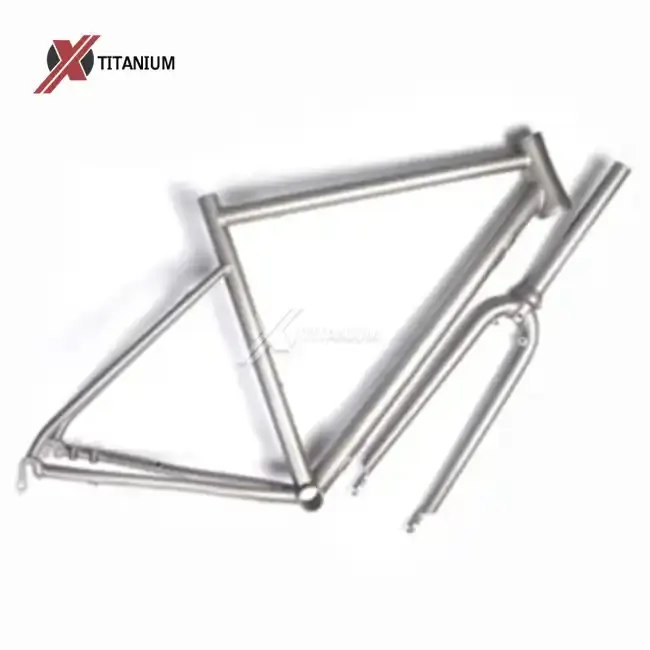
A properly constructed titanium bike frame has a number of clear features that make it easy to spot. Perfect weld beads with a constant silver-to-straw coloration show that premium titanium bicycle frame parts were properly shielded with argon during manufacturing. The tubes have regular wall thickness, accurate size limits, and junction places where they fit together perfectly. Material approval that confirms Grade 9 titanium alloy (Ti-3Al-2.5V) for tubes or Grade 5 (Ti-6Al-4V) for machined parts like dropouts protects the structure. No matter if the surface is brushed, bead-blasted, or anodized, it looks clean and doesn't have any coloring that shows rust. When judging the quality of a frame, these technical indicators show the difference between high-end expertise and poor production.
Understanding the Core Characteristics of Titanium Bike Frames
Titanium is well-known in high-performance riding because it has a unique set of mechanical qualities that are hard for other materials to match at the same time. The material is better than other frame materials because of the way its molecules are structured, which makes it stand out.
Material Properties That Define Performance
The standard for tube in the business is Grade 9 titanium alloy, which has a tensile strength of up to 900 MPa and a density of only 4.43 g/cm³. This mix gives it a strength-to-weight ratio that is similar to carbon fiber while still being predictable like metal. The amount of elasticity is between 100 and 110 GPa, which is about half that of steel. This lets the material bend in a controlled way that absorbs road vibrations without affecting the flow of power. Instead of getting worse with each stress cycle like aluminum does, titanium has a clear wear limit. When the stress level is below this level, the service life is potentially infinite, turning frames into investments that last for generations.
The inactive oxide layer (TiO₂) forms instantly when exposed to air, protecting against rusting for good. This shield stops saltwater, chemicals used on the road, and moisture in the air. In places where steel rusts and aluminum oxidizes, frames stored near the coast or exposed to winter road salt stay strong. This feature gets rid of protected coats, revealing raw finishes that can be fixed with simple abrasives after being scratched for fun.
Essential Frame Components and Their Functions
Understanding the terms used for components helps people who buy things judge the quality of building. The top tube, the down tube, and the seat tube make up the basic triangle. They are usually made from drawn smooth Grade 9 tubing. The rear triangle is finished off with chainstays and seat stays. The diameter of these parts can range from 16mm to 32mm, based on the purpose and load needs. Machined Grade 5 titanium is often used in bottom bracket shells, head tubes, and dropouts because it is very hard and doesn't wear down easily at high-stress points.
Titanium is made differently than other elements because of how it is made. Aluminum and steel frames can be joined mechanically or by soldering, but titanium frames need to be welded using TIG (Tungsten Inert Gas) in a controlled argon atmosphere. Laminated layup and hardening processes are important for carbon fiber. These differences in how things are done have a direct effect on the standards for checking and quality. Titanium is easily contaminated by oxygen during welding, so controlling the atmosphere is the most important factor in the manufacturing process. The end weld look shows how well this was done.
Key Signs of a Well-Manufactured Titanium Bike Frame
To spot high-quality workmanship, you need to know about metallurgical standards and best practices for production. Quality signs include the approval of materials, the accuracy of geometry, the welding process, and the rules for surface treatment.
Material Certification and Alloy Selection
Trustworthy makers provide material traceability paperwork that confirms the alloy makeup and mill test results. For titanium bicycle frame parts, Grade 9 titanium should have an aluminum content of 2.5% to 3.5% and a vanadium content of 2% to 3.0%, which is in line with ASTM B338 standards for continuous tubes. The Brinell Hardness test gives results between 300 and 350 HB, which shows that the heat treatment and work hardening were done correctly. Changes in the chemical makeup can weaken the mechanical qualities of a material, making it less able to stretch or pull.
The people who work in procurement should ask for proof of batch stability. Changes in the amounts of aluminum and vanadium used in different production runs cause performance differences that impact how the bike rides and how long it lasts. These changes don't get to finished goods because suppliers follow strict rules for inspecting arriving materials. Vertical integration, in which makers control the whole supply chain, from getting the raw materials to doing the final machining, usually leads to more consistent results than companies that buy materials on the spot market.
Welding Quality as the Definitive Indicator
The way weld beads look right away tells you a lot about how well they were made. When titanium is welded correctly, it makes bits that are smooth, uniform, and range in color from light straw to bright silver. This narrow range of colors shows that proper argon protection kept the air clean during the welding process. Discoloration that is blue, purple, or white means that oxygen has been exposed, which makes the alpha-case structure flimsy and weakens the joints. The level of penetration should look even, with no undercuts, overlaps, or holes that can be seen with the human eye.
At tube bends, the weld zone needs extra attention. Smooth changes from the base metal to the fusion zone show that the heat input was managed and the filler rod method was correct. Uneven bead width, surface cracking, or crater cracks are signs that the welder isn't skilled enough or that the shielding gas covering isn't good enough. Professional frames have weld reinforcement that fits in well with the parent material and doesn't have any sharp stress spots. Internal purging, which involves filling the inside of frames with argon while they are being welded, keeps the backsides from rusting, which is a practice that sets high-end makers apart from low-cost ones.
Frame Geometry and Design Optimization
Accuracy in measurements affects both efficiency and the ability of parts to work together. For interference fits, headset cup bores need to meet ISO 2768-m accuracy standards, which are usually ±0.05mm. To avoid cross-threading or early bearing wear, the threads on the bottom bracket should exactly match the JIS or BSA standards. Dropout spacing must keep parallel line within 0.5 mm to make sure wheels fit properly and the gear works well. The choice of tube width strikes a balance between the needs for structural strength and compliance. Tubes with diameters that are too large (28–32 mm) make the rotational stiffness higher for power transfer but lower the vertical compliance. Although smaller diameters (22–25 mm) make the ride more comfortable by allowing for more controlled bend, they may lose some of their horizontal stiffness when accelerating quickly. Application-specific optimization shows how smart an engineer is; for example, endurance shapes focus on comfort over long distances, while criterium race frames focus on stiffness.
Surface Treatment and Finishing Standards
To make the surface texture constant, raw titanium treatments are often bead-blasted or brushed. These steps get rid of the marks left by the making process while keeping the material's natural shine. Gold, blue, green, purple, black, and rainbow colors can be added by anodizing. This is done by controlled oxidation that makes the top layer thicker to certain nanometer sizes. During the electrochemical process, each color is linked to a specific set of voltage and time values. Anodizing doesn't separate from the base material like paint does, so it doesn't chip or peel.
Nitriding processes spread nitrogen into the top layers of titanium, making titanium nitride products that make the surface much harder. This process improves areas that wear quickly, like dropout connectors and bottom bracket shells, making them last longer when they come into touch with rough surfaces. Polishing makes mirror finishes that are nice to look at, but they need more upkeep than flat surfaces. When you finish something well, the texture should be the same on all surfaces. There shouldn't be any tool marks, buffer burns, or color differences between frame parts.
Comparing Titanium Frames with Other Materials: What to Look For?
Choose the right material for the frame affects its features, how often it needs to be maintained, and how much it costs to own the whole thing. Knowing these trade-offs helps you make choices about what to buy that are in line with your budget and performance goals.
Performance Characteristics Across Materials
Titanium is in a unique middle ground in the range of materials. Steel frames have better ride quality because they naturally dampen vibrations, but they are heavier and more likely to rust. A normal steel frame weighs 1.8 to 2.2 kg, while a titanium frame of the same size and shape weighs 1.3 to 1.6 kg. Aluminum is about the same weight as titanium but costs less. However, it doesn't fight wear as well as titanium, so most aluminum frames only last 5 to 7 years while titanium lasts forever in normal conditions.
Carbon fiber makes frames that are the lightest (up to 800–1000g for expensive frames), but it also makes failure modes that are very bad. Impact damage causes internal delamination that can't be seen from the outside, which could weaken the structure without any outward signs. Titanium's flexibility lets you know when it's about to break by showing you how it deforms. This makes titanium bicycle frame parts more reliable for long-term use. Titanium is cheaper to fix than carbon because skilled fabricators can cut out damaged parts and re-weld them back together. Carbon repair, on the other hand, requires a lot of layup work with no guarantee that the structure will be restored.
Total Cost of Ownership Analysis
The costs of the initial purchase are only one part of the overall costs. Titanium frames are more expensive ($2,000 to $4,000 for a good set of frames), but they don't need to be replaced as often. Every 5 to 10 years, aluminum frames need to be replaced, which adds up to a lot of money over time. Differences in maintenance costs make these numbers even worse. Titanium doesn't need any special treatments to keep it safe, regular cleaning, or steps to stop rust. To get rid of scratches, use gritty pads instead of trying to fix them or touch them up with paint.
Keeping the value of an item after it has been sold adds to the business case for titanium. After ten years of use, high-end titanium frames still have 60–70% of their original value, while metal frames lose 80–90% of their value over the same time period. Carbon fiber is in the middle of these two extremes, but buyers have trouble verifying the stability of the internal structure, which drives down the price on the secondary market. Titanium's higher entry costs are spread out over longer service spans by companies that manage fleet sales or OEM production. This makes titanium more cost-effective per unit of time compared to alternatives that last less time.
Durability Under Real-World Conditions
Titanium stands out in challenging uses because it can withstand harsh environments. Aluminum and steel break down faster in marine settings, winter riding with road salt exposure, and damp storage circumstances. Titanium doesn't change when these things happen; its structure stays the same at temperatures ranging from -50°C to 100°C. The material is more resistant to contact than aluminum but not as much as steel. It absorbs energy through plastic distortion instead of catastrophic cracking.
The biggest advantage in terms of longevity is fatigue performance under cyclic stress. Every time the stress changes, aluminum takes more damage. Cracks start at high-stress places like weld heat-affected zones or tube joints. Because titanium has a wear limit, pressures below a certain level—usually 50 to 60% of its tensile strength—do not cause any damage over time, no matter how many cycles are done. When properly built, titanium frames don't really care about standard ride loads from a fatigue point of view. This is why makers are so sure of their products that they offer warranties that cover them for life.
Procurement Considerations When Selecting Titanium Bike Frames
When making strategic sourcing choices, you need to look at more than just price when judging a supplier's skills. Consistency in quality, depth of technical support, adaptability to customization, and dependability in operations are what set apart good providers from relationships that go badly.
Supplier Evaluation and Certification Requirements
Quality system certifications should be the first step in checking a manufacturer's skills. ISO 9001 shows basic infrastructure for quality management, while AS9100 shows aerospace-grade process controls that are often used to make titanium. Medical device approvals (ISO 13485) show that materials can be tracked and that stricter rules for preventing pollution are in place than in most factories. By asking for audit records or facility certifications, you can make sure that the claimed skills match the ones that are actually used.
Assessing production capacity keeps supplies from being interrupted during growth stages. Manufacturers should show that their equipment can handle the amount of work that is being done. For example, they should have CNC machine centers for dropout manufacturing, tube manipulation equipment for bending, and specialized welding stations with the right argon purge systems. In China's "City of Titanium," Baoji Chuanglian New Metal Material Co., Ltd. has a lot of CNC cutting equipment and strict quality control systems that make sure everything is the same, from the raw materials to the finished parts. Their production infrastructure can handle both making prototypes and mass production, which works for the project-based buying cycles that are common in specific uses.
Customization Capabilities and Technical Support
Standard frame shapes don't usually work for unique uses. Suppliers that let you change the dimensions (tube length, thickness, and dropout configurations) for titanium bicycle frame parts make it possible to find the best options for each customer's needs. Custom design needs engineering help to make sure the structure is strong enough. Reliable providers provide FEA (Finite Element Analysis) validation or practical testing data that shows how changes to the design keep the safety factors right for the purpose they were made for.
Technical advice during the selection of materials adds a lot of value that goes beyond just filling orders. Different types of titanium materials, from widely pure grades to high-strength combinations, are each best for different types of uses. Grade 9 is good for general frame building because it is both strong and easy to shape. Grade 5 is better for wear-critical parts because it is harder. If a supplier gives advice on which metal to use based on load analysis, wear requirements, and the corrosion environment, it keeps material qualities from not matching the needs of an application, which can be very expensive.
Here are the core service advantages distinguishing professional titanium suppliers:
- Material Traceability: Full paperwork chains, from mill certifications to inspection records for finished goods, build trust in quality and make it easier to check compliance.
- Process Transparency: Allowing facility audits or giving thorough records of the manufacturing process shows operating trust that is missing from companies that aren't as strong.
- Post-Delivery Support: Technical help during assembly, advice on upkeep, and prompt response to warranty claims all show a customer service focus that goes beyond business relationships.
With these skills, buying from suppliers goes from being a one-time thing to a long-term partnership that helps with product growth and market placing.
Logistics and Quality Assurance Protocols
International sources makes shipping more complicated and makes it harder to check the quality. Packaging rules should keep titanium parts from getting damaged during shipping. Specialized foam inserts, rigid cases, and separating parts correctly stop scratches or contact damage from happening during transport. Metrics for delivery dependability show how competent a business is. When suppliers regularly meet stated lead times, it shows that they have the production control and inventory management skills that are needed for project-based buying.
Protocols for incoming screening protect against departures from the specifications. Verification of dimensions using precise measuring tools shows that important dimensions match the models. Visual weld checking finds flaws on the surface of the welds before the parts are put together. Portable XRF analyzers can be used to check the chemical makeup of things to make sure that certifications are correct. Setting up these steps for checking with sellers makes acceptance criteria clear and stops arguments over material that doesn't meet standards.
Maintenance and Longevity: How to Maximize Titanium Frame Durability?
Titanium is naturally more durable than other materials, but following the right care steps will extend its useful life and keep its performance over long periods of time.
Routine Inspection Procedures
Visual checks done on a regular basis can find problems early on, before they become too big to fix. Pay extra attention to the weld zones—hairline cracks can form at high-stress joints, especially in frames that are loaded very heavily or hit hard during a crash. Micro-cracks that can't be seen without 10x loupes are noticeable when inspected under a microscope. Dropout alignment checks make sure that the mounting areas of the wheels stay parallel. This keeps the drivetrain from wearing out and prevents control problems.
Cleaning and Surface Care
Checking the thread condition of bottom brackets and headset connections on a regular basis is important. Titanium tends to galle, which is cold bonding between titanium threads and metals that are not the same, which makes assembly difficult. Thread damage can be avoided by using copper- or nickel-based anti-seize chemicals during fitting. Periodic teardown and re-greasing keeps things running smoothly and stops seizures that need damaging removal methods.
Repair Feasibility and Component Replacement
Titanium frames are easier to maintain than painting frames because they don't rust. Using light soap and warm water to remove road grime and buildup doesn't cause any problems with chemical compatibility. Surface etching can be avoided by not using strong alkaline or acidic cleaners, but titanium can handle contact much better than aluminum or steel. Finishes that have been brushed or bead-blasted can be cleaned gently with Scotch-Brite pads, which can remove scratches and restore surfaces that can't be done on painted finishes. Anodized surfaces need to be treated with a little more care. The oxide layer is resistant to most chemicals, but rough cleaning can remove color by wearing through the thin anodised layer. To protect artistic finishes, cleaning can only be done with soft cloths and solutions that don't scratch. Titanium-safe polish can be used on polished or raw surfaces on a regular basis to keep their shine. However, physical age has no effect on how well they work.
Conclusion
When judging titanium bike frames, you need to look at more than just the frame's appearance. You need to look at the metal's properties, the quality of its construction, and the supplier's skills. The look of the weld, the proof of the material, the accuracy of the measurements, and the standards for surface cleaning are all real signs of quality for titanium bicycle frame parts. Titanium's longer service life and low upkeep needs make up for its higher cost. It is better at resisting fatigue, rust, and damage, and it can be easily repaired. Partnering with manufacturers that show process control, material traceability, and a high level of expert help is good for procurement pros. These connections change titanium buying from a one-time purchase to a long-term partnership that helps differentiate products and create long-term value in a wide range of challenging fields, from aerospace to high-performance cycling.
FAQ
Q1: Can titanium frames be repaired after damage?
A: Carbon fiber frames can't be fixed structurally, but titanium frames can. In argon-purged settings, qualified welders can cut out broken tubes and weld in new sections. This fixes the structure for a lot less than it would cost to repair it, usually between $200 and $500, based on where the damage is and how bad it is.
Q2: Why does titanium feel different from carbon or aluminum when riding?
A: Titanium has an elastic value of about 100 to 110 GPa, which means it can bend and bend without losing its ability to transfer power. This makes a unique ride quality that strikes a balance between comfort and agility. With the same frame geometry, carbon's stiffness and aluminum's strength send more road input.
Q3: Do titanium components require special assembly procedures?
A: Copper- or nickel-based anti-seize compounds must be used at thread surfaces to keep titanium threads from galling on aluminum or steel parts. To keep the fastening secure, torque specs should be 10-15% lower than what the manufacturer recommends. This will keep the threads from getting damaged and the fastening safe.
Q4: How long do quality titanium frames actually last?
A: When properly made, titanium frames have an endless fatigue life under normal ride loads. This means that regular stress cycles do not damage their structure in any way. Unless they are damaged in a crash or were made incorrectly, frames usually last 20 to 30 years or more, often longer than multiple component groups and wheelsets.
Partner with Chuanglian for Premium Titanium Bicycle Frame Parts
For titanium bicycle frame parts to be of high quality, they need to be made with great care and by people who have worked with the material for years. Baoji Chuanglian New Metal Material Co., Ltd. is strategically located in China's titanium production hub and has strong quality control systems in place. They also offer full CNC cutting services. Our Grade 9 titanium parts have unique sizes, can have multiple surface treatments like polishing, anodizing, and nitriding, and can fully trace their material history. They are used by OEM makers, custom frame builders, and research uses that demand the highest quality.
As a seller of titanium bicycle frame parts with a lot of experience, we make sure that all of our products meet strict international standards. Before being shipped, each part is checked for accuracy in its dimensions, its welds, and its materials. Our research team can help you choose the right alloy, make the best design, and make changes that are specific to your purpose. Our production machinery can handle anything from small prototypes to large-scale production of chainstays, dropouts, and full frame component sets. Contact our technical team at info@cltifastener.com or djy6580@aliyun.com to discuss your titanium bicycle frame parts requirements. We provide detailed specifications, material certifications, and engineering support ensuring your components meet exact performance standards.
References
1. Donachie, M.J. (2000). Titanium: A Technical Guide, 2nd Edition. ASM International, Materials Park, Ohio.
2. Lutjering, G., & Williams, J.C. (2007). Titanium: Engineering Materials and Processes. Springer-Verlag, Berlin.
3. Schutz, R.W., & Watkins, H.B. (1998). "Recent Developments in Titanium Alloy Application in the Energy Industry." Materials Science and Engineering: A, 243(1-2), 305-315.
4. Boyer, R., Welsch, G., & Collings, E.W. (1994). Materials Properties Handbook: Titanium Alloys. ASM International, Materials Park, Ohio.
5. Leyens, C., & Peters, M. (2003). Titanium and Titanium Alloys: Fundamentals and Applications. Wiley-VCH, Weinheim, Germany.
6. Froes, F.H., & Qian, M. (2018). Titanium in Medical and Dental Applications. Woodhead Publishing, Cambridge, United Kingdom.
Learn about our latest products and discounts through SMS or email