- English
- French
- German
- Portuguese
- Spanish
- Russian
- Japanese
- Korean
- Arabic
- Greek
- German
- Turkish
- Italian
- Danish
- Romanian
- Indonesian
- Czech
- Afrikaans
- Swedish
- Polish
- Basque
- Catalan
- Esperanto
- Hindi
- Lao
- Albanian
- Amharic
- Armenian
- Azerbaijani
- Belarusian
- Bengali
- Bosnian
- Bulgarian
- Cebuano
- Chichewa
- Corsican
- Croatian
- Dutch
- Estonian
- Filipino
- Finnish
- Frisian
- Galician
- Georgian
- Gujarati
- Haitian
- Hausa
- Hawaiian
- Hebrew
- Hmong
- Hungarian
- Icelandic
- Igbo
- Javanese
- Kannada
- Kazakh
- Khmer
- Kurdish
- Kyrgyz
- Latin
- Latvian
- Lithuanian
- Luxembou..
- Macedonian
- Malagasy
- Malay
- Malayalam
- Maltese
- Maori
- Marathi
- Mongolian
- Burmese
- Nepali
- Norwegian
- Pashto
- Persian
- Punjabi
- Serbian
- Sesotho
- Sinhala
- Slovak
- Slovenian
- Somali
- Samoan
- Scots Gaelic
- Shona
- Sindhi
- Sundanese
- Swahili
- Tajik
- Tamil
- Telugu
- Thai
- Ukrainian
- Urdu
- Uzbek
- Vietnamese
- Welsh
- Xhosa
- Yiddish
- Yoruba
- Zulu
What are the three types of cotter pins?
Cotter pins are essential fastening components that secure mechanical assemblies by preventing nuts, bolts, and pins from loosening under vibration or stress. The three primary types include split cotter pins with their characteristic bifurcated design that bends to lock components, R-clip cotter pins featuring a curved shape for quick installation and removal, and hairpin cotter pins offering spring-like retention for heavy-duty applications. Among these, the titanium cotter pin represents a premium solution that combines the fundamental locking mechanisms with exceptional material properties, making it indispensable for aerospace, marine, and high-performance applications where standard steel pins would fail.
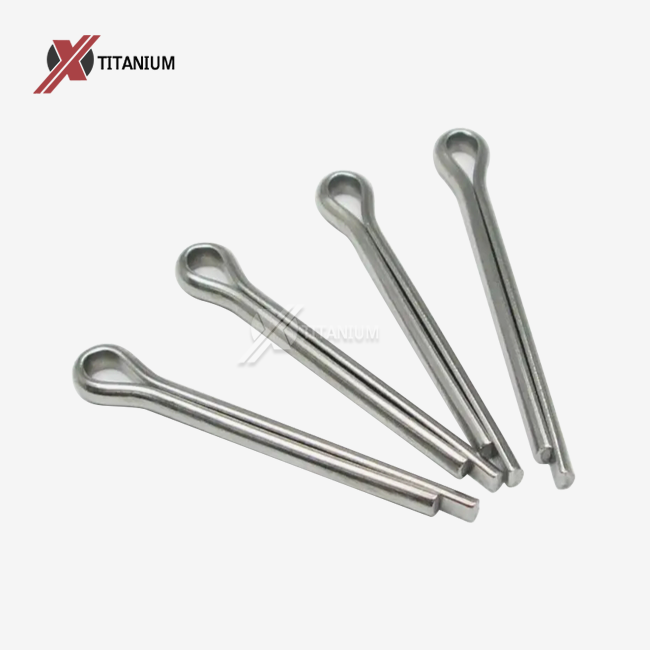
Overview of the Three Main Types of Cotter Pins
When engineers and procurement workers know the differences between cotter pin types, they can make smart decisions that affect how well a system works and how easily it can be fixed.
Split Cotter Pins: The Industry Standard
The shaft of a split cotter pin is half-cylindrical and split down the middle, creating two legs that can move. When putting these legs together, bolts or rods are put through holes that have already been made. After that, they are bent outward to keep them from coming out. People most often use split pins to hold things together in cars, factories, and other places where things need to be put together. They work because the plastic bends while they're being put together, making a strong mechanical lock that can handle some loads and vibrations.
When the split is being made, it is shaped with precision cutting or pressing. This keeps the leg sizes the same, which makes it easy to put them on. Materials like carbon steel, stainless steel, and special metals are often used, depending on the environment and the amount of weight that needs to be carried.
R-Clip Cotter Pins: Quick-Release Convenience
By their unique shape, R-clip pins, which are also known as spring clips or holding pins, look like the letter "R" when viewed from the side. Here, one end has a tight loop and the other end has an open gap. The spring tension makes it fit securely and lets you put it on and take it off quickly and easily without tools. Because the pin's body is bent, stress is spread out evenly across it. This makes it less likely to wear out when it needs to be put together and taken apart a lot.
People who work on systems that need a lot of maintenance and need workers to be able to get to parts quickly will love these pins. The spring motion makes sure that it stays in place well and lets you use it with one hand. Without having to bend and fix the split pins, this makes maintenance go much more quickly.
Hairpin Cotter Pins: Heavy-Duty Retention
Hitch pins, clevis pins, and hairpin pins are all names for the same thing. They have two straight legs that are linked by a bent hinge. They have springs in them. They have a strong holding power because they can stretch and return to their original shape. This makes them great for heavy-duty uses in cars, construction equipment, and trailer hitches. When the widths are too big for standard designs to handle, the parallel leg arrangement can be used because it spreads shear forces better than split pins.
When the spring is made, high-strength spring steel is shaped into exact geometric forms that keep the stress of the spring constant over time. If you use these pins outside, where they are likely to rust, you can cover the surface with zinc plating or powder coating.
Titanium Cotter Pins — Enhancing Performance and Reliability
Cotter pins made of titanium are a big step forward in the way things are fixed. A lot of problems can happen when you use regular materials. These materials solve those problems and offer levels of performance that have never been seen before in tough industrial settings.
Superior Material Properties
For the best strength-to-weight ratio, you can't go wrong with titanium alloys, especially Grade 5 (Ti-6Al-4V) and Grade 2 economically pure titanium. They are about 45% lighter than steel, but they can still pull apart just as well. When you're in the air, every gram counts because it changes how much fuel you use and how much you can carry. It doesn't rust naturally because it has a steady oxide film that builds on its surfaces. Saltwater, chlorides, and acidic acids up to 500°F (260°C) can't damage titanium because of this film.
Due to the fact that titanium is not magnetic, it does not interact with electrical systems, medical devices, or military navigation equipment that could be damaged by magnetic fields. The biocompatibility features also meet strict standards for medical devices, which means they can be used in surgery tools and devices that are implanted without having any negative effects on living things.
Industry Applications and Benefits
Standard steel pins would add extra weight and raise the risk of galvanic rusting when used with aluminum structures. Aerospace manufacturers use titanium cotter pins in places like engine mounts, control surfaces, and airplane landing gear systems. Because they are strong enough to handle high-frequency shocks and heat cycles, these pins are used in the brake and suspension systems of race cars.
Titanium is great for use in the ocean because it doesn't rust when it comes in contact with salt. This is very helpful in places like purification plants, underwater platforms, and underwater vehicles where a broken pin could make the whole system stop working. In chemical plants, these pins are used in places where strong chemicals would quickly break down other materials, like in pump systems and links between pressure tanks.
How to Select the Right Cotter Pin for Your Application?
When choosing cotter pins, it's important to think about how they will be used, their surroundings, and how often they need to be maintained, all of which can affect how well they work and how much they cost over time.
Engineering Considerations
You need to do a load study to pick the right pin. As part of this, the pin's lifetime's static loads, dynamic forces, and wear processes are all taken into account. Engineers have to figure out how much bending strength is needed while keeping safety in mind and thinking about what happens when stress builds up around pin holes. The outdoor study looks at the different temperature ranges, chemical exposure, humidity levels, and UV rays that could damage pin materials over time.
How easy it is to put in will affect the type of pin you pick. For instance, fix methods might choose R-clips for tight spaces or split pins for long-term placement. The parts should be made of a material that can be taken apart a lot of times. Titanium is the most sturdy material for things that need to be put together and taken apart a lot.
Material Selection Criteria
Grade 2 titanium is the best choice for split pin uses that need to be bent a lot during use. When shear strength is important, Grade 5 (Ti-6Al-4V) titanium is the best choice. Pure titanium or titanium alloys? Each person chooses based on their own technical wants and means. It costs more for alloys than for pure titanium, but they work better.
Putting things on their surfaces in ways like cleaning and anodizing can make them look better and protect them from rust. This is very important for public uses or places with a lot of dirt. Because they can be customized, you can pick from sizes between 1 mm and 10 mm and lengths that can be changed to fit your needs.
Installation and Maintenance of Titanium Cotter Pins
When titanium cotter pins are placed and kept properly, their performance advantages and useful life are maximized. By doing this, safety rules are followed and the machine works efficiently.
Installation Best Practices
When putting in titanium pins, it's very important to use the right tools because the metal has unique properties that need to be handled in a certain way to keep it from breaking. Because the mouths of needle-nose pliers are smooth, they don't scratch surfaces, and the right entry angles make sure that the pliers go all the way through the holes in the part. When you bend split pins, you need to use controlled force to keep them in place without stretching the metal too far.
As the piece is being put together, quality control checks make sure that all the pins are in place, the legs are connected properly, and there is enough room around the moving parts. Keeping detailed records of the installation process helps with tracking, which is common in medical and military settings where rules demand it.
Maintenance and Inspection Protocols
How often regular checks are done relies on the environment and the type of application. Things that are under a lot of stress need to be checked more often. Visual inspections look for signs of wear, rust, or stress cracks that could make the pin less stable. Dimensional verification makes sure that pins stay in place within accepted limits. This keeps the pins from coming loose and breaking the part.
It's easy to see when pins need to be changed because of things like clear deformation, surface wear, or after a certain number of service runs. Recycling materials might be possible if the right steps are taken to get rid of removed pins. This helps protect the environment and fits with efforts to be more environmentally friendly.
Procuring Titanium Cotter Pins: What B2B Buyers Need to Know?
You need to know about quality standards, sellers' skills, and changes in the market that affect supply and price in order to buy titanium cotter pins carefully.
Supplier Evaluation Criteria
Some examples of manufacturing certificates are AS9100 for aircraft uses, ISO 9001 for quality management, and ISO 13485 for medical goods. They show that the seller meets the standards set by the industry. There are organized ways to keep quality high and always make things better, which shows in these rights. This directly affects how reliable and consistent the goods are.
Part of the production process is finding the right raw materials, precision-machining options, surface treatment options, and places to test the mechanical properties and make sure the measurements are correct. Some of the things that make a supplier stable are their financial health, their history of making orders on time, and their ability to offer technical support that keeps the supply chain running smoothly throughout the project.
Cost Factors and Procurement Strategies
There are a lot of things that go into setting prices, like the type of titanium used, the size, the quantity, and the level of customization that is needed. Most of the time, Grade 2 titanium is less expensive than Grade 5 metals. Any special sizes or treatments on the surface come at extra costs that must be weighed against the efficiency gains.
When you buy a lot of something, the price can go down a lot, especially for versions that are used for a lot of different things. Lead times depend on how easy it is to get the parts and how long it takes to make the product. Standard sizes are usually in stock, but unique specs need a different production plan.
Conclusion
Tongs come in three main types: split, R-clip, and hairpin. Different types are used in different fields because of how they are set up and how they work. China titanium cotter pin are better than regular metal fixings because they are made of a better material that makes up for the things that are bad about regular metals. Titanium pins are important for high-performance, naval, and airplane applications that need to be reliable. They don't rust, are lighter, and last longer. To make sure the project goes easily, you should think about the materials being used, the environment, and the skills of the provider. This will help you get the best performance and value for your money in tough industrial settings.
FAQ
What makes titanium cotter pins superior to steel alternatives?
Titanium cotter pins offer several key advantages over steel versions, including 45% weight reduction, superior corrosion resistance, and non-magnetic properties. The stable oxide film on titanium surfaces provides immunity to saltwater and chemical exposure that would rapidly degrade steel pins. Additionally, titanium's biocompatibility enables use in medical applications where steel pins would be unsuitable.
Should I choose Grade 2 or Grade 5 titanium for split pin applications?
Grade 2 titanium is generally preferred for split pin applications due to its superior ductility, which allows proper bending without fracturing. Grade 5 (Ti-6Al-4V) has higher strength but can exhibit spring-back effects that make it difficult to bend flush against components. Grade 2 provides the necessary malleability for secure mechanical locking while maintaining adequate strength for most applications.
Can titanium cotter pins be reused after removal?
Titanium cotter pins should not be reused after removal, as the installation process involves plastic deformation that permanently alters the material structure. Attempting to re-bend the pins causes work hardening and creates stress concentration points that significantly increase fracture risk. Always install new pins to maintain assembly integrity and safety.
What certifications should I request when ordering titanium pins?
Always request EN 10204 Type 3.1 Material Certification, which verifies the chemical composition and mechanical properties of the specific titanium heat lot used in manufacturing. Additional certifications may include AS9100 for aerospace applications, ISO 13485 for medical devices, or NACE compliance for marine applications, depending on your industry requirements.
Are titanium cotter pins compatible with carbon fiber components?
Yes, titanium does work well with carbon fiber reinforced plastics (CFRP). If steel or metal pins touched carbon fiber, on the other hand, they would rust very fast. Tiny titanium pins are needed in airplanes and cars because they work with carbon fiber structures.
Partner with Chuanglian for Premium Titanium Cotter Pin Solutions
Chuanglian stands as your trusted titanium cotter pin manufacturer, combining over ten years of titanium processing expertise with advanced CNC machining capabilities to deliver precision fastening solutions. Our comprehensive product range includes Grade 2 and Grade 5 titanium pins manufactured to DIN94, ANSI B18.8.1, and ISO 1234 standards, with customizable dimensions from 1.0mm to 10mm diameter and various surface treatments including polishing, anodizing, and nitriding. Located in Baoji, the renowned "City of Titanium," we leverage local material advantages and cutting-edge equipment to ensure consistent quality and competitive pricing.
Our strict quality control system encompasses every production phase, from raw material verification to final inspection, supporting your critical applications with certified products and responsive technical support. Contact our team at info@cltifastener.com or djy6580@aliyun.com to discuss your titanium cotter pin requirements and experience the reliability that has earned trust from aerospace, marine, and industrial customers worldwide.
References
1. American Society for Testing and Materials. "Standard Specification for Titanium and Titanium Alloy Strip, Sheet, and Plate." ASTM International, West Conshohocken, PA.
2. Boyer, Rodney R. "An Overview on the Use of Titanium in the Aerospace Industry." Materials Science and Engineering: A, Vol. 213, No. 1-2.
3. International Organization for Standardization. "Fasteners - Cotter Pins - Product Grade A." ISO 1234:2019, Geneva, Switzerland.
4. Lütjering, Gerd and James C. Williams. "Titanium: Engineering Materials and Processes." Springer-Verlag Berlin Heidelberg.
5. Society of Automotive Engineers. "Cotter Pins - Specifications and Test Methods." SAE International Standards, Warrendale, PA.
6. Zhang, Wei and Liu Ming. "Corrosion Behavior of Titanium Alloys in Marine Environments: A Comprehensive Study." Journal of Materials Engineering and Performance, Vol. 28, No. 4.
Learn about our latest products and discounts through SMS or email