- English
- French
- German
- Portuguese
- Spanish
- Russian
- Japanese
- Korean
- Arabic
- Greek
- German
- Turkish
- Italian
- Danish
- Romanian
- Indonesian
- Czech
- Afrikaans
- Swedish
- Polish
- Basque
- Catalan
- Esperanto
- Hindi
- Lao
- Albanian
- Amharic
- Armenian
- Azerbaijani
- Belarusian
- Bengali
- Bosnian
- Bulgarian
- Cebuano
- Chichewa
- Corsican
- Croatian
- Dutch
- Estonian
- Filipino
- Finnish
- Frisian
- Galician
- Georgian
- Gujarati
- Haitian
- Hausa
- Hawaiian
- Hebrew
- Hmong
- Hungarian
- Icelandic
- Igbo
- Javanese
- Kannada
- Kazakh
- Khmer
- Kurdish
- Kyrgyz
- Latin
- Latvian
- Lithuanian
- Luxembou..
- Macedonian
- Malagasy
- Malay
- Malayalam
- Maltese
- Maori
- Marathi
- Mongolian
- Burmese
- Nepali
- Norwegian
- Pashto
- Persian
- Punjabi
- Serbian
- Sesotho
- Sinhala
- Slovak
- Slovenian
- Somali
- Samoan
- Scots Gaelic
- Shona
- Sindhi
- Sundanese
- Swahili
- Tajik
- Tamil
- Telugu
- Thai
- Ukrainian
- Urdu
- Uzbek
- Vietnamese
- Welsh
- Xhosa
- Yiddish
- Yoruba
- Zulu
What Industries Use Titanium Slider Pins for Precision Engineering?
Across aerospace, automotive braking systems, marine engineering, medical devices, and chemical processing, the titanium slider pin has become a go-to solution where steel components simply fall short. These precision-machined cylindrical guides — typically produced from Grade 5 Ti-6Al-4V — offer a tensile strength of roughly 950 MPa at only 55–60% of steel's density (approximately 4.43 g/cm³). Their natural corrosion immunity, low thermal conductivity (6.7 W/m·K vs. steel's 50+ W/m·K), and compatibility with surface treatments like nitriding and PVD coating make them a technically sound upgrade for engineers who prioritize both safety and longevity.
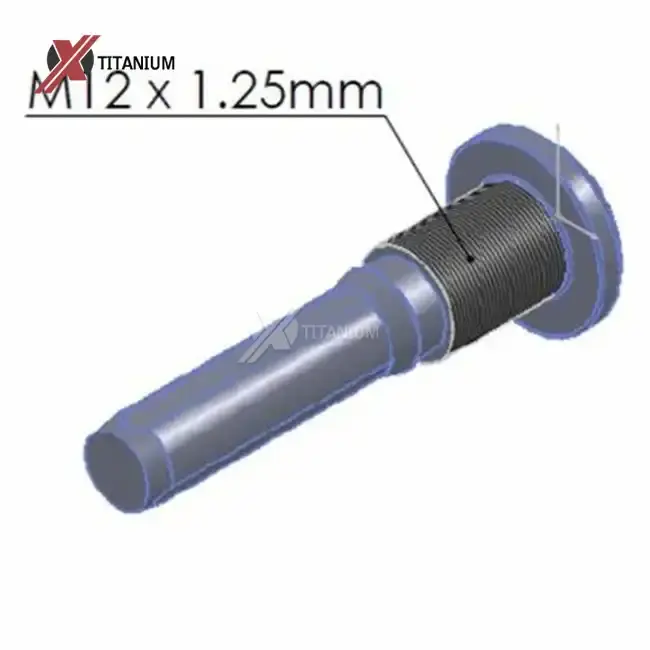
Understanding Titanium Slider Pins: Key Properties and Benefits
About material science, it's helpful to know what makes titanium different from other materials before choosing a guide pin for a good fit.
Material Grade and Mechanical Strength
It is made by Chuanglian from ASTM B348 Grade 5 (Ti-6Al-4V), a metal that is 40% lighter than high-tensile steel but has the same stress strength. For systems with many parts, like moving brake calipers, this difference in weight is very important. Every gram below the suspension line changes how the car handles. Grade 2 titanium is commercially pure, but it doesn't have the shear strength needed for load-bearing uses, so it shouldn't be used for moving parts that are very important for safety.
Corrosion Resistance and Surface Engineering
Titanium forms an oxide layer that is not active. This layer builds itself up and can withstand most industrial chemicals, road salt, and brake fluid. Salt spray tests are done every day for more than 72 hours, and there is no rust to be seen. In this amount of time, steel parts can't keep up without continuous coatings that protect them. When PVD nitriding or DLC (Diamond-Like Carbon) treatment is used on luxury pins, the coefficient of friction goes down. When metals touch each other, titanium tends to stick together and wear down. This stops the galling that can happen.
Surface Finish and Dimensional Precision
The surface of these pins is rough, with a resolution of less than 0.4 μm, and they can move smoothly back and forth in tight hole fits. They need to be within ±0.01 mm of the outer diameter and within 0.02 mm of being straight for the H8/f7 clearance to fit properly in caliper bores. They come in lengths from 10 mm to 200 mm and diameters from 5 mm to 20 mm. You can change everything about them to fit your wants. Titanium slider pin precision is what makes this range of fit and finish possible.
Key Industries Using Titanium Slider Pins for Precision Applications
All of the above qualities of the material directly lead to better performance in a number of difficult fields. Titanium guide pins are very useful in this case.
Automotive and Motorsport Brake Systems
Floating brake caliper systems are used on almost all cars and motorcycles today. The pin slides the caliper over the rotor as the pads wear down. Tiny steel pins rust inside the rubber boot. This makes the caliper not work and wears down the pads unevenly. They don't stick as well when made of titanium because the rust stops it, the unsprung mass goes down, and the titanium stops heat from going into the hydraulic fluid. This is why race teams that use Nissin or Brembo brakes often ask for guide pins made of titanium.
Aerospace and Aviation Components
Making planes lighter is one of the main engineering goals when they are being made. For every pound of weight that is taken off of a business plane, the FAA says that it will save about $1,000 in fuel costs over the life of the plane. TiN slider pins are used in actuator systems, landing gear mechanisms, and door opening guides when they need to be strong, light, and resistant to corrosion. They also don't have any magnetic properties, so they don't mess up the electronics on board.
Marine and Offshore Equipment
Salt water is one of the worst places for metal parts to be if they want to rust. Cracked rust can happen in stainless steel from seawater that doesn't move. This is a common issue in buildings that are out at sea. Because titanium doesn't change chemically in these conditions, it can be used for winch guides, deck machinery, and the insides of systems that remove salt from water. The shorter time between maintenance jobs is enough to make up for the higher costs of materials when activities are done abroad.
Medical Devices and Surgical Instruments
Titanium is recognized as safe by ISO 5832, which means it can be used on people. Because the material doesn't respond with other things and isn't magnetic, it works well for slider pins in surgery robotic arms, orthopedic implant assembly tools, and precision positioning fixtures. The reason for this is that the material must not be magnetic in MRI rooms. It is easier to find parts in complicated surgical sets because the different anodized colors—gold, blue, green, purple, black, and rainbow—make them stand out. Titanium slider pin applications in medical and precision equipment are built on exactly these properties.
Chemical Processing and Energy Sectors
Inside of reactors, valve assemblies, and pumps that deal with acids, alkalis, and chlorinated compounds, any part that slides has to work very hard. This is a good place for guide pins made of titanium because it can handle both acids and bases. In the energy industry, tools used to manage nuclear plants and change the pitch of wind turbines last longer and cost less when they are made of materials that are both strong and resistant to rust.
How to Choose the Right Titanium Slider Pin for Your Needs
Not every titanium pin suits every application. Selecting the correct specification requires evaluating a few key parameters.
Material Grade Selection
Grade 5 (Ti-6Al-4V) is the correct choice for load-bearing, safety-critical, and high-cycle applications such as brake calipers and aerospace actuators. Grade 2 (commercially pure) is only appropriate for low-stress chemical-resistance applications where strength is secondary.
Surface Treatment Options
The surface treatment should match the operating environment. Polishing brings Ra down to ≤0.4 μm for smooth sliding fits. Anodizing adds a colored oxide layer that improves corrosion resistance and aids component identification. Nitriding increases surface hardness significantly — reducing wear particle generation and extending service life in high-cycle reciprocating assemblies.
Supplier Verification and Certification
Before placing a production order, request XRF spectrometry reports to confirm the alloy is genuine Ti-6Al-4V. Ask for dimensional inspection records from a CMM or laser micrometer, confirming tolerances against ISO h7/g6 or your specified fit class. Reputable manufacturers will also provide salt spray test certificates and dye penetrant inspection results for fatigue-sensitive components. Titanium slider pin quality verification depends on exactly these documentation layers.
Installation, Maintenance, and Long-Term Performance
A correctly specified pin will underperform if installed or maintained carelessly.
Correct Fit and Lubrication
Even a corrosion-resistant pin requires proper lubrication. Use a high-quality silicone-based or ceramic brake paste on caliper guide pins. Copper anti-seize compounds should be avoided, as dissimilar metal contact can introduce galvanic reaction potential. Confirm the pin slides freely within the bore before final assembly — neither binding nor showing radial play.
Inspection Schedule
Inspect sliding components every 12 months or at each brake service interval, whichever comes first. Check for visible surface scoring on the sliding shaft, degradation of the rubber boot that protects the pin, and any evidence of pitting at the thread-to-shaft transition. Early detection of scoring prevents wear particles from entering the brake fluid circuit.
Replacement Indicators
Replace the pin if the sliding shaft shows measurable diameter loss exceeding 0.03 mm, if surface coating has worn through to bare titanium in the contact zone, or if the pin exhibits any bend beyond the 0.02 mm straightness tolerance. Structural failure of a caliper guide pin can cause the caliper to separate from the mount — a safety risk that makes timely replacement non-negotiable.
Procurement Best Practices for Titanium Slider Pins
If you want to get a lot of precise moving parts, you need an organized method that balances business needs with technical needs.
Sampling and Validation Workflow
It takes about six to eight weeks to get titanium brake guide pins. In the first two weeks, technical requirements are matched up. The third and fourth weeks are used to look at what sources can do. Finally, samples are made and full-dimensional verification, which includes fit and wear testing, is done. Before every three months production starts, there are often small test orders of 500 to 1,000 pieces.
Customization and SKU Management
For each type of caliper, the pins must have different lengths, widths, thread types, and boot groove shapes. You don't have to keep track of as many nearly identical parts when you work with a maker who makes things based on models. Get all of your SKUs from one supplier. This makes it easier to check the quality and speeds up the reordering process.
Pricing and Total Cost Assessment
For the same size, titanium guide pins cost more per unit than steel ones. Because if a rusty steel pin gets stuck in the caliper bore, the whole caliper may need to be changed, which costs a lot more than the extra cost of a titanium change, this is how it works. It's possible for OEM brake brands and aftermarket providers to charge more for their products because they work better and don't rust.
Conclusion
Titanium slider pins deliver measurable advantages in automotive braking, aerospace assemblies, marine machinery, medical devices, and chemical processing. Their Grade 5 alloy composition, CNC-machined tolerances, and engineered surface treatments make them a technically sound choice whenever corrosion, weight, or thermal conductivity are limiting factors. The procurement process requires careful supplier evaluation, sample validation, and specification discipline — but the operational gains justify that investment. For brake system brands and caliper repair suppliers, upgrading from steel to titanium guide pins is one of the most straightforward product improvements available.
FAQ
How much weight does a titanium guide pin save compared to steel?
Titanium is approximately 40% lighter than steel by volume. On a per-pin basis the saving is modest, but it accumulates across a multi-component caliper assembly and contributes to reduced unsprung mass — which has a direct effect on suspension response and handling precision.
Do titanium slider pins still require lubrication?
Yes. Lubrication is required to support smooth sliding motion and prevent dry adhesive wear. Use silicone-based or ceramic brake paste. Avoid copper anti-seize compounds due to galvanic compatibility concerns with titanium.
Can Grade 2 titanium be used for brake caliper guide pins?
No. Grade 2 is commercially pure titanium and lacks the tensile and yield strength needed for safety-critical brake components. Only Grade 5 (Ti-6Al-4V) is appropriate for load-bearing sliding applications.
How do I verify a supplier's alloy certification?
Request XRF spectrometry test reports with each batch. A reputable titanium slider pin manufacturer will provide material certificates referencing ASTM B348 and dimensional inspection records from CMM equipment.
What surface treatment is best for high-cycle brake applications?
Nitriding or PVD coating are preferred for high-cycle reciprocating contact. These treatments increase surface hardness, reduce wear particle generation, and lower the sliding coefficient of friction.
Partner with Chuanglian for Custom Titanium Slider Pins
TiN slider pins that are carefully made are bought by OEM brake brands and aftermarket sellers all over the world. They are made with a CNC machine from ASTM B348 Grade 5 Ti-6Al-4V and are smoothed out to Ra ≤0.4 μm. Nitriding, anodizing, or finishing can be used to change them. You can get full-dimensional data and make your own models. Email us at info@cltifastener.com or djy6580@aliyun.com to get a free price for your titanium slider pin supplier program.
References
1. ASM International. Titanium: A Technical Guide. ASM International, 2000.
2. ASTM International. ASTM B348: Standard Specification for Titanium and Titanium Alloy Bars and Billets. ASTM International, 2019.
3. ISO. ISO 5832-3: Implants for Surgery — Metallic Materials — Part 3: Wrought Titanium 6-Aluminium 4-Vanadium Alloy. International Organization for Standardization, 2021.
4. Donachie, Matthew J. Titanium: A Technical Guide, 2nd ed. ASM International, 2000.
5. SAE International Journal of Materials and Manufacturing. "Thermal and Tribological Performance of Titanium Alloy Components in Automotive Brake Systems." SAE International, 2018.
6. Corrosion Science. "Passive Film Stability of Ti-6Al-4V in Chloride-Containing Environments." Elsevier, 2020.
Learn about our latest products and discounts through SMS or email