- English
- French
- German
- Portuguese
- Spanish
- Russian
- Japanese
- Korean
- Arabic
- Greek
- German
- Turkish
- Italian
- Danish
- Romanian
- Indonesian
- Czech
- Afrikaans
- Swedish
- Polish
- Basque
- Catalan
- Esperanto
- Hindi
- Lao
- Albanian
- Amharic
- Armenian
- Azerbaijani
- Belarusian
- Bengali
- Bosnian
- Bulgarian
- Cebuano
- Chichewa
- Corsican
- Croatian
- Dutch
- Estonian
- Filipino
- Finnish
- Frisian
- Galician
- Georgian
- Gujarati
- Haitian
- Hausa
- Hawaiian
- Hebrew
- Hmong
- Hungarian
- Icelandic
- Igbo
- Javanese
- Kannada
- Kazakh
- Khmer
- Kurdish
- Kyrgyz
- Latin
- Latvian
- Lithuanian
- Luxembou..
- Macedonian
- Malagasy
- Malay
- Malayalam
- Maltese
- Maori
- Marathi
- Mongolian
- Burmese
- Nepali
- Norwegian
- Pashto
- Persian
- Punjabi
- Serbian
- Sesotho
- Sinhala
- Slovak
- Slovenian
- Somali
- Samoan
- Scots Gaelic
- Shona
- Sindhi
- Sundanese
- Swahili
- Tajik
- Tamil
- Telugu
- Thai
- Ukrainian
- Urdu
- Uzbek
- Vietnamese
- Welsh
- Xhosa
- Yiddish
- Yoruba
- Zulu
What Is a Titanium Seamless Tube and Why Is It Used?
A Titanium Seamless Tube is a high-performance hollow cylinder made from titanium billets that doesn't have any lengthwise weld seams. Usually, extrusion or rotary cutting is used to make the product, and then cold rolling methods like pilgering and vacuum heating are used. This seamless construction gives the structure the same level of strength all the way around, getting rid of the weak spots and possible failure zones that come with bonded options. Industries that work in harsh circumstances choose these tubes because they are very resistant to corrosion, have high strength-to-weight ratios, and perform reliably in situations where failure is not a choice.
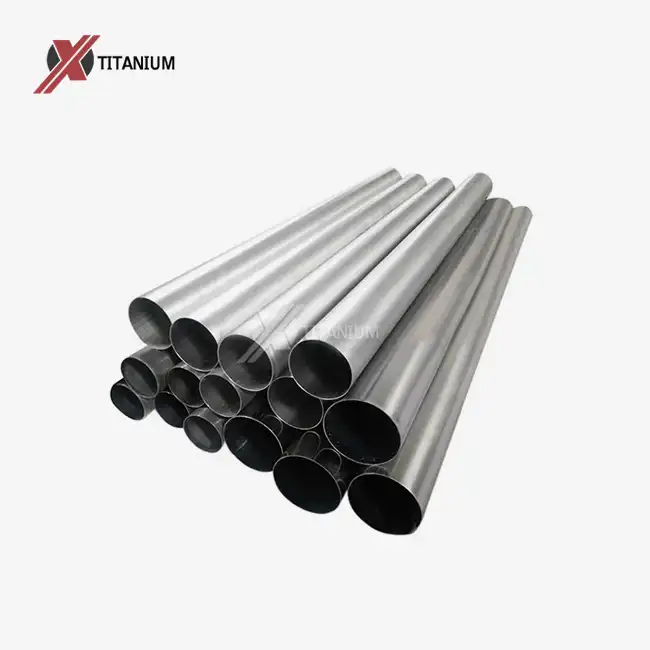
Understanding Titanium Seamless Tubes
Manufacturing Process and Structural Advantages
Solid titanium billets are heated precisely to the right temperatures to start the process of making a titanium seamless tube. Either extrusion or rotary drilling are used by manufacturers to make the initial hollow shape without adding any bonded seams. This method makes the microstructure the same all the way through the cross-section, which gets rid of the Heat Affected Zone that is a typical weakness in welded options.
After the tubes are first formed, they are cold-rolled through pilgering mills, which improves their mechanical properties and makes them smaller. The next step is vacuum annealing, which is very important because it reduces internal stresses and makes the metal's structure work better, so it always works well. This multi-step manufacturing process solves some problems that the industry is having, like hydraulic systems breaking down too soon, rust in harsh chloride-filled areas, and the need to drastically reduce weight without sacrificing structural integrity. Since there isn't a weld line, there isn't a possible weak spot or area of different metal composition that could cause crevice rust, break under high hydraulic pressure, or lead to fatigue failure in places with a lot of shaking.
Material Grades and International Standards
Based on their alloy makeup and mechanical features, different types of titanium are used for different tasks. For general industry uses, Grade 2 commercially pure titanium is very resistant to rust. Grade 5 (Ti-6Al-4V) is stronger and is used for challenging aircraft parts. Grade 9 (Ti-3Al-2.5V) is perfect for hydraulic tubes because it is both strong and easy to shape. Palladium additions in Grade 7 and Grade 12 make them more resistant to reducing acids, which is useful for certain chemical processing needs.
International standards set the rules for how these tubes are made and how good they are. Specifications for Titanium Seamless Tube covering sizes, chemical make-up, and mechanical features are set by ASTM B862 and ASME SB862. These standards make sure that all sellers follow the same rules and give buying teams clear criteria for checking the quality of goods. The tubes come in OD 6mm to OD 1020mm sizes, with wall thicknesses ranging from 0.5mm to 12mm. They can also be ordered in lengths up to 6000mm or customized to fit the needs of the project. When expert teams know about these grade differences and standard requirements, they can make sure that their applications meet all of them, and quality assurance departments can use standard testing methods to make sure that they are followed.
Metallurgical Properties That Matter
The solid structure of the Titanium Seamless Tube is a direct cause of their better performance. The process of making something smooth keeps the grain flow patterns that would be broken by welding. This continuous grain structure means that the material will behave in an expected way when it is stressed, loaded, and heated and cooled. The material is very resistant to both oxidizing and reducing conditions. It keeps protective oxide layers that reform themselves when they get broken.
In addition to being resistant to rust, these tubes keep their strength over a wide range of temperatures. In some metals, they keep their structural integrity from very low temperatures close to absolute zero to high temperatures over 600°C. Because it is low density (about 60% lighter than steel) and high tensile strength, it can be used in designs that need to be light without losing safety. In aircraft uses, where every gram of weight loss helps save fuel and increase payload capacity, this strength-to-weight ratio is especially useful. The fact that titanium is not magnetic makes it very useful in situations where magnetic interference could damage sensitive instruments or medical imaging equipment.
Benefits and Applications of Titanium Seamless Tubes
Core Performance Advantages
Since it has been tested in harsh settings for decades, Titanium Seamless Tube has shown performance traits that solve important practical problems. The smooth construction gets rid of the places where corrosion can start, which is a problem with welded options, especially in chloride-containing settings where crevice corrosion can quickly weaken the structure. This is especially important in chemical processes and marine uses, where even small leaks can turn into safety problems or environmental violations.
The technical benefits go beyond just measuring strength. These tubes can handle huge changes in pressure without getting stress cracks, which would shorten the life of soldered tubes. When hydraulic systems are set to 3000 to 5000 psi, they go through repetitive loads that checks the consistency of the material thousands of times every day. The even wall width and lack of weld flaws make sure that stress is distributed evenly and there is no strain. Another big benefit is that titanium can handle changes in temperature. Its protective oxide layer stays intact even when it is heated and cooled many times, which would break down other materials. Some types of titanium are biocompatible, which means they can be used in medical settings where the material needs to safely bond with human flesh over long periods of time without causing any harm or releasing dangerous ions.
Industry-Specific Applications
These tubes are used a lot in heat exchangers and surface condensers in power plants and desalination plants. In Multi-Stage Flash and Reverse Osmosis desalination processes, the tubes have to be able to handle the high-velocity scour and impact hits from seawater that break down copper-nickel alloys too soon. The seamless construction makes it impossible for cold water to leak into the steam cycle. This keeps the boiler's purity and keeps the heat working efficiently. Titanium Seamless Tube units have been used in coastal power plants that work in harsh sea settings for more than twenty years, while other materials need to be replaced more often.
Aerospace and military industries use high-strength metals like Grade 9 for hydraulic lines, fuel manifolds, and pneumatic systems. These parts work under very high and very low pressures while also helping to reduce weight, which is important for fuel economy. Because a failure of a part at high altitude could be very dangerous, aircraft makers need to make sure that the metals they use have perfect qualities that have been checked by strict testing procedures. The tubes work effectively in a wide range of temperatures, from very low temperatures on the ground to very high temperatures during cruise.
Documented Performance Cases
The value of Titanium Seamless Tube is supported by data from real-world deployments. A big desalination plant in the Middle East found that switching from copper-nickel condenser tubes to titanium seamless tubes saved more than 40% in costs over ten years of operation. Eliminating the need for replacement rounds every two years and the downtime that came with them directly led to more plant availability and less maintenance work. When an aerospace maker switched to Grade 9 seamless tubes in their hydraulic systems, the platform for their aircraft lost 12% of its weight. This meant that, depending on the task, the aircraft could carry more cargo or travel farther.
Chemical makers say that their equipment lasts longer in harsh environments where stainless steel options need to be replaced every three to five years. In these uses, titanium heat exchanger tubes have been used continuously for more than fifteen years without any major damage. The consistent performance across batch differences solves a major problem for businesses where changes in material properties can hurt product quality or put workers in danger. These documented results show why procurement professionals are choosing Titanium Seamless Tube more and more, even though it costs more at first. They know that titanium has a lower total cost of ownership over its lifetime, which is important for demanding uses.
Titanium Seamless Tubes vs. Alternatives: Making the Right Choice
Comparative Material Analysis
When buying tubular parts for tough jobs, sourcing teams usually look at choices made of stainless steel, aluminum alloys, and welded titanium, along with options made of Titanium Seamless Tube. Stainless steel has lower start-up costs and good resistance to corrosion in general, but it doesn't work as well in situations where weight is important or in certain corrosive conditions. A 316L stainless steel tube with the same pressure rating weighs about 60% more than a titanium tube of the same rating. This is a big problem for aircraft or mobile equipment. In places with a lot of salt, even high-grade stainless steel can pit and crack from stress rust, but titanium will never do that.
Aluminum metals are great for saving weight, but they aren't strong enough or resistant enough to corrosion to be used in high-pressure or chemically active environments. Titanium's strength-to-weight edge is clear in situations where both light building and structural integrity under tough conditions are needed. Welded titanium tubes are a middle ground choice that has lower production costs, but they have a Heat Affected Zone that makes the metal not always behave consistently. With repeated loads or high temperatures, this weld area becomes a good place for rust to start and could become a failure point. Because the smooth construction gets rid of these weaknesses, the extra cost is worth it in situations where dependability can't be ignored.
Grade Selection Considerations
To pick the right titanium grade, you have to match the qualities of the material to the needs of the application. Grades that are commercially pure, like Grade 2, work best in places where corrosion protection is more important than power. These grades work well in architectural uses, marine heat exchanges, and chemical processes, as long as the lower strength meets the needs of the design. Commercially pure grades are cost-effective options for many industry needs because they are less likely to rust and can be shaped easily.
In situations where strength is important, Grade 5 is the go-to alloy. It has a tensile strength of about 130 ksi and good corrosion protection. This type is often needed for aerospace structural parts, high-pressure hydraulic systems, and tough subsea equipment. The higher strength lets the wall parts be smaller, which helps save even more weight in situations where every ounce counts. Grade 9 is a middle option that is both strong and easy to shape, which makes it the best choice for complicated tube shapes that need to be bent or flared. The better shapeability makes production easier and lowers the chance that the item will crack while it's being made.
Specialized grades with palladium or other additions are used in chemical processing where standard titanium grades would be damaged by reducing acids. It costs more for Grade 7 and Grade 12, but they are necessary for processes that use hot hydrochloric acid or other lowering settings. Professionals in procurement need to work closely with technical teams to fully understand the unique conditions, pressure needs, temperature exposure, and fatigue loads that their uses will be put through. This joint specification method makes sure that the best grade is chosen, one that meets both performance needs and price limits.
Procurement Guide for Titanium Seamless Tubes
Global Supply Chain Dynamics
The titanium processing business uses a centralized supply network where the price is not the most important factor. Material quality and source dependability are much more important. The Baoji area in China is known as the "City of Titanium," and it is home to many producers who are experts in making Titanium Seamless Tube and extruding titanium. Because there is a lot of knowledge and tools in this area, prices and technical abilities are more competitive. North American and European sellers often buy semi-finished goods from Asian producers and add value by processing them further, checking the quality, and managing their stock locally.
Knowing what kinds of products can be made in a certain area helps procurement teams come up with buying plans that combine cost goals with supply chain risk. Asian providers usually have better prices for large orders, but they may need longer wait times and stricter quality control procedures. Western providers charge more, but they can respond faster, have better quality control systems in place, and make it easier to talk about technology issues. Using qualified suppliers in two or more areas as part of a dual-sourcing plan can help keep costs low and prevent supply problems.
Finished tube prices are affected by changes in the markets for titanium raw materials, and these changes usually take three to six months. Titanium sponge prices change depending on the demand cycle in the aerospace industry, the activity in the energy sector, and the politics of the main production areas. Professionals in procurement should keep an eye on these upstream signs to predict price trends and find the best time to make a buy. For project-based manufacturing operations, volume promises and framework deals can help get better prices and keep the supply chain running smoothly.
Quality Verification Protocols
Because uses that use Titanium Seamless Tube are so important, they need strict quality control measures. Specifications for buying things should make it clear that materials must have certifications that list their chemical make-up, mechanical qualities, and size limits. Certificates should include unique heat or lot numbers that can be used to track back to the original sources of the materials. Third-party testing by accredited labs gives you more trust, especially when looking at new suppliers or important uses where failure would have very bad results.
Protocols for physical inspection should check that the dimensions are correct, the surface finish is good, and there are no flaws that could affect performance. Ultrasonic testing can find flaws inside that can't be seen with the naked eye, while eddy current testing can find breaks in the surface. Hydrostatic pressure testing makes sure that the structure is strong when it is being used. Suppliers with certifications like AS9100 for aircraft, ISO 9001 for general quality management, or medical device certifications show that they have well-established quality systems that lower the risk of buying from them.
Establishing clear acceptance criteria and inspection processes in buy agreements stops disagreements and makes sure that the materials you receive meet your needs. Concerns about differences in properties that might affect performance are eased by testing samples from production lots to make sure that all batches are the same. Building ties with sellers who know about these verification needs and provide clear paperwork speeds up the buying process while keeping quality standards high. The money spent on careful training pays off because there are fewer failures in the field and parts last longer.
Purchasing Strategy Development
To successfully buy Titanium Seamless Tube, you need more than just price comparison tactics. Long procurement processes are common in this business, so it's important to plan ahead to make sure that project schedules and resource supply are in sync. A lot of companies buy things based on projects, and the change from making samples to making a lot of them takes a few months. Getting suppliers involved early in the design process lets you get expert advice on things like grade choice, optimizing dimensions, and making the product, which can cut costs and boost performance.
By combining volumes from several projects, you may be able to get better prices and get suppliers to spend in goods or tools that are specifically made for your needs. Framework agreements that set quality standards, pricing frameworks, and delivery goals make it easier for people to make repeat purchases and give sellers more information about demand, which helps them plan their capacity better. Because titanium uses usually only need small amounts, building relationships with chosen suppliers is more valuable than always looking for the lowest price on the spot market.
Evaluating the total cost of ownership instead of just the cost of purchase leads to better decisions. When cheaper tubes break down early, they cause problems that cost a lot more than the savings they offered at first. These problems include unplanned repairs, production delays, and guarantee claims. When it comes to application engineering, suppliers who offer technical help, quick responses to quality questions, and reliable shipping performance are worth the extra cost. The goal is to find partners who understand the needs of your application and have the technical skills and quality dedication to help you succeed in the long run.
Technical Standards and Quality Assurance
ASTM and International Specifications
The ASTM B862 standard sets strict rules for Titanium Seamless Tube. These rules include limits on chemical makeup, minimum mechanical properties, size tolerances, and quality standards. This standard covers a wide range of titanium grades, from commercially pure titanium to complex alloys. It gives procurement teams a single source for technical needs. Knowing the differences between the different ASTM standards lets you precisely list the qualities that are needed without listing too many factors that don't affect the suitability of the application.
The standards in ASME SB862 are the same as those in ASTM B862, but they include extra rules for pressure vessels and boilers that are controlled by ASME codes. Materials that meet these requirements, along with the right certificates and paperwork, are needed for equipment that falls under the control of ASME. In different areas, international standards like ISO specifications and different state rules offer different ways to do things. To make sure they are following the rules, procurement professionals should check which standards apply to their unique tasks and areas.
These guidelines say what properties are required to be acceptable, but the real material often has better qualities. By asking for approved material test results, you can find out the real properties of certain production lots, which lets engineers make more accurate calculations. The standards also set up testing processes that make sure that all sellers use the same ways to evaluate products. Standardized methods are used for tensile testing, hardness verification, and chemical analysis, so the results are the same no matter where the tests are done.
Critical Testing Protocols
Mechanical testing validates that Titanium Seamless Tube units possess the strength and ductility required for their intended applications. Tensile testing checks the final tensile strength, yield strength, and elongation qualities, which show how much weight the material can hold and how easily it can be shaped. Impact testing checks how tough something is and how well it doesn't break easily, which is especially important for uses that involve low temperatures or shock loading. Hardness testing is a quick way to figure out how uniform and in good shape a material is.
Protocols for corrosion testing imitate business settings to check how resistant something is to certain chemicals. Immersion testing in sample media measures rust rates and finds possible failure mechanisms. Electrochemical testing speeds up the evaluation process and lets you quickly see how well a material works in different settings. These tests are especially helpful when choosing materials for new uses where they may not have been used much before.
Non-destructive testing methods check the soundness of the tube without changing how it works. Ultrasonic testing finds internal breaks, inclusions, or mistakes in the way the product was made. Eddy current testing finds cracks, splits, or changes in conductivity on the surface. Testing for hydrostatic or pneumatic pressure makes sure that the structure is strong enough to withstand working forces. Dimensional checking makes sure that the tubes made meet the required standards for length, straightness, outer diameter, and wall thickness. Comprehensive testing methods give people faith that tubes will work reliably for as long as they are supposed to.
Heat Treatment and Finishing Processes
Vacuum cooling is an important step in the process of making the Titanium Seamless Tube better. This heat process reduces the stresses that come with making while creating a fine microstructure that is strong and flexible in the best way possible. Surface oxidation and contamination that could hurt qualities or look are stopped by the vacuum environment. When you change the annealing temperature and cooling rate, the properties change. This lets providers make the features fit the needs of the application.
You can finish the surface in a number of ways, from the as-rolled mill finish to different chemical and mechanical processes. Pickling gets rid of surface scale and dirt and makes the look clean and uniform. Polishing makes surfaces smooth, which reduces roughness in fluid handling uses or improves the look of parts that can be seen. Passivation methods make the protecting oxide layer stronger, which makes it less likely that the metal will rust. Depending on the application, the right surface finish may be different. For example, hydraulic systems need smooth internal surfaces, while structural uses may be fine with a normal mill finish.
Quality assurance includes more than just the features of each tube. It also includes rules for the production process that make sure that the same quality is used in all runs. Statistical process control methods keep an eye on the factors of production to find changes before they lead to the production of non-conforming material. Systems that keep track of finished tubes can connect them to specific temperatures of raw materials, working conditions, and test results. This paperwork helps find the root cause of problems in the field and shows the process control that customers who care about quality value. Suppliers with strong quality control systems give clients the consistency they need for long-term relationships.
Conclusion
Precision-engineered options like Titanium Seamless Tube are perfect for uses that need high reliability in tough circumstances. The production process gets rid of the structural weaknesses that come with welded options while keeping performance the same in all kinds of working conditions. When procurement professionals know the differences between material grades, standards that apply, and quality verification processes, they can make choices that combine technical needs with supply chain issues.
FAQ
What distinguishes seamless tubes from welded titanium alternatives?
Titanium Seamless Tube products are made from solid billets by extruding or rotating piercing them so that there is no lengthwise seam. This method makes the structure strong all the way around, getting rid of the Heat Affected Zone that is common in soldered tubes. In welded options, the weld area is a metallurgical break that can have preferred corrosion and could fail under repeated stress.
Which industries benefit most from titanium seamless tube deployment?
Titanium Seamless Tube is very useful for aerospace uses that need light, high-strength hydraulic and fuel lines. Corrosion protection is important for chemical processing businesses that work with strong acids. They are used in heat exchangers and condensers that are exposed to seawater in power plants and desalination plants.
What certifications should procurement teams verify when qualifying suppliers?
AS9100 certification shows that an aircraft quality control system is up to code. ISO 9001 is a general method for checking the quality of something. Companies that make medical devices should have the right FDA or ISO 13485 certifications. It is important to have material certificates that show their chemical make-up and mechanical qualities according to ASTM B862 or ASME SB862 standards. Third-party testing by approved labs gives you even more trust. Accreditation by NADCAP for certain processes, such as heat treatment or non-destructive testing, shows that the product has improved capabilities for tough uses.
Partner with Chuanglian for Your Seamless Titanium Tube Requirements
Baoji Chuanglian New Metal Material Co., Ltd. stands as a trusted Titanium Seamless Tube manufacturer serving high-performance industrial sectors worldwide. Located in Baoji City, internationally recognized as the "City of Titanium," our company combines advanced manufacturing capabilities with rigorous quality systems that meet the exacting standards of aerospace, petrochemical, medical device, and marine engineering customers. Our comprehensive production facilities include CNC machine tools and specialized processing equipment supported by strict quality control protocols that verify every tube from raw material selection through final inspection.
We maintain AS9100, ISO9001, and industry-specific certifications that demonstrate our commitment to quality and traceability. Our engineering team helps customers get the best performance by giving them expert advice on grade choice, dimensional optimization, and suggestions that are specific to their needs. We offer approved materials with full paperwork for any project, whether it needs widely pure Grade 2 for corrosive environments, high-strength Grade 5 for structural uses, or special alloys for specific chemical exposures. Reach out to our procurement specialists at info@cltifastener.com or djy6580@aliyun.com to discuss your requirements, request detailed specifications, or obtain competitive quotations for your upcoming projects.
References
1. American Society for Testing and Materials. "ASTM B862-14: Standard Specification for Titanium and Titanium Alloy Welded Pipe." ASTM International, 2014.
2. Boyer, R., Welsch, G., and Collings, E.W. "Materials Properties Handbook: Titanium Alloys." ASM International, Materials Park, Ohio, 1994.
3. Donachie, Matthew J. "Titanium: A Technical Guide, 2nd Edition." ASM International, Materials Park, Ohio, 2000.
4. Lutjering, Gerd and Williams, James C. "Titanium, 2nd Edition." Springer-Verlag, Berlin Heidelberg, 2007.
5. Sedriks, A. John. "Corrosion of Stainless Steels and Titanium in Marine and Related Environments." National Association of Corrosion Engineers, Houston, Texas, 1991.
6. Schutz, R.W. and Thomas, D.E. "Corrosion of Titanium and Titanium Alloys." ASM Handbook Volume 13B: Corrosion of Materials. ASM International, 2005.
Learn about our latest products and discounts through SMS or email