- English
- French
- German
- Portuguese
- Spanish
- Russian
- Japanese
- Korean
- Arabic
- Greek
- German
- Turkish
- Italian
- Danish
- Romanian
- Indonesian
- Czech
- Afrikaans
- Swedish
- Polish
- Basque
- Catalan
- Esperanto
- Hindi
- Lao
- Albanian
- Amharic
- Armenian
- Azerbaijani
- Belarusian
- Bengali
- Bosnian
- Bulgarian
- Cebuano
- Chichewa
- Corsican
- Croatian
- Dutch
- Estonian
- Filipino
- Finnish
- Frisian
- Galician
- Georgian
- Gujarati
- Haitian
- Hausa
- Hawaiian
- Hebrew
- Hmong
- Hungarian
- Icelandic
- Igbo
- Javanese
- Kannada
- Kazakh
- Khmer
- Kurdish
- Kyrgyz
- Latin
- Latvian
- Lithuanian
- Luxembou..
- Macedonian
- Malagasy
- Malay
- Malayalam
- Maltese
- Maori
- Marathi
- Mongolian
- Burmese
- Nepali
- Norwegian
- Pashto
- Persian
- Punjabi
- Serbian
- Sesotho
- Sinhala
- Slovak
- Slovenian
- Somali
- Samoan
- Scots Gaelic
- Shona
- Sindhi
- Sundanese
- Swahili
- Tajik
- Tamil
- Telugu
- Thai
- Ukrainian
- Urdu
- Uzbek
- Vietnamese
- Welsh
- Xhosa
- Yiddish
- Yoruba
- Zulu
What makes GR5 titanium a preferred material for rear axle nuts?
The Gr5 Titanium Rear Axle Nut represents a significant advancement in fastening technology for high-performance applications. Manufactured from Ti-6Al-4V alloy, this component addresses critical challenges in motorsports, aerospace, and advanced manufacturing sectors. The material delivers a tensile strength exceeding 895 MPa while maintaining a density of just 4.43 g/cm³—approximately 45% lighter than conventional steel alternatives. This combination eliminates corrosion-induced seizure, reduces unsprung mass, and ensures consistent torque retention across demanding operational environments where reliability cannot be compromised.
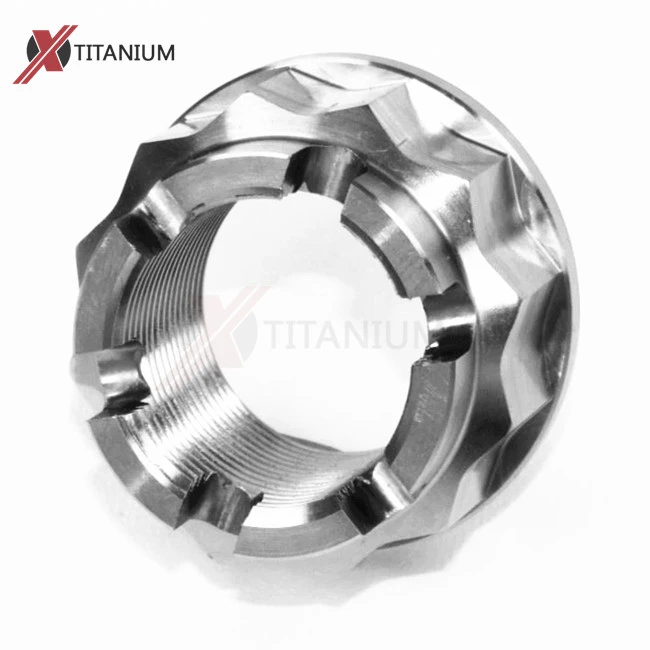
Understanding GR5 Titanium Rear Axle Nuts
The Metallurgical Foundation of Ti-6Al-4V Alloy
About 90% of Gr5 titanium is titanium, 6% is aluminium, and 4% is vanadium. This makes it an aerospace-grade material that meets ASTM B348 standards. The aluminium part makes it stronger and lighter, and the vanadium part makes it more flexible and keeps the beta phase stable during thermal processing. This exact mix gives it a minimum yield strength of 830 MPa, which is higher than many heat-treated steels and better at resisting fatigue.
The microstructure of the metal is made up of alpha and beta phases that work together to absorb impact loads and stop cracks from spreading. These are important qualities for parts like the Gr5 Titanium Rear Axle Nut that are exposed to repeated stress and vibration.
Weight Reduction Without Performance Compromise
Engineers who are trying to optimise weight have a constant problem: they have to keep the structure strong while lowering the mass. Typical steel axle nuts weigh between 25 and 40 grams, while titanium nuts that do the same job weigh only 12 to 20 grams. This decrease has a direct effect on the suspension dynamics of motorcycles and bicycles, making it possible for dampers to react more quickly to changes in the terrain.
Racing teams have seen real gains in lap times when they replace all of the vehicle's steel hardware with titanium versions. The weight savings go beyond individual parts; when applied consistently across an assembly, the total effect can lower unsprung mass by several pounds, which means better acceleration, stopping, and cornering stability.
Applications Across High-Performance Sectors
Ti-6Al-4V rear axle nuts can be used in a lot of different industries. Motorcycle racing teams depend on these parts to keep the rear wheel assemblies in place and reduce the amount of rotational inertia. The material is naturally resistant to chloride-induced degradation, which makes it good for adventure travel bikes that are used in corrosive environments like salt flats, seaside roads, and tropical climates. Titanium gear is used by mountain bike makers in their most expensive models, where every gram matters for climbing ability.
These fasteners are used in landing gear systems and actuator devices for aerospace ground support equipment. Marine uses include wheels for boat trailers and tools used offshore, where saltwater would quickly damage steel options. Manufacturers of industrial machinery use titanium fasteners in chemical processing equipment and pharmaceutical manufacturing systems that need to be biocompatible and very pure.
GR5 Titanium Rear Axle Nuts vs. Alternative Materials
Comparative Performance Against Stainless Steel
Grades of stainless steel like 316 and 410 are pretty good at resisting corrosion and aren't too strong, but they don't perform nearly as well as titanium. A nut made of 316 stainless steel has a density of 8.0 g/cm³ and a tensile strength of about 515–620 MPa. This means that it needs a lot more mass to have the same load-bearing capacity. Even though stainless steel costs less per kilogram, the total cost of the part usually stays the same over the lifetime of the product when weight losses and changes in fuel economy are taken into account.
When threaded against similar metals with a lot of torque, stainless steel also tends to gall, which can damage threads permanently. The natural oxide layer on the Gr5 Titanium Rear Axle Nut acts like a self-lubricant, lowering friction and keeping threads from seizing up, even after years of use in tough circumstances.
GR2 Titanium and Grade Differentiation
Titanium alloys aren't all good for high-stress fastening jobs. GR2 commercially pure titanium has a tensile strength of about 345 MPa and is very resistant to rust. This is strong enough for chemical processing equipment but not for structural bolts that are subject to dynamic loads. GR2 is not as hard as Gr5 because it does not contain aluminium or vanadium. Its hardness is about 25 HRC, while Gr5's is 36 HRC.
When engineers choose materials for important bolts, they need to be aware of these differences. GR2 works very well in situations where biocompatibility or extreme chemical resistance are important and loads don't move around much. Gr5 is the best choice when you need the highest strength-to-weight ratio, resistance to impact, and long-term steadiness in size under repeated loading.
Environmental Impact and Lifecycle Considerations
The process of getting titanium requires a lot of energy, which makes people wonder if it is sustainable for the environment. The material's very long life, on the other hand, changes the lifecycle estimate. A steel axle nut might need to be replaced every two to three years because it rusts, but a titanium one can last for ten to fifteen years or even longer. The energy used in production is spread out over a much longer service life, which has a smaller overall effect on the environment.
Titanium can also be recycled over and over again without losing any of its mechanical qualities. Scrap titanium is highly valued on the market and quickly goes back into production streams. Companies that want to get environmental approvals are becoming more aware of titanium's lifecycle benefits, even though it has a higher original embodied energy.
Installation, Maintenance, and Torque Specifications for GR5 Titanium Rear Axle Nuts
Proper Installation Protocols
Preparing the threads is the first step to installing titanium fasteners correctly. Thoroughly clean all areas that touch to get rid of dirt from the road, old lubricant residue, and metal shavings that could cause stress spots. Put on a thin layer of an anti-seize compound made just for titanium. Products based on molybdenum disulphide or copper work well.
Standard torque wrenches are accurate enough for most tasks, but digital torque adapters are more accurate for very important tasks. Instead of applying full standard torque all at once, tighten the Gr5 Titanium Rear Axle Nut in steps. A first pass at 40–50% of the specified torque and then a final tightening to full torque make sure that the load is spread out evenly and keep the threads from getting damaged.
Torque Values and Thread Engagement
For motorcycles, manufacturer specs usually range from 40 to 60 Nm, and for bicycle rear axles, they range from 8 to 12 Nm. However, exact values depend on the thread diameter and pitch. When titanium screws are over-torqued, the threads can break or galle, but when they are under-torqued, they can become free when they are vibrated. The recommended thread engagement is 1.5 times the diameter of the bolt.
This is enough to spread the load across a large enough thread area without going too deep. There are options for both metric and imperial threading to meet the needs of different regions and old equipment. Always make sure that the threads are compatible before installing them, because mixing standards can cause them to not connect properly and fail early.
Maintenance Routines for Extended Service Life
Titanium doesn't need much care, but it still benefits from being checked every so often. At regular service intervals, look at the nut visually to see if the surface is damaged, if it has any unusual wear patterns, or if it has changed colour from being exposed to heat. Use water and a light cleanser to clean the part; do not use rough cleaners that could scratch the protected oxide layers.
If the fastener is going to be taken off and put back on again, you should reapply the anti-seize substance because the first application can wear off after several assembly rounds. In places with a lot of shaking, check the torque retention once a year. Record the times and results of inspections to create a standard of performance that can help find problems early on before they become failures.
Procurement Insights: Sourcing and Buying GR5 Titanium Rear Axle Nuts
Supplier Evaluation Criteria
Finding a trustworthy titanium bolt provider takes more than just comparing prices. Make sure that the companies you're looking at have the right certifications for your business. For example, AS9100 is good for aerospace uses, ISO 9001 is good for general manufacturing, and ISO 13485 is good for medical products. For each production lot, you should ask for material certifications that list the chemicals used, their mechanical properties, and the way they were heated.
Established suppliers keep track of systems that connect batches of raw materials to finished parts. This lets them respond quickly if quality problems arise. Check to see how much the source can produce and how consistent the lead times are for each Gr5 Titanium Rear Axle Nut batch. Companies that work with high-consequence industries usually keep safety stock and extra ways to make things in case there are supply problems.
Understanding Pricing Dynamics
The price of titanium raw materials changes depending on the global supply and demand balance and the price of energy, which affects the extraction process. Prices for Ti-6Al-4V bar stock on the market right now are between $25 and $45 per kilogram, which is a lot more than steel or aluminium. CNC machining titanium needs special tools and cuts more slowly than other metals, which raises the cost of labour.
When looking at the total cost of ownership, on the other hand, the price point changes. A $35–$60 titanium rear axle nut that works well for ten years is a good deal compared to a $8–$12 steel one that needs to be replaced every two years. For orders of more than 100 pieces, bulk purchasing agreements can cut unit costs by 15–30%. This is especially true if you are willing to wait longer for supplies so that you can schedule your production more efficiently.
Customization and Value-Added Services
Standard catalogue items can be used for a lot of different things, but custom specs often make them work better for certain uses. Different mounting setups can be accommodated by changing the threads, adding special finishes, and changing the sizes. Anodising processes add colour-coding features—gold, blue, purple, black, or rainbow finishes make things easier to see and add 2–5 microns of grit to the surface.
Nitriding methods raise the surface hardness to 50–60 HRC, which makes it more resistant to wear in rough conditions. Good suppliers offer technical advice that helps engineers choose the right materials, come up with torque specifications, and figure out what went wrong. Support after the sale, such as guarantee coverage and the ability to get new parts, shows that the seller wants to build long-term relationships with customers instead of just doing business with them.
Why GR5 Titanium Rear Axle Nuts Are the Preferred Choice for Industry Leaders
Performance Validation Through Real-World Testing
Before approving parts for production integration, major motorbike makers put them through a lot of tests to make sure they work, and one such critical component is the Gr5 Titanium Rear Axle Nut. The SAE J1455 guidelines for vibration tests, temperature cycling between -40°C and 150°C, and salt spray exposure for more than 1000 hours are all things that the Gr5 Titanium Rear Axle Nut goes through. Test results constantly show that correctly made Ti-6Al-4V fasteners keep their torque specs and don't show any measurable corrosion after being exposed for long periods of time that would completely destroy steel options.
When racing teams in the MotoGP and World Superbike championships use certified titanium hardware, they have no problems with fasteners during the whole season. These validation results give procurement managers objective evidence to back up their decisions about which materials to choose.
Cost-Benefit Analysis for Strategic Sourcing
The initial cost of purchase is only one part of a full procurement study. When choosing between titanium and steel screws, you should think about the costs of guarantee claims for early failures, the time and money needed for unplanned maintenance, and the damage to your company's image that comes from failures in the field. Liability costs for a single catastrophic axle failure that hurts someone or damages property can go over $500,000.
Quality titanium fasteners completely remove this risk. Manufacturers that cater to high-end customers know that using better materials to make their products justifies charging more for them and helps build their brand. The choice of material shows that the engineers are dedicated to performance and quality, which appeals to picky customers who are willing to pay more for clear quality benefits.
Innovation in Titanium Processing Technology
As additive production, precision casting, and cold pressing get better, titanium's cost-effectiveness keeps growing. Selective laser melting makes it possible to make complex shapes that can't be made any other way, which could cut down on waste by 40 to 60%. Over the past ten years, better cutting tool materials and better CNC settings have cut the time it takes to machine titanium by 25 to 35 percent.
These process improvements slowly make the price difference between titanium and other materials smaller, which makes their use possible in situations where it wasn't possible before because of cost concerns. When suppliers spend in new production technology and efforts to make things better all the time, they place themselves as strategic partners instead of just selling goods.
Conclusion
People choose Gr5 titanium for back axle nuts because it is the only material that can combine strength, light weight, and resistance to rust. The performance properties of Ti-6Al-4V alloy directly address the practical problems that the aircraft, motorsports, marine, and industry sectors face. Because the material is more resistant to fatigue and stable in different environments, it means longer service intervals, lower maintenance costs, and higher safety margins.
Even though the starting costs are higher than other options, a full lifecycle study shows that the overall costs are much lower for the Gr5 Titanium Rear Axle Nut. As manufacturing techniques keep getting better and industries put more emphasis on durability and reducing weight, titanium screws will move from being used only in racing to being widely used in high-performance equipment.
FAQ
Does GR5 titanium outperform steel in high-stress applications?
Ti-6Al-4V titanium has the same tensile strength as Grade 8.8 steel (895 MPa at least), but it is 45% lighter. The material is better at resisting fatigue and keeping its mechanical properties over a wider range of temperatures. Titanium, unlike steel, makes a stable oxide layer that stops corrosion from spreading. This means that the Gr5 Titanium Rear Axle Nut does not get seizure or thread damage when exposed to water and road salt.
What torque specifications apply when installing titanium rear axle nuts?
How much torque is needed depends on the thread width and the task. Applications for motorcycles usually need 40 to 60 Nm, while rear wheels for bicycles need 8 to 12 Nm. Always look at the paperwork that came with your model from the maker. To avoid galling and make sure you have the right preload, apply torque in stages and use an anti-seize compound made for titanium.
Can titanium rear axle nuts be customized for specialized equipment?
You can make changes to the dimensions, choose between metric and imperial threading, and polish, anodise in multiple colours, or nitride the surface. Reputable manufacturers offer engineering help to create specifications that fit specific mounting arrangements. This makes sure that the product works well and fits perfectly in a variety of aerospace, marine, and industrial settings.
Partner with Chuanglian for Superior Titanium Fastening Solutions
Through strict quality control and advanced CNC cutting, Baoji Chuanglian New Metal Material Co., Ltd. has become a well-known and reliable company that makes the Gr5 Titanium Rear Axle Nut. Baoji is known as the "City of Titanium" in China, and our facility there gives us direct access to high-quality raw materials and more than ten years of specialised processing knowledge. We have strict testing procedures in place to make sure that every part meets foreign standards, such as ASTM B348 requirements.
Our production capabilities allow us to make thread configurations, surface treatments, and anodising finishes that are exactly what you need. Get in touch with our technical team at info@cltifastener.com or djy6580@aliyun.com to talk about material certifications, bulk prices, and shipping times that work with your project's plan.
References
1. Boyer, R., Welsch, G., & Collings, E.W. (1994). Materials Properties Handbook: Titanium Alloys. ASM International, Materials Park, Ohio.
2. Peters, M., Kumpfert, J., Ward, C.H., & Leyens, C. (2003). Titanium Alloys for Aerospace Applications. Advanced Engineering Materials, Volume 5, Issue 6, pp. 419-427.
3. Donachie, M.J. (2000). Titanium: A Technical Guide, Second Edition. ASM International, Materials Park, Ohio.
4. Lütjering, G., & Williams, J.C. (2007). Titanium: Engineering Materials and Processes, Second Edition. Springer-Verlag, Berlin Heidelberg.
5. ASTM International. (2013). ASTM B348-13: Standard Specification for Titanium and Titanium Alloy Bars and Billets. West Conshohocken, Pennsylvania.
6. Veiga, C., Davim, J.P., & Loureiro, A.J.R. (2012). Properties and Applications of Titanium Alloys: A Brief Review. Reviews on Advanced Materials Science, Volume 32, pp. 133-148.

Learn about our latest products and discounts through SMS or email