- English
- French
- German
- Portuguese
- Spanish
- Russian
- Japanese
- Korean
- Arabic
- Greek
- German
- Turkish
- Italian
- Danish
- Romanian
- Indonesian
- Czech
- Afrikaans
- Swedish
- Polish
- Basque
- Catalan
- Esperanto
- Hindi
- Lao
- Albanian
- Amharic
- Armenian
- Azerbaijani
- Belarusian
- Bengali
- Bosnian
- Bulgarian
- Cebuano
- Chichewa
- Corsican
- Croatian
- Dutch
- Estonian
- Filipino
- Finnish
- Frisian
- Galician
- Georgian
- Gujarati
- Haitian
- Hausa
- Hawaiian
- Hebrew
- Hmong
- Hungarian
- Icelandic
- Igbo
- Javanese
- Kannada
- Kazakh
- Khmer
- Kurdish
- Kyrgyz
- Latin
- Latvian
- Lithuanian
- Luxembou..
- Macedonian
- Malagasy
- Malay
- Malayalam
- Maltese
- Maori
- Marathi
- Mongolian
- Burmese
- Nepali
- Norwegian
- Pashto
- Persian
- Punjabi
- Serbian
- Sesotho
- Sinhala
- Slovak
- Slovenian
- Somali
- Samoan
- Scots Gaelic
- Shona
- Sindhi
- Sundanese
- Swahili
- Tajik
- Tamil
- Telugu
- Thai
- Ukrainian
- Urdu
- Uzbek
- Vietnamese
- Welsh
- Xhosa
- Yiddish
- Yoruba
- Zulu
What Makes Gr5 Titanium Double Banjo Bolts Better Than Standard Steel Parts?
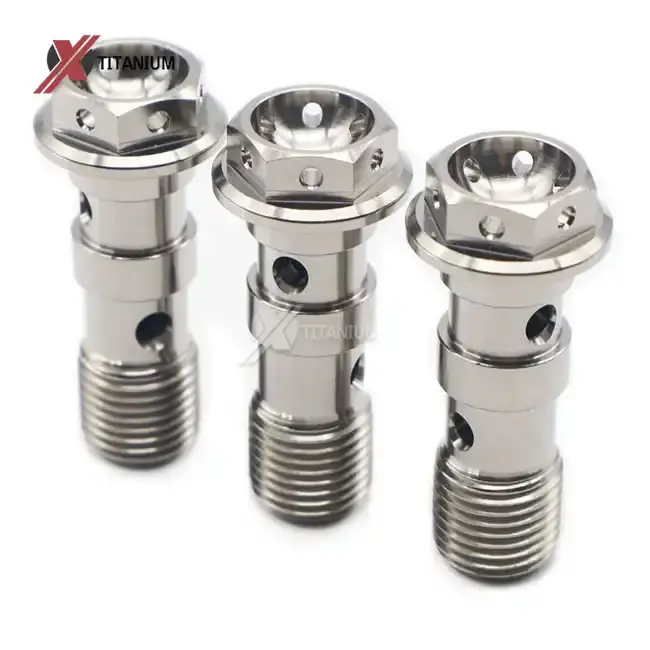
If you've been sourcing brake line hardware for motorcycle hydraulic systems, you already know that not all banjo bolts are equal. Gr5 titanium double banjo bolts — machined from Ti-6Al-4V alloy — offer a measurable advantage over standard steel parts in three areas that matter most to brake system brands: weight, corrosion resistance, and long-term structural integrity under hydraulic pressure. At roughly 45% lighter than steel and with tensile strength exceeding 950 MPa, these components hold their mechanical properties well beyond the thermal and chemical stress ranges that steel struggles with. That difference isn't cosmetic — it's functional and safety-relevant.
Understanding Gr5 Titanium Double Banjo Bolts
Before comparing materials, it helps to understand exactly what makes Grade 5 titanium the standard for safety-critical fasteners.
What Is Ti-6Al-4V and Why Grade 5?
Ti-6Al-4V, commonly called Grade 5 titanium, contains approximately 90% titanium, 6% aluminum, and 4% vanadium. This composition produces a material with a density of just 4.43 g/cm³ alongside a minimum tensile strength of 950 MPa. Compared to Grade 2 commercially pure titanium, Grade 5 carries nearly double the yield strength — making it the appropriate choice where hydraulic loads, vibration, and thermal cycling are constants.
Key Dimensional Specifications
Chuanglian's Gr5 titanium double banjo bolts are CNC-machined to precise tolerances, with sealing surface flatness held to ≤0.02mm. Thread options include M10×1.0 and M10×1.25 — the two sizes most common in motorcycle brake caliper connections — as well as M6, M8, M12, and M14. Length is customizable from 10mm to 100mm, and internal oil passage diameters are machined and inspected to confirm full flow path clearance.
Certifications and Authenticity
Counterfeit titanium fasteners are a documented risk in the aftermarket parts supply chain. Reputable suppliers conduct PMI (Positive Material Identification) testing to confirm the Ti-6Al-4V elemental composition. Batch-level tensile and proof load testing, Go/No-Go thread gauging, and dye penetrant inspection for surface micro-fractures are standard quality checkpoints. These steps are non-negotiable for components used in brake systems, where failure affects rider safety directly.
Performance Comparison: Gr5 Titanium vs Standard Steel Banjo Bolts
The real-world performance gap between titanium and steel becomes clear once you put the numbers side by side.
Strength and Fatigue Resistance
Grade 5 titanium posts a minimum tensile strength of 130,000 psi (approximately 895 MPa) and a yield strength of 120,000 psi. Under repeated hydraulic pressure cycles — the kind generated in dual-disc braking systems reaching 10–15 MPa — titanium maintains its structural shape without the work-hardening fatigue that accelerates in high-carbon steel over time. This directly reduces the frequency of hardware replacement across a product's service life.
Corrosion Performance in Harsh Conditions
Steel banjo bolts corrode. In road-salt environments, chemical exposure, or marine applications, standard steel develops surface pitting and thread deterioration within one to two seasons. Grade 5 titanium forms a stable passive oxide layer that resists brake fluid (DOT 3, 4, and 5.1), saltwater, and most acids and alkalis without surface treatment. This property alone eliminates a common failure mode that brake system brands frequently field complaints about.
Weight Reduction and Its Downstream Effects
A titanium double banjo bolt weighs roughly 45% less than a comparable steel part. In motorcycle brake systems, that weight saving reduces unsprung mass — which improves suspension response and handling precision. For brands assembling titanium upgrade kits that include brake lines, bleed screws, and banjo hardware, this weight reduction is a documented selling point that end users can feel during cornering.
Typical Applications and Use Cases
It is possible to use Gr5 titanium double banjo bolts in places where steel flaws are more obvious and cost a lot.
Motorcycle Dual-Disc Braking Systems
The double banjo bolt has two cross-drilled ports on the sides and a hollow core. This means that one caliper port can connect to two brake lines at the same time. This is how most front ends with two disks are set up. Pump pressure can rise above 1,500 PSI during MotoGP and track days. Titanium doesn't get hot from carbon or steel blades that are moving at high temperatures and keeps its shape under these loads.
Marine and Offshore Hydraulic Systems
Hydraulic parts on offshore race boats and production marine craft are always wet with saltwater. Titanium doesn't rust in salt water; the U.S. Navy has used it in seawater pipe systems for decades. When the naval hydraulic steering and trim tab circuits replace the steel banjo hardware with Ti-6Al-4V parts, there is no longer a need to do regular repairs.
Aerospace Fluid Transfer and UAV Systems
Lightweight UAVs and backup power units need parts that don't add extra weight to the airframe and help move fluids around. Galvanic corrosion doesn't happen to grade 5 titanium when it's joined to carbon or aluminum housings. This isn't the case with stainless steel screws. Plus, it stays the same shape up to 400°C.
Procurement Guide for Gr5 Titanium Double Banjo Bolts
To buy safety-critical hydraulic hardware, you need an organized evaluation method. Before picking a seller, these are the main things that owners of brake system brands who have done it before look at.
- Material verification: Confirm that supplier provides batch-level PMI reports confirming Ti-6Al-4V composition. Substitution of Grade 2 titanium is a known risk and results in inadequate yield strength for hydraulic applications.
- Sealing surface precision: Request dimensional inspection reports showing sealing face flatness ≤0.02mm. This spec determines whether the bolt seals against copper or aluminum crush washers without brake fluid weeping.
- Internal oil passage inspection: Machining debris inside cross-drilled hydraulic passages causes brake feel degradation and potential blockage. Reputable manufacturers run ultrasonic cleaning and visual bore inspection before shipping.
- Thread treatment: Anti-galling protection is mandatory. Titanium is prone to cold-welding against mating metal threads. Look for suppliers offering PVD coatings, nitriding, or who specify anti-seize application procedures in their installation guidance.
- Customization capability: Brake line brand developers often need non-standard thread pitches, bolt lengths, or integrated bleed valve ports. A capable Gr5 titanium double banjo bolt manufacturer accepts custom drawings and provides prototype samples before production runs.
There are five things that will show you if a supplier can help you make a product and not just fill an order. These things are checked by brands before they start making things. This way, there is no quality gap between samples and production, which helps them avoid guaranty returns.
Maintenance, Longevity, and User Best Practices
Even the best titanium hardware fails early if installed incorrectly. These practices apply directly to Grade 5 titanium banjo bolts in brake system assemblies.
Installation Torque and Anti-Seize Protocol
The recommended torque range for M10 titanium banjo bolts is 15–25 Nm depending on thread pitch and crush washer material. Always apply a high-quality titanium-compatible anti-seize compound to the threads before assembly. Titanium's coefficient of friction differs from steel, and dry installation significantly increases galling risk. Do not extrapolate steel torque specs to titanium without checking the manufacturer's documentation. Gr5 titanium double banjo bolts are the SKU where this torque discipline matters most.
Inspection Intervals and Seal Monitoring
Inspect banjo bolt seating areas at every brake fluid change. Look for fluid staining around the washer contact zone, which signals crush washer deformation or sealing face contamination. Titanium does not rust, but mechanical damage to the sealing face — from over-torquing or contaminated reassembly — can compromise the zero-leak requirement that brake systems demand.
Surface Treatment and Finish Options
Chuanglian's bolts are available in natural titanium, gold, blue, green, purple, black, and rainbow anodized finishes. Note that anodizing must not be applied to the sealing face — only the bolt body and head. Nitriding is available as a surface hardening option that improves galling resistance without compromising the sealing surface geometry. Polished finishes are standard for precision sealing applications.
Conclusion
It is heavier, more likely to rust, and has a shorter fatigue life than standard steel parts. Gr5 titanium double banjo bolts are better in all of these areas. Performance-wise, there is a big difference. It's the difference between a line of goods that people return and ones that get insurance claims. Picking the right production partner is important for a business that makes titanium hydraulic improvement kits for bikes, boats, or racing to make sure that the benefits make it from the design stage to the finished product.
FAQ
What torque spec should I use for M10 titanium banjo bolts?
Apply 15–25 Nm depending on thread pitch (M10×1.0 or M10×1.25). Always use anti-seize compound and follow the manufacturer's wet torque specification. Do not apply the same torque values used for high-tensile steel without verification.
Do titanium banjo bolts resist DOT brake fluid?
Yes. Grade 5 titanium forms a stable oxide layer that is chemically inert to DOT 3, DOT 4, and DOT 5.1 brake fluids. Steel bolts are vulnerable to glycol-based brake fluid degrading their protective coatings over time.
How do I prevent galling with titanium threads?
Apply a dedicated anti-seize compound rated for titanium fasteners before every installation. Alternatively, specify bolts with PVD or nitrided surface treatment from the manufacturer. Never install titanium-to-metal threads dry.
Can these bolts handle racing brake temperatures?
Grade 5 titanium maintains structural properties up to 400°C. That exceeds the thermal exposure generated by brake rotor proximity in most motorcycle racing applications. The brake fluid boiling point is typically the limiting factor — not the bolt.
What internal flow rate do titanium double banjo bolts provide?
CNC-precision cross-drilled titanium double banjo bolts are machined to match or exceed OEM steel bolt flow rates. Verified internal bore dimensions ensure no hydraulic restriction that would cause a spongy brake pedal response.
Get Custom Gr5 Titanium Double Banjo Bolts from Chuanglian
Chuanglian is based in Baoji, which is known as the center of titanium production in China. They have been making safety-critical titanium fasteners on precise CNC machines for more than ten years. We make Gr5 titanium double banjo bolts in a straight line, so we can offer custom thread sizes, designs with built-in bleed valves, and a range of surface treatments. You can join our OEM program or buy samples. You can email our technical team at info@cltifastener.com or djy6580@aliyun.com for specs.
References
1. ASM Handbook, Volume 2: Properties and Selection — Nonferrous Alloys and Special-Purpose Materials. ASM International, 1990.
2. Donachie, M. J. Titanium: A Technical Guide. ASM International, 2000.
3. SAE International Journal of Materials and Manufacturing — "Fatigue Performance of Titanium Alloy Fasteners in Automotive Brake Systems." SAE International, 2018.
4. Peters, M., Kumpfert, J., Ward, C. H., & Leyens, C. "Titanium Alloys for Aerospace Applications." Advanced Engineering Materials, Wiley-VCH, 2003.
5. Machinery's Handbook, 31st Edition. Industrial Press, 2020.
6. Schutz, R. W., & Watkins, H. B. "Recent Developments in Titanium Alloy Application in the Energy Industry." Materials Science and Engineering: A, Elsevier, 1998.
Learn about our latest products and discounts through SMS or email