- English
- French
- German
- Portuguese
- Spanish
- Russian
- Japanese
- Korean
- Arabic
- Greek
- German
- Turkish
- Italian
- Danish
- Romanian
- Indonesian
- Czech
- Afrikaans
- Swedish
- Polish
- Basque
- Catalan
- Esperanto
- Hindi
- Lao
- Albanian
- Amharic
- Armenian
- Azerbaijani
- Belarusian
- Bengali
- Bosnian
- Bulgarian
- Cebuano
- Chichewa
- Corsican
- Croatian
- Dutch
- Estonian
- Filipino
- Finnish
- Frisian
- Galician
- Georgian
- Gujarati
- Haitian
- Hausa
- Hawaiian
- Hebrew
- Hmong
- Hungarian
- Icelandic
- Igbo
- Javanese
- Kannada
- Kazakh
- Khmer
- Kurdish
- Kyrgyz
- Latin
- Latvian
- Lithuanian
- Luxembou..
- Macedonian
- Malagasy
- Malay
- Malayalam
- Maltese
- Maori
- Marathi
- Mongolian
- Burmese
- Nepali
- Norwegian
- Pashto
- Persian
- Punjabi
- Serbian
- Sesotho
- Sinhala
- Slovak
- Slovenian
- Somali
- Samoan
- Scots Gaelic
- Shona
- Sindhi
- Sundanese
- Swahili
- Tajik
- Tamil
- Telugu
- Thai
- Ukrainian
- Urdu
- Uzbek
- Vietnamese
- Welsh
- Xhosa
- Yiddish
- Yoruba
- Zulu
Where to buy titanium-clad copper wire online?
Being able to find dependable providers of specific bimetallic wires is essential for the success of a project. The titanium-clad copper wire is an engineering answer made for fields where weather degradation can't affect the electrical performance. The main problem that this hybrid material tries to solve is how to keep its excellent conductivity while also being able to handle harsh chemicals. More and more, procurement managers in electroplating plants, marine engineering projects, and cathodic protection systems are realizing that regular copper conductors break down quickly in acidic or salty environments, while pure titanium options cause too much resistance loss. It's not enough to just compare price sheets to find the right seller. You also need to check the quality of the metallic welding, make sure that the dimensions stay the same across production batches, and make sure that the supplier has the right certifications to meet cross-departmental clearance processes. Our talk gives B2B buyers useful tips for handling this complicated buying environment. These tips come from more than ten years of industrial experience in Baoji, China, which is the center of titanium production.
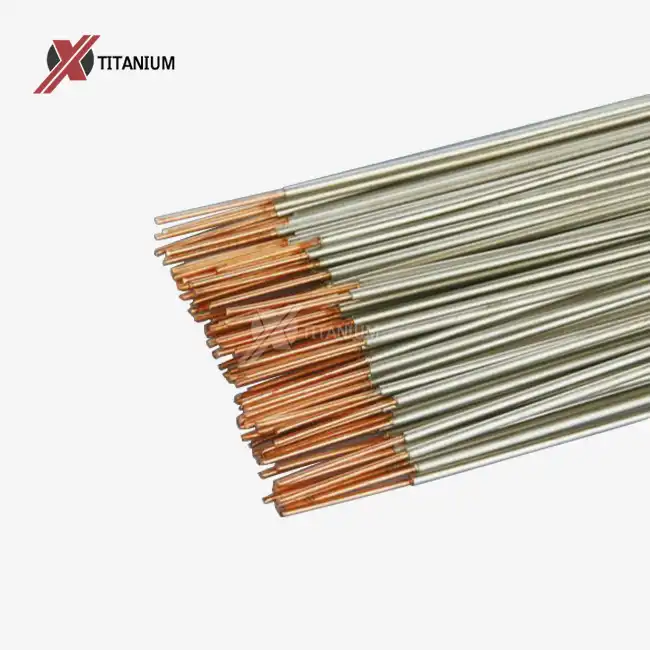
Understanding Titanium-Clad Copper Wire
Defining the Composite Structure
This wire has a high-conductivity copper core that is oxygen-free and is metallurgically joined to a Grade 1 or Grade 2 titanium outer layer. Real titanium-clad copper wire has sleeve widths that range from 0.1mm to 2mm, which makes a constant atomic diffusion zone between the metals. Electroplated options have coats that are only a few microns thick. The copper core, which can be made to fit any width from 0.5 mm to 25 mm, keeps about 65% of its IACS conductivity, which is much better than solid titanium. The titanium shell makes an oxide layer that heals itself and protects against chloride attack, acidic fumes, and galvanic corrosion.
Performance Characteristics That Matter
Important requirements are shown by testing protocols: the minimum tensile strength must hit 500 MPa so that it can support mechanical loads in structure racks and jigs. The bond shear strength is higher than 130 MPa, which makes sure that layers stay together when the wire is bent to curves as small as 5 times its diameter. Thermal safety means that the system can work at temperatures ranging from -400°C to cryogenics without delaminating. Electroplating plants can easily see that this material is better at carrying current than tinned copper or stainless steel options. Clad wire can handle levels that are 4–5 times higher without overheating.
Industrial Applications Driving Demand
In electroplating, this wire is used for hangers that move parts through chromic acid baths. The titanium surface keeps the conductor from dissolving and the current flowing evenly. Clad wire is used for lead links in chlor-alkali plants because the anode systems are stable in terms of size. This means that the systems will work for decades in places that make chlorine gas. When it comes to feeding wires, offshore cathodic protection systems choose this material because it doesn't corrode in saltwater and has low signal resistance. Biocompatible wire is used by medical device makers in surgery tools that need to be able to withstand cleaning and work electrically.
How Titanium-Clad Copper Wire Is Made and Works?
Manufacturing Process Overview
To start production, T2 grade copper rod and commercially pure titanium strip are chosen. Both of these are checked using optical analysis. The advanced bonding method, which is usually explosive welding or hot-roll bonding, makes atomic interdiffusion without melting either metal. This keeps the conductivity of the copper and the passivation properties of the titanium. After the first bond, producers use hot rolling to make the circle smaller while keeping the exact clad ratios. They then use cold rolling through increasingly smaller dies to get the finished size. During annealing processes, internal stresses are relieved, and surface oxides are removed during pickling, leaving titanium-clad copper wire with a bright or polished finish. Quality control checks include hardness tests, bending tests, and hydraulic pressure tests for different tube designs.
Working Principle in Service
The practical benefit comes from the qualities of the materials working well together. The copper core has the least amount of resistance, so electricity flows through it in the way that causes the least amount of voltage drop and heat production. At the same time, the titanium skin comes into contact with acidic media and quickly forms a strong TiO2 film that is only a few nanometers thick. If this film gets scratched, it automatically heals itself. This passivation layer stays stable at pH levels from 1 to 14. It stops ions from moving, which would dissolve the copper otherwise. Engineers often say that this solves the conductivity-corrosion problem, which makes designs possible that wouldn't be possible with wires made of a single metal.
Performance Benchmarking
It was tested against pure copper in 10% sulfuric acid and found that the clad wire kept its full cross-section after 2,000 hours, while the copper lost 40% of its width. The coated form of titanium has 80% less resistance than solid titanium when the same amount of current is applied. This lowers energy costs and gets rid of hot spots. Silver-clad copper is slightly better at conducting electricity, but it costs three times as much and isn't as strong mechanically. This makes it a bad choice for industrial uses that need both electrical and structural performance.
Titanium-Clad Copper Wire vs. Alternative Wire Materials
Comparative Material Analysis
At 100% IACS, pure copper is still the standard for conductivity, but it melts quickly in electrolytic settings, so it needs to be replaced often and contaminates the solution. Many corrosives can't damage stainless steel, but it has 70 times the resistance of copper, which means that a huge amount of efficiency is lost. Copper covered in silver is almost as conductive as pure copper, but it doesn't have the rust resistance that titanium's oxide layer does, especially when it comes to chlorides. Copper that has been tinned works fine in light conditions, but the tin coating goes off physically and breaks down in strong acids. The titanium-clad copper wire delivers 65% IACS conductivity—far exceeding stainless steel and titanium—while matching titanium's corrosion resistance across virtually all industrial chemicals.
Application-Specific Selection Guidance
Clad wire is better than copper-only wire in chemical manufacturing areas with a pH below 3 or chloride levels above 1,000 ppm. Titanium surfaces are the only ones that can protect marine equipment from chlorine that are in splash zones or full absorption. For high-frequency uses, the skin effect helps to concentrate current near the conductor surface, where the alloy still has enough cross-sectional copper. Budget-conscious projects figure out the total cost of ownership. The price of a clad wire unit is 150–200% higher than the price of a pure copper unit, but it lasts 10–20 years, so it doesn't need to be replaced as often, which saves money on work and downtime.
Where to Buy Titanium-Clad Copper Wire Online?
To find qualified sources, you need to look into producing qualifications beyond what the company says on its marketing materials. Real manufacturers have factories that have explosive bonding equipment or multi-stand rolling mills. These are big investments that cost more than $2 million and set real manufacturers apart from trade middlemen. Over 80% of the world's titanium production capacity is concentrated in Baoji City in Shaanxi Province, China. It is home to vertically integrated makers who can get raw materials, bond them together, and finish the work all in one place.
AS9100 approval means that the quality systems cover process controls and material tracking for the titanium-clad copper wire at an aerospace-grade level. ISO 9001 is a standard for quality control, and qualifications like ASME or PED show that you know how to use pressure tools. Medical apps need to be compliant with ISO 13485. Instead of depending on what a website says, ask for pictures of the certifications directly; legitimate makers will send them within 24 hours.
Supplier Assessment Criteria
Minimum order amounts show how big and flexible the company is. Manufacturers who use continuous processes usually set MOQs at around 100 to 200 kilos per standard. This is because it is more cost-effective to work with smaller lots for die changes and heating cycles. When MOQs are low, it usually means that trade operations are buying from real makers, which adds margin without adding value. Delivery wait times give us more information: 4-6 weeks means that the product is made to order and materials are bought, while claims that the product is "stock available" but can be customized should be taken with a grain of salt because this is a very specialized product.
Pricing and Logistics Considerations
Material prices are linked to the markets for copper and titanium, and processing fees are added to clear pricing systems. Rates per kilogram vary on the order amount, width, and clad ratio, but are usually between $45 and $75. When you buy between 500 kg and 1,000 kg, you can get a discount because of the efficiency of your production. Custom surface finishes, such as grinding or more pickling, cost 8–12% more than the base price. Be wary of prices that are a lot lower than the market price. Those rates usually mean that manually wrapped wire or off-spec material will be used instead. Shipping times depend on where the package is going and how customs steps work. It takes 7–10 days for air freight to get from China to US sites, plus processing time. It takes 4–5 weeks for ocean freight.
Tips for Seamless Procurement of Titanium-Clad Copper Wire
Strategic Planning for Lead Times
Before full-scale orders are placed, materials must be tested as part of the project plan. Ask for sample amounts (usually 5–10 kg) to be used for internal quality testing, such as cross-sectional imaging to check the strength of the bond and installation trials to prove how the titanium-clad copper wire bends. This approval phase lasts for two to three weeks before a buy order is placed. Once the order is placed, production wait times begin. Samples should be timed to coincide with design freeze goals so that short deadlines don't force suppliers to make concessions on their screening.
Negotiation Strategies
By committing to buy a lot of something, you can get better deals than just lower unit prices. Annual deals that cover multiple projects give sellers a better idea of what customers want and often get them discounts of 10 to 15 percent and priority booking when capacity is limited. Talk about payment terms in an open way. Reputable makers will accept letters of credit or 30-day net terms after the relationship has been established. On the other hand, requests for full prepayment may be a sign of financial trouble. When you set quality hold points and review rights in collaborative contracts, you hold each other more accountable than when you compete for the lowest price.
Quality Assurance Protocols
Set up processes for getting and inspecting goods that check important factors. Using micrometers to check the dimensions makes sure that the circle errors are within ±0.05mm for precise uses. A visual inspection can find flaws on the surface, such as pits or cuts that go through to the titanium layer. Shipments should come with official mill test records that list tensile tests, conductivity measures, and chemical analyses that can be linked to heat numbers for each batch.
If the specs allow it, ask to see witness testing at the manufacturer's plant before the product is shipped. Seeing bend tests and bond peel tests for yourself ends any arguments that might happen later. Third-party labs can test sample pieces destructively, which gives an independent confirmation of the quality of the metallic joining.
Conclusion
Finding sources for this hybrid circuit requires more scientific research than just buying goods. Because titanium is a very specialized material that needs to be processed with great care and under strict quality control, most of the approved production is concentrated in places that already have the right infrastructure in place. To be successful in procurement, you need to check the production capabilities through certifications and testing methods, negotiate terms that balance cost with dependability, and build relationships with suppliers based on open communication.
Industries using electrochemical processing, naval equipment, or cathodic protection systems can save a lot of money over the course of their lifetimes if they request properly made titanium-clad copper wire, as long as they choose a source whose quality is checked first and then price is considered. In the end, the choice protects operating consistency in situations where a failed wire could lead to safety risks, environmental leaks, or long periods of downtime that cost a lot more than the material savings.
FAQ
Can this wire be fabricated into complex shapes?
Yes, the metallic link does allow for shaping, such as coiling, bending to angles of at least 5x diameter, and pressing into brackets or terminals. When you machine something, don't cut through the metal layer because that would expose the copper body to things that are toxic. The metallurgical bond of the titanium-clad copper wire ensures integrity during these forming operations.
How should electrical connections be made?
There are two main ways to do this: either physically remove the titanium covering at the end points to reveal the copper so that it can be bent or fused, or weld titanium rings to the outside surface. To stop galvanic rusting at the bimetallic contact, fully encapsulating titanium is needed for submerged joints.
What differentiates clad wire from titanium-plated copper?
Electroplated titanium layers are only 5–20 microns thick and have holes in them that let electrolytes pass through. Clad wire uses solid titanium plates that are 100 to 2000 microns thick, joined at the atomic level, and can't be broken by chemicals or mechanical wear.
Partner with Chuanglian for Reliable Titanium-Clad Copper Wire Supply
Baoji Chuanglian New Metal Material Co., Ltd. has been in business for more than ten years and has a wide range of mechanical skills, from finding raw materials to making finished wire. Our factory is ISO 9001-certified and has specialized CNC machine centers and controlled-atmosphere heating ovens. This makes sure that all output batches are the same in terms of size and quality. We can make copper core sizes from 0.5 mm to 25 mm and titanium coating thicknesses that are specific to your weathering environment. Our work is backed up by mill test results that show the tensile strength, conductivity, and bond quality for each heat. As a straight producer of titanium-clad copper wire, we cut out the middlemen and offer reasonable prices along with technical support that helps with fitting issues and performance enhancement. You can email our expert team at info@cltifastener.com or djy6580@aliyun.com to talk about your needs, ask for sample testing, or get full quotes.
References
1. ASM International. "Titanium and Titanium Alloys: Fundamentals and Applications." ASM Handbook Volume 2: Properties and Selection of Nonferrous Alloys and Special-Purpose Materials, 2021.
2. Chen, L., Zhang, W. "Metallurgical Bonding Mechanisms in Titanium-Copper Bimetallic Composites." Journal of Materials Processing Technology, Volume 287, 2019.
3. International Copper Association. "Conductivity and Corrosion Resistance in Composite Conductors for Electrochemical Applications." Technical Report ICA-2020-14, 2020.
4. National Association of Corrosion Engineers. "Material Selection for Cathodic Protection Systems in Marine Environments." NACE Standard Practice SP0176, 2018.
5. Smith, R.D., Johnson, P.K. "Explosive Welding Technology for Dissimilar Metal Joining in Industrial Applications." Welding Journal Research Supplement, Volume 98, Issue 6, 2019.
6. Zhang, Y., Liu, H. "Performance Evaluation of Titanium-Clad Copper Wire in Electroplating Operations." Surface and Coatings Technology, Volume 412, 2022.
Learn about our latest products and discounts through SMS or email