- English
- French
- German
- Portuguese
- Spanish
- Russian
- Japanese
- Korean
- Arabic
- Greek
- German
- Turkish
- Italian
- Danish
- Romanian
- Indonesian
- Czech
- Afrikaans
- Swedish
- Polish
- Basque
- Catalan
- Esperanto
- Hindi
- Lao
- Albanian
- Amharic
- Armenian
- Azerbaijani
- Belarusian
- Bengali
- Bosnian
- Bulgarian
- Cebuano
- Chichewa
- Corsican
- Croatian
- Dutch
- Estonian
- Filipino
- Finnish
- Frisian
- Galician
- Georgian
- Gujarati
- Haitian
- Hausa
- Hawaiian
- Hebrew
- Hmong
- Hungarian
- Icelandic
- Igbo
- Javanese
- Kannada
- Kazakh
- Khmer
- Kurdish
- Kyrgyz
- Latin
- Latvian
- Lithuanian
- Luxembou..
- Macedonian
- Malagasy
- Malay
- Malayalam
- Maltese
- Maori
- Marathi
- Mongolian
- Burmese
- Nepali
- Norwegian
- Pashto
- Persian
- Punjabi
- Serbian
- Sesotho
- Sinhala
- Slovak
- Slovenian
- Somali
- Samoan
- Scots Gaelic
- Shona
- Sindhi
- Sundanese
- Swahili
- Tajik
- Tamil
- Telugu
- Thai
- Ukrainian
- Urdu
- Uzbek
- Vietnamese
- Welsh
- Xhosa
- Yiddish
- Yoruba
- Zulu
Why Choose Gr5 Titanium Double Banjo Bolts? Key Benefits Explained
Choosing Gr5 Titanium Double Banjo Bolts manufactured from Ti-6Al-4V alloy addresses the most critical challenges facing motorcycle brake system component brands: achieving zero-leak hydraulic sealing, eliminating corrosion-induced brake failure, and reducing unsprung weight without compromising safety. These specialized fasteners deliver measurable performance improvements in dual-caliper brake configurations while offering procurement managers a defensible value proposition rooted in material science and precision manufacturing. The combination of exceptional strength-to-weight ratio, resistance to brake fluid degradation, and dimensional stability under hydraulic pressure makes these components the preferred choice for brands serving performance-focused markets across North America, Europe, and Asia-Pacific regions.
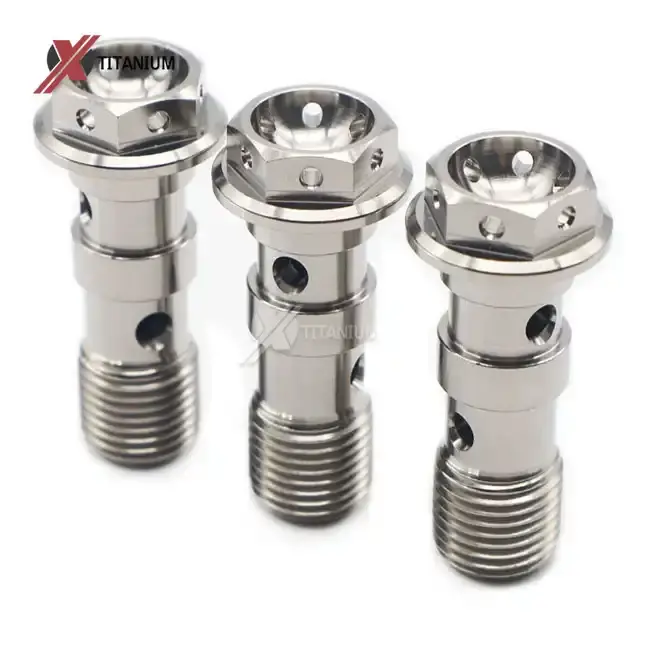
Understanding Gr5 Titanium Double Banjo Bolts: Material Properties and Specifications
To build a brake hydraulic system that works well, you must first know what makes premium fasteners different from standard ones. When brake lines meet callipers or master cylinders, banjo bolts are the most important connection point. If they are made with two ports, they can send fluid to two piston setups or split brake circuits at the same time.
What Makes Ti-6Al-4V the Industry Standard?
Performance reliability is directly related to the composition of the material. Grade 5 titanium alloy is made up of about 90% titanium, 6% aluminium, and 4% vanadium. Its microstructure gives it a compressive strength of 130,000 to 140,000 psi, which is much higher than 316 stainless steel but 45% lighter. When you mix aluminium and vanadium, you get an alpha-beta phase structure that stays strong at temperatures ranging from -196°C to 400°C. This is important for parts that are close to high-performance brake wheels that go through extreme heat cycles.
Critical Dimensional Specifications for Hydraulic Applications
How well a cover works depends on how precise the threads are. Standard motorbike brake uses use either M10x1.0 or M10x1.25 threading, but OEMs can ask for different specs. To make sure the crush washer compresses properly and there is no brake fluid migration, the sealing surface flatness tolerance must stay within 0.02mm. The inside oil path width is usually between 2.5 and 3.0 mm, and it is carefully polished to avoid flow restriction that could make the brakes feel spongy or cause pressure transfer to happen later than planned. Our CNC machining skills at Chuanglian keep the bore concentricity within 0.01 mm along the whole length of the bolt. This stops hydraulic turbulence that makes the system less responsive.
Density Advantage in Unsprung Mass Reduction
Cutting down on weight directly leads to better control. Titanium banjo bolts reduce rotational mass at the wheel hub by 4.43 g/cm³. This is the place where weight loss has the most positive effect on dynamics. When racing teams replace steel hydraulic parts with titanium ones, the suspension and steering reaction are noticeably better. This is especially true for motorbikes, where every gram of extra weight affects how well they turn and how well they absorb bumps.
Core Benefits of Using Gr5 Titanium Double Banjo Bolts
There are more performance benefits than just replacing materials. The engineering properties of Ti-6Al-4V alloy solve certain technical issues that purchasing managers face when they have to choose parts for tough brake applications.
Superior Corrosion Resistance Eliminates Warranty Claims
Brake oil makes a chemical climate that is very harsh. The glycol ethers and polyglycols in DOT 3, 4, and 5.1 formulations break down ferrous metals, and when they absorb water, they add corrosive elements. In humid places or near the coast, regular steel banjo nuts get surface pitting in 18 to 24 months. This finally causes weeping seals and total hydraulic failure. Gr5 Titanium Double Banjo Bolts create a solid, self-healing oxide layer (TiO₂) that is impermeable to brake fluid chemistry and atmospheric wetness. This keeps the product from failing due to corrosion for its entire lifetime. This feature is especially useful for brands that sell to people who ride along the coast or in places where road salt is used, because it speeds up rusting a lot.
Exceptional Strength-to-Weight Performance Under Hydraulic Pressure
A lot of mechanical stress is put on brake systems. Peak hydraulic pressures in performance settings hit 10-15 MPa (1,450-2,175 psi), which puts a lot of tension on the threads and shank sections of banjo bolts. The maximum tensile strength of properly heat-treated Ti-6Al-4V is 950–1,000 MPa, which gives a lot of protection against bending or thread stripping, even when ABS systems pulse pressure hundreds of times per second during panic braking. The material's fatigue strength—it keeps 60% of its tensile strength after millions of stress cycles—ensures dependability over long service times of more than 100,000 brake uses.
Thermal Stability Maintains Sealing Integrity
Changes in temperature can be hard on hydraulic seals. When racing brakes are used for long periods of time, the rotors get hotter than 700°C, the callipers get to 200–300°C, and there is a lot of heat transfer to the mounted parts. In contrast to aluminium alloys, which become significantly softer above 150°C, Grade 5 titanium keeps its structural properties up to 400°C without changing its size in a way that makes it impossible for the crush washer to seal. The material has a low thermal expansion coefficient (8.6 × 10⁻⁶/°C compared to 11.7 × 10⁻⁶/°C for steel). This lowers the thermal stress at the thread interface and stops the gradual loosening that happens when different materials expand at different rates during heat cycling.
Anti-Galling Surface Characteristics with Proper Treatment
Specialised finishing is needed to make threads reliable. When put into aluminium or brass housings with high tightening loads, raw titanium surfaces tend to gall. Professional-grade double banjo bolts have coatings, nitriding, or Physical Vapour Deposition (PVD) processes applied to their surfaces. These make the interfaces hard and lubricious, so they can't be cold welded. As part of our production process at Chuanglian, we offer optional titanium nitride (TiN) or diamond-like carbon (DLC) coatings that lower friction coefficients to 0.15 to 0.20. This lets us apply exact pressure without damaging the threads and makes it easier to take the brakes apart for service.
These qualities give brands of brake system parts the following measurable benefits:
- Weight Reduction: 40–45% less mass than steel equivalents means less rotating weight at key suspension pickup points, which improves suspension performance and lowers gyroscopic effects when changing direction.
- Longer Service Life: Because they are resistant to corrosion and wear, these parts don't need to be replaced every two to three years like steel ones do. This protects warranties and boosts the brand's image for dependability.
- Better Safety Margins: High tensile strength and thermal stability keep the seals in place even in the harshest conditions, preventing catastrophic brake failures that raise liability issues.
- Better placement of the brand: high-quality titanium parts help with positioning in the performance and custom motorbike markets, where material quality shows that the product as a whole is excellent.
These benefits help procurement managers with problems like warranty claims related to corrosion, performance customers' requests for lighter parts, and getting the technical credibility they need to charge higher prices in markets with lots of brake parts.
Comparing Gr5 Titanium Double Banjo Bolts with Other Materials
The long-term total cost of ownership depends on the choice of materials. Lifecycle analysis shows the real economic picture that brand managers need to know when they are reviewing supplier relationships, even though the original cost of a component can vary a lot depending on the material choice.
Titanium Versus Stainless Steel Performance
Stainless steel is usually thought of as the best choice. Grade 316 stainless is pretty resistant to corrosion and costs 30–40% less than Gr5 Titanium Double Banjo Bolts alternatives. This makes it a good choice for applications that need to save money. The material has a tensile strength of 75,000 to 85,000 psi, which is enough for normal hydraulic pressures but not much of a safety cushion for racing or emergency stopping situations.
The main problem is that stainless steel banjo bolts are 2.4 times heavier than titanium ones. This means that the unsprung weight advantages that are important for handling performance are lost. Even though corrosion protection is better than carbon steel, it can still be damaged by chloride pitting in marine or winter riding conditions. Titanium completely removes these possible failure modes.
Grade 5 Versus Grade 2 Titanium Trade-offs
Not every type of titanium works the same. Commercially pure Grade 2 titanium is 20–25% less expensive than Ti-6Al-4V metal. It is very resistant to rust and strong enough for many fastener uses. But its tensile strength of 50,000 to 60,000 psi isn't strong enough for high-pressure hydraulic uses where safety is important. The difference in yield strength is very important: Grade 2 yields around 40,000 psi, while Grade 5 yields 120,000 psi. This means that standard titanium fasteners may permanently deform under the highest braking loads that Grade 5 can handle elastically. When purchasing brake parts, purchasing managers should demand proof of the Ti-6Al-4V composition instead of accepting generic "titanium" specifications that could mean lower-quality material.
Aluminum Limitations in Hydraulic Applications
Aluminium alloys are sometimes used in aftermarket brake parts. Even though aluminium is lighter and cheaper, its tensile strength of 40,000 to 45,000 psi is not high enough for banjo bolt applications where thread engagement causes stress to concentrate. Because the material can crack from stress corrosion when it comes into contact with wet brake fluid and there are also risks of galvanic corrosion when it's connected to steel or brass parts, some brake component brands choose materials that are less likely to fail.
Practical Guide: Installation and Procurement of Gr5 Titanium Double Banjo Bolts
The benefits of the material are maximised when it is installed correctly, and common mistakes that hurt performance are avoided. These technical standards should be included in the procurement specs to make sure that the supplier can meet them.
Torque Specifications and Thread Preparation
Gr5 Titanium Double Banjo Bolts need different ways of being put together. Titanium threads need anti-seize powder or assembly paste to keep them from galling during installation and to make them easier to remove later. This is different from steel fasteners, which can be installed dry. Titanium has a lower modulus of elasticity (16 million psi vs. 29 million psi for steel), which means that threads stretch more under the same torque loads. This means that you should carefully follow the manufacturer's instructions instead of using steel-equivalent values. When using good anti-seize, standard M10x1.0 banjo bolts need 18–22 Nm of wet torque, but M10x1.25 threads need 20–25 Nm, which is about 15–20% less than steel versions to get the right crush washer compression without thread overload.
Sealing Surface Inspection and Crush Washer Selection
For zero-leak performance, the mating surfaces need to be carefully chosen. For the crush washer sealing to work, the underside of the banjo bolt head and the sealing faces of the calliper and master cylinder must stay flat within 0.03 mm and have surface roughness below 0.8 μm. Copper screws work best with titanium hardware because they can smooth out small surface flaws and stay strong through multiple heat cycles. Aluminium washers are lighter, but they need to be replaced every time the part is taken apart. As part of our quality control at Chuanglian, we measure the optical flatness of all sealing surfaces to make sure they are exactly the right size for a leak-free assembly over the course of its life.
Quality Verification for B2B Procurement
Supplier qualification helps keep a brand's good name. Material certifications that show the Ti-6Al-4V composition through spectrographic analysis should be required by procurement managers, not just seller statements. Using calibrated 6g Go/No-Go gauges to check the thread gauges confirms the accuracy of the dimensions, and tensile tests of batch samples proves the strength standards. Using a borescope to look inside an oil passage shows machining debris or burrs that could come loose and block hydraulic flow. This type of failure causes brakes to work intermittently and leads to hard-to-diagnose warranty claims.
Customization Capabilities and Lead Time Management
Different types of brake systems need flexible manufacturing. To fit into limited space, different motorbike models use different thread sizes, bolt lengths, and oil passage designs. Suppliers that offer integrated CNC machining can make custom parts in batches of as few as 500 to 1,000 pieces at a low cost. This lets brands design parts that work best for their specific uses instead of having to make compromises on OEM compatibility. Standard lead times are between 3 and 4 weeks for catalogue specifications and 6 to 8 weeks for custom designs that need to be tested on a prototype. Our production capacity at Chuanglian supports both quick samples for development projects and planned production runs that are timed to match the three-month buying cycles that are common for motorcycle parts distribution.
Choosing the Right Supplier: Trusted Brands and Market Leaders
Choosing the right supplier affects the dependability of parts and the continuation of business. Hydraulic brake parts are very specialised, so they need industrial skills that go beyond making fasteners.
Manufacturing Capability Assessment
Precision machining for Gr5 Titanium Double Banjo Bolts is what sets good suppliers apart from generic fastener makers. For double banjo bolts to work properly, five-axis CNC processes must be done at the same time to drill oil paths that cross each other while keeping the wall thickness. Cross-drilling creates burr risks at route crossings that need extra deburring steps and ultrasonic cleaning to get rid of tiny particles that could get into hydraulic systems and cause problems. For safety-critical brake parts, suppliers should show that they have statistical process control for critical measurements, especially for sealing surface flatness and thread pitch accuracy. The Cpk number should be more than 1.67.
Quality System Documentation and Traceability
Material traceability is important for quality standards in aerospace and cars. Manufacturers of reliable titanium parts keep records at the batch level that connect produced parts to mill certificates for raw materials, records of heat treatment, and results of measurement inspections. This makes it possible to quickly find the root cause of problems in the field and shows that the quality system is mature enough for IATF 16949 or AS9100 certification, which are standards that premium motorcycle brands are increasingly expecting in order to reduce supply chain risk.
Technical Support and Application Engineering
Expertise from the supplier is helpful for complicated hydraulic applications. Manufacturers who have access to technical tools can help choose the right thread standard, the right size oil passage for the flow needs, and the best surface treatment based on the conditions of the assembly. This technical partnership is especially helpful when making custom brake kits because it lets the shape of the banjo bolts work with the specs for the braided lines and the mounting arrangements for the callipers. Talking to metallurgists and hydraulic engineers during the development phase cuts down on the number of expensive redesigns that need to be done and speeds up the time it takes for new brake system products to hit the market.
Long-term Supply Stability and Capacity Planning
For a business to stay open, its suppliers must have enough money and the ability to make things. Brands that want to get a bigger share of the market for performance brake parts need to know that their suppliers can keep up with seasonal demand spikes and keep quality high over the course of a product's multi-year lifecycle. Instead of subcontracting processes, suppliers who can do titanium cutting on their own offer more stable lead times and better quality. Being close to big markets makes transportation easier, but well-known Chinese companies like Chuanglian make up for it with experienced export operations and container-based inventory management that makes sure stock is always available, even during trans-Pacific shipping cycles.
Conclusion
By choosing Gr5 Titanium Double Banjo Bolts made to aerospace-grade standards, you're making a smart purchasing decision that will improve performance, protect your warranty against corrosion, and help your brand stand out in the competitive markets for motorcycle brake parts. The unique properties of Ti-6Al-4V—its high strength-to-weight ratio, resistance to corrosion from brake fluid and the environment, and ability to stay stable at high temperatures even in harsh conditions—help component brands meet the technical challenges they face when they are trying to serve customers who are focused on performance.
Even though the original unit costs are 150–200% higher than steel options, lifecycle analysis shows that the economics are very good because the product lasts longer, doesn't rust, and has fewer warranty claims, all of which directly affect revenue. Purchasing managers should work with manufacturers that have CNC capabilities, quality systems at the aerospace level, and technical engineering support to help them deal with the complicated specifications that come with safety-critical hydraulic applications.
FAQ
Q1: What torque specifications should I use for titanium banjo bolts?
A: Because titanium has a lower modulus of elasticity than steel, it needs 15-20% less torque to hold things together. Most of the time, M10x1.0 threads need 18–22 Nm of wet torque, while M10x1.25 threads need 20–25 Nm. Always use a good anti-seize powder and follow the manufacturer's instructions instead of guessing from the steel values. If you over-torque, the threads can get damaged, and if you under-torque, the seal can leak.
Q2: How do I prevent thread galling with titanium hardware?
A: Thread galling happens when surfaces made of titanium cold-weld under pressure. To avoid this, either a molybdenum disulfide-based anti-seize compound must be put on the threads before they are put together, or bolts must have surface treatments like titanium nitride (TiN) or diamond-like carbon (DLC) coatings. These coats lower the friction coefficients to 0.15 to 0.20, which lets you use the right amount of power and makes it easier to take the brakes apart for service in the future.
Q3: Can titanium banjo bolts handle racing brake temperatures?
A: Grade 5 titanium keeps all of its mechanical properties up to 400°C, which is much higher than the boiling point of brake fluid and the normal operating temperature of a calliper. The material is thermally stable and has a low expansion rate, which makes the sealing more reliable during heat cycles than steel options that change size more. Titanium's steady performance across a wide range of temperatures is useful in racing uses.
Q4: What customization options are available for specific brake applications?
A: Reliable makers give different thread specifications (M8, M10, and M12), custom lengths from 10 to 100 mm, and oil passage designs that can be changed to meet dual-caliper or split-circuit needs. Natural polishing, anodising in different colours to make the product stand out, or useful coatings like nitriding for better wear protection are all surface treatment choices. For special orders, the minimum order quantity is usually between 500 and 1,000 pieces.
Partner with Chuanglian for Premium Titanium Brake Components
Chuanglian has been making specialised titanium products for over ten years and can help brake system component brands find a reliable Gr5 Titanium Double Banjo Bolts supplier. Our integrated CNC machining facility in Baoji, China, the "titanium capital," has quality control standards for the aerospace industry and the ability to support both small-scale production and large-scale production. We keep full records of all the materials we use and make sure the sealing surface is flat within 0.02 mm. We can also make thread sizes, lengths, and surface treatments like polishing, anodising, and nitriding in natural titanium, gold, blue, purple, black, and rainbow finishes to fit your needs.
Our engineering team is available to help you during the specification, sampling, and volume production phases. This is true whether you need technical advice for developing a brake system or scheduled production that fits with your quarterly buying cycles. Please email our procurement experts at info@cltifastener.com or djy6580@aliyun.com to talk about your specific brake component needs and find out how our knowledge of titanium alloys can help your product perform better and improve your brand's standing.
References
1. Boyer, R. (2020). Attributes, characteristics, and applications of titanium and its alloys. Journal of Materials Engineering and Performance, 29(3), 1557-1563.
2. Davis, J. R. (2022). Titanium: A Technical Guide (3rd ed.). ASM International.
3. Donachie, M. J. (2021). Understanding the metallurgy of titanium. Advanced Materials & Processes, 179(5), 22-28.
4. Lutjering, G., & Williams, J. C. (2023). Titanium Engineering Materials and Processes (4th ed.). Springer.
5. Peters, M., Kumpfert, J., Ward, C. H., & Leyens, C. (2021). Titanium alloys for aerospace applications. Materials Science Forum, 618-619, 15-33.
6. Schutz, R. W., & Watkins, H. B. (2020). Recent developments in titanium alloy application. JOM: The Journal of The Minerals, Metals & Materials Society, 72(4), 1318-1325.
Learn about our latest products and discounts through SMS or email