- English
- French
- German
- Portuguese
- Spanish
- Russian
- Japanese
- Korean
- Arabic
- Greek
- German
- Turkish
- Italian
- Danish
- Romanian
- Indonesian
- Czech
- Afrikaans
- Swedish
- Polish
- Basque
- Catalan
- Esperanto
- Hindi
- Lao
- Albanian
- Amharic
- Armenian
- Azerbaijani
- Belarusian
- Bengali
- Bosnian
- Bulgarian
- Cebuano
- Chichewa
- Corsican
- Croatian
- Dutch
- Estonian
- Filipino
- Finnish
- Frisian
- Galician
- Georgian
- Gujarati
- Haitian
- Hausa
- Hawaiian
- Hebrew
- Hmong
- Hungarian
- Icelandic
- Igbo
- Javanese
- Kannada
- Kazakh
- Khmer
- Kurdish
- Kyrgyz
- Latin
- Latvian
- Lithuanian
- Luxembou..
- Macedonian
- Malagasy
- Malay
- Malayalam
- Maltese
- Maori
- Marathi
- Mongolian
- Burmese
- Nepali
- Norwegian
- Pashto
- Persian
- Punjabi
- Serbian
- Sesotho
- Sinhala
- Slovak
- Slovenian
- Somali
- Samoan
- Scots Gaelic
- Shona
- Sindhi
- Sundanese
- Swahili
- Tajik
- Tamil
- Telugu
- Thai
- Ukrainian
- Urdu
- Uzbek
- Vietnamese
- Welsh
- Xhosa
- Yiddish
- Yoruba
- Zulu
Why Use Titanium Flanged Axle Nuts in Racing and Motorsport?
Racing and motorsport demand components that deliver uncompromising performance under extreme conditions. Titanium flanged axle nuts have emerged as the fastener of choice for serious racing teams and performance enthusiasts seeking to optimize vehicle dynamics while ensuring safety and reliability. Manufactured from aerospace-grade Ti-6Al-4V (Grade 5) titanium alloy, these specialized fasteners combine an integrated flange design with titanium's exceptional strength-to-weight ratio—delivering tensile strength exceeding 900 MPa while weighing approximately 45% less than comparable steel nuts. This weight reduction directly at the wheel assembly lowers unsprung mass, improving suspension response, cornering precision, and overall vehicle handling. The built-in flange eliminates the need for separate washers while distributing clamping loads evenly across mounting surfaces, preventing damage to expensive swingarms and dropouts during high-stress racing conditions.
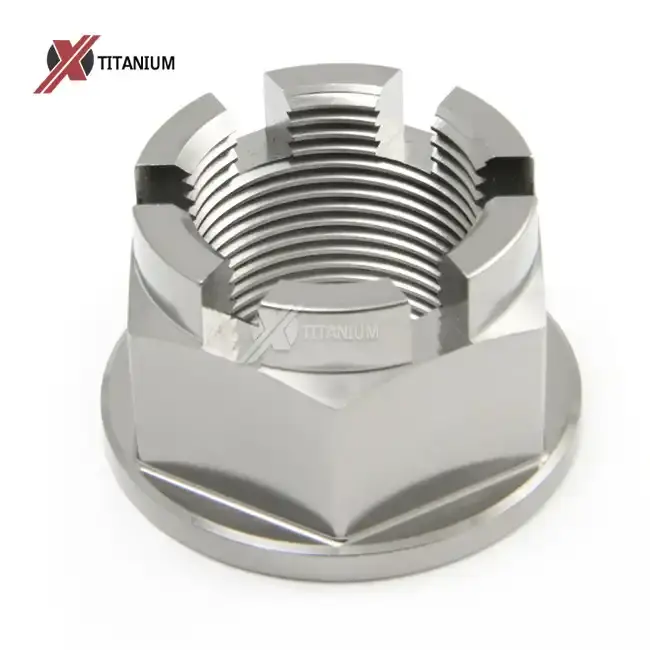
Understanding Titanium Flanged Axle Nuts: What Makes Them Ideal for Racing?
Racing parts are put through harsh conditions that quickly show where the materials are weak. Standard steel axle nuts rust when they come into contact with track chemicals, rain, and road debris. Eventually, they seize up and are very hard to remove during maintenance or pit stops. Alternatives made of aluminium don't have the fatigue strength needed to handle repeated high-torque installations and the vibrations that come with motorsport uses.
Through a number of built-in design and material benefits, Titanium Flanged Axle Nuts address these problems. We use Grade 5 titanium metal (Ti-6Al-4V) at Chuanglian. When it comes in contact with oxygen, it makes a stable oxide layer that protects it from corrosion in the air and chemical attacks from fuels, brake fluids, and track cleaners. If this passive film gets scratched, it heals right away, keeping the part safe for as long as it's used.
Superior Strength-to-Weight Performance
The motorsports business is always trying to make cars lighter without losing their strength. Our Titanium Flanged Axle Nuts are CNC-machined and have tensile strengths between 950 and 1050 MPa, which is the same as Class 10.9 steel bolts. They are also very light, weighing only 4.43 g/cm³. Getting rid of even small amounts of spinning mass at the wheel hub will directly lead to better acceleration, stopping, and suspension movement.
Integrated Flange Design Benefits
The built-in flange spreads the binding forces over a bigger contact area, like a washer. This design stops stress from building up in one place, which can break aluminium swingarms or hurt carbon fibre dropouts on high-end racing bikes and motorcycles. The lip also doesn't come loose when it's vibrated, which is a very important safety feature when racing and parts are constantly oscillating at high frequencies.
Temperature and Environmental Resistance
Extreme temperature changes can happen to screws in racing settings. Titanium's mechanical properties stay the same at temperatures ranging from -250°C to 600°C. This means that the clamping force stays the same whether it's cold when it's first used or after long periods of high-speed running that heats up brake rotors and hubs. Titanium, unlike steel, won't grow too much when heated or lose its shape when heated and cooled many times.
Titanium vs. Other Flanged Axle Nut Materials: A Comparative Analysis
When purchasing managers look at different axle nut materials, they have to weigh the starting costs against the costs of performance and upkeep over time. When you know how titanium stacks up against other materials, you can see why high-end race teams choose titanium, even though it costs more up front.
Titanium vs. Steel Comparison
Steel flanged axle nuts are easy to find and don't cost much to buy at first, unlike a Titanium Flanged Axle Nut. But steel's density (7.85 g/cm³) makes it almost twice as heavy to spin as titanium. The fact that steel can rust is even worse; even stainless steel can pit and rust in marine or chemically harsh race conditions. Through galvanic rust, steel nuts often become stuck on wheels, and they have to be taken off in a way that damages other parts nearby. Because it's heavier and harder to keep up, steel is becoming less useful in professional race uses.
Titanium vs. Aluminum Analysis
With a density of about 2.81 g/cm³, aluminium 7075 metals are great for saving weight. But aluminum's wear strength is a lot lower than titanium's durability limit. When high-torque installs and stress cycling happen over and over again, aluminium threads deform and finally strip. This is especially dangerous in critical safety uses like wheel retention. Galvanic corrosion can also happen to aluminium when it comes into contact with metals that are not the same, which is common in hub assemblies.
Long-Term Value Proposition
Titanium Flanged Axle Nuts are more expensive than steel or aluminium options, but a look at their total cost of ownership shows that they are well worth the extra money. Because titanium doesn't corrode, replacing seized or corroded fasteners doesn't cost anything. Because the material is so resistant to fatigue, it can be used over and over again without the threads wearing down. Steel and aluminium nuts usually need to be replaced after a few installation cycles. By using the same titanium screws every season, racing teams can cut down on stocking costs and avoid problems in the middle of the season.
Installation, Maintenance, and Performance Optimization of Titanium Flanged Axle Nuts
To get the most out of titanium screws' performance benefits, you need to know how to install them and how to keep them in good shape. Using the right techniques will keep you safe and make parts last longer.
Correct Installation Protocols
Titanium and steel have different frictional properties, which changes force specs. Our Titanium Flanged Axle Nuts are made with rolled threads instead of cut threads. This process improves grain flow consistency, which makes the nuts much more resistant to wear. But because titanium tends to gall when placed against metals that are similar, special care must be taken.
Before installing, use a special anti-seize compound that has copper or nickel in it to coat the threads. This keeps the titanium surfaces from cold welding together and keeps the friction coefficients constant so that the right amount of force can be applied. Standard torque values for steel bolts usually work for Grade 5 titanium nuts of the same size, but check with the maker because anti-seize is a lubricant that changes the torque-to-preload ratios.
Routine Inspection and Maintenance
In racing environments, parts need to be checked regularly. Before every race weekend, look at the Titanium Flanged Axle Nuts to see if they have any strange wear patterns on the flange surface or hex head. The integrated flange should have even contact all the way around. If it doesn't, it means that the mating surfaces aren't lined up right and need to be fixed. To clean titanium screws, use water and a light cleanser. Do not use harsh chemicals or wire brushes, as they could damage the protected oxide layer. We offer a natural titanium surface or anodised finish in gold, blue, purple, black, and rainbow colours. These finishes make it easier to inspect visually, as changes in colour or irregularities show right away that there might be a problem.
Performance Monitoring Tips
Keep track of the torque requirements and fitting instructions for every bolt. Keep records of any unusual resistance you encounter when installing or removing something. This could be a sign of thread damage or galling that is starting to form. To make sure that all of your product has the same amount of wear, move the fasteners to different wheel places. Titanium is very durable, so this can be done without putting safety at risk. This is a big plus over aluminium or lower-grade steel nuts, which need to be replaced more often.
Procurement Insights: How to Source and Evaluate Titanium Flanged Axle Nuts for Motorsport?
Choosing trustworthy sources for titanium racing parts has a direct effect on the speed of the supply chain, the quality of the products, and how well they do in competition. Racing teams and distributors that work with the motorsports market should use certain criteria to evaluate potential suppliers.
Essential Supplier Qualifications
Manufacturers of high-quality titanium fasteners follow strict certification rules. Getting ISO 9001:2015 approval shows that you handle quality in a planned way throughout the whole production process. As long as the material meets the requirements of ASTM B348 compliance, it means that it meets internationally recognised standards for titanium alloys. RoHS compliance guarantees environmental responsibility, which is becoming more and more important as racing organisations start to focus on sustainability.
Our Chuanglian plant in Baoji City, which is known as "China's Titanium Valley," has all the necessary licenses and has been specialised in titanium machining for over ten years. Our dozen CNC machines and thorough inspection routines make sure that the quality is always the same, from checking the raw materials to delivering the finished product.
Geographic Sourcing Considerations
International purchasing managers can get a lot out of buying titanium from Chinese companies like Chuanglian. Over half of the world's titanium comes from China. This creates integrated supply lines that lower the cost of raw materials and shorten wait times. Baoji's focus on titanium gives them access to specialised machining skills and technical knowledge that is hard to find elsewhere. It usually takes 7-15 days for air freight to get from China to major racing markets in Southeast Asia, South America, and Eastern Europe, and 4–6 weeks for ocean freight. Our experience managing international logistics helps distributors keep track of their stock and keep landed costs as low as possible by using the best shipping methods.
Flexible Ordering and Customization
For distributors to be successful, they need providers who offer reasonable minimum order amounts (MOQ) that balance the cost of keeping inventory with the need to offer competitive prices. We accept MOQs as low as 500 pieces for standard specs. This lets smaller wholesalers keep a wide range of sizes in stock without having to spend a lot of money. Professional racing has unique needs that can be met by custom manufacturing. Our CNC machines make Titanium Flanged Axle Nuts with thread sizes ranging from M6 to M100. The fitting can be metric or imperial, and the tolerances are as low as ±0.01mm. The surfaces can be polished, anodised, or nitrided. Custom anodising colours help teams promote their logos and make the surface harder.
Why Titanium Flanged Axle Nuts Are Becoming the Preferred Choice in Motorsport: Industry Trends and Future Outlook
Titanium fasteners are being used more and more in motorsport. This is part of a larger trend in technology toward lightweight, high-performance materials that give competitors an edge while also making things safer.
Material Evolution in Racing
For decades, traditional steel screws ruled racing because they were easy to use, cheap, and worked well in earlier competitions. Material limits became performance bottlenecks as racing technology got better, with faster speeds, more powerful engines, and more complex suspension systems. The extra weight and susceptibility to rust that steel had no longer met the needs of current performance. Titanium's history in aerospace made it a reliable material that could adapt to changing racing needs. Titanium is used in aircraft buildings because it has great strength-to-weight ratios, doesn't rust, and doesn't break down over time. These same qualities also make it perfect for motorsports, which require high performance.
Electric and Hybrid Racing Vehicle Impact
The rise of electric racing series like Formula E and MotoE has made people want to lose weight even more. Since batteries add a lot of weight to electric powertrains, every gram of weight savings elsewhere is very important for competitive performance. Titanium parts like flanged axle nuts help with strategies for reducing total weight that are necessary to be effective in electric racing. Titanium is also good for racing hybrid cars in series like Le Mans Prototype racing because it makes them lighter. Complex powertrains that include internal combustion engines, electric motors, and energy recovery systems add a lot of weight. Titanium bolts used in the frame and suspension systems help make up for this loss of mass while keeping the structure strong.
Market Growth and Supplier Investment
OEMs that sell parts to race teams are making titanium screws standard equipment more and more, instead of adding them as an extra. Because of this trend, more is being made, which leads to economies of scale that lower prices over time compared to traditional materials. When suppliers invest in the ability to make titanium, they set themselves up for success as the market grows. Professional racing trends can be seen in both the custom motorcycle and high-performance bicycle markets. Fans of both are looking for the same lightweight, corrosion-resistant parts that professional teams use. This wider market acceptance opens up chances for distributors who serve both professional racing customers and retail customers who are interested in performance.
Conclusion
Titanium Flanged Axle Nuts are a smart investment for race teams and motorsport distributors that want to gain a competitive edge by reducing weight, improving reliability, and lowering the need for upkeep. The material's high strength-to-weight ratio, resistance to corrosion, and resistance to fatigue meet important performance and safety standards in tough racing environments. Initial costs are higher than steel or aluminium options, but long-term value through longer service life, no replacement costs, and consistent performance makes the extra cost worth it for serious rivals. As motorsports move toward using more lightweight, high-performance materials, especially with the rise of electric and hybrid racing cars, titanium fasteners will become standard features rather than add-ons that can be bought separately. Working with seasoned makers guarantees access to high-quality parts, technical know-how, and a dependable supply chain, all of which are necessary for success in the tough racing markets.
FAQ
Q1: What torque specifications should I use for titanium flanged axle nuts?
A: In general, use the torque values given for steel fasteners that are the same size and thread pitch. High-tensile steel and grade 5 titanium both have about the same yield strength. But because the anti-seize compounds needed for titanium installation also work as lubricants, torque values should be lowered by about 10 to 15 percent to avoid over-tightening. Always check the manufacturer's instructions and use torque tools that have been adjusted to get the job done right.
Q2: Will titanium flanged axle nuts work across different racing vehicle types?
A: Of course. Titanium Flanged Axle Nuts come in sizes ranging from M6 to M100 and can be threaded in either metric or imperial units. They can be used on competition bikes, motorbikes, race cars, and other specialised racing vehicles. The most important thing is to choose the right thread size and pitch for your application. Our expert team can help you check the specifications.
Q3: How does the lifespan of titanium nuts compare to steel alternatives?
A: Titanium Flanged Axle Nuts have a significantly longer lifespan than steel counterparts. If you don't take care of titanium screws properly, they will last forever. Steel nuts may need to be replaced after one or two seasons because of rust or thread damage. The material is very resistant to fatigue, so it can be installed over and over again without the threads breaking. It is also resistant to corrosion, which is the most common way that steel fasteners fail in racing environments.
Partner with Chuanglian for Premium Titanium Flanged Axle Nuts
Chuanglian is in a unique situation to meet the needs of distributors and race teams looking for a reliable Titanium Flanged Axle Nut provider. Our Baoji factory blends specialised titanium knowledge with full CNC machining capabilities. It makes Grade 5 titanium fasteners that meet ASTM B348 standards and has quality management that is ISO 9001:2015 approved.
We know how hard it is for motorsport distributors to find the right suppliers while also keeping inventory costs low, lead times under control, and customers' high standards of quality always met. Our flexible MOQ policies, which start at 500 pieces, let smaller distributors offer a wide range of products without having to spend a lot of money. Bulk purchasing programs give you savings for buying in bulk, which helps you compete in price-sensitive markets.
Custom production can meet unique needs, such as thread sizes that aren't standard or anodised colours that are unique to each team. Our expert team works directly with your engineers to make sure that requirements are met and to suggest the best solutions for each application. We make it easier to buy things from other countries while keeping landing costs low by arranging shipping to Southeast Asia, South America, Eastern Europe, and other places.
Get in touch with our team right away to talk about your Titanium Flanged Axle Nut needs. You can email us at info@cltifastener.com or djy6580@aliyun.com. Let Chuanglian's ten years of experience with titanium help you do well in the market.
References
1. ASM International. (2015). Titanium: A Technical Guide (2nd ed.). Materials Park, OH: ASM International.
2. Donachie, M.J. (2000). Titanium: A Technical Guide (2nd Edition). ASM International.
3. Boyer, R., Welsch, G., & Collings, E.W. (1994). Materials Properties Handbook: Titanium Alloys. ASM International.
4. Lutjering, G., & Williams, J.C. (2007). Titanium (2nd ed.). Springer-Verlag Berlin Heidelberg.
5. Race Tech Magazine. (2021). "Material Innovation in Modern Motorsport." Race Tech, 15(3), 44-52.
6. Schutz, R.W., & Watkins, H.B. (1998). "Recent developments in titanium alloy application in the energy industry." Materials Science and Engineering: A, 243(1-2), 305-315.
Learn about our latest products and discounts through SMS or email