- English
- French
- German
- Portuguese
- Spanish
- Russian
- Japanese
- Korean
- Arabic
- Greek
- German
- Turkish
- Italian
- Danish
- Romanian
- Indonesian
- Czech
- Afrikaans
- Swedish
- Polish
- Basque
- Catalan
- Esperanto
- Hindi
- Lao
- Albanian
- Amharic
- Armenian
- Azerbaijani
- Belarusian
- Bengali
- Bosnian
- Bulgarian
- Cebuano
- Chichewa
- Corsican
- Croatian
- Dutch
- Estonian
- Filipino
- Finnish
- Frisian
- Galician
- Georgian
- Gujarati
- Haitian
- Hausa
- Hawaiian
- Hebrew
- Hmong
- Hungarian
- Icelandic
- Igbo
- Javanese
- Kannada
- Kazakh
- Khmer
- Kurdish
- Kyrgyz
- Latin
- Latvian
- Lithuanian
- Luxembou..
- Macedonian
- Malagasy
- Malay
- Malayalam
- Maltese
- Maori
- Marathi
- Mongolian
- Burmese
- Nepali
- Norwegian
- Pashto
- Persian
- Punjabi
- Serbian
- Sesotho
- Sinhala
- Slovak
- Slovenian
- Somali
- Samoan
- Scots Gaelic
- Shona
- Sindhi
- Sundanese
- Swahili
- Tajik
- Tamil
- Telugu
- Thai
- Ukrainian
- Urdu
- Uzbek
- Vietnamese
- Welsh
- Xhosa
- Yiddish
- Yoruba
- Zulu
Why Choose Titanium Disc Bolts for Your Bike?
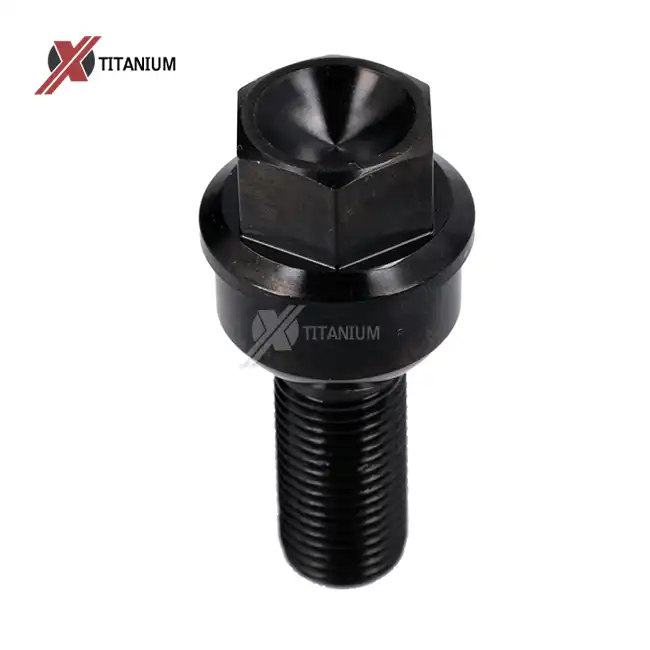
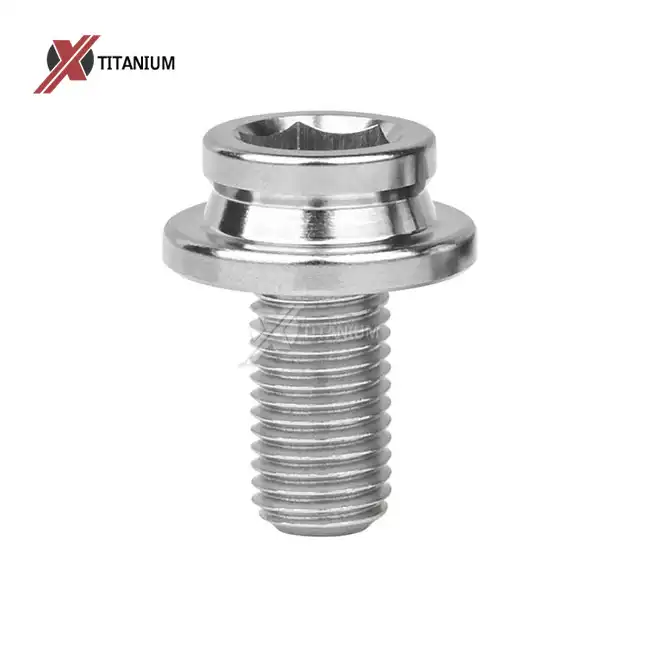
Titanium motorcycle disc bolts are the best way to fasten things for users and procurement workers who want the best performance. These specialized parts are very strong while also being very light. This makes them essential for uses that need to be reliable under a lot of stress. These bolts are made from Grade 5 titanium metal (Ti-6Al-4V), which gives them tensile strength of more than 950 MPa and resistance to corrosion in tough conditions. When it comes to longevity, weight savings, and upkeep intervals, titanium motorcycle disc bolts are better than traditional steel ones for holding brake rotors in place on racing bikes or custom builds. These are benefits that buyers can directly see in their operations and lower costs.

Understanding Titanium Motorcycle Disc Bolts
Material Science Behind Superior Performance
High-performance titanium motorcycle disc bolts are made from Grade 5 titanium metal, which is much stronger than steel in terms of weight to strength ratio. This metal is made up of about 6% aluminum and 4% vanadium, which makes the microstructure strong enough to withstand repeated stopping loads. Because the density of the material is 4.43 g/cm³, parts made of it weigh 45% less than steel versions while still being strong. This extra weight has a direct effect on spinning inertia, which is a very important factor for race teams and performance fans who want to improve handling response times by milliseconds.
Corrosion Resistance That Redefines Longevity
Titanium fasteners make a passive oxide layer that fixes itself when scratched, unlike steel fasteners that break down quickly when exposed to road salt, water, or chemical contaminants. This natural buffer completely stops galvanic corrosion, which is very important when bolts connect to metal hubs. Coastal riders and adventure bikers who work in wet settings benefit a lot because regular steel bolts often get stuck in hub threads and have to be taken out in a destructive way. Titanium motorcycle disc bolts completely get rid of this risk, so they can still be used in the field even after thousands of miles of rough circumstances.
Addressing Common Misconceptions
Some procurement managers wonder if the fact that titanium is more expensive does mean that it is not as tough as strengthened steel. Tests show that Grade 5 nuts that are properly made can handle proof loads that are higher than what the industry requires without deforming. The key is in the way they are made: rolled threads keep the grain flow continuous, which makes them much more resistant to wear than cut threads. When buyers are qualifying a seller, they should check the thread production process because it is the only thing that decides whether bolts will be able to handle the repeated temperature changes and vibrations that come with braking systems.
Titanium vs Other Materials: Making the Right Choice
Comparative Analysis of Fastener Materials
Steel nuts are used a lot in original equipment making because they are cheap and have well-established supply chains. Different types of carbon steel have good tensile strength, but they fail horribly in coastal or winter settings due to corrosion. Stainless steel is better at resisting corrosion, but it's also heavy than titanium—about 220% heavier for the same strength values. Even though aluminum bolts are lighter, they don't have the shear strength needed for safety-critical brake uses. This means that emergency stopping torque could cause the head to shear.
Titanium motorcycle disc bolts are one of a kind because they combine the power of steel with the light weight of aluminum while being more resistant to chemicals than either material alone. The results of tests show that Ti-6Al-4V bolts keep their structural integrity after 500 hours of being exposed to salt water, showing no measurable degradation. Under the same conditions, steel counterparts show surface damage and changes in size within 72 hours.
Application Suitability Across Riding Scenarios
Professional race tracks want every gram to be cut without lowering safety standards. MotoGP teams use titanium fasteners all over their wheel systems, which are required by law to have safety wires to keep drivers from backing out. The material's ability to prevent galling during high-torque installation is very important because workers need to get the exact preload without the thread seizing up. Track-day fans who use race-spec parts notice improvements in how the suspension responds and how the brakes feel because there is less unsprung mass. Adventure travel comes with a whole new set of problems. Dual-sport bikes that cross waterways or work in humid coastal areas need fasteners that can be used even after being wet for a long time. Titanium motorcycle disc bolts do not rust, so fixes can be done on the side of the road. This keeps riders from having to use corroded steel bolts to drill out stuck screws without the right tools.
Cost-Benefit Considerations for Strategic Procurement
Titanium motorcycle disc bolts usually cost three to five times as much as steel nuts when they are first bought. Lifecycle study shows a different picture of the economy. In harsh settings, steel screws usually need to be replaced every 12 to 18 months, but titanium parts can be used for longer than five years without breaking down. Costs that aren't obvious, like the work needed to remove corroded steel pins for maintenance, are added by titanium. When procurement offices look at the total cost of ownership, they always find that titanium gives them a better return on investment when they take into account how often they need to be replaced and how much it costs to hire workers.
Practical Insights for Procurement and Installation
Precision Installation Protocols
To get the best performance, you need to follow the torque specs given by the maker. For M8 brake disc uses, these are usually between 18 and 22 Nm. Titanium motorcycle disc bolts have a lower friction coefficient than steel, so they need to be installed with extra care. If you over-torque, you could damage the threads in the aluminum hubs, and if you don't put enough preload on them, vibrations could cause them to come loose. Installation teams should always have good torque wrenches that are set to within 4% of the true value.
Minimum thread engagement length standards must be met. For metal hubs, this is usually found by multiplying the bolt width by 1.5. When there isn't enough contact, stress builds up at the thread roots, which makes it more likely that the thread will strip during heat expansion cycles. When engineers define custom-length nuts, they need to take into account that different wheel hub designs have different rotor mounting surfaces.
Surface Treatment Options and Their Implications
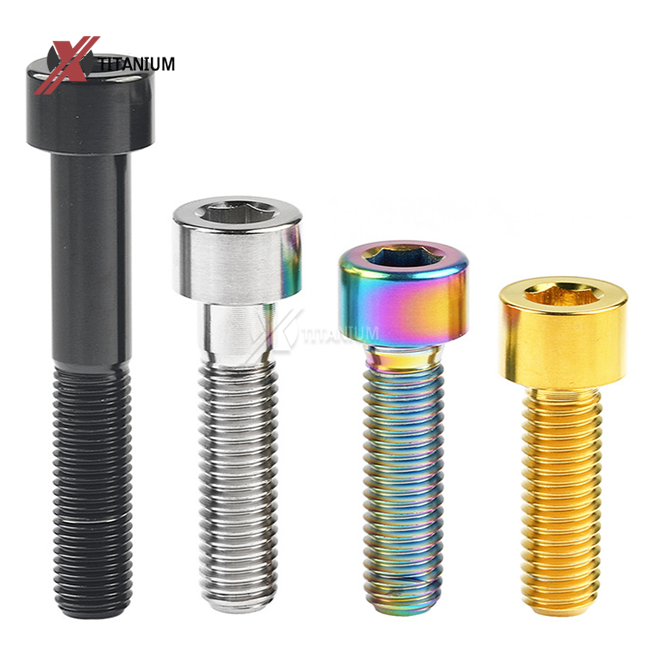
Different surface processes are applied to CNC-machined titanium motorcycle disc bolts, which change both their look and how they work. Polished finishes bring out the natural shine of the metal while reducing surface flaws that could cause stress to build up. Anodizing adds controlled oxide layers in colors like blue, purple, gold, and the rainbow spectrum. This makes branded motorcycle builds stand out without changing the material's qualities. Nitriding processes raise the surface hardness to HV 900, which is good for situations where tools will be touching the surface a lot during maintenance.
Quality Verification Standards
For professional procurement, strict quality control procedures are needed that go beyond eye inspection. Positive Material Identification using X-Ray Fluorescence spectroscopy shows that the chemical makeup meets the requirements for Grade 5. This means that inferior Grade 2 market pure titanium cannot be used instead. Random batch sampling for tensile testing confirms that the real strength meets the minimum 950 MPa standards. This protects against metallurgical flaws that might have been introduced during forging or heat treatment.
Using Go/No-Go scales to check the thread profile makes sure that the dimensions are exactly in line with ISO 965 tolerance classes. Loose threads cause vibrations that cause them to back out, and oversized threads cause galling during fitting. Both of these situations are unsafe for brake uses. Every production batch should come with a Certificate of Conformance. This way, the materials and production runs can be tracked back to their original lots.
Market Solutions and Trusted Suppliers
Evaluating Supplier Capabilities
There are two types of makers in the titanium motorcycle disc bolts supply chain: those that focus on high-performance markets and those that make standard products for general industrial uses. Professionals in procurement have to evaluate providers in more ways than just price per unit. The infrastructure for manufacturing is very important. Having CNC machines, thread rolling machines, and anodizing facilities on-site all show that the company is vertically integrated, which cuts down on wait times and quality variations.
Custom Ordering and Specification Flexibility
Normal motorcycle uses thread sizes like M6, M8, and M10, but unique builds often need thread sizes and combinations that aren't standard. OEMs working on their own designs can benefit from suppliers that offer unique lengths, head styles (such as socket cap, button head, and countersunk), and drive types (hex, Torx). Different suppliers have very different minimum order amounts. For example, boutique makers may take orders as low as 50 pieces, but industrial-scale producers need at least 5,000 pieces.
Baoji Chuanglian: Specialized Manufacturing Excellence
Baoji Chuanglian New Metal Material Co., Ltd. is in Baoji City, which is known around the world as the "City of Titanium." They work at the crossroads of metalworking knowledge and high-tech CNC production. With more than ten years of experience making titanium motorcycle disc bolts, the business is a good resource for buying teams that need to figure out complicated technical requirements. The factory has a lot of different kinds of machines for machining, like thread rolling, multi-axis CNC turning, and controlled-atmosphere anodizing. This lets the whole process of production be supervised by one person for quality.
The production process is flexible enough to handle both small batches of prototypes for racing team development projects and large orders for OEM integration. Custom specs are looked over by engineers to make sure they can be manufactured well while still staying true to the design purpose. This lowers the risk of production problems that happen on projects that don't have a lot of material science knowledge. At several steps of production, strict quality routines check the composition of the materials, their dimensions, and their mechanical properties. This makes sure that each batch meets the high standards needed for safety-critical uses.
Maximizing ROI: Why Titanium Disc Bolts Are a Smart Investment?
Performance Benefits Translating to Operational Gains
When compared to static weight saves, reducing the weight of moving parts leads to much better performance. When compared to steel versions, titanium motorcycle disc bolts that are 60% lighter reduce spinning inertia. This lets suspension systems react more quickly to changes in the road surface. Riders feel more precise handling and better feedback through the handlebars. This is especially visible when turning quickly on technical roads or racetracks. Braking system thermal management benefits from titanium's lower thermal conductivity relative to steel. When you repeatedly apply hard braking, the heat that is made moves more slowly into bolts, keeping the temperatures of other parts more stable. This temperature separation helps brake pads work consistently and lowers the chance of hydraulic fluid evaporation during long periods of high-performance riding.
Lifecycle Cost Analysis
Full cost modeling shows that titanium motorcycle disc bolts pay for themselves within 24 to 36 months, even though they cost more at first. Steel fastener replacement rounds that last an average of 18 months add up to a lot of money spent on parts and work over the life of a motorbike. Titanium parts usually last longer than five years before they need to be replaced. This means that they don't have to be replaced more than once, which would cause downtime.
Future-Oriented Procurement Strategies
Advances in material science keep making titanium motorcycle disc bolts useful in more situations. With additive manufacturing, complicated bolt shapes that aren't possible with traditional machining can now be made. For example, safety wire features can be built in, and head profiles can be adjusted to reduce aerodynamic drag. When procurement teams build ties with providers who are on the cutting edge of technology, they set up their companies to use these new ideas as they move from being in development to being ready for production. Sustainability factors are becoming more and more important in all types of businesses when it comes to buying things. Titanium is very durable, so parts last longer and use less material and produce less waste than steel options that need to be changed often. The metal can be recycled over and over again without losing any of its properties. This makes it appealing to businesses that have environmental responsibility policies built into their purchasing policies.
Conclusion
Choosing titanium motorcycle disc bolts is a smart choice that weighs the short-term costs against the long-term benefits for operation. The better strength-to-weight ratio, complete resistance to corrosion, and longer service life of the material make it useful for racing, traveling, and special uses. Partnering with specialized makers that offer technical support, quality approvals, and the ability to make changes gives procurement pros a competitive edge. Even though titanium costs more up front than other materials, lifecycle cost analysis regularly shows that it is cheaper in the long run when replacement costs and upkeep work are taken into account. Titanium motorcycle disc bolts are the best value for money in demanding motorbike uses, according to companies that care about stability, speed, and total cost of ownership.
FAQ
Q1: Are titanium disc bolts safe for all motorcycle types?
A: When put correctly, Grade 5 titanium motorcycle disc bolts that meet ASTM B348 standards are strong enough for sportbikes, touring motorbikes, and adventure bikes. When nuts are used in racing, they should have rolled threads instead of cut threads because the consistency of the grain structure makes them much more resistant to fatigue over time and repeated thermal cycle. In metal hubs, you should always make sure that the thread engagement meets the minimum 1.5x diameter standards.
Q2: What torque specifications should be applied during installation?
A: Titanium motorcycle disc bolts and steel don't have the same friction properties, so it's important to carefully follow the manufacturer's instructions. Usually, M8 brake disc bolts need 18–22 Nm of torque, which is applied with torque wrenches that have been measured. Anti-seize solutions should only be used on threads that are touching steel parts. To avoid over-torquing, aluminum hub interfaces should usually be installed dry. Vibration-induced opening can be prevented with thread locking solutions that are rated for high temperatures.
Q3: Where can procurement teams source certified titanium disc bolts in bulk quantities?
A: For large orders, the most stable supply lines come from specialized makers in areas that make titanium. Check that sellers keep their quality standards up to date (AS9100, ISO 9001) and can give you Certificates of Conformance that show how each batch was made. Before committing to large orders, ask for sample batches of the material to be checked by a third party. This is especially important when switching sources to make sure that the material qualities and dimensions are consistent.
Partner with Chuanglian for Premium Titanium Motorcycle Disc Bolts
Baoji Chuanglian New Metal Material Co., Ltd. makes high-quality products with the help of strong quality systems and a lot of experience handling titanium. The company makes titanium motorcycle disc bolts that are recognized in the aerospace, racing, and custom motorcycle industries. They offer custom solutions that meet exact requirements for thread sizes, lengths, and surface treatments. From the PMI testing of the raw materials to the final checking of the dimensions, strict quality control makes sure that each batch performs the same way and meets the needs of safety-critical applications. Engineering teams work with clients to make plans as easy to make as possible while still meeting performance standards. Contact Chuanglian's technical experts at info@cltifastener.com or djy6580@aliyun.com to talk about buying in bulk, making unique specs, and how Grade 5 titanium fasteners can help your product compete in tough markets.
References
1. Boyer, R., Welsch, G., & Collings, E. W. (1994). Materials Properties Handbook: Titanium Alloys. ASM International, Materials Park, Ohio.
2. Donachie, M. J. (2000). Titanium: A Technical Guide, 2nd Edition. ASM International, Materials Park, Ohio.
3. Lutjering, G., & Williams, J. C. (2007). Titanium: Engineering Materials and Processes, 2nd Edition. Springer-Verlag, Berlin Heidelberg.
4. SAE International. (2015). AMS 4928: Titanium Alloy Bars, Wire, Forgings, Rings, and Drawn Shapes 6Al-4V Annealed. SAE Aerospace Material Specifications.
5. ASTM International. (2020). ASTM B348: Standard Specification for Titanium and Titanium Alloy Bars and Billets. ASTM Book of Standards Volume 02.04.
6. ISO Standards. (2017). ISO 965-1: ISO General Purpose Metric Screw Threads — Tolerances — Part 1: Principles and Basic Data. International Organization for Standardization, Geneva.
Learn about our latest products and discounts through SMS or email