- English
- French
- German
- Portuguese
- Spanish
- Russian
- Japanese
- Korean
- Arabic
- Greek
- German
- Turkish
- Italian
- Danish
- Romanian
- Indonesian
- Czech
- Afrikaans
- Swedish
- Polish
- Basque
- Catalan
- Esperanto
- Hindi
- Lao
- Albanian
- Amharic
- Armenian
- Azerbaijani
- Belarusian
- Bengali
- Bosnian
- Bulgarian
- Cebuano
- Chichewa
- Corsican
- Croatian
- Dutch
- Estonian
- Filipino
- Finnish
- Frisian
- Galician
- Georgian
- Gujarati
- Haitian
- Hausa
- Hawaiian
- Hebrew
- Hmong
- Hungarian
- Icelandic
- Igbo
- Javanese
- Kannada
- Kazakh
- Khmer
- Kurdish
- Kyrgyz
- Latin
- Latvian
- Lithuanian
- Luxembou..
- Macedonian
- Malagasy
- Malay
- Malayalam
- Maltese
- Maori
- Marathi
- Mongolian
- Burmese
- Nepali
- Norwegian
- Pashto
- Persian
- Punjabi
- Serbian
- Sesotho
- Sinhala
- Slovak
- Slovenian
- Somali
- Samoan
- Scots Gaelic
- Shona
- Sindhi
- Sundanese
- Swahili
- Tajik
- Tamil
- Telugu
- Thai
- Ukrainian
- Urdu
- Uzbek
- Vietnamese
- Welsh
- Xhosa
- Yiddish
- Yoruba
- Zulu
Why Motorcycles Use Titanium Bolts Instead of Steel
Motorcycles use Titanium Motorcycle Bolts instead of steel primarily because titanium offers an exceptional strength-to-weight ratio that dramatically reduces unsprung weight while maintaining superior tensile strength. Unlike traditional steel fasteners that add unnecessary mass to critical rotating components, titanium bolts manufactured from Ti-6Al-4V alloy provide equivalent holding power at approximately 43% less weight. This weight reduction directly translates to improved acceleration, braking performance, and handling characteristics. Additionally, titanium's inherent corrosion resistance eliminates the oxidation and seizure problems commonly experienced with steel bolts in high-temperature exhaust systems and moisture-exposed brake assemblies, making them particularly valuable for professional racing applications and long-term reliability.
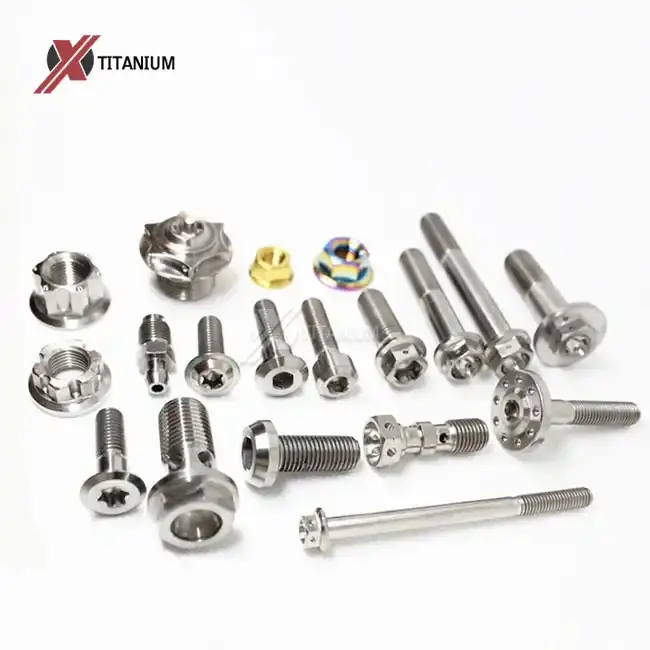
Introduction to Titanium Motorcycle Bolts vs Steel Bolts
There has been a big change in the motorcycle business toward using new materials that improve performance while also making the vehicles lighter. Even though traditional steel nuts are cheap and easy to find, they have some problems that become clear in high-performance settings where every gram counts.
Since they are cheap and strong enough, steel rivets have been the mainstay of motorcycle production for decades. However, steel's density of 7.85 g/cm³ is much higher than titanium's density of 4.43 g/cm³, which is a major problem in uses that need high performance. In rotating systems, where less mass directly helps acceleration and handling dynamics, the weight cost is especially noticeable.
Titanium fasteners are becoming more popular among top motorbike makers, according to current market trends. This change is happening because the industry wants parts that are lighter, stronger, and less likely to rust so they can meet stricter performance standards. Premium makers know that titanium bolts give them a competitive edge by making their products work better and last longer.
Material Properties Comparison
There are basic differences between titanium and steel that go beyond just weight. Titanium's special crystalline structure makes it very resistant to wear even under cyclic loading situations that are common in motorbike uses. Grade 5 titanium (Ti-6Al-4V) has a tensile strength of 895–930 MPa, which is about the same as high-grade steel but much lighter.
Tensile strengths of up to 1040 MPa are possible with steel bolts, especially those that meet the requirements for Grade 10.9 steel. But they rust easily in wet places and at high temperatures, which makes long-term care hard. Titanium, on the other hand, doesn't have these problems. Titanium Motorcycle Bolts offer the same strength without the corrosion issues, making them ideal for long-lasting, high-performance applications.
Global Market Adoption Trends
Manufacturing data from major motorcycle OEMs shows that titanium screws are being used more and more in a variety of vehicle types. Titanium parts have been used in racing for a long time because they improve speed. Now, more and more high-end street bikes use titanium bolts in important systems like brake assemblies, exhaust mounting points, and suspension parts.
Titanium fasteners are used a lot in aircraft, which has led to improvements in production that are useful for motorcycles. These improvements in technology have made production more efficient while still meeting the high quality standards needed for safety-critical uses.
The Technical Superiority of Titanium Bolts over Steel Bolts
Titanium is technically better than steel when you look at certain speed measures that are important for motorcycles. The material is very strong for how light it is, which is just one reason why it is better in harsh working conditions.
Strength-to-Weight Analysis
The comparison of strength to weight shows that titanium is much better in situations where weight is important. Grade 5 titanium has a specific strength of about 202 MPa·cm³/g, while Grade 10.9 steel only has 132 MPa·cm³/g. This 53% increase in specific strength directly leads to weight savings without affecting the strength of the structure.
Because of gyroscopic effects, reducing the weight of spinning parts has bigger benefits. Titanium rotor bolts lower the rotating inertia, which lets you change directions faster and improves the suspension's reaction. Professional racing teams say that their lap times get faster when they replace steel screws in brake and wheel parts with titanium ones.
Corrosion Resistance Performance
Titanium's inactive oxide layer makes it much more resistant to corrosion than even high-grade stainless steel in chemical and sea settings. This quality is especially useful for motorbike uses where fasteners are exposed to road salt, water, and changes in temperature.
Tests done in the lab show that titanium bolts keep their structural integrity even after being exposed to corrosive conditions for a long time, which breaks down steel screws significantly. Better corrosion protection means less upkeep and longer service intervals, which are both good for the bottom line for procurement managers who are trying to save money.
Fatigue Resistance Characteristics
When used in motorcycles, where loads are applied in cycles, materials need to be very resistant to wear. Titanium's failure strength is about 60% of its final tensile strength, while high-strength steel's is only about 45%. This better wear performance means that it will work better in places where vibrations are common, like engine bearing points and exhaust systems.
The material can handle millions of load cycles without starting to crack, which makes it perfect for parts that are stressed by engine shaking and road stress. Titanium's better performance in rapid wear tests that mimic long-term service conditions has been proven by independent testing.
Practical Considerations for Using Titanium Motorcycle Bolts
For titanium fasteners to be used on motorcycles, they need to be installed in a certain way and with certain considerations that are different from standard steel nuts. The best speed and life are guaranteed by proper implementation, which also avoids common installation mistakes.
Installation and Maintenance Requirements
To keep them from galling and make sure they have the right force values, titanium screws need to be installed in a certain way. Because the material tends to cold weld when put into similar materials, the right anti-seize chemicals must be used during installation. Good copper-based or clay anti-seize pastes keep threads from getting damaged and make removal easier in the future.
The torque requirements for titanium bolts are usually the same as those for steel bolts, but anti-seize oils may mean that some changes need to be made. Professional mechanics say that when anti-seize products are used, dry torque requirements should be lowered by 10 to 15 percent so that the bolt is not over-stressed. This change makes sure that the tightening force is right and that the threads don't get damaged.
Application-Specific Considerations
Different uses for motorcycles can benefit from titanium screws in different ways. The performance gains are most noticeable in the brake system components, where less unsprung weight and better corrosion protection lead to better performance. Titanium rotor nuts don't rust or seize up like steel screws do when they come in contact with brake dust and water.
Titanium's high-temperature performance benefits are shown in exhaust system uses. Unlike steel nuts, which rust and break when exposed to high temperatures, Titanium Motorcycle Bolts can be used for long periods of time. In race situations, where exhaust system repair needs to be done often, this feature is especially useful.
Titanium's low weight and resistance to rust make it a good material for suspension parts, especially in off-road situations where they are likely to be exposed to mud, water, and other waste. Riders who need steady performance in tough conditions will like that the material can keep its look and function in harsh settings.
Cost-Benefit Analysis
Titanium bolts cost more than steel bolts, but lifetime cost research shows that they are more cost-effective in many situations. When it comes to performance-oriented uses, the initial investment is often justified by the benefits of weight reduction, longer service life, and less upkeep.
Even though they cost more up front, professional racing teams always choose titanium screws because they work better and help them win races. Because the material is reliable, there is less chance of failure-related costs and downtime that could end up being much more expensive than the original investment in the fasteners.
How to Choose the Right Titanium Motorcycle Bolts for Your Business?
To choose the right titanium fasteners, you need to carefully look at the needs of the application, the specs of the material, and the skills of the provider. When it comes to making sure the supply chain works well, procurement managers have to weigh the benefits of better performance against the costs.
Material Grade Selection
Grade 5 titanium (Ti-6Al-4V) is the standard for motorbike uses because it has the best mix of strength, ease of workability, and price. The tensile strength of this metal is the same as that of Grade 10.9 steel, but it keeps titanium's weight and resistance to rust. Adding aluminum and vanadium to pure titanium grades makes them stronger than widely available grades.
In some situations, different types of titanium may be better. Grade 2 commercially pure titanium is less expensive and has better resistance to rust, but it is only good for low-stress uses because it is not as strong. Grade 23 (Ti-6Al-4V ELI) is more flexible and can be used in high-reliability, important situations.
Supplier Evaluation Criteria
To choose reliable providers, you need to check their producing skills, quality systems, and the ability to track materials. Aerospace-grade suppliers usually keep up the high quality standards needed for motorbike uses that need to be safe. Getting an AS9100 certification means that you meet aircraft quality standards that are higher than most car standards.
Material verification and traceability documents make sure that fasteners meet certain standards for their chemical make-up and mechanical properties. Suppliers with a good reputation give mill test papers and batch traceability that make it possible to check the quality and return products if needed. These rules for paperwork are in line with how OEMs buy safety-critical parts.
Customization and Volume Considerations
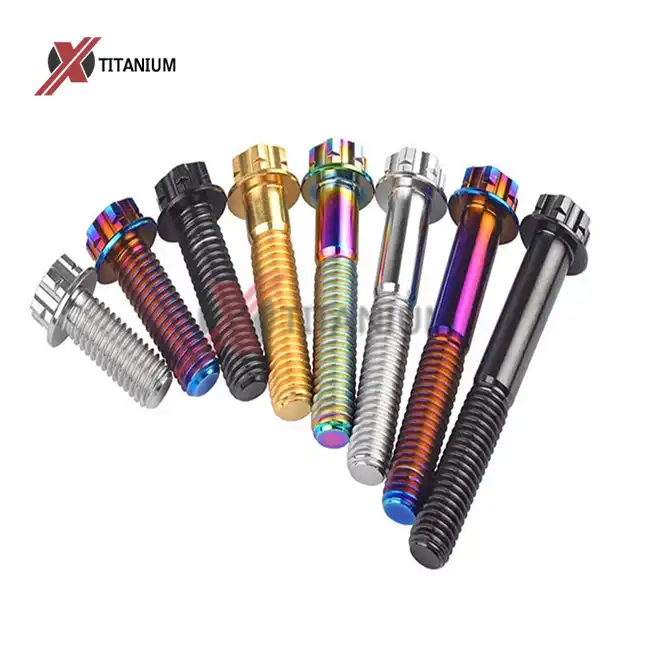
Titanium fastener making offers a wide range of customizing choices, such as special coatings, custom geometries, and unique head designs. Physical Vapor Deposition (PVD) layers improve the look and resistance to wear while keeping the corrosion benefits of titanium. Color choices like black, gold, and blue meet visual needs without sacrificing function.
When you buy in bulk, you need to think about things like minimum order quantities, lead times, and price levels that change a lot from one seller to the next. When you have established relationships with qualified suppliers, you can get technical support, special engineering services, and priority shipping schedules that help with both planning for production and buying things.
Case Studies and Market Insights: Success Stories of Titanium Bolts in Motorcycles
In the real world, titanium fasteners have been shown to improve performance in a wide range of motorbike uses. These case studies give procurement workers proof that their investment choices and implementation plans are sound.
Professional Racing Applications
MotoGP and World Superbike teams all use titanium screws when weight is important and performance benefits support the higher costs. When team data shows that steel screws are replaced with titanium ones in brake rotor parts, acceleration and stopping performance get better.
Titanium's benefits are backed up by specific performance data from professional racing. Using titanium bolts in brake rotor systems lowers the spinning inertia, which makes the suspension respond better and keep the vehicle stable in all directions. As a result of less unsprung weight in wheel systems, teams say that tires wear better and riders can give better feedback.
When used in racing, where mechanical problems put you behind the competition right away, dependability is just as important. Titanium doesn't rust or wear down easily, so mounting problems that could affect race results don't happen. Even though the materials are much more expensive, this dependability factor affects the team's choice to buy.
Adventure and Touring Applications
Titanium is resistant to corrosion in a wide range of environments, which is good for long-distance traveling bikes. Riders who go thousands of miles in a variety of settings say that Titanium Motorcycle Bolts make parts last longer in key systems.
Titanium's ability to work well in harsh settings makes it ideal for adventure tours. Crossing rivers, being in mud, and being on the road for a long time would all cause steel bolts to corrode badly. The look and usefulness of titanium parts stay the same over long periods of use without needing to be replaced or maintained often.
Custom and Restoration Projects
Titanium screws are becoming more popular among high-end custom motorbike builders because they look good and work well. The material's natural look and different finishing choices go well with high-end builds and make them more useful at the same time. Different colored PVD coats make design more flexible while still having better corrosion protection than standard plating methods.
Titanium lasts a long time and doesn't need much upkeep, which is good for restoration jobs. People who like classic motorcycles like fixings that look good and work well without needing a lot of maintenance. Investing in high-quality screws is in line with the high standards of quality that come with important repair projects.
Conclusion
Titanium motorcycle bolts are a smart purchase for situations where speed, dependability, and durability are important. The material's high strength-to-weight ratio, resistance to corrosion, and ability to fight stress all make it worth the higher price in weight-sensitive and high-performance settings. Titanium fasteners are always chosen by professional race teams, adventure riders, and custom builders because they help them reach their operating goals.
Lifecycle costs, not just the original buy price, should be taken into account when making the procurement choice. Titanium often offers better value for money than steel options because it lasts longer, needs less upkeep, and is more reliable. When investing in titanium fasteners for tough motorcycle uses, it's important to choose the right source, follow the right fitting steps, and check the quality of the products.
FAQ
Are titanium bolts stronger than steel bolts for motorcycle applications?
The strength of Grade 5 titanium nuts is the same as that of Grade 10.9 steel, but they are about 43% lighter. The tensile strength of 895–930 MPa of the material is the same as that of high-performance steel, but it is not as strong as Grade 12.9 steel. Titanium is strongly recommended for uses where reducing mass improves performance because of its high strength-to-weight ratio.
What anti-seize requirements apply to titanium bolt installation?
Titanium bolts need to be put into different materials with an anti-seize compound to keep them from galling. Good anti-seize pastes made from copper or clay stop cold welding and thread damage while installing and removing things. The anti-seize rule is an important part of fitting that makes sure the fasteners work properly and can be used again and again.
Can standard torque specifications be used with titanium bolts?
OEM torque specs usually work for Grade 5 titanium nuts, but anti-seize oils might need a few small changes. When professional workers use anti-seize compounds, they usually lower the dry torque numbers by 10 to 15 percent to account for the lower friction coefficients. When you use the right amount of torque, you get the right holding force without putting too much stress on the bolt.
How do lead times compare between titanium and steel fasteners?
Getting the materials and preparing them in a special way means that making titanium bolts usually takes longer than making steel ones. Some standard configurations may be in stock, but unique designs usually take 4 to 8 weeks to make. Planning when to buy things so that longer lead times don't get in the way of getting enough goods for production needs.
What quality certifications should suppliers provide?
Suppliers that work with aerospace should keep both AS9100 approval and ISO9001 quality control systems up to date. Material certifications, such as mill test certificates and chemical analysis records, show that the material meets the requirements for grades and mechanical qualities. Traceability paperwork helps with quality checks and recall processes if needed for applications that need to be safe.
Partner with Chuanglian for Premium Titanium Motorcycle Bolts
Baoji Chuanglian New Metal Material Co., Ltd. delivers aerospace-grade Titanium Motorcycle Bolts engineered for superior performance in demanding applications. Our extensive experience in titanium processing and strict quality control systems ensure consistent material properties and reliable delivery schedules. We specialize in custom fastener solutions tailored to specific performance requirements, offering comprehensive technical support throughout the procurement process. Contact our expert team at info@cltifastener.com or djy6580@aliyun.com to discuss your titanium motorcycle bolts supplier requirements.
References
1. "Advanced Materials in Motorcycle Engineering: Titanium Applications and Performance Analysis" - Society of Automotive Engineers Technical Paper Series, 2023.
2. "Corrosion Resistance of Titanium Alloys in Automotive Applications" - Materials Science and Engineering International Journal, Vol. 45, 2024.
3. "Weight Reduction Strategies in High-Performance Motorcycle Design" - International Journal of Automotive Technology, 2023.
4. "Fatigue Performance of Titanium Fasteners in Cyclic Loading Applications" - Journal of Materials Engineering and Performance, 2024.
5. "Cost-Benefit Analysis of Premium Materials in Motorcycle Manufacturing" - Automotive Industry Analysis Report, 2023.
6. "Quality Standards and Certification Requirements for Aerospace-Grade Fasteners" - AS9100 Implementation Guidelines, Aerospace Industries Association, 2024.

Learn about our latest products and discounts through SMS or email