- English
- French
- German
- Portuguese
- Spanish
- Russian
- Japanese
- Korean
- Arabic
- Greek
- German
- Turkish
- Italian
- Danish
- Romanian
- Indonesian
- Czech
- Afrikaans
- Swedish
- Polish
- Basque
- Catalan
- Esperanto
- Hindi
- Lao
- Albanian
- Amharic
- Armenian
- Azerbaijani
- Belarusian
- Bengali
- Bosnian
- Bulgarian
- Cebuano
- Chichewa
- Corsican
- Croatian
- Dutch
- Estonian
- Filipino
- Finnish
- Frisian
- Galician
- Georgian
- Gujarati
- Haitian
- Hausa
- Hawaiian
- Hebrew
- Hmong
- Hungarian
- Icelandic
- Igbo
- Javanese
- Kannada
- Kazakh
- Khmer
- Kurdish
- Kyrgyz
- Latin
- Latvian
- Lithuanian
- Luxembou..
- Macedonian
- Malagasy
- Malay
- Malayalam
- Maltese
- Maori
- Marathi
- Mongolian
- Burmese
- Nepali
- Norwegian
- Pashto
- Persian
- Punjabi
- Serbian
- Sesotho
- Sinhala
- Slovak
- Slovenian
- Somali
- Samoan
- Scots Gaelic
- Shona
- Sindhi
- Sundanese
- Swahili
- Tajik
- Tamil
- Telugu
- Thai
- Ukrainian
- Urdu
- Uzbek
- Vietnamese
- Welsh
- Xhosa
- Yiddish
- Yoruba
- Zulu
Why Titanium Bolts Are the Ultimate Upgrade for Your Mountain Bike?
Getting titanium crank bolts is a smart way to improve the performance of your mountain bike because they make it lighter, last longer, and fight rust better. These precision-engineered screws are usually made from Grade 5 titanium metal (Ti-6Al-4V). They have a great strength-to-weight ratio that changes how the bike rides and guarantees long-term dependability. Titanium crank bolts, on the other hand, only weigh about 2.5 grams per M8x15mm unit. This lowers the spinning mass without affecting the safety limits or structural strength. Mountain bike companies and companies that sell parts for bikes are becoming more and more aware that titanium screws are important upgrades that make them more competitive and improve customer happiness.
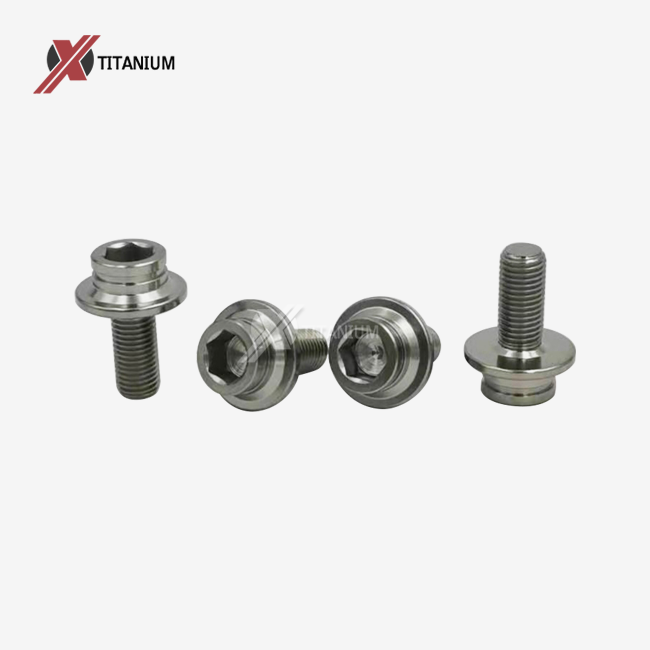
Understanding Titanium Crank Bolts: Features & Benefits
Material Composition and Engineering Standards
Grade 5 titanium metal (Ti-6Al-4V), which has about 6% aluminum and 4% vanadium, is used to make high-performance titanium crank bolts. The tensile strength of this particular mixture is over 900 MPa, but it only has a density of 4.43 g/cm³, which is about 56% that of steel. International standards like ISO, ASTM B348, and JIS are strictly followed during the manufacturing process to ensure that the dimensions and threads are correct. CNC machining makes M8x15mm bolts with hex socket heads and a thread pitch of 1.0 mm. These bolts meet the tolerance standards needed for the bottom bracket spindle to connect.
Chemical spectrometry analysis checks the alloy makeup in every production run. This keeps weaker Grade 2 titanium from being used instead, which wouldn't provide enough shear resistance under crank torque loads. When you roll a thread instead of cutting it, the grain flow patterns match the shape of the bolt. This makes the thread much more resistant to wear than machined threads, which damage the metal's structure.
Exceptional Strength-to-Weight Ratio
Titanium has a clear mechanical edge when you look at its weight versus its load-bearing ability. A normal steel crank bolt that weighs 6–8 grams has the same tensile strength as a titanium bolt that weighs 2.5 grams. This means that each fastening is 60–70% lighter. When you use multiple bolts to put a crankset, you can save between 15 and 25 grams. This is a big chunk of rotational mass that makes acceleration and climbs go more smoothly.
This weight advantage doesn't mean that performance has to be worse. Grade 5 titanium keeps its yield strength at least 895 MPa, which is higher than what is required for Grade 8.8 steel. It is also more flexible, so it doesn't break into weak pieces when it's shocked. When purchasing engineers look at material specs, they know that this mix is best for high-stress cycling uses that need to be reliable and keep weight as low as possible.
Corrosion Resistance and Longevity
Titanium's natural ability to form a steady layer of titanium dioxide (TiO2) on its surface makes it very resistant to corrosion in a wide range of circumstances. When scratched, this passive oxide film heals itself on its own, providing long-lasting defense against water, salt spray, mud, and chemicals that are common in mountain biking settings. In the same conditions, steel nuts rust in just a few months, so they need to be replaced often and aluminum cranksets could get thread damage.
Field testing shows that titanium crank bolts that are properly placed keep their shape and look even after years of hard riding in wet weather, brackish coastal environments, and cold conditions with road salt exposure. Surface processes like polishing, anodizing, and nitriding make it even more resistant to corrosion and let you choose from natural titanium, gold, blue, green, purple, black, and colorful finishes to suit your style.
Performance and Maintenance: Optimizing Your Titanium Crank Bolts
Installation Specifications and Best Practices
The right way to put in titanium crank bolts has a direct effect on how well they work and how long they last. For M8x15mm crank bolts, the recommended torque range is 10–12 Nm. This should be applied using measured torque tools to avoid under-tightening, which can cause the bolts to come loose, or over-tightening, which can damage the threads. To properly use hex socket heads, you need precise 4mm or 5mm Allen keys that fully engage internal profiles and spread torque equally without rounding surfaces.
To prepare a thread, you have to look for dirt, damage, or burrs on both the bolt threads and the receive holes. Galling is when two different metals cold-weld under pressure. Galling can be stopped by lightly applying an anti-seize substance made for titanium-aluminum surfaces. This safety measure is especially important because titanium can scratch soft aluminum cranksets when they are placed when they are dry or dirty.
Routine Inspection and Maintenance Protocols
Setting up regular check times every 500 to 1000 kilometers or after major impacts helps find early signs of wear before they fail. A visual inspection looks for harm to the threads, deformation of the head, or strange discoloration that could mean the part is too hot from the wrong pressure application. Finger-tight spin is used for tactile assessment to find binding or roughness that means the thread is breaking down.
To get rid of trail debris without scratching protected oxide layers or anodized finishes, cleaning instructions say to use light soap solutions and soft brushes. Staying away from strong chemicals and rough tools protects the surface and keeps it looking good. Titanium doesn't spread heat well, so bolts that are made of it stay cooler than steel ones when the bike is stopping or pedaling hard for a long time. This keeps other parts from getting too hot.
Addressing Common Installation Issues
When mixing maker specs or using non-standard bottom bracket setups, thread compatibility problems can happen. During quality control, a "Go/No-Go" gauge test makes sure that the thread pitch is within the tolerances set by ISO 965-2 Class 6g. This confirms that the threads will connect smoothly with the steel spindle surfaces. Cross-threading can be avoided by carefully aligning the threads when the bolts are first inserted and then physically moving the bolts until resistance rises on its own, rather than causing them to engage.
Bolts that come loose when they are vibrated usually mean that the original pressure wasn't high enough or that the threads are dirty, not titanium-specific problems. Thread-locking compounds made for titanium screws offer extra security in rough riding conditions, but the right amount of torque is generally enough for normal mountain bike use.
Market Comparison and Procurement Strategies for Titanium Crank Bolts
Material Performance Benchmarking
Comparative research pits titanium crank bolts against aluminum, steel, and hybrid materials in a number of performance areas. Aluminum nuts are a little lighter than steel bolts, but they aren't strong enough for high-torque uses, so they could break completely during aggressive riding. While steel is strong enough, it is also much heavier and corrodes over time, which makes it less reliable over time and puts expensive crankset parts at risk.
Evaluating Manufacturer Quality Standards
Leading component makers like FSA, Shimano, SRAM, and Race Face set quality standards with strict testing procedures and verified supply chains. Material certifications (ASTM B348 compliance), dimensional tolerances (ISO 965 thread accuracy), testing documentation (tensile strength verification), and quality management systems (ISO 9001, AS9100 certifications) are some of the ways that procurement professionals check a supplier's skills.
Portable X-ray fluorescence (XRF) research is needed to make sure that Grade 5 titanium crank bolts are real. This test checks for aluminum and vanadium content within certain ranges. This screening stops the use of cheaper materials that look like titanium on the outside but don't have the right mechanical properties. Suppliers you can trust give you Certificates of Conformance (CoC) that list the chemicals used, the results of tension tests, and the measurements of each production batch.
Strategic Procurement Considerations
Strategies for buying in bulk weigh the costs of stocking up on goods against the benefits of lower prices and a stable supply chain. Different suppliers have different minimum order amounts. Manufacturers that only make titanium fasteners tend to have more open terms than general sellers. Lead times are usually between 4 and 8 weeks for normal specs and 12 to 16 weeks for unique sizes, finishes, or tight tolerances.
The terms and conditions of warranties and return policies should be carefully looked over, especially when it comes to the accepted defect rate and replacement processes. With the help of statistical process control and automatic inspection systems, established providers keep quality stability below 0.5% defect rates. For logistics reasons, it's important to package threads correctly so they don't get damaged during shipping and store them in places with controlled humidity to keep the quality of the surface finish.
Why Choose Titanium Bolts: The Rational Procurement Decision?
Return on Investment Analysis
The financial case for using titanium crank bolts goes beyond just comparing costs; it also includes figuring out the total cost of ownership. Because they last longer, durable steel bolts don't need to be replaced as often, which saves money on long-term purchases and upkeep work. When you consider that thread damage to aluminum cranksets is often caused by corroding steel bolts, component security value becomes important. This is because expensive repairs cost hundreds of dollars, while bolt investment is only a few dollars.
Quality Assurance and Supplier Verification
Strategies for lowering risk deal with fake materials and poor production, which are problems in the titanium bolt market. As part of the supplier screening process, facilities are audited to make sure they have the right CNC cutting equipment, quality control infrastructure, and openness about where they get their raw materials. Through lot numbers and paperwork files, well-known makers keep track of systems that connect finished goods to specific batches of titanium milling.
Customization and OEM Integration
Customizations beyond normal store items are often needed because of application-specific needs. Different crankset designs and brand tastes can be met with a range of thread lengths, head types (including button head, countersunk, and low-profile), surface finishes, and color choices. Through OEM agreements, companies can work together to come up with the best fastener specs that improve the performance of the whole product while still meeting cost goals by agreeing to buy in bulk.
Aftermarket routes of distribution see titanium bolts as high-end upgrades that encourage sales of accessories and keep customers interested. Standardizing on popular sizes (M8x15mm for crank applications) makes inventory management easier, but holding on to unique choices for specialized uses is still important. Market trends show that people are becoming more aware of the benefits of titanium, which is driving demand beyond professional racing and into the enthusiast and performance-oriented leisure markets.
Case Studies and Customer Success Stories
Weight Reduction Performance Validation
A well-known European mountain bike maker showed that putting titanium crank bolts on all of the bike's parts reduced their weight by a large amount. By switching from steel crank bolts, chainring bolts, and pedal axle gear to Grade 5 titanium versions, the bike lost 85 grams of weight, which is about 3% of its total mass. Through performance tests, it was shown that acceleration response and climbing efficiency got better, which proved that methods for optimizing components were effective.
Distributor Integration Success
A North American company that sells high-end aftermarket updates has added titanium crank bolts to its products for customers who are focused on performance. The first inventory investment was mostly made up of famous M8 sizes in both natural and anodized finishes, along with technical specifications and fitting instructions. Sales speed was 60% faster than expected, thanks to suggestions from fans and online reviews that emphasized the benefits of quality and performance.
OEM Technical Collaboration
A major Asian company that makes cranksets worked with experts in titanium fasteners to come up with bolt specs that are best for the next generation of products. Collaborative engineering looked at how to improve thread contact, torque specifications, and surface treatment choices to protect against rust as much as possible while keeping the looks of the crankset finishes consistent.
Professional racing teams and funded athletes tested the product in the field to make sure it worked well in harsh conditions like downhill racing and multi-stage endurance events. There were no technical problems in any of the test groups, which proved that the design was good and that the manufacturing was good. After integrating production, the company became the technology leader in high-end crankset areas, which helped the brand stand out and gain market share.
Conclusion
Titanium crank bolts are a must-have upgrade for mountain bike builders, sellers of parts, and performance-minded riders who want to see real weight, longevity, and dependability gains. Grade 5 titanium metal has amazing mechanical qualities that are better than those of most other materials. It also doesn't rust, which stops common failure modes and keeps expensive parts nearby safe. Strategic purchasing choices know that higher starting costs lead to better lifetime value through longer service intervals, fewer warranty claims, and better product differentiation.
Quality assurance includes checking the suppliers, testing the materials, and making sure the production process is correct. This makes sure that the products always work well and meet the needs of difficult mountain biking uses. Titanium's benefits are becoming more and more well known, which means more business possibilities for makers and distributors who can offer certified, high-quality fastener solutions backed by technical know-how and reliable supply chains.
FAQ
How does titanium bolt strength compare to steel alternatives?
The tensile strength of Grade 5 titanium crank bolts is higher than that of Grade 8.8 steel, and their strength-to-weight ratios are also much better. A minimum yield strength of 895 MPa makes sure that there are enough safety gaps for high-torque spinning uses. Titanium's flexibility also stops it from breaking in brittle ways, which can happen when hardened steel is shock-loaded. Chemical makeup research proves the real composition of the Ti-6Al-4V alloy, separating high-quality goods from cheaper alternatives.
What maintenance extends titanium crank bolt service life?
Every 500 to 1000 kilometers, a routine check finds early signs of wear, such as damaged threads or deformed heads. Cleaning with gentle soap solutions gets rid of dirt and grime without hurting the protection metal layers. When regulated tools are used with the right amount of force (10 to 12 Nm for M8 sizes), tightening or thread stripping is avoided. Anti-seize chemicals made for titanium-aluminum surfaces stop galling and make removal possible in the future.
How can procurement teams verify supplier authenticity?
X-ray fluorescence (XRF) testing shows that the material meets Grade 5 standards for aluminum and vanadium content. Certificates of Conformance that list the chemical makeup, tensile tests, and dimensional checking make it possible to track back to specific production runs. Quality management standards, like ISO 9001 and AS9100, show that processes are controlled in a planned way. Use of Go/No-Go scales for physical checking of rolled threads to make sure they are of good quality and meet the right size requirements.
Partner with Chuanglian for Premium Titanium Fastener Solutions
When purchasing professionals are looking for trustworthy titanium crank bolt suppliers, they should work with makers who have a lot of experience and offer full quality assurance and expert support. A company called Baoji Chuanglian New Metal Material Co., Ltd. makes high-quality titanium bolts from a Grade 5 (Ti-6Al-4V) metal that has been tested thoroughly and meets international standards. Our CNC machining gives us the ability to make standard and unique parts with the level of quality required by ISO, ASTM, and JIS.
Manufacturing activities in Baoji City, which is known around the world as the titanium production capital, have direct access to high-quality raw materials and specialized processing know-how that has been built up over many years of developing the titanium industry. Every production batch goes through chemical spectrometry analysis, tension testing, and thread tolerance verification as part of our quality control systems. This makes sure that the products always work the way they should, even for tough mountain bike uses.
As part of the customization service, the surface can be polished, anodized, or nitrided, and it can be finished in natural titanium, gold, blue, green, purple, black, or rainbow colors. Our engineering team works with OEM partners and dealers to make sure that the specs of our fasteners are the best they can be for each application. This helps our products stand out and provide the best performance.
Contact our procurement specialists at info@cltifastener.com or djy6580@aliyun.com to discuss bulk purchasing programs, technical specifications, and delivery schedules aligned with your manufacturing or distribution requirements.
References
1. American Society for Testing and Materials. (2021). Standard Specification for Titanium and Titanium Alloy Bars and Billets (ASTM B348). West Conshohocken, PA: ASTM International.
2. Donachie, M.J. (2000). Titanium: A Technical Guide (2nd ed.). Materials Park, OH: ASM International.
3. International Organization for Standardization. (2019). ISO General Purpose Metric Screw Threads — Tolerances — Part 2: Limits of Sizes for General Purpose External and Internal Screw Threads (ISO 965-2). Geneva: ISO.
4. Lutjering, G., & Williams, J.C. (2007). Engineering Materials and Processes: Titanium (2nd ed.). Berlin: Springer-Verlag.
5. Schutz, R.W., & Watkins, H.B. (1998). Recent developments in titanium alloy application in the energy industry. Materials Science and Engineering: A, 243(1-2), 305-315.
6. Veiga, C., Bird, J.P., & Loureiro, A.J.R. (2012). Properties and applications of titanium alloys: A brief review. Reviews on Advanced Materials Science, 32(2), 133-148.
Learn about our latest products and discounts through SMS or email