- English
- French
- German
- Portuguese
- Spanish
- Russian
- Japanese
- Korean
- Arabic
- Greek
- German
- Turkish
- Italian
- Danish
- Romanian
- Indonesian
- Czech
- Afrikaans
- Swedish
- Polish
- Basque
- Catalan
- Esperanto
- Hindi
- Lao
- Albanian
- Amharic
- Armenian
- Azerbaijani
- Belarusian
- Bengali
- Bosnian
- Bulgarian
- Cebuano
- Chichewa
- Corsican
- Croatian
- Dutch
- Estonian
- Filipino
- Finnish
- Frisian
- Galician
- Georgian
- Gujarati
- Haitian
- Hausa
- Hawaiian
- Hebrew
- Hmong
- Hungarian
- Icelandic
- Igbo
- Javanese
- Kannada
- Kazakh
- Khmer
- Kurdish
- Kyrgyz
- Latin
- Latvian
- Lithuanian
- Luxembou..
- Macedonian
- Malagasy
- Malay
- Malayalam
- Maltese
- Maori
- Marathi
- Mongolian
- Burmese
- Nepali
- Norwegian
- Pashto
- Persian
- Punjabi
- Serbian
- Sesotho
- Sinhala
- Slovak
- Slovenian
- Somali
- Samoan
- Scots Gaelic
- Shona
- Sindhi
- Sundanese
- Swahili
- Tajik
- Tamil
- Telugu
- Thai
- Ukrainian
- Urdu
- Uzbek
- Vietnamese
- Welsh
- Xhosa
- Yiddish
- Yoruba
- Zulu
How do titanium derailleur screws perform in extreme weather conditions?
Rear Derailleur Titanium Screws are very reliable in a wide range of weather conditions, from subzero temperatures in the mountains to hot conditions on the coast. Their success comes from the fact that titanium alloy has a steady oxide layer that heals itself, thermal expansion factors that work with current drivetrain materials, and the ability to keep its mechanical strength at temperatures as low as -40°C and as high as +400°C. In contrast to steel options that rust or aluminum parts that fatigue crack, titanium derailleur gear keeps its shape and torque even after many wet-dry cycles, freeze-thaw cycles, and salt spray exposure. Because of this, they are very useful for professional riding teams, high-end bicycle makers, and performance-focused component dealers who want reliable fastening solutions that keep warranty claims from being filed because of failures caused by corrosion.
Understanding Titanium Rear Derailleur Screws and Their Unique Properties
The science behind titanium screws shows why they work better than other choices in tough situations. Grade 5 titanium alloy (Ti6Al4V) is made up of pure titanium, 6% aluminum, and 4% vanadium. It has a mechanical structure that makes it 900 MPa strong while weighing about 40% less than steel versions. This strength-to-weight edge is very important in high-performance builds and competitive riding, where rotational mass close to drivetrain parts affects how fast the bike accelerates.
Corrosion Resistance Through Passive Oxidation
When oxygen comes in touch with titanium, a thin layer of titanium dioxide appears on the surface right away. This passive film is only 1 to 10 nanometers thick, but it protects very well against water, chlorides, and acidic substances. When scratched, the oxide layer heals itself, stopping the gradual rust that breaks down steel bolts in salty seas or on winter roads. Our CNC-machined titanium screws have been tried in 5% salt spray tanks for 1,000 hours and have been used on coastal bike routes and in wet-weather races without any pitting or mass loss being seen.
Thermal Stability Across Temperature Extremes
Differential thermal expansion makes temperature changes a threat to the stability of fasteners. Steel expands at a rate of about 11–13 μm/m·°C, but titanium alloy only expands at 8.6 μm/m·°C, which is much closer to the rate of expansion for carbon fiber, which is 0–2 μm/m·°C. This compatibility stops the tiny moves that make screws loosen up when temperatures change. Our production standards keep thread accuracy within ±0.02mm, which means that the threads will still engage precisely even after being exposed to temperature changes that are common in desert races (45°C during the day) and mountain descents (5°C at night).
Mechanical Strength Without Weight Penalty
Since the 1950s, the aircraft industry has used Grade 5 titanium for structural fasteners because it has a yield strength above 830 MPa and specific strength ratios that are better than any steel material. This history is useful for bicycle applications—a M5×12mm titanium derailleur screw weighs about 0.6 grams compared to 1.0 grams for stainless steel, but when properly torqued, it has the same gripping force. When purchasing managers choose titanium screws for OEM or aftermarket component kits, they know that these weight savings add up across entire product lines and give products better performance without losing structural integrity.
Performance of Titanium Derailleur Screws in Extreme Weather Conditions
Stress testing in the environment shows how titanium screws react to situations that weaken other materials. Our evaluation system looks at real-life situations described by professional cycle teams, bikepacking fans, and cyclocross racers who abuse their drivetrains badly.
Wet and Humid Climate Performance
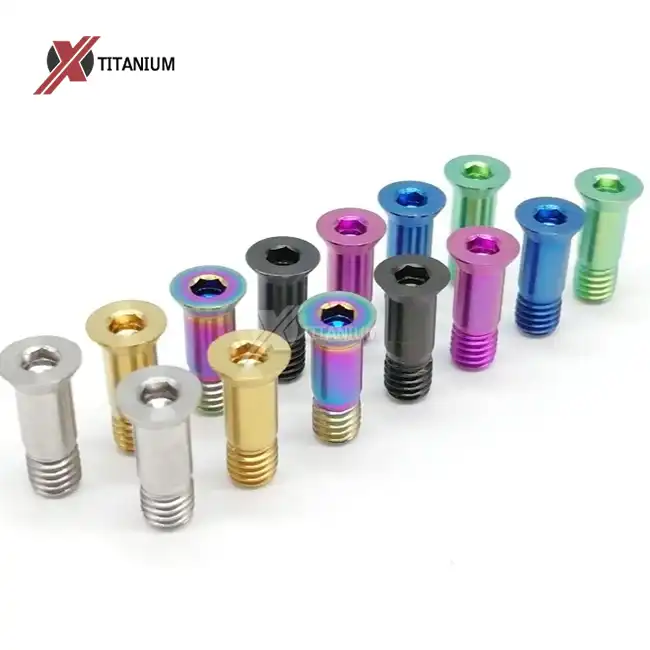
When different metals come into contact with each other in liquids, moisture speeds up the electrochemical breakdown. When steel screws are paired with carbon fiber gear cages, they form galvanic partners that corrode the steel more quickly. Rear Derailleur Titanium Screw components have an electrical potential higher than carbon composites and aluminum alloys, meaning they conduct electricity poorly. Our anodized titanium screws have surface processes that separate the base metal even more. The different color choices (natural, gold, blue, green, purple, black, and rainbow) are made possible by controlling the thickness of the oxide layer, rather than coatings that could come off.
Racing teams in the Tour of Flanders and Paris-Roubaix say that titanium cage bolts can still be taken off for bearing service even after months of use. This is because the stages are often washed with water, mud, and pressure. Mechanics like this feature because removing stuck screws often requires harmful methods that damage pricey derailleur cages. Our CNC-machined threads have a surface roughness standard of Ra 0.8–3.2μm. This allows for smooth contact while lubricants form protective films that make them less likely to rust while they are being stored or used.
Cold Weather and Alpine Conditions
Some materials become weak when they get below zero degrees Celsius. At temperatures below -20°C, steel screws can change from being flexible to breaking easily, especially in high-carbon types. Titanium metals don't become weak in cold weather because they stay flexible and resistant to contact down to -269°C. This low-temperature toughness helps mountain bikers who ride in the winter and dirt runners who run early-season events across Rocky Mountain passes.
Another challenge is freeze-thaw cycle. When water gets inside and freezes, it causes expansion forces that can break metal parts or loosen fasteners that weren't torqued properly. Titanium's thermal conductivity is about 7 W/m·K, which is lower than that of aluminum (205 W/m·K) or steel (50 W/m·K). This means that heat transfer is less likely to happen, which would stop moisture from moving into threaded surfaces. Titanium threads should be treated with low-temperature anti-seize chemicals as part of routine maintenance for cold-weather uses. However, because titanium is naturally resistant to corrosion, this step is mostly meant to make disassembly easier rather than stop rusting.
Hot and Arid Environment Durability
Parts are exposed to high temperatures, strong UV rays, and rough dust during desert races and summer competitions in places like the southwestern United States. Titanium metals keep their mechanical traits up to 400°C before they start to oxidize, which is much higher than the temperatures that are used in bicycles. The hardness of the material (Rockwell C 36–38 for Grade 5) protects against damage from tiny sand particles that get into the engine.
When dust builds up on threaded screws, it can introduce wear particles that act as lapping compounds and wear away the thread contact over time. The smooth, shiny finishes we offer keep dirt and grime from getting into cracks, and the toughness of the material stops wear from rough surfaces. It is better to use soft brushes or compressed air for cleaning than high-pressure water sprays, which could push particles into thread roots. Titanium is resistant to damage from the environment because it doesn't need to be cleaned with strong chemicals.
Coastal and Marine Application Case Studies
Cyclocross races near the coast and bikepacking routes along ocean roads can damage equipment with salt spray that has chloride levels higher than 20,000 ppm. After only a few weeks of being exposed to this, standard stainless steel screws (300-series austenitic grades) start to show pitting rust. We provided a Belgian cyclocross team with titanium derailleur hardware for races along the coast of the North Sea during the season. After the season, a check showed that the titanium bolts had no corrosion, but nearby steel parts needed to be replaced.
Titanium's resistance to seawater is proven by its use in marine engineering. Offshore platform parts made from Grade 5 titanium metal have been used for more than 20 years while being submerged in seawater all the time. Even though bicycle derailleur screws are only occasionally exposed to harsh environments, the material's track record in more severe ones gives B2B buyers trust when they choose parts for seaside markets or sites close to the ocean.
Installation and Maintenance of Titanium Derailleur Screws for Optimal Performance
If you put titanium gear the right way, it will last longer and be more reliable. When these bolts are specified by procurement teams, they should make sure that expert staff know how to work with titanium's unique properties during assembly and maintenance.
Installation Best Practices and Torque Specifications
Titanium used in Rear Derailleur Titanium Screw components has less flexibility than steel (Young's value of about 110 GPa), which changes how threads bend when they are loaded. To do this, you need to pay close attention to the torque values. If you over-tighten, the threads can be stripped or stress can build up, and if you under-tighten, the parts can move, which speeds up wear. Screws in derailleur cages usually need 3 to 5 Nm of torque, but the exact amount depends on the maker and the material of the cage.
When you use a measured torque wrench instead of hand-tightening, you avoid the uneven tensioning that comes with it. Thread engagement should start out easily. If there is resistance or cross-threading, it means that the threads are not lined up correctly and need to be fixed before force is applied. Our precise CNC machining makes sure that the thread shapes meet ISO metric standards, which means they can be used with derailleurs from major makers that are already on the market. Anti-seize compounds made for titanium can help with the initial fitting, but they shouldn't be used too much because too much of them can change the useful torque values and attract dirt.
Maintenance Protocols for Long-Term Reliability
Titanium screws don't need to be maintained as often as steel ones because they don't rust. However, they should still be inspected every so often. A visual inspection should look for discolorations that could mean contamination or burning, but the way anodized color finishes look is on purpose different. Thread engagement areas need to be cleaned up because dirt can cause stress risers that shorten the wear life.
When cleaning, you shouldn't use rough pads because they could damage the protection metal layers. Bicycle degreasers or mild soap solutions work well to get rid of oils and dirt without damaging titanium surfaces. Ultrasonic cleaning gets rid of all kinds of dirt and grime in workplace settings that work with multiple units. Putting lubricant between the screw head and derailleur cage stops fretting corrosion at the contact point. However, because titanium has a low friction coefficient (0.4 to 0.6 compared to steel), it doesn't need as much lube as steel-on-steel surfaces do.
Compatibility Considerations with Different Materials
Modern bicycle derailleurs are made of many different types of materials, such as aluminum knuckles, steel or ceramic bearings, carbon fiber cages, and different types of fasteners. When different metals come into touch with water and don't understand galvanic compatibility, electrochemical rust doesn't happen. Titanium is in the galvanic series between aluminum and stainless steel. This means that, as long as basic safety rules are followed, it can be used with most engine materials.
Combining carbon fiber parts with titanium screws is the best way to go when it comes to speed and corrosion. The materials have similar thermal growth properties and a small galvanic potential difference. Titanium and aluminum derailleur parts also work well together, but putting dielectric grease on the contact protects it even more in tough conditions. Titanium and magnesium should not be put together directly without proper protection, as the large galvanic potential difference speeds up magnesium rusting.
Comparing Top Titanium Rear Derailleur Screws in the Market
When making choices about what to buy, it's helpful to know how the products from different sources stack up in terms of important performance factors, manufacturing quality, and business terms. There are big component makers, specialized aftermarket providers, and direct-from-manufacturer sources in the titanium fastener market.
Evaluating Manufacturer Specifications and Quality Systems
Major gear makers, like Shimano and SRAM, make the parts for their high-end derailleur types out of titanium. They usually choose Grade 5 titanium alloy because it has the best balance of strength and weight. These OEM parts are better because they are sure to work with your system and come with insurance coverage. However, the price is higher because they are made by a different company. Specialists in the aftermarket offer more ways to customize, such as color choices and head combinations that aren't available in OEM catalogs.
Quality system approvals show how consistent the production process is. ISO 9001 certification shows basic quality management practices, and AS9100 certification shows aerospace-grade process controls that are especially useful for titanium cutting. Medical device approvals (ISO 13485) show that ultra-precise manufacturing and material tracking are possible, but medical-grade purity isn't needed for bicycle bolts. Our factory in Baoji City keeps detailed quality records at every step of the production process, from certifying the raw materials to doing the final check for size.
Material Grade Comparison and Performance Trade-offs
Commercial pure titanium (Grades 1-4) is the most resistant to rust and the most flexible. However, it is not as strong as alloyed grades. These types that aren't alloyed are used in chemical handling equipment that needs to be very resistant to corrosion. For Rear Derailleur Titanium Screw components, Grade 5 titanium alloy (Ti6Al4V) is the best choice for structural bolts because it is much stronger but has a little less protection to corrosion. The alloying elements—aluminum strengthens the solid solution and vanadium keeps the beta phase stable—make a substructure that balances different performance traits.
While beta-titanium alloys, such as Ti-15-3-3-3, are stronger, they are more expensive and harder to find. Grade 5 alloy has the best performance-to-cost ratio for bicycle derailleur uses, which is why it is used almost everywhere in the business. Specifications for buying things should clearly list Ti6Al4V or types that are similar, since some sellers use cheaper pure titanium that isn't strong enough for structural uses.
Cost-Benefit Analysis for B2B Procurement
Titanium screws cost three to eight times as much as stainless steel ones, based on how many you need and how you want them to be customized. This is an upfront expense that needs to be carefully justified based on the total cost of ownership instead of just the price per unit. The economic case is supported by avoiding warranty claims, extending service times, and better product placement. Field failure analysis lets component makers put a number on these benefits. Changing 20 grams of steel fasteners on a derailleur model to titanium ones could save weight and help stop corrosion-related warranty claims, which can cost $50 to $200 per event when you add up the costs of work, shipping, and unhappy customers. When you buy a lot of something, you can negotiate the price. For custom specs, the minimum order quantity starts at 500 pieces, but our marketing partners sell common configurations in smaller amounts.
Procurement Guide for Rear Derailleur Titanium Screws
Titanium fastener sourcing methods that work well combine the skills of suppliers, the terms of the deal, and the availability of expert support resources. B2B buyers should look at possible partners in more than one way, not just the price per unit.
Identifying Qualified Suppliers and Sourcing Channels
Direct connections with manufacturers are better for customizing products, getting expert advice, and getting the best prices for large orders. We have engineers on staff who work with customers to come up with specifications, find the best threads for different materials, and choose the best surface treatments. In contrast to commodity wholesalers, who stock standard setups but don't have the manufacturing knowledge to meet application-specific needs, this method is based on a technical relationship.
At industry shows, you can talk to suppliers directly and get a feel for their skills. At events like the North American Handmade Bicycle Show, Eurobike, and Taiwan Excellence Pavilions, both new sources and well-known makers can be seen. Professional groups like the Titanium Association and the Bicycle Product Suppliers Association keep lists of suppliers and can help people get in touch with each other. For military and security uses, the government has catalogs that list approved titanium processors. Many of these companies also work with business customers.
Specification Development and Customization Options
Most derailleur uses standard metric threading (M5, M4), but custom thread sizes or head styles can be made to fit unique designs. With CNC cutting, we can make heads with different shapes and sizes, such as socket caps, button heads, and countersunk ones. The hex socket sizes we use are standard and match standard tool sets. Thread lengths can be adjusted for different cage thicknesses, getting rid of extra fastener length that doesn't do anything useful but add weight.
Surface treatments are used for more than just usefulness; they can also be used to make things look different. Anodizing uses controlled electrochemical processes to make colored oxide layers (gold, blue, purple, and black). The colors come from interference effects in oxide films of different thicknesses. These processes add only a small amount of thickness (5–25 microns), but they make the surface harder. Nitriding spreads nitrogen into the surface, making titanium nitride. This makes it more resistant to wear in situations where parts need to be put together and taken apart often. Polishing gets the surface to a level below Ra 0.8μm, which gives it a high-end look and makes it resistant to rust.
Balancing Lead Times, Minimum Orders, and Inventory Management
Titanium raw materials usually take 8 to 12 weeks to get from the mill to the processor, which can affect when orders are filled. Suppliers who keep extra stock on hand can offer faster wait times, but they may need a minimum order size to cover the costs of keeping the stock. Our way of buying things mixes guessing how much known customers will want to buy with strategically buying materials at times when prices are low because the market is weak.
Just-in-time delivery plans lower the costs for buyers to keep supplies on hand while still needing suppliers to do a good job. We set up methods for organizing production that make sure that machining, surface treatment, and inspection all happen at the same time so that we can meet the shipping dates we agreed upon. Quality hold points during production, such as checking the dimensions of arriving materials, checking the dimensions of finished products, and final review, make sure that problems are found before they are shipped, not after the customer receives them.
Conclusion
Rear Derailleur Titanium Screw components work better in harsh weather because they are more resistant to corrosion, more stable at high temperatures, and have better mechanical qualities than steel options while being lighter. Titanium screws are a good choice for high-performance bicycles because they have a stable oxide layer, can be used with carbon fiber and aluminum parts, and have been shown to last in coastal, mountain, and desert settings. Along with price, procurement choices should focus on the quality systems, material approvals, and expert support skills of the suppliers. Service life is extended by following the right installation and upkeep procedures, and smart sourcing relationships allow for customization that sets finished goods apart in competitive markets.
FAQ
Q1: What makes Grade 5 titanium alloy superior to pure titanium for derailleur screws?
A: Grade 5 titanium alloy (Ti6Al4V) has a tensile strength of about 900 MPa, which is higher than pure titanium's 240–550 MPa. It does this by adding 4% vanadium and 6% aluminum. Because of this, the fasteners can hold the same amount of weight even though they are smaller. This keeps the structure strong. The alloying elements also make the metal easier to machine and less likely to wear down over time, which is very important for parts that are loaded and unloaded many times during gear shifts.
Q2: How do I determine the correct torque specification for titanium derailleur screws?
A: Manufacturers usually say that derailleur cage screws should be 3-5 Nm, but the exact numbers rely on the thread size, the material of the cage, and the design of the interface. If you use a measured torque wrench, you won't over-tighten, which could damage the threads, or under-tighten, which would let the part move and wear out. If you don't have access to the manufacturer's specs, it's best to start at 3 Nm and slowly increase it by 0.5 Nm at a time while checking for safe engagement without deforming the material.
Q3: Can anodized color finishes affect corrosion resistance or durability?
A: Anodizing makes something more resistant to rust by purposely making the protective oxide layer thicker from its natural thickness of 1 to 10 nanometers to 5 to 25 microns. The color comes from light interacting with this thicker oxide film instead of coats that are added on top. This means that the security is built into the structure of the surface. Anodized titanium keeps the qualities of the base material while adding hardness to the surface and making it stand out visually. This means that colored finishes are useful upgrades rather than just cosmetic ones.
Partner with Chuanglian for Premium Titanium Fastener Solutions
The Baoji Chuanglian New Metal Material Co., Ltd. makes high-precision Rear Derailleur Titanium Screw parts out of Grade 5 titanium metal that is worked on by high-tech CNC machines. Our factory in China's "City of Titanium" has strict quality control systems that check every step of the production process, from certifying the raw materials to making sure the finished sizes are correct. We have over ten years of experience processing titanium. We work with aerospace makers, medical device companies, marine engineering firms, and high-performance bicycle component names that need to be able to track where their materials come from and make sure that the quality of each batch is the same.
Our engineering team works with sourcing managers and technical staff to make sure that the fastener specs are perfect for your needs. This is true whether you need custom thread lengths, special surface treatments, or color anodizing to match the look of the product. As a direct producer and seller of titanium fasteners, we can offer reasonable prices on large orders while still being able to handle small amounts for prototypes while the product is being developed. Every shipment comes with material test results, dimensional inspection data, and compliance paperwork to help you meet legal standards and improve quality.
To talk about your titanium fastener needs, email our expert sales team at info@cltifastener.com or djy6580@aliyun.com. We help you choose the right materials, offer application engineering support, and send you unique quotes within 48 hours, on average.
References
1. Boyer, R., Welsch, G., & Collings, E.W. (1994). Materials Properties Handbook: Titanium Alloys. ASM International, Materials Park, Ohio.
2. Schutz, R.W. & Watkins, H.B. (1998). "Recent developments in titanium alloy application in the energy industry." Materials Science and Engineering: A, 243(1-2), 305-315.
3. Donachie, M.J. (2000). Titanium: A Technical Guide, 2nd Edition. ASM International, Materials Park, Ohio.
4. Lutjering, G. & Williams, J.C. (2007). Titanium: Engineering Materials and Processes, 2nd Edition. Springer-Verlag, Berlin.
5. Cotton, J.D., Briggs, R.D., Boyer, R.R., Tamirisakandala, S., Russo, P., Shchetnikov, N., & Fanning, J.C. (2015). "State of the Art in Beta Titanium Alloys for Airframe Applications." JOM, 67(6), 1281-1303.
6. ASTM International (2021). ASTM F136-13: Standard Specification for Wrought Titanium-6Aluminum-4Vanadium ELI (Extra Low Interstitial) Alloy for Surgical Implant Applications. ASTM International, West Conshohocken, Pennsylvania.

Learn about our latest products and discounts through SMS or email