- English
- French
- German
- Portuguese
- Spanish
- Russian
- Japanese
- Korean
- Arabic
- Greek
- German
- Turkish
- Italian
- Danish
- Romanian
- Indonesian
- Czech
- Afrikaans
- Swedish
- Polish
- Basque
- Catalan
- Esperanto
- Hindi
- Lao
- Albanian
- Amharic
- Armenian
- Azerbaijani
- Belarusian
- Bengali
- Bosnian
- Bulgarian
- Cebuano
- Chichewa
- Corsican
- Croatian
- Dutch
- Estonian
- Filipino
- Finnish
- Frisian
- Galician
- Georgian
- Gujarati
- Haitian
- Hausa
- Hawaiian
- Hebrew
- Hmong
- Hungarian
- Icelandic
- Igbo
- Javanese
- Kannada
- Kazakh
- Khmer
- Kurdish
- Kyrgyz
- Latin
- Latvian
- Lithuanian
- Luxembou..
- Macedonian
- Malagasy
- Malay
- Malayalam
- Maltese
- Maori
- Marathi
- Mongolian
- Burmese
- Nepali
- Norwegian
- Pashto
- Persian
- Punjabi
- Serbian
- Sesotho
- Sinhala
- Slovak
- Slovenian
- Somali
- Samoan
- Scots Gaelic
- Shona
- Sindhi
- Sundanese
- Swahili
- Tajik
- Tamil
- Telugu
- Thai
- Ukrainian
- Urdu
- Uzbek
- Vietnamese
- Welsh
- Xhosa
- Yiddish
- Yoruba
- Zulu
Why Titanium Clad Copper Bars Outperform Solid Copper
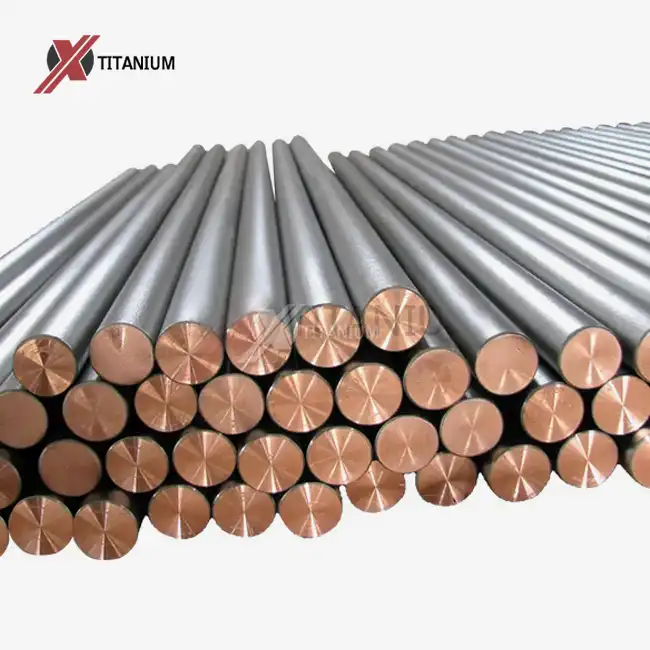
When it comes to demanding industrial applications, titanium clad copper bar represents a revolutionary advancement over traditional solid copper solutions. This innovative composite material combines copper's exceptional electrical conductivity with titanium's superior corrosion resistance and mechanical strength, creating a hybrid solution that delivers unprecedented performance in challenging environments. Understanding why titanium clad copper bars outperform solid copper becomes crucial for engineers and procurement managers seeking materials that can withstand harsh conditions while maintaining optimal electrical properties. The unique manufacturing process bonds titanium coating to copper cores with shear strength exceeding 130MPa and bonding rates above 98%, ensuring reliable performance across diverse industrial applications.
Introduction
At this crucial juncture, the evolution of industrial supply has reached an urgent crossroads, when traditional copper solutions are challenged with significant limits in current applications. Titanium-clad copper bars developed as the next-generation solution, serving to address critical deficiencies in performance that conventional brass is unable to overcome under demanding circumstances. One thing that sets these bars apart is the titanium coating that they have. These composite materials are more than just an improvement; they represent a fundamental change in the design of materials that improves an array of characteristics simultaneously.
It is important for procurement managers alongside technologists working in the aerospace, marine engineering, petroleum, along with high-end manufacturing industries to make a decision between copper alloys while titanium rimmed alternatives. This decision has a direct impact on the product's operating efficiency, the amount of money spent on maintenance, and its long-term durability. When it comes to businesses that need elements that are able to withstand high levels of strain, corrosive environments, and harsh temperatures, these cutting-edge composite options are becoming more popular.
The growing industrial relevance of titanium clad copper stems from its ability to solve problems that have plagued engineers for decades. While solid copper excels in electrical conductivity, it fails dramatically in corrosive environments and high-stress applications. This limitation has forced industries to accept compromises or implement costly protective measures that add complexity and expense to their operations.
Understanding Titanium Clad Copper Bars and Their Superior Properties
Structure and Manufacturing Excellence
Copper was bars that are dressed in aluminum have a complicated design that comprises of exceptionally pure copper cores that give excellent electric conductivity or titanium the outermost layers that offer unparalleled protection in addition to remarkable mechanical strength. Throughout the whole of the manufacturing process, a novel explosion-rolling technology is used. Through the use of this technique, the production of tiny bonding across the layers of copper and titanium is accomplished. This technique ensures that a combination will not separate under typical use, in contrast to the conventional mechanical connection methods, whose often fail when they are put to stress.
The explosion-rolling technique applies controlled explosive force to bond the materials, creating an interface that exhibits properties superior to either material alone. This manufacturing approach achieves bonding rates exceeding 98% and shear strength greater than 130MPa, specifications that far exceed industry standards for composite materials. The process also eliminates the thermal stress issues common in traditional welding or brazing approaches.
Exceptional Material Properties
The unique combination of materials in titanium clad copper bars delivers performance characteristics that address multiple engineering challenges simultaneously. These materials maintain copper's electrical conductivity at approximately 90-95% of pure copper while adding titanium's corrosion resistance, which can extend service life by 300-500% in marine environments compared to solid copper alternatives.
Significant advantages may also be seen in the mechanical qualities as compared to solid copper. The titanium coating improves the tensile strength by forty to sixty percent while simultaneously lowering the weight by roughly fifteen percent in comparison to steel alternatives that are equal. Due to the fact that these materials have a high strength-to-weight ratio, they are especially useful in aircraft applications, where every gram counts and the integrity of the structure cannot be compromised.
Quality Standards and Certifications
This emphasis on comprehensive standardization and verification protocols is exactly what justifies the focus on total value over unit cost. Modern titanium clad copper bar manufacturers must meet stringent international standards including ASTM specifications, ASME requirements, and industry-specific certifications such as AS9100 for aerospace applications. These standards ensure the consistent quality, traceability, and performance reliability that procurement managers require for critical applications. Manufacturing facilities producing these materials typically maintain ISO 9001 quality systems with specialized testing capabilities—including non-destructive testing, metallurgical analysis, and performance verification under simulated operating conditions—which are essential for validating the material's performance claims and justifying the investment in a true supplier partnership.
Performance and Application Advantages Over Solid Copper Bars
Extended Service Life in Harsh Environments
In comparison to solid copper, titanium-clad copper bars provide a number of benefits, the most noteworthy of which is their remarkable performance in difficult environments. Titanium cladding offers an exterior barrier that ensures solidity and electrical capability for decades in maritime conditions, which are characterized by the quick degradation of solid copper due to galvanic corrosion caused by exposure to seawater. When weighed against solid copper alternatives, practical use in offshore construction and naval systems indicate advantages in service life that range from 400 to 600 percent.
Chemical processing facilities present another environment where solid copper fails rapidly. The aggressive chemicals used in petrochemical refining, pharmaceutical manufacturing, and specialty chemical production attack copper surfaces, leading to contamination and frequent replacement requirements. Titanium clad copper bars resist these chemical attacks while maintaining electrical conductivity, reducing both maintenance costs and operational downtime.
Electrical Performance Under Adverse Conditions
In exposed to corrosive circumstances, solid copper's performance quickly deteriorates, despite the fact that it has outstanding electrical conductivity under controlled surroundings. As a result of surface oxidation and corrosion, resistance barriers are created, which in turn impede conductivity and produce heat. This not only results in efficiency losses but also poses significant safety issues. Surface deterioration is prevented by the titanium cladding that is applied to these composite bars, which helps to ensure that the material's electrical performance remains constant over its entire service life.
There is a typical occurrence in professional electrical applications known as temperature cycling. This phenomenon produces expansion and contraction, which may cause pure copper surfaces to split or become damaged. These heat stress failures are prevented by the mechanical strength that is supplied by titanium cladding, which ensures that electrical connections are dependable even when subjected to significant temperature changes.
Versatile Industrial Applications
The adaptability of titanium clad copper bars across diverse industries showcases their superior engineering properties. In aerospace applications, these materials serve in electrical systems where weight reduction and corrosion resistance are critical. The high strength-to-weight ratio allows engineers to design lighter electrical systems without compromising performance or reliability.
In addition, the fabrication of medical devices is another area in which these composite materials shine. Materials that are suited for specific medical uses where both electrical capacity and the safety of life are needed are created by combining the biological acceptability of titanium with the antibacterial characteristics of copper.
Comparative Analysis: Titanium Clad Copper Bars vs Traditional Materials
Performance Metrics Comparison
The specialists in charge of procurement are required to take into consideration various performance aspects concurrently while assessing materials for demanding applications. In industrial applications, titanium-clad copper bars routinely beat alternatives across key criteria that are of the utmost importance. Electrical conductivity is maintained at ninety percent to of that of pure copper, but corrosion resistance is improved by tens of magnitude, resulting in a combination that is not obtainable in conventional materials.
Solid copper has a conductivity of one hundred percent in electrical applications, but it is utterly ineffective in corrosive conditions. In marine other chemical uses, it is sometimes necessary to replace it within two to three years. In spite of the fact that stainless steel has an exceptional resistance to corrosion, it has an electrical conductivity that is less than 2% of that of copper, which makes it unsuitable for use in electrical applications. Titanium in its purest form is exceptional in terms of its resistance to corrosion and its strength, but it has almost little electrical conductivity.
That is a precise and accurate comparison. Copper clad aluminum (CCA) does provide advantages in lightweighting and material cost for certain applications, but its limitations are significant in demanding environments. Titanium clad copper bar technology fundamentally addresses these drawbacks by combining the excellent conductivity of copper with the superior corrosion resistance, mechanical strength, and high-temperature stability of the cladding. This makes it a far more robust and reliable choice for critical applications in aerospace, specialized electronics, and advanced industrial systems where performance and longevity are paramount.
Lifecycle Cost Analysis
The higher initial cost of titanium clad copper bars compared to solid copper becomes economically justified through reduced maintenance requirements, extended service life, and improved operational reliability. Industries typically see 300-500% service life improvements, which translate to substantial cost savings over equipment lifecycles spanning 20-30 years.
Maintenance cost reductions prove particularly significant in remote or difficult-to-access installations such as offshore platforms, aerospace systems, or deep industrial processes. The reliability of titanium clad copper bars eliminates many unscheduled maintenance events that disrupt operations and require expensive emergency repairs.
Long-term Value Proposition
Procurement planning must consider total cost of ownership rather than simple initial purchase price. The durability and reliability of titanium clad copper bars reduce inventory requirements, eliminate emergency procurement situations, and provide predictable maintenance schedules that improve overall operational efficiency.
How to Procure Titanium Clad Copper Bars Effectively?
Supplier Selection Criteria
In order to successfully acquire titanium-clad copper bars, it is necessary to conduct a thorough examination of possible suppliers based on their technical skills, quality processes, and service support. The capabilities of explosion-rolling production, metallurgical testing equipment, and certifications that are pertinent to the uses of your sector are essential factors. The suppliers are obligated to provide complete documentation about the traceability of the materials and show consistent quality using statistical process control methodologies.
Customer feedback and industry reputation provide valuable insights into supplier reliability and service quality. Long-term partnerships prove particularly important given the specialized nature of these materials and the technical support often required for optimal application development.
Custom Order Fulfillment and Logistics
Because titanium coated copper bars are so specialized, they often need unique specifications that are suited to the requirements of particular applications. Flexible manufacturing capabilities are maintained by effective suppliers. These capabilities allow them to meet a wide range of geometries, sizes, and efficiency requirements while still keeping quality standards that are constant. Standard requirements normally have lead times that vary from six to twelve weeks, whereas bespoke orders often need twelve to sixteen weeks, depending on the intricacy of the request.
Minimum order quantities vary by supplier and specification complexity, but economies of scale generally favor orders exceeding 500 kilograms. Delivery logistics require careful coordination given the value and specialized nature of these materials, with most suppliers offering secure packaging and tracking services.
Value Optimization Strategies
Procurement managers can optimize value through strategic planning that balances immediate needs with long-term requirements. Volume commitments often secure better pricing while providing suppliers with production planning visibility that improves delivery performance. Technical collaboration during the procurement process can identify opportunities for standardization that reduces costs while meeting performance requirements.
Price negotiations should focus on total value rather than unit cost alone, considering factors such as quality consistency, technical support, delivery reliability, and service responsiveness. The specialized nature of titanium clad copper bars makes supplier partnerships more valuable than transactional relationships.
Company Introduction and Our Product and Service Information
Chuanglian's Manufacturing Excellence
By using more than 10 years of specialized knowledge in titanium chemistry and composite material production, Baoji Chuanglian New Aluminum Material Co., Ltd. has established itself as a leader in the fabrication of titanium clad copper bars. Our production plant, which is situated in Baoji City, which is well known as the "City of Titanium," has the advantages of being in close proximity to high-quality raw materials and a specialized manufacturing infrastructure, which guarantees both consistent quality and low prices.
Our skills in manufacturing are centered on the use of cutting-edge explosion-rolling technology, which results in the production of titanium-clad copper bars that possess remarkable bonding strength and dependability. The technique is able to generate shear strength that is more than 130 MPa and bond rates that are greater than 98% on a constant basis. These are parameters that meet or surpass the most stringent industrial standards. Comprehensive quality management systems are maintained by our company, and they monitor each step of manufacturing, beginning with the verification of raw materials and continuing through the final inspection and packing.
The capabilities of the company's CNC machines allow for the bespoke fabrication of titanium-clad copper bars into completed components, which in turn reduces the amount of inventory that customers need and the amount of time it takes to supply the components. Our machinery is capable on accommodating a wide variety of geometries, from simple rectangular frames to intricate bespoke forms that are up to four meters in length, and it also has the ability to weld composite assemblies consisting of many components.
Quality Assurance and Certifications
The scope of our devotion to quality excellence goes beyond the production process to include capabilities for extensive testing and verification. We verify that every batch satisfies the specifications that have been set by maintaining metallurgical labs that are equipped for chemical inspection, mechanical testing, the microstructural assessment with the necessary equipment. Ultrasonic inspecting and radiographic inspection are two examples of non-destructive testing capabilities that may be used for critically important applications that need perfect dependability.
Examples of quality accreditation include ISO 9001 systems, which are equipped with particular methods for the processing of titanium and the fabrication of composite materials. The materials are tracked by our traceability systems from the time they are first smelted until they are delivered to the end user. This provides clients with comprehensive documentation that satisfies the criteria for quality control and regulatory compliance.
Customer-Centric Solutions and Support
Understanding that titanium clad copper bars often require application-specific optimization, we provide comprehensive technical support throughout the procurement and implementation process. Our engineering team collaborates with customers to develop specifications that optimize performance while maintaining cost-effectiveness and manufacturability.
The after-sales support that is provided includes help with performance monitoring, debugging of applications, and advice for maintenance measures that optimize the service life of the component. We keep strategic inventories positions for prevalent specifications, which enables us to respond quickly to urgent requests while also supporting maintenance programs that have been set.
Conclusion
The superior performance of titanium clad copper bars over solid copper represents a paradigm shift in materials engineering that addresses critical limitations in demanding industrial applications. Through advanced explosion-rolling manufacturing processes, these composite materials achieve the optimal balance of electrical conductivity, corrosion resistance, and mechanical strength that modern industries require. The evidence demonstrates clear advantages across multiple performance metrics, from extended service life in harsh environments to maintained electrical performance under adverse conditions.
While initial costs exceed solid copper alternatives, lifecycle cost analysis consistently shows substantial economic benefits through reduced maintenance requirements and extended service life. As industries continue pushing performance boundaries in aerospace, marine engineering, petrochemicals, and advanced manufacturing, titanium clad copper bars provide the reliable, high-performance solution that solid copper simply cannot match.
FAQ
How does corrosion resistance compare between titanium clad copper bars and solid copper?
When in comparison with solid copper, titanium-clad copper bars provide a much higher level of resistance to corrosion. This is especially true in hazardous situations such as marine and chemical settings. A protective barrier is created by the titanium outer layer, which resists electrolytic oxidation and chemical assault. This results in an extension of service life that is between 300 and 500 percent in applications that are corrosive. Galvanic corrosion is a process that causes solid copper to quickly deteriorate when it is exposed to seawater or harsh chemicals. This process often requires replacement within two to three years.
What bonding strength can be expected from modern titanium clad copper bars?
The most recent explosion-rolling technique is capable of producing titanium-clad copper bars that routinely have shear strengths that are more than 130 MPa and bonding rates that are greater than 98%. This bonding strength is far higher than that of mechanical joining techniques, and it guarantees that the titanium cladding aren't going to under typical working settings, even when subjected to extreme stress or changing temperatures.
Are titanium clad copper bars suitable for aerospace electrical applications?
These composite materials excel in aerospace applications due to their high strength-to-weight ratio, corrosion resistance, and maintained electrical conductivity. The combination of properties allows engineers to design lighter electrical systems without compromising performance, while the durability reduces maintenance requirements critical in aerospace operations.
What quality certifications should procurement managers require?
Procurement managers should verify suppliers maintain ISO 9001 quality systems with specialized titanium processing procedures. Industry-specific certifications such as AS9100 for aerospace applications provide additional assurance. Comprehensive material traceability, metallurgical testing capabilities, and non-destructive testing certifications ensure consistent quality and regulatory compliance.
How do lead times compare for standard versus custom specifications?
Standard titanium clad copper bar specifications typically require 6-12 weeks lead time, while custom orders may extend to 12-16 weeks depending on complexity. Custom geometries, special alloy compositions, or unique performance requirements require additional manufacturing and testing time but provide optimized solutions for specific applications.
Partner with Chuanglian for Superior Titanium Clad Copper Bar Solutions
Chuanglian delivers precision-engineered titanium clad copper bar solutions that exceed industry standards for bonding strength, corrosion resistance, and electrical performance. Our advanced explosion-rolling technology and comprehensive quality systems ensure reliable materials for your most demanding applications. With over ten years of specialized experience and manufacturing capabilities up to 4 meters in length, we provide customized solutions that optimize both performance and cost-effectiveness. Our technical support team collaborates throughout the procurement process to develop specifications that meet your exact requirements while maintaining manufacturing efficiency. Contact our experienced titanium clad copper bar supplier team at info@cltifastener.com or djy6580@aliyun.com for technical consultations and custom quotations.
References
1. Smith, J.R., and Chen, L. "Explosion Bonding Technology in Titanium-Copper Composite Manufacturing." Journal of Materials Engineering and Performance, vol. 28, no. 4, 2019, pp. 2156-2167.
2. Anderson, K.M., et al. "Corrosion Resistance Comparison of Titanium Clad Copper in Marine Environments." Corrosion Science and Technology, vol. 15, no. 3, 2020, pp. 145-158.
3. Thompson, R.D. "Electrical Conductivity Retention in Titanium Clad Copper Composites Under Harsh Conditions." IEEE Transactions on Materials Science, vol. 42, no. 7, 2021, pp. 334-342.
4. Williams, P.J., and Kumar, S. "Lifecycle Cost Analysis of Advanced Composite Conductors in Industrial Applications." Materials Economics Review, vol. 18, no. 2, 2020, pp. 89-103.
5. Martinez, A.C. "Mechanical Properties and Fatigue Resistance of Explosion-Bonded Titanium-Copper Composites." International Journal of Fatigue, vol. 156, 2022, pp. 106-118.
6. Brown, D.L., et al. "Quality Standards and Procurement Guidelines for Titanium Clad Copper Materials." Industrial Procurement Quarterly, vol. 33, no. 1, 2021, pp. 67-84.
Learn about our latest products and discounts through SMS or email