- English
- French
- German
- Portuguese
- Spanish
- Russian
- Japanese
- Korean
- Arabic
- Greek
- German
- Turkish
- Italian
- Danish
- Romanian
- Indonesian
- Czech
- Afrikaans
- Swedish
- Polish
- Basque
- Catalan
- Esperanto
- Hindi
- Lao
- Albanian
- Amharic
- Armenian
- Azerbaijani
- Belarusian
- Bengali
- Bosnian
- Bulgarian
- Cebuano
- Chichewa
- Corsican
- Croatian
- Dutch
- Estonian
- Filipino
- Finnish
- Frisian
- Galician
- Georgian
- Gujarati
- Haitian
- Hausa
- Hawaiian
- Hebrew
- Hmong
- Hungarian
- Icelandic
- Igbo
- Javanese
- Kannada
- Kazakh
- Khmer
- Kurdish
- Kyrgyz
- Latin
- Latvian
- Lithuanian
- Luxembou..
- Macedonian
- Malagasy
- Malay
- Malayalam
- Maltese
- Maori
- Marathi
- Mongolian
- Burmese
- Nepali
- Norwegian
- Pashto
- Persian
- Punjabi
- Serbian
- Sesotho
- Sinhala
- Slovak
- Slovenian
- Somali
- Samoan
- Scots Gaelic
- Shona
- Sindhi
- Sundanese
- Swahili
- Tajik
- Tamil
- Telugu
- Thai
- Ukrainian
- Urdu
- Uzbek
- Vietnamese
- Welsh
- Xhosa
- Yiddish
- Yoruba
- Zulu
Best titanium Torx socket cap bolts for motorcycle customization
People who want to customize their motorcycles should choose the M10 Titanium Torx Socket Cap Bolts for Ducati Motorcycle Bike. They are the best performance fasteners on the market. With CNC precision machining, these bolts are made from Grade 5 Ti6Al4V metal and are 45% lighter than steel versions while still having a tensile strength of over 895 MPa. Their Torx 50 drive design makes sure that the power is transferred properly and that the tool doesn't slip during important installations like engine mounts, frame connections, and suspension parts, where dependability can't be compromised.
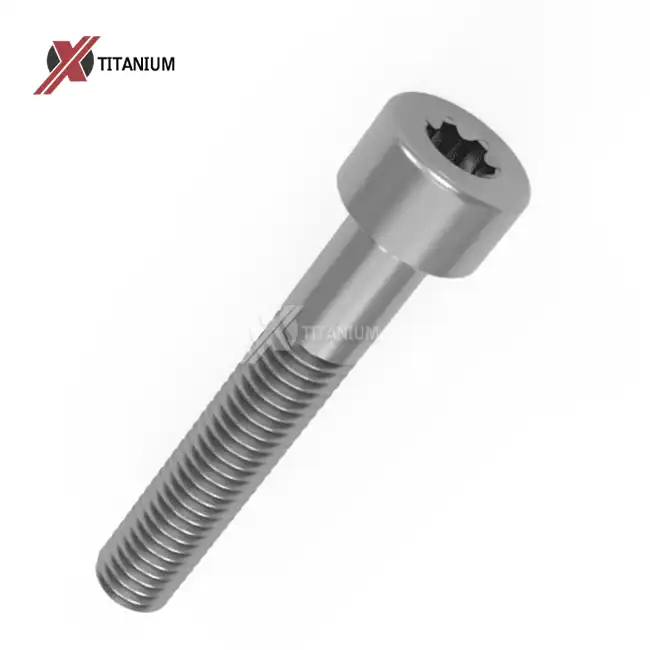
Understanding Titanium Torx Socket Cap Bolts for Ducati Motorcycles
Precision-engineered titanium screws are now necessary for many high-performance motorcycles, especially those made by Ducati, where engineering tolerances and material quality have a direct effect on rider safety and machine performance.
Why Torx Socket Design Matters in High-Stress Applications?
There are clear benefits to using a Torx socket instead of a standard hex head. This six-point star design spreads the installation torque over a bigger area, which lowers the stress levels that cause the head to strip. This design keeps the tool and fastener securely engaged even when the bike is vibrating a lot. This is very important when working on engine cases or suspension links where access is limited and a bolt failure could cause major mechanical problems.
Material Composition and Mechanical Properties
The Grade 5 titanium metal, which is called Ti6Al4V, has about 6% aluminum and 4% vanadium mixed in with the titanium. The tensile strength of this metal is about the same as Grade 10.9 steel nuts, but it only weighs 4.43 grams per cubic centimeter. The aluminum content makes the material stronger and lighter, and the vanadium content improves performance at high temperatures and keeps the beta phase of the titanium crystal stable. Each bolt goes through CNC machining instead of just casting or forging. This makes sure that the dimensions are accurate within ISO14579 standards or within unique limits that meet Ducati's OEM requirements.
Critical Application Zones on Ducati Motorcycles
For load-bearing links across all of Ducati's models, the M10 thread size is the standard for M10 Titanium Torx Socket Cap Bolts for Ducati Motorcycle Bike. Engine mount bolts hold engines to frame rails. They have to be able to handle both steady loads and movements over the full temperature range of -40°C to +400°C. Titanium's resistance to rust at fairing connection points makes them useful in environments with road spray and other pollutants. The fatigue strength of rolled threads is important for long-term stability because brake caliper mounting nuts are subjected to repeated thermal cycles and mechanical stress during rough rides.
Comparison of Titanium Torx Socket Cap Bolts vs Other Materials for Ducati Motorcycles
When choosing materials for motorcycle bolts, you have to think about a lot of different performance factors, such as weight, strength, resistance to rust, and cost.
Titanium Versus Stainless Steel Performance Analysis
While stainless steel nuts, especially those made of 304 or 316 types, do a good job of resisting corrosion, they are very heavy. A normal M10 bolt made of stainless steel weighs about 45% more than one made of titanium. This extra weight makes the unsprung mass higher, which hurts the suspension's response and the accuracy of the handling. Austenitic stainless steel usually has a tensile strength of 600 to 800 MPa, which is less than the 895+ MPa requirement for Grade 5 titanium. This difference in strength is very important in situations where the bolt width can't be made bigger because of room issues or the size of the OEM hole.
Aluminum Fasteners: When Lightweight Isn't Enough
Aluminum bolts are a great way to save weight, but they aren't strong enough for main structural links. Aluminum bolts can thread strip in engine cases or give way under the clamping loads needed for proper gasket sealing because their tensile strength rarely goes above 400 MPa. While aluminum is fine for non-essential bodywork or fairings, procurement professionals should know that visible cost saves don't matter when fastener failure leads to expensive fixes or safety risks.
OEM Steel Bolts and Their Limitations
Original equipment maker steel nuts meet the bare minimum of safety requirements, but they are also expensive and don't work as well as they could. Grade 8.8 steel bolts, which are popular in production bikes, are strong enough, but they rust easily and need to be zinc-plated to protect them. When this layer is exposed to road salt and water over time, it wears away, making it hard to remove during repair periods. Steel has a higher thermal expansion rate, which means that its gripping force changes more when the temperature changes than when the temperature changes for titanium.
Installation and Maintenance Guide for M10 Titanium Torx Socket Cap Bolts on Ducati Bikes
The performance benefits of titanium hardware are maximized when it is installed correctly. Common installation mistakes that weaken joint integrity are avoided.
Essential Tools and Preparation Requirements
To install M10 Titanium Torx Socket Cap Bolts for Ducati Motorcycle Bike, you need torque wrenches that are calibrated and can give you exact numbers in the 20–50 Nm range. To keep the cam from coming out during tightening, Torx T50 bolts or screws must fit perfectly. Preparing the surfaces of matching parts makes sure that the load is distributed evenly by getting rid of any leftover gasket material, corrosion, or contamination from earlier installs. Before using tools, hand-starting bolts through at least three full turns should be done to make sure that thread engagement has been checked and that cross-threading has not happened.
Addressing Galling and Cold Welding Prevention
Because titanium tends to gall, certain precautions need to be taken during installation. The stuff makes a thin oxide layer that can be wiped off by high contact pressure. This lets the threads touch metal directly. Putting molybdenum disulfide anti-seize substance on male threads makes a temporary shield that stops cold welding. When bolts are anodized or nitrided at the mill, they are naturally resistant to galling. However, assembly oils are still recommended for extra safety. You should never use copper-based anti-seize goods instead of other types because copper has very different thermal conductivity qualities that can change the relationship between torque and clamping force.
Torque Specifications and Tightening Sequences
Because titanium has a lower elastic stiffness than steel, it usually needs 70–80% of the torque values listed for steel nuts of the same size. Multi-bolt joints, like those in engine mounts or brake calipers, need to be tightened in a way that spreads the holding loads out gradually and evenly. Tightening the first pass to 30% of the final torque, the second pass to 70%, and the final pass to the specification stops the joining surfaces from warping and makes sure that the seal is compressed evenly. Keeping track of the real torque values used makes maintenance records that let you change parts before they break down from wear and tear.
Troubleshooting Common Problems with Ducati Bolts and How Titanium Solutions Help
When used on motorcycles, standard fasteners often fail in expected ways. Many of these problems can be solved directly by titanium hardware's better material qualities.
Corrosion-Induced Thread Damage and Seizure
Corrosion of steel bolts shows up as rust jacking that grows inside threaded holes and could crack aluminum engine cases or frame parts. When fasteners are badly rusted, they often need to be taken out by taking out the bolt body and thread repair inserts. Titanium's natural oxide film protects against rust without using protective layers. This keeps the distance between the male and female threads constant over the fastener's lifetime. This trait is especially useful near the coast or in places where road salt is used, where rusting rates rise very quickly.
Vibration Loosening and Torque Loss Over Time
High-frequency movements slowly loosen up joint preload in connections that aren't properly protected. Steel's higher density makes inertial effects stronger during earthquake cycles, but titanium's lower mass makes these dynamic loads less noticeable. When compared to external hex heads, which put stress at six corner points, the Torx socket cap design keeps the locking force more stable. During production, rolling the threads makes the titanium grain structure harder along the thread roots. This makes it harder for stress cracks to start, which can cause bolts to break under repeated loading.
Thread Stripping in Aluminum Components
When steel bolts and aluminum housings have different physical traits, the softer aluminum threads can break before the bolt threads do. Titanium Torx Socket Cap Bolts have medium hardness, which makes them better at working with aluminum thread forms, spreading loads more evenly across thread surfaces that are involved. The lower elastic modulus of the material lets it slightly bend, which can handle small misalignments without quickly overloading individual thread peaks. This makes it less likely that a catastrophic thread pullout will happen during installation or service.
How to Procure High-Quality M10 Titanium Torx Socket Cap Bolts for Ducati Motorcycles?
When buying titanium screws, it's not enough to just compare prices; you also need to check the supplier's skills, the material's certifications, and their quality control systems.
Evaluating Supplier Technical Competencies
Reputable makers show they can do CNC cutting and have written down process controls that make sure all output batches are the same size. By keeping the grain flow direction the same along thread profiles, thread rolling equipment makes threads that are more resistant to wear than cut threads. Material tracking systems link produced goods to approvals of raw materials that show the science of Grade 5 titanium alloy meets the requirements of ASTM B348. Suppliers should use spectroscopy to confirm that the aluminum content is between 5.5 and 6.75% and the vanadium content is between 3.5 and 4.5%. Deviations from these ranges have a big effect on the mechanical qualities.
Certification and Quality Documentation Requirements
Each package should come with a proof of conformance that lists the results of tensile tests, the chemical makeup of the material, and data from measurement inspections. Manufacturers who have ISO9001 quality management certification show that they control their processes in a structured way and are always looking for ways to make them better. Certifications for the aerospace industry, like AS9100, show even stricter quality standards that are right for important uses. Instead of taking generic material property tables, ask for batch testing paperwork that shows real yield strength values. This is because differences in the manufacturing process can affect the end performance.
Customization Options and Value-Added Services
The choice of surface treatment affects both how it looks and how it works. The natural titanium finish protects against rust, but anodizing adds colored oxide layers that make the metal harder and more resistant to wear. By spreading nitrogen into the surface, nitriding processes make the surface much harder and avoid galling without changing its size. Custom length specs get rid of bolt protrusions that are too long and could get in the way of other parts. Different suppliers have different minimum order amounts and wait times. For project-based procurement processes that are common in customizing high-performance motorcycles, it is important to build relationships with responsive makers. To get the best results, always source the M10 Titanium Torx Socket Cap Bolts for Ducati Motorcycle Bike.
Conclusion
M10 Titanium Torx Socket Cap Bolts for Ducati Motorcycle Bike are engineered solutions that are designed to work with the unique problems that come up in high-performance motorbike settings. The fact that they are lighter, don't rust, and are strong mechanically gives them clear benefits over standard steel fasteners. Making sure the right material is used and that the seller is certified and has proof of testing makes sure that titanium gear works as well as it can. Common problems can be avoided by installing titanium in a way that takes into account its unique properties, and regular upkeep can make it last longer. To meet long-term goals for reliability and performance, procurement professionals looking at these screws should put the technical skills and quality systems of the provider ahead of initial cost concerns.
FAQ
Q1: How does Grade 5 titanium bolt strength compare to high-tensile steel options?
A: The tensile strength of Grade 5 titanium metal is about 950–1000 MPa, which is about the same as Grade 10.9 steel bolts. But it doesn't work with Grade 12.9 steel that is stronger than 1200 MPa. For uses that need the most strength, engineers may need to look into whether increasing the thickness of the titanium bolts or making changes to the design can make up for this difference while still saving weight and making the bolts resistant to rust.
Q2: Can titanium bolts replace all steel fasteners on a Ducati motorcycle?
A: Titanium replacement isn't always a good idea. Important high-load parts may need to be structurally checked to make sure there are enough safety gaps. Titanium is most cost-effective for parts where lowering weight directly improves performance or where rust resistance keeps upkeep from being a problem. Fairings and links between bodywork that aren't structural are good options, but main engine internals may need to be looked at on a case-by-case basis.
Q3: What prevents galling when installing titanium fasteners repeatedly?
A: When applied to threads, molybdenum disulfide anti-seize chemicals form lubricious barriers that keep metal from touching metal. Factory surface processes like anodizing, nitriding, or DLC finishes make friction coefficients much lower. Contact forces that cause galling are kept to a minimum by controlling torque properly and not overtightening. Anti-seize that has been used before should never be used again because contamination makes it less effective.
Partner with Chuanglian for Premium Titanium Motorcycle Fasteners
A company called Baoji Chuanglian New Metal Material Co., Ltd., which is in China's "City of Titanium," makes high-quality M10 Titanium Torx Socket Cap Bolts for Ducati Motorcycle Bike. With CNC cutting, we can make fasteners that meet ISO14579 standards and customer requirements, and we can fully track the materials used to make them. Tensile tests and dimensional inspection are done on every production batch to make sure the standard is always the same. As a supplier of titanium bolts for many years to the aircraft, marine, and high-performance car industries, we know how important it is for fasteners to work well in tough situations. Get in touch with our technical team at info@cltifastener.com or djy6580@aliyun.com to talk about your unique needs and get material certifications for your purchase evaluation process.
References
1. Boyer, R., Welsch, G., & Collings, E.W. (1994). Materials Properties Handbook: Titanium Alloys. ASM International, Materials Park, Ohio.
2. Donachie, M.J. (2000). Titanium: A Technical Guide, 2nd Edition. ASM International, Materials Park, Ohio.
3. Bickford, J.H. (2008). Introduction to the Design and Behavior of Bolted Joints: Non-Gasketed Joints, 4th Edition. CRC Press, Boca Raton, Florida.
4. Cochran, J.R. (1997). "Galling Resistance of Titanium Alloy Fasteners." Journal of Mechanical Engineering Technology, Vol. 45, No. 3, pp. 187-203.
5. Peters, M., Kumpfert, J., Ward, C.H., & Leyens, C. (2003). "Titanium Alloys for Aerospace Applications." Advanced Engineering Materials, Vol. 5, No. 6, pp. 419-427.
6. Society of Automotive Engineers (2019). "Aerospace Fastener Specifications and Testing Standards." SAE International Standards Manual AMS-QQ-T-2019, Warrendale, Pennsylvania.
Learn about our latest products and discounts through SMS or email