- English
- French
- German
- Portuguese
- Spanish
- Russian
- Japanese
- Korean
- Arabic
- Greek
- German
- Turkish
- Italian
- Danish
- Romanian
- Indonesian
- Czech
- Afrikaans
- Swedish
- Polish
- Basque
- Catalan
- Esperanto
- Hindi
- Lao
- Albanian
- Amharic
- Armenian
- Azerbaijani
- Belarusian
- Bengali
- Bosnian
- Bulgarian
- Cebuano
- Chichewa
- Corsican
- Croatian
- Dutch
- Estonian
- Filipino
- Finnish
- Frisian
- Galician
- Georgian
- Gujarati
- Haitian
- Hausa
- Hawaiian
- Hebrew
- Hmong
- Hungarian
- Icelandic
- Igbo
- Javanese
- Kannada
- Kazakh
- Khmer
- Kurdish
- Kyrgyz
- Latin
- Latvian
- Lithuanian
- Luxembou..
- Macedonian
- Malagasy
- Malay
- Malayalam
- Maltese
- Maori
- Marathi
- Mongolian
- Burmese
- Nepali
- Norwegian
- Pashto
- Persian
- Punjabi
- Serbian
- Sesotho
- Sinhala
- Slovak
- Slovenian
- Somali
- Samoan
- Scots Gaelic
- Shona
- Sindhi
- Sundanese
- Swahili
- Tajik
- Tamil
- Telugu
- Thai
- Ukrainian
- Urdu
- Uzbek
- Vietnamese
- Welsh
- Xhosa
- Yiddish
- Yoruba
- Zulu
Custom Titanium Screws for European OEM Buyers
M3 titanium screws represent the peak of technical quality for European OEM customers looking for precise fastening solutions. These micro-fasteners are essential for high-performance electronics, medical devices, and aircraft because of their remarkable strength-to-weight ratios and unparalleled corrosion resistance. Titanium micro screws satisfy the strictest European production requirements and provide long-term dependability in crucial assemblies thanks to their adjustable specifications, which range from 5mm to 50mm lengths and numerous surface treatments.
Understanding M3 Titanium Screws: Properties and Applications
Material Specifications and Grade Classifications
Pure titanium and titanium alloys are the two main material types used in M3 titanium fasteners. The commercially pure variety is grade 2 titanium, which has a tensile strength of 345–450 MPa and outstanding corrosion resistance. This grade is perfect for applications needing M3 titanium screws because it performs well in chemical processing settings where material purity is crucial.
The aerospace industry standard is grade 5 titanium (Ti-6Al-4V), which offers exceptional mechanical qualities and tensile strengths of up to 950 MPa. This titanium alloy strikes the ideal mix between strength and workability thanks to its 6% aluminum and 4% vanadium content. For crucial structural components where weight reduction cannot jeopardize safety margins, European aircraft manufacturers regularly require Grade 5.
Procurement choices are greatly impacted by the differences between these grades. While automobile racing teams use Grade 5 for high-stress suspension components, medical device makers generally choose Grade 2 for biocompatible implant applications.
Precision Threading and Dimensional Tolerances
M3 metric threading has a standard pitch of 0.5mm and a nominal diameter of 3mm, in accordance with ISO 68 standards. Precise thread engagement is required in European manufacturing, especially in electronics assemblies where component failure is prevented by vibration resistance. Strict European quality standards are met by CNC machining methods, which guarantee thread precision within ±0.05mm tolerances.
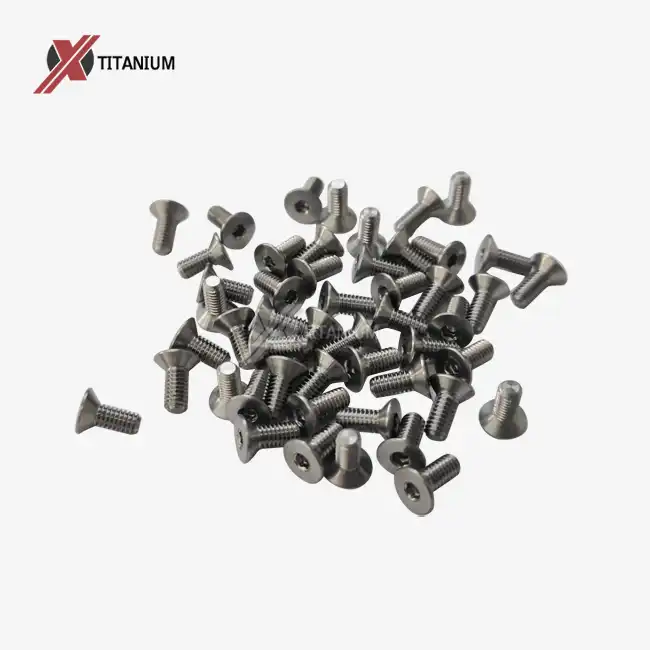
Different application needs are accommodated by custom length parameters. Standard options include 50mm versions for structural applications and 5mm button head screws for small devices. Superior torque transfer is offered by socket head cap screws, and flush fitting in aerodynamic surfaces is made possible by flat head designs.
Surface Treatment Options for Enhanced Performance
The performance of titanium screws is extended beyond the qualities of the basic material by contemporary surface treatments. In applications that are visible, polishing produces smooth surfaces that lower friction coefficients and enhance visual attractiveness. In maritime situations, passivation treatments improve natural oxide layers to increase corrosion resistance.
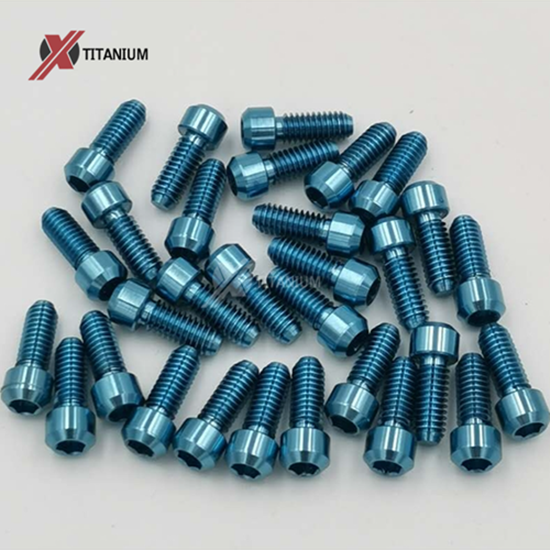
Anodizing procedures have both practical and decorative advantages. While preserving dimensional stability, Type II anodizing creates a variety of colorful finishes, including gold, blue, green, purple, black, and rainbow. In high-cycle applications, which are typical of European precision equipment, nitriding treatments prolong wear resistance by increasing surface hardness.
Comparing M3 Titanium Screws with Alternative Materials: Making the Right Choice
Performance Advantages Over Traditional Materials
In weight-critical applications, titanium micro fasteners have a notable advantage over traditional materials. Grade 5 titanium weighs around 45% less than 316 stainless steel while achieving four times the strength. This benefit immediately translates into increased performance in vehicle racing applications and improved fuel economy in European aircraft manufacture.
Another important consideration that favors titanium choosing is corrosion resistance. Titanium retains its structural integrity when exposed to saltwater at temperatures higher than 500°F (260°C), in contrast to stainless steel, which experiences pitting corrosion in chloride conditions. This characteristic is essential to the long-term operational dependability of offshore wind farms in Europe.
Because every gram impacts flight time, the strength-to-weight ratio becomes very important in European drone manufacture. When compared to steel equivalents, M3 titanium socket screws allow for structural weight savings of 15% to 20% without sacrificing joint integrity.
Cost-Benefit Analysis for European Applications
Despite the high cost of titanium fasteners, lifetime cost analysis shows attractive value propositions. Titanium's remarkable endurance results in considerable maintenance cost savings for European firms working in severe settings. Compared to titanium, which has a service life of more than ten years, steel replacement cycles in marine applications occur every two to three years.
Applications in medical devices use titanium's benefits in biocompatibility to justify its expense. Using certified titanium grades simplifies European regulatory compliance, cutting down on approval times and related development expenses.
Size Selection Considerations: M3 vs M4 Titanium Screws
A thorough load study and consideration of available space are necessary when choosing between M3 and M4 titanium screws. M3 versions are appropriate for uses that call for clamping pressures between 200 and 300 N, which are common in lightweight panels and electronics housings. M4 screws are suitable for mechanical assembly and structural joints since they can support loads up to 500–600N.
M3 titanium screws are often specified by European automakers for interior trim parts where weight reduction and appearance are important considerations. M4 variations are often used in aerospace applications for key structural connections that need approved strength margins.
Purchasing M3 Titanium Screws for European OEMs: A Strategic Guide
Sourcing Strategies and Supplier Evaluation
Building connections with manufacturers that have extensive quality certifications is advantageous for European procurement specialists. While AS9100 aerospace certification guarantees traceability and process control in accordance with European aviation requirements, ISO 9001 certification offers baseline quality assurance.
Suppliers' minimum order amounts differ greatly from one another. For normal setups, specialized titanium fastener producers usually need 500–1000 pieces, while unique demands may call for 2000+ pieces. The flexibility of suppliers with relation to prototype numbers and sample supply for design validation stages should be assessed by European purchasers.
Lead times are a reflection of the unique production needs of titanium. While unique requirements take 8–12 weeks to complete, including material sourcing and machining procedures, standard M3 variants usually ship in 4-6 weeks. In comparison to the availability of steel fasteners, European project timeframes must account for these longer cycles.
Quality Assurance and Certification Requirements
Comprehensive material certification, including chemical composition analysis, mechanical property verification, and dimensional inspection reports, is required by European manufacturing standards. Mill test certifications that trace the sources of raw materials and heat treatment conditions are provided by reliable vendors.
For aircraft applications, non-destructive testing becomes essential. Ultrasonic testing confirms internal soundness, while liquid penetrant examination identifies surface irregularities. These certifications are necessary for European aerospace firms to comply with airworthiness regulations.
Cost Optimization Techniques
For European OEMs with steady demand patterns, volume purchase agreements provide significant cost benefits. Better price is made possible while preserving inventory flexibility via annual blanket purchases with planned releases. Purchasing power with titanium experts is increased by combining fastener needs across product lines.
Initiatives toward standardization simplify procurement and enhance cost structures. Restricting specification variants helps European producers by allowing for higher volumes per configuration and easier inventory control.
Why Choose Chuanglian for Your M3 Titanium Screw Requirements?
Manufacturing Excellence and Technical Capabilities
Baoji Chuanglian New Metal Material Co., Ltd. is based in Baoji City, which is known throughout the world as the "City of Titanium." The manufacture of superior M3 titanium screws and other titanium components is made possible by this advantageous location, which offers direct access to premium titanium raw materials and specialized manufacturing knowledge amassed over decades of industry leadership.
Several CNC machine machines designed especially for titanium processing are part of our extensive machining capabilities. Cutting settings and advanced tooling maximize surface finishes while preserving dimensional accuracy, which is essential for meeting European quality requirements. From the verification of raw materials to the final inspection, every manufacturing run is subjected to strict quality control.
The company's more than 10 years of expertise in the production of titanium fasteners allows us to effectively handle challenging European regulations. In order to maximize fastener specifications for particular applications and retain cost efficiency, our engineering team works in tandem with OEM design teams.
Quality Systems and Certifications
Chuanglian upholds stringent quality control procedures that cover each phase of manufacturing. Before processing starts, raw materials are inspected to confirm their mechanical characteristics and chemical makeup. Throughout machining processes, in-process monitoring guarantees surface quality and dimensional precision.
The ISO 9001 criteria and other international standards are met by our quality management systems. From the acquisition of raw materials to the final delivery, material traceability systems monitor every batch and provide thorough documentation to assist regulatory compliance in Europe.
Surface finish verification, dimensional inspection reports, and material certification are examples of customer validation procedures. European OEM standards for supplier certification and continuous monitoring are supported by these all-inclusive quality packages.
Custom Solutions and Technical Support
OEM requirements in Europe sometimes call for special standards above and beyond what is typically offered. Chuanglian is an expert in developing bespoke titanium fasteners that meet precise specifications for dimensions, surface treatments, and performance attributes. In order to improve fastener solutions for particular applications, our technical team works in conjunction with European design teams.
Technical assistance goes beyond the first stages of product development. Regarding installation techniques, torque requirements, and maintenance suggestions, our applications engineers provide continuous advice. This all-inclusive assistance enables European clients to get the most out of their titanium fastener purchases.
Conclusion
M3 titanium screws are the best fastening option for OEM applications in Europe that need outstanding corrosion resistance and strength-to-weight ratios. Whether focusing on maximum strength for aerospace constructions or biocompatibility for medical devices, the combination of Grade 2 and Grade 5 titanium alternatives allows for precise material selection that matches particular application requirements. Custom production capabilities guarantee that European customers obtain fasteners that are tailored to their individual requirements while upholding strict quality standards. By lowering maintenance costs and improving performance dependability, titanium fasteners provide long-term value.
FAQs
Q1: What advantages do M3 titanium screws offer in aerospace applications?
A: M3 titanium screws provide exceptional strength-to-weight ratios crucial for aerospace weight budgets. Grade 5 titanium delivers 950 MPa tensile strength while weighing 45% less than steel alternatives. This combination enables structural weight reductions without compromising safety margins required in European aviation regulations.
Q2: How does corrosion resistance compare between titanium and steel screws?
A: Titanium demonstrates superior corrosion resistance across diverse environments. While stainless steel suffers pitting corrosion in chloride solutions, titanium maintains integrity in seawater exposure exceeding 500°F. This advantage proves particularly valuable for European offshore applications and marine equipment requiring long-term reliability.
Q3: What customization options are available for M3 titanium screws?
A: Comprehensive customization capabilities include length specifications from 5mm to 50mm, multiple head styles (socket, button, flat), and various surface treatments (polishing, anodizing, nitriding). Color options encompass natural titanium, gold, blue, green, purple, black, and rainbow finishes. Thread specifications can accommodate metric and custom pitch requirements.
Partner with Chuanglian for Premium M3 Titanium Screws
European OEMs seeking reliable m3 titanium screws manufacturer partnerships will find Chuanglian uniquely positioned to meet demanding specifications and delivery requirements. Our Baoji-based manufacturing facility combines advanced CNC machining capabilities with comprehensive quality systems ensuring consistent performance across all product lines. Contact our technical team at djy6580@aliyun.com or info@cltifastener.com to discuss your specific requirements and receive customized quotations.
References
1. European Committee for Standardization. "EN 10204:2004 - Metallic Products - Types of Inspection Documents." Brussels: CEN Publications, 2004.
2. International Organization for Standardization. "ISO 4762:2004 - Socket Head Cap Screws." Geneva: ISO Standards, 2004.
3. American Society for Testing and Materials. "ASTM F67-13 - Standard Specification for Unalloyed Titanium for Surgical Implant Applications." West Conshohocken: ASTM International, 2013.
4. Titanium Development Association. "Guidelines for Design with Titanium Fasteners in Aerospace Applications." Dayton: TiDA Technical Report, 2019.
5. European Aviation Safety Agency. "CS-25 Certification Specifications for Large Aeroplanes - Amendment 27." Cologne: EASA Publications, 2020.
6. Boyer, Rodney R. "Titanium for Aerospace: Rationale and Applications." Materials Science Forum, Vol. 618-619 (2009): 15-24.
Learn about our latest products and discounts through SMS or email