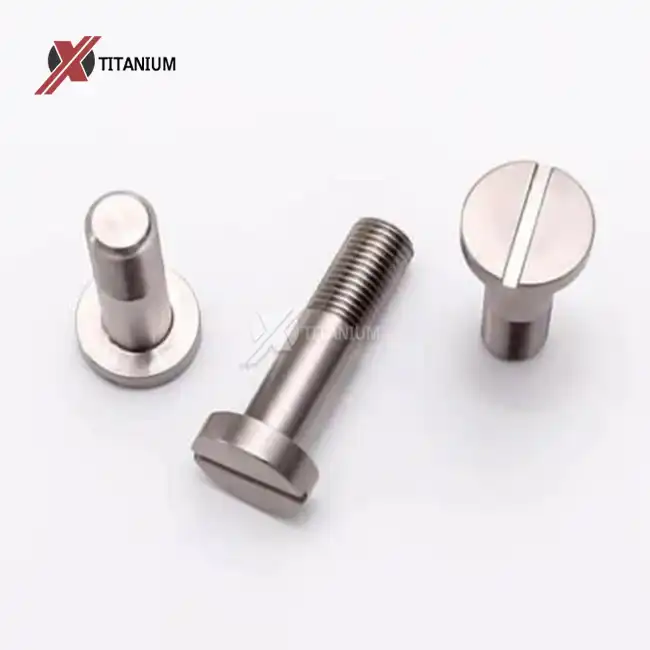
Selecting the right titanium countersunk screws requires understanding fabric grades, application necessities, and provider capabilities. These exactness clasp combine titanium's remarkable strength-to-weight proportion with the flush-mounting plan of level head screws, making them fundamental for aviation, restorative, and marine applications. The choice between Review 2 and Review 5 titanium, legitimate string details, and surface medicines straightforwardly impacts execution, erosion resistance, and long-term unwavering quality in requesting environments.
Understanding Titanium Grades for Countersunk Applications
Material determination shapes the establishment of fruitful titanium clasp acquirement. Review 2 titanium offers amazing erosion resistance and direct quality properties, making it appropriate for chemical preparing hardware and marine structures. This commercially unadulterated titanium gives pliable quality up to 345 MPa whereas keeping up predominant formability for complex countersunk geometries. Grade 5 titanium (Ti-6Al-4V) conveys essentially higher mechanical properties with ductile quality coming to 1300 MPa.
This alpha-beta combination contains 6% aluminum and 4% vanadium, making improved quality characteristics perfect for aviation applications and high-stress situations. The amalgam composition gives great weakness resistance whereas keeping up workability for exactness CNC machining operations. Material certification gets to be basic when assessing providers. Aviation clients ordinarily require AS9100 certification nearby fabric test reports reporting chemical composition, mechanical properties, and traceability documentation. Restorative applications request biocompatibility certification and compliance with ASTM F136 measures for surgical embed materials.
Critical Design Specifications and Threading Standards
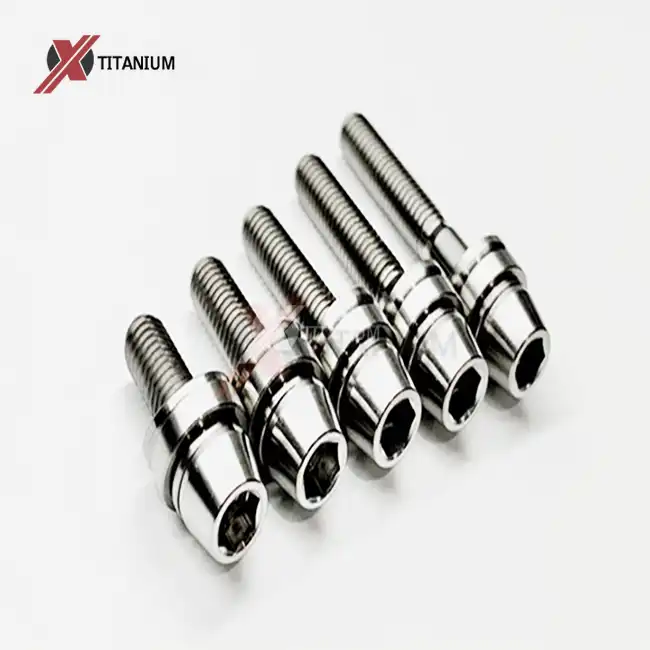
Thread details altogether affect latch execution and get-together compatibility, especially in precision components such as titanium countersunk screws. Metric threading (M3 through M24) overwhelms European and Asian fabricating, whereas Bound together String Standard (UTS) remains predominant in North American aviation applications. The choice between coarse and fine string pitches influences holding quality, vibration resistance, and get together torque requirements.
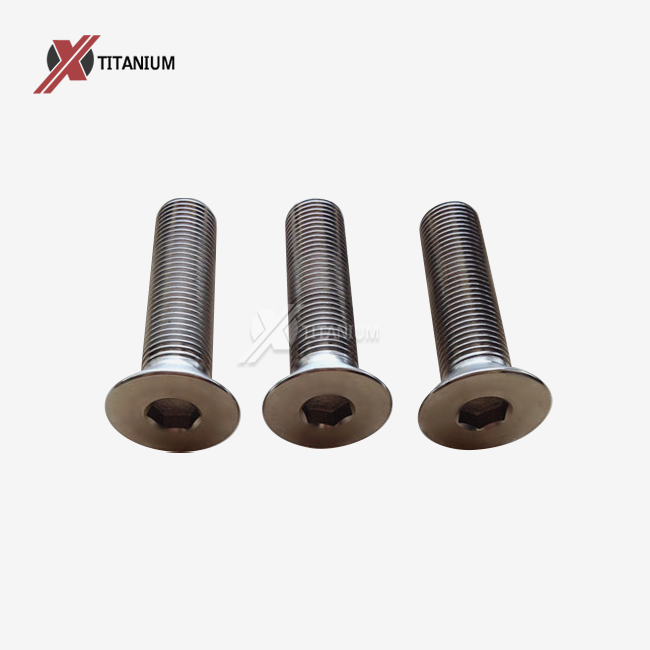
Countersunk head geometry requires exact precise resistances to guarantee flush mounting and appropriate stretch conveyance. Standard countersunk points of 82° or 90° must coordinate comparing gap arrangements to anticipate stretch concentration and untimely disappointment. Head distance across details specifically impact bearing surface zone and pull-through resistance in thin-section applications. Length contemplations expand past essential dimensional prerequisites. Hold length calculations must account for fabric stack-up, washer thickness, and string engagement prerequisites.
Deficiently string engagement diminishes joint quality, whereas over the top length makes get together complications and potential impedances issues. Custom measuring capabilities empower optimization for particular applications. Producers advertising dimensional adaptability can oblige one of a kind dividing necessities, weight lessening objectives, and get together imperatives common in model improvement and specialized hardware designs.
Surface Treatment Options and Performance Enhancement
Surface medicines upgrade both utilitarian execution and stylish offer of titanium clasp. Cleaning operations progress surface wrap up quality, decreasing stretch concentrations and improving weariness life in cyclic stacking applications. Mirror-finish cleaning makes surfaces appropriate for pharmaceutical and semiconductor hardware where molecule defilement control is critical. Anodizing forms make controlled oxide layers that improve erosion resistance whereas empowering color customization.
Sort II anodizing produces enriching wraps up in gold, blue, green, purple, dark, and rainbow colors whereas keeping up dimensional soundness. Sort III difficult anodizing increments surface hardness and wear resistance for high-friction applications. Nitriding medicines make greatly difficult surface layers through nitrogen dissemination forms. This treatment altogether makes strides wear resistance and bothering security whereas keeping up the fundamental titanium's erosion resistance properties.
Nitrided surfaces demonstrate especially important in applications including rehashed gathering and dismantling operations. Surface treatment choice requires adjusting execution prerequisites with taken a toll contemplations. Standard cleaned wraps up regularly give satisfactory execution for numerous applications, whereas specialized medicines address particular natural or utilitarian challenges.
Application-Specific Selection Criteria
Aerospace applications request uncommon unwavering quality beneath extraordinary temperature varieties, vibration loads, and weight limitations, making titanium countersunk screws fundamental for mission-critical fastening performance. Air ship auxiliary congregations utilize Review 5 titanium countersunk jolts for wing connections, fuselage joints, and motor mounting frameworks. The flush-mounted plan decreases streamlined drag whereas giving secure affixing in basic stack paths.
Medical gadget applications prioritize biocompatibility, erosion resistance, and radiolucency properties. Surgical instrument gatherings advantage from titanium's non-magnetic characteristics and chemical dormancy. Implantable gadgets require Review 2 or Review 23 titanium with certified biocompatibility and surface medications that advance tissue integration. Chemical preparing situations uncover clasp to forceful chemicals, lifted temperatures, and destructive environments.
Titanium's uncommon resistance to chloride push erosion breaking makes it perfect for weight vessel congregations, warm exchanger development, and channeling frameworks dealing with destructive media. Marine building applications confront saltwater introduction, galvanic erosion potential, and mechanical stacking from wave activity. Seaward stage structures depend on titanium clasp for basic associations where steel choices would endure quick debasement.
The material's insusceptibility to seawater erosion kills support prerequisites in blocked off locations. Energy division applications span atomic control era, wind turbine gatherings, and sun powered board mounting frameworks. Each application presents one of a kind prerequisites for radiation resistance, vibration resistance, and natural solidness that impact fabric review determination and surface treatment specifications.
Quality Control and Testing Standards
Material traceability documentation gives basic quality affirmation for basic applications. Process test certificates report chemical composition, mechanical properties, and warm treatment conditions for each fabric part. This documentation empowers disappointment examination and underpins administrative compliance necessities in aviation and restorative applications. Dimensional review conventions confirm conformance to building drawings and industry measures.
CMM (Arrange Measuring Machine) assessment guarantees head geometry, string determinations, and length resiliences meet indicated necessities. Factual handle control observing recognizes patterns that may demonstrate tooling wear or prepare variations. Non-destructive testing strategies distinguish inside absconds and surface discontinuities that seem compromise clasp judgment. Fluid penetrant assessment uncovers surface breaks, whereas ultrasonic testing distinguishes inside voids or incorporations. These testing strategies demonstrate especially critical for high-stress aviation applications.
Mechanical testing approves quality properties and affirms fabric review details. Malleable testing, hardness estimation, and weariness testing give quantitative information supporting plan calculations and benefit life forecasts. Lot-specific testing guarantees consistency over generation runs. Certificate of conformance documentation summarizes all testing comes about and confirms compliance with indicated necessities. This documentation gets to be portion of the changeless record for basic applications and underpins traceability prerequisites all through the item lifecycle.
Supplier Evaluation and Partnership Considerations
Manufacturing capabilities appraisal uncovers provider qualities and restrictions important to particular venture prerequisites, particularly when assessing precision components such as titanium countersunk screws. CNC machining gear details, tooling capabilities, and generation capacity decide possibility for complex geometries and conveyance plans. Providers with committed titanium machining encounter get it the special challenges related with this material's handling characteristics.
Quality framework certifications give certainty in provider forms and documentation hones. AS9100 certification illustrates aviation quality administration capabilities, whereas ISO 13485 shows restorative gadget fabricating skill. These certifications require standard reviews and persistent change activities that advantage all customers. Technical bolster capabilities recognize remarkable providers from product suppliers. Application building help makes a difference optimize latch choice for particular prerequisites, whereas fabric choice direction guarantees fitting review and treatment choices.
Model improvement administrations empower plan approval some time recently committing to generation quantities. Supply chain soundness gets to be progressively imperative for long-term ventures and continuous generation prerequisites. Providers with set up titanium process connections and stock administration frameworks can superior explore fabric accessibility challenges and cost changes that occasionally influence the titanium market. Geographic contemplations affect conveyance times, communication adequacy, and add up to landed costs. Neighborhood providers may offer preferences for model advancement and little amounts, whereas worldwide providers might give way better estimating for bigger volumes or specialized capabilities.
Conclusion
Selecting optimal titanium countersunk screws requires careful evaluation of material grades, threading specifications, surface treatments, and supplier capabilities. Grade 2 titanium provides excellent corrosion resistance for chemical and marine applications, while Grade 5 offers superior strength for aerospace and high-stress environments. Success depends on partnering with experienced manufacturers who understand application-specific requirements and maintain robust quality control systems. Proper specification and supplier selection ensure reliable performance, regulatory compliance, and long-term value in demanding industrial applications.
Partner with Chuanglian for Premium Titanium Countersunk Screw Solutions
Chuanglian stands as a leading titanium countersunk screws manufacturer with over ten years of specialized experience in titanium machining and processing. Located in Baoji City, known as the "City of Titanium," our facility combines advanced CNC machining capabilities with comprehensive quality control systems to deliver exceptional titanium fasteners for demanding applications.
Our titanium countersunk screws utilize premium Grade 2 and Grade 5 materials, manufactured to precise specifications with available surface treatments including polishing, anodizing, and nitriding. Custom sizing options accommodate unique application requirements, while our quality control system ensures consistent performance from raw material selection through final inspection.
The company's technological expertise extends across aerospace, medical device, chemical processing, and marine engineering applications. Our AS9100 and ISO9001 certified processes provide the documentation and traceability required for critical applications, while our experienced engineering team offers technical support throughout the selection and specification process. Discover how our titanium fastener expertise can enhance your next project by reaching out to our technical team. Contact us at info@cltifastener.com or djy6580@aliyun.com to discuss your specific requirements and receive detailed technical recommendations for your application.
References
1. Boyer, R. R., & Briggs, R. D. (2005). The Use of β Titanium Alloys in the Aerospace Industry. Journal of Materials Engineering and Performance, 14(6), 681-685.
2. Peters, M., Kumpfert, J., Ward, C. H., & Leyens, C. (2003). Titanium Alloys for Aerospace Applications. Advanced Engineering Materials, 5(6), 419-427.
3. Rack, H. J., & Qazi, J. I. (2006). Titanium Alloys for Biomedical Applications. Materials Science and Engineering: C, 26(8), 1269-1277.
4. Cotton, J. D., Briggs, R. D., Boyer, R. R., Tamirisakandala, S., Russo, P., Shchetnikov, N., & Fanning, J. C. (2015). State of the Art in Beta Titanium Alloys for Airframe Applications. JOM, 67(6), 1281-1303.
5. Banerjee, D., & Williams, J. C. (2013). Perspectives on Titanium Science and Technology. Acta Materialia, 61(3), 844-879.
6. Lütjering, G., & Williams, J. C. (2007). Titanium: Engineering Materials and Processes. Springer-Verlag Berlin Heidelberg.