- English
- French
- German
- Portuguese
- Spanish
- Russian
- Japanese
- Korean
- Arabic
- Greek
- German
- Turkish
- Italian
- Danish
- Romanian
- Indonesian
- Czech
- Afrikaans
- Swedish
- Polish
- Basque
- Catalan
- Esperanto
- Hindi
- Lao
- Albanian
- Amharic
- Armenian
- Azerbaijani
- Belarusian
- Bengali
- Bosnian
- Bulgarian
- Cebuano
- Chichewa
- Corsican
- Croatian
- Dutch
- Estonian
- Filipino
- Finnish
- Frisian
- Galician
- Georgian
- Gujarati
- Haitian
- Hausa
- Hawaiian
- Hebrew
- Hmong
- Hungarian
- Icelandic
- Igbo
- Javanese
- Kannada
- Kazakh
- Khmer
- Kurdish
- Kyrgyz
- Latin
- Latvian
- Lithuanian
- Luxembou..
- Macedonian
- Malagasy
- Malay
- Malayalam
- Maltese
- Maori
- Marathi
- Mongolian
- Burmese
- Nepali
- Norwegian
- Pashto
- Persian
- Punjabi
- Serbian
- Sesotho
- Sinhala
- Slovak
- Slovenian
- Somali
- Samoan
- Scots Gaelic
- Shona
- Sindhi
- Sundanese
- Swahili
- Tajik
- Tamil
- Telugu
- Thai
- Ukrainian
- Urdu
- Uzbek
- Vietnamese
- Welsh
- Xhosa
- Yiddish
- Yoruba
- Zulu
What are the advantages of titanium clad copper bars compared to pure copper bars?
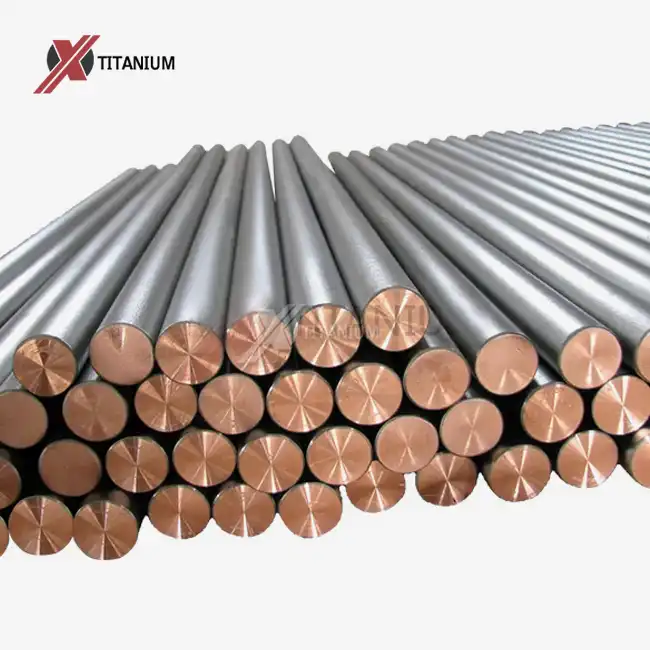
When looking at conductor materials for harsh industrial settings, titanium clad copper bar comes out as a well-thought-out choice that brings together the best qualities of both metals. Titanium clad copper bars have a titanium outer shell that is metallurgically attached to a high-conductivity copper core. This is different from pure copper bars, which break down quickly in corrosive environments. This composite structure is better at resisting corrosion, lasts longer, and costs less over its lifetime. These benefits are especially useful in electrochemical processing, marine applications, and chemical manufacturing, where failure of a material directly leads to production delays and contamination risks.
Understanding Titanium Clad Copper Bars and Pure Copper Bars
What Defines Each Material Type?
For many years, industries have used pure copper bars because they are very good at conducting electricity (about 100% IACS, or International Annealed Copper Standard) and moving heat. Manufacturers make these by continuously casting or extruding them, which makes bars with regular cross-sections that can be used for things like busbars, electrical connections, and heat transfer. The naturally malleable nature of the material makes it easy to machine and shape.
Manufacturing Process and Quality Assurance
A more advanced way to work with materials is to use titanium clad copper bars. Our company, Baoji Chuanglian New Metal Material Co., Ltd., makes these composite conductors by using explosion bonding or hot-rolling methods that stick an oxygen-free copper core to a titanium layer that is usually 0.1mm to 2mm thick. This process, which usually includes cold rolling, hot rolling, heating, and pickling, makes sure that the bond strength is higher than 130 MPa. This means that there is no chance of delamination when the temperature changes or when the metal is stressed.
Our production process starts with choosing Grade 1 or Grade 2 industrial pure titanium for the covering layer, which must meet ASTM B265 standards. For the core, we use C10200 or C11000 copper, which must also meet ASTM B170 standards. The bonding process makes a metallic contact that can't be made with plating or simple mechanical connection.
At our plant, we check the quality of the products by checking their hardness to make sure they've been properly heated, their ability to withstand being bent without breaking, and their ability to withstand hydrostatic pressure for uses that involve fluid contact. Ultrasonic testing is done on every production run to make sure that there is full bonding coverage across the interface. This is a key way to tell professional-grade material from cheaper options. Depending on the application and the processing that will follow, surface finishing can be bright and shined, pickled, acid-cleaned, or sandblasted.
Major Advantages of Titanium Clad Copper Bars Over Pure Copper Bars
Enhanced Corrosion Resistance Extending Service Life
In chemically active settings, there is the biggest difference in performance. Pure copper bars are quickly damaged by acidic electrolytes, chloride solutions, or alkaline media. These are common conditions in electroplating plants, hydrometallurgical operations, and desalination plants. Corrosion usually happens where liquid and air meet, making weak spots that weaken the structure and poison processes with copper ions that have dissolved.
Titanium's inactive oxide film (TiO₂) forms on its own and fixes itself when it gets scratched. This makes it very resistant to chlorine, chromic acid, sulfuric acid, and saltwater when they are wet. This secure layer makes sure that titanium clad copper bars keep their shape and electrical performance over long periods of time. Our clients who make chlor-alkali say that titanium clad copper bars last longer than five years, while exposed copper busbars need to be replaced every six months. This is a huge improvement that saves money on materials and keeps production running smoothly.
Due to their high resistance to corrosion, low density (about 4.5 g/cm³ for the titanium layer), and good thermal stability, these bars are perfect for use in chemical processing equipment, industrial electrolysis systems, and marine engineering, where normal materials would break down quickly in harsh environments.
Maintaining Electrical Performance While Adding Mechanical Strength
A common misunderstanding is that adding titanium makes conduction worse. The truth turns out to be more complex and positive. The highly conductive copper core holds most of the current because electricity flows along the path with the least resistance. The titanium layer's main job is to protect the core. Our normal setups keep 90–98% of the original copper conductivity. This is a small loss that isn't noticeable in most industrial settings because the corrosion protection is so good.
The mechanical properties are also better because of the composite structure. Because pure copper is so soft, it needs to be handled carefully and supported often when it is used in structures. The titanium coating makes the material stronger in tension and less likely to wear down mechanically without adding a lot of weight. This combo makes it possible for busbar systems to have longer unsupported lengths and less damage during shipping and installation, which are instant benefits that procurement managers and field engineers value.
Lifecycle Cost Efficiency and Operational Reliability
Companies that want to stay within their budgets are sometimes hesitant to compare the starting costs of buying pure copper and titanium clad copper bars. This narrow view doesn't look at the total cost of ownership. Taking into account how often they need to be replaced, the time they take to be maintained, quality problems caused by contamination, and the cost of removal, titanium clad copper bars are clearly more cost-effective.
Less frequent replacing means lower costs for purchasing and administration and fewer breaks in production for upkeep. Getting rid of copper contamination in electrolytic processes makes the products better and cuts down on the amount of trash that needs to be treated. The longer repair intervals also lower the cost of work needed for installation and removal. The initial price premium is usually cancelled out by these saves over the first working year. Subsequent years are mainly cost avoidance and efficiency gains.
Comparative Analysis: Titanium Clad Copper Bars vs Pure Copper Bars
Performance in Demanding Environments
When copper is exposed to saltwater, which happens more quickly in marine and ocean uses, things can get tricky. Shipbuilders and owners of offshore platforms say over and over that pure copper parts need protection coatings that always fail at connection points or places where there is mechanical stress. Titanium clad copper bars completely remove this weakness; they work reliably even when submerged in salt water for a long time without any extra protection.
Different active media pose similar problems for chemical manufacturing plants. The rust resistance of titanium coating is very helpful for processes like electroplating with chromic acid pools, copper electrowinning cells using sulfuric acid electrolytes, and chlorate production systems. The material can handle changes in temperature and chemical concentration that would quickly damage systems made of pure copper.
Electrical and Structural Considerations
Conductivity is still very important for high-current and power transfer uses. Pure copper has a small edge in electrical performance, but that advantage is lost when rust raises contact resistance or forces early replacement. Titanium clad copper bars work better over time because their electrical properties stay the same, unlike pure copper options that wear out over time.
The combination is better at being stiff and resistant to damage, which makes it useful for structural uses. For the same level of mechanical performance, equipment makers can ask for smaller cross-sections, which can sometimes make up for the higher cost of the materials by lowering the volume needs. Manufacturing freedom is maintained by being able to cut, bend, and join titanium clad copper bars using standard methods (with the right steps for titanium surfaces).
Market and Procurement Factors
Availability and seller dependability are very important things to think about when buying something. There are a lot of places to buy pure copper bars, which makes prices low but sometimes leads to inconsistent quality. Titanium clad copper bars need special production skills that not all sellers have, so it is important to qualify vendors.
At Chuanglian, we keep a large stock of tubes with diameters from 10mm to 200mm and lengths from 500mm to 3000mm. The thickness of the titanium layer can be changed from 0.1mm to 2mm depending on the seriousness of the application. Our quality control systems meet the requirements of ISO 9001, and we provide full material traceability paperwork that meets AS9100 standards for aerospace uses and the necessary certifications for medical device manufacturing.
How to Choose Between Titanium Clad Copper Bars and Pure Copper Bars for Your Projects?
Evaluating Environmental and Operational Demands
Before choosing materials, it's important to be honest about how they will be used. Applications inside of controlled settings with little moisture and stable air pressure may work well with pure copper, especially when price is the main factor in the choice. But if it will be exposed to corrosive media, installed outside, or come into touch with process chemicals, titanium clad copper bars should be seriously thought about.
Changes in temperature and patterns of mechanical stress also affect the choice of material. Because titanium and copper expand and contract at different rates, they need to be properly bonded to keep them from coming apart. This isn't a problem with good makers, but it could be a failure mode for bad ones. Our precision rolling and explosion bonding methods make surfaces that don't break down after hundreds of thermal cycles.
Supplier Qualification and Technical Support
Because making titanium clad copper bars is so specialized, choosing the right provider is very important. Teams in charge of buying things should check that the suppliers can make the goods, have the right certifications for quality, and offer expert help. Can the seller give me material test results that show the bond strength, conductivity, and corrosion resistance? Does their quality system have procedures for non-destructive tests and batch tracking?
Before committing to large orders, we encourage possible customers to ask for samples to try on their own. Our expert team helps companies find the best material specifications for their needs by providing application engineering support. This way of working together makes sure that the right materials are chosen and that the plan is carried out correctly. It also builds the kind of long-term ties that are common in the titanium processing business.
Customization and Delivery Considerations
Timelines for projects and the need for customization have a big effect on buying strategy. Standard copper bars can be shipped fast from stock at a wholesaler, but custom titanium clad copper bars may need more time to be made. When projects need to be finished quickly, the choice of materials is often based on how well they meet performance standards and delivery deadlines.
Because we are flexible in how we make things, we can meet both standard and unique needs. Planning for production can take into account limits for diameters, length needs, preferred surface finishes, and special testing procedures. We keep in touch with our customers throughout the entire making process and send them updates that help them plan their installations and stay on schedule for the project.
Case Studies and Industry Applications Showcasing Titanium Clad Copper Bar Benefits
Titanium clad copper bar benefits are shown through case studies and real-world applications in industry.
Electroplating and Surface Finishing Operations
A North American company that sells car parts used to change the copper busbars in their chrome plating line every four months because the solution interface corroded them. Copper that had been dissolved in water also caused quality problems that had to be fixed over and over again. After switching to our titanium clad copper bars, they were able to use the same material continuously for over two years, which got rid of all pollution problems. The higher quality materials were well worth the extra cost because they increased production and quality.
Hydrometallurgical and Electrowinning Facilities
High-temperature, acidic fluids with a lot of electrical current density make copper processing very difficult. A mining business in South America said that regular cathode conductor bars had to be rotated and replaced every month, which caused upkeep problems that slowed down production. Using titanium clad copper bar technology shortened the time between service rounds to once a year, which directly increased the facility's output by cutting down on downtime hours. The project paid for itself in seven months just by increasing output, not counting the money saved on upkeep.
Marine and Offshore Engineering
When shipbuilders put in electricity distribution systems, they have to fight saltwater rust all the time. After multiple fails with coated copper alternatives, a European navy builder switched all of its shipbuilding to titanium clad copper bars. The lack of coating breakdown problems and the material's ability to withstand mechanical vibration without delamination led to higher dependability, which improved the operating readiness of the vessel—a benefit that was worth much more than the difference in material cost in defense uses.
Conclusion
When choosing between pure copper and titanium clad copper bar, you have to weigh the prices of the immediate product against the durability and performance of the product over time. While pure copper can still be used in safe settings where starting cost is the most important factor, titanium clad copper bars offer strong benefits such as corrosion resistance, longer service life, and operating stability that make their purchase worthwhile. The hybrid structure successfully resolves the dilemma of conductivity versus corrosion, offering superior electrical performance along with high chemical resistance. Titanium clad copper bars are not just an option for businesses like chemical processing, electroplating, marine engineering, and hydrometallurgy; they are the best answer. Our knowledge of how to make things and dedication to quality control make sure that choosing titanium clad copper bars gives modern industrial operations the performance boosts and cost saves they need.
FAQ
How does conductivity compare between clad and pure copper bars?
Because the copper core carries most of the current flow, titanium clad copper bars keep 90–98% of pure copper's natural conductivity. The thin layer of titanium adds almost no electrical resistance but protects against rust very well. In real life, this small drop in conductivity doesn't matter compared to the huge drop in performance that pure copper goes through when its resistance goes up due to rust.
What bond strength should I expect from quality clad bars?
Titanium clad copper bars made by explosion bonding or precise rolling are professional-grade and have shear bond strengths of more than 130 MPa, which meets ASTM B898 standards. This metal bond can stand up to changes in temperature, mechanical stress, and bending without coming apart. Ultrasonic tests should make sure that the bonding is completely covered; any holes show problems with the way it was made, which will cause it to fail early.
Can clad bars be machined and formed like pure copper?
Standard cutting operations, like drilling, milling, and sawing, work well on titanium clad copper bars when done with methods that are right for titanium surfaces. When bending, it's important to follow the right radius rules so that the bond surface doesn't get too stressed out. For welding to work, you need to use the right techniques for different metals, especially where the two pieces are joining. For efficient processing, our expert team gives specific instructions for fabrication processes.
Partner With Chuanglian for Superior Clad Bar Solutions
Precision-engineered conductor options are provided by Baoji Chuanglian New Metal Material Co., Ltd., a titanium clad copper bar manufacturer with over ten years of materials experience. An modern manufacturing center and strict quality systems at our Baoji City (known as the "City of Titanium") location make sure that every bar meets world standards. Our clients come from industries like aerospace, petrochemicals, marine, and industry all over the world. They need consistent materials, reliable performance, and expert help throughout the whole procurement process. Our research team can help you choose the best material for your application, whether it needs standard specs or unique configurations. You can email us at info@cltifastener.com or djy6580@aliyun.com to talk about your project needs, ask for technical specs, or get quotes.
References
1. Davis, J.R. (2001). Copper and Copper Alloys: ASM Specialty Handbook. ASM International, Materials Park, Ohio.
2. Banker, J.G., et al. (1993). "Explosion-Welded Bimetallic Materials for Industrial Applications." Advanced Materials & Processes, Vol. 144, Issue 5, pp. 22-27.
3. Shreir, L.L., Jarman, R.A., & Burstein, G.T. (2000). Corrosion: Metal/Environment Reactions, 3rd Edition, Volume 1. Butterworth-Heinemann, Oxford.
4. Schutz, R.W. & Thomas, D.E. (1987). "Corrosion of Titanium and Titanium Alloys." Metals Handbook, 9th Edition, Volume 13: Corrosion. ASM International, pp. 669-706.
5. ASTM International (2019). ASTM B898-11: Standard Specification for Reactive and Refractory Metal Clad Plate. West Conshohocken, Pennsylvania.
6. Findlay, S.J. & Harrison, N.D. (2002). "Why Aircraft Fail." Materials Today, Volume 5, Issue 11, pp. 18-25.
Learn about our latest products and discounts through SMS or email