- English
- French
- German
- Portuguese
- Spanish
- Russian
- Japanese
- Korean
- Arabic
- Greek
- German
- Turkish
- Italian
- Danish
- Romanian
- Indonesian
- Czech
- Afrikaans
- Swedish
- Polish
- Basque
- Catalan
- Esperanto
- Hindi
- Lao
- Albanian
- Amharic
- Armenian
- Azerbaijani
- Belarusian
- Bengali
- Bosnian
- Bulgarian
- Cebuano
- Chichewa
- Corsican
- Croatian
- Dutch
- Estonian
- Filipino
- Finnish
- Frisian
- Galician
- Georgian
- Gujarati
- Haitian
- Hausa
- Hawaiian
- Hebrew
- Hmong
- Hungarian
- Icelandic
- Igbo
- Javanese
- Kannada
- Kazakh
- Khmer
- Kurdish
- Kyrgyz
- Latin
- Latvian
- Lithuanian
- Luxembou..
- Macedonian
- Malagasy
- Malay
- Malayalam
- Maltese
- Maori
- Marathi
- Mongolian
- Burmese
- Nepali
- Norwegian
- Pashto
- Persian
- Punjabi
- Serbian
- Sesotho
- Sinhala
- Slovak
- Slovenian
- Somali
- Samoan
- Scots Gaelic
- Shona
- Sindhi
- Sundanese
- Swahili
- Tajik
- Tamil
- Telugu
- Thai
- Ukrainian
- Urdu
- Uzbek
- Vietnamese
- Welsh
- Xhosa
- Yiddish
- Yoruba
- Zulu
What are the characteristics of premium m8 titanium rotor bolts?
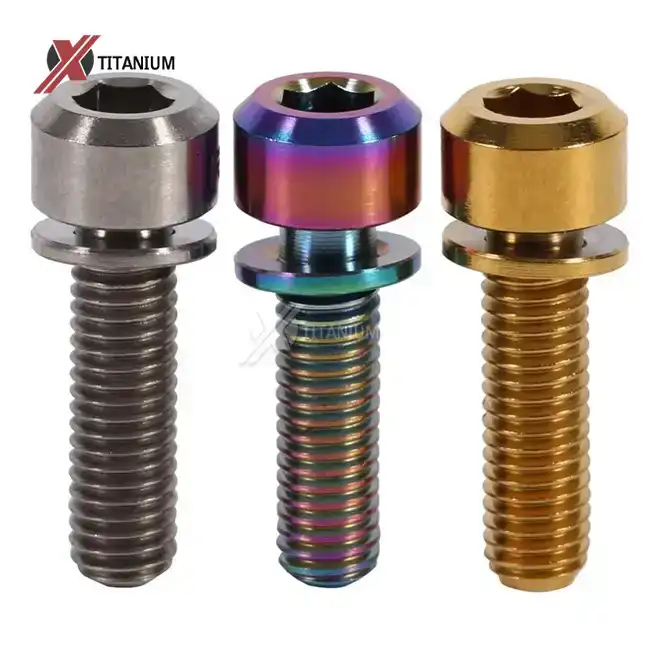
Premium M8 titanium rotor bolts are precision-engineered fasteners manufactured from aerospace-grade Ti-6Al-4V (Grade 5) titanium alloy, purpose-built for securing brake rotors in high-stress automotive, motorsport, and industrial environments. These bolts carry an M8 thread diameter with a 1.25mm standard pitch, tensile strength ≥ 950 MPa, and a density of just 4.51 g/cm³—roughly 45% lighter than carbon steel equivalents. Their defining characteristics include exceptional corrosion immunity, superior fatigue resistance under cyclic braking loads, and dimensional precision within ±0.05mm tolerance, making them a rational upgrade for engineers who cannot afford failure.
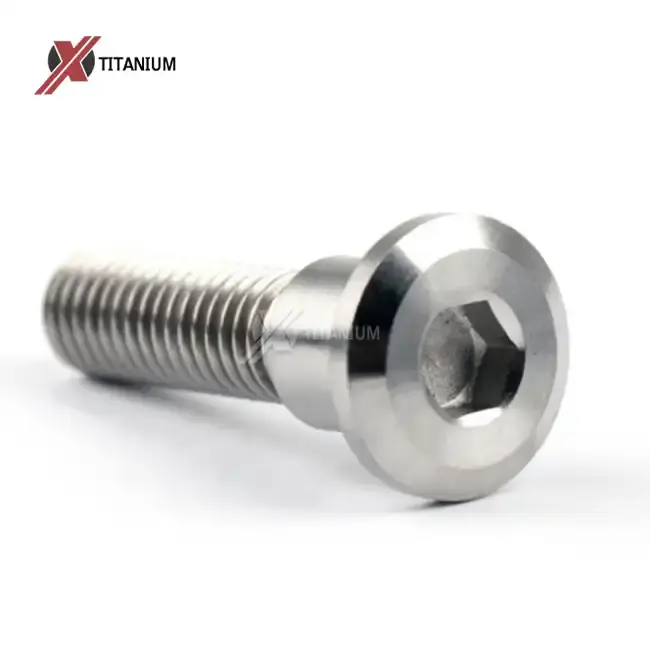
Understanding M8 Titanium Rotor Bolts: An Overview
When it comes to precision hardware, titanium rotor screws fit into a unique and difficult niche. Unlike regular metric nuts, these parts have to be able to withstand shear forces, thermal cycles, vibration wear, and electrochemical corrosion all at the same time, and they often have to do this for the lifetime of the car or system. The number "M8" refers to a nominal thread diameter of 8 mm. For rotor bolt applications, this shape offers the best balance between clamping area and installation torque. At Chuanglian, we make these bolts from Grade 5 Ti-6Al-4V, which is the same alloy standard used in aircraft structural applications. This is because it gives safety-critical parts an unbeatable performance cushion.
Why Grade 5 Titanium Defines the Standard?
Ti-6Al-4V is made up of 6% aluminum and 4% vanadium, which are alloying elements that keep the microstructure stable and the material's tensile stability at temperatures up to 400°C. This thermal stability is directly related to brake rotor environments, where repeated high-energy slowing down creates intense heat in one place. Commercially pure titanium grade 2 can't keep up with this kind of performance, which is why serious OEM and racing buying teams only choose Grade 5.
Technical Specifications and Performance Metrics
Procurement teams and process engineers can make more solid choices about where to get M8 titanium rotor bolts when they know the exact engineering factors behind these bolts. The main dimensional and technical facts are shown in the table below.
Specifications in Dimensions:
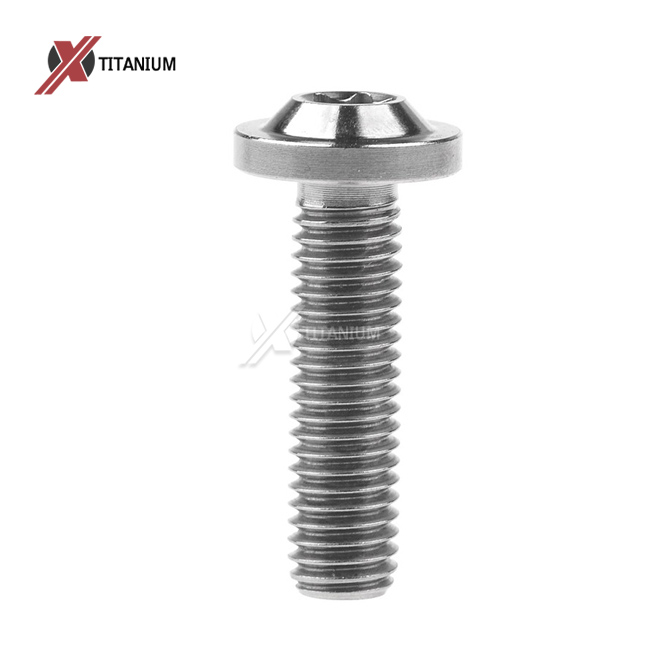
The thread size is M8, the length range is 15mm to 40mm, the thread pitch is 1.25mm (Standard), the head style is Torx, Allen, Hex, or Custom, and the drive type is T25 Torx or Hex Socket.
| Parameter | Value |
|---|---|
| Thread Size | M8 |
| Length Range | 15mm – 40mm |
| Thread Pitch | 1.25mm (Standard) |
| Head Style | Torx, Allen, Hex, Custom |
| Drive Type | T25 Torx or Hex Socket |
"Material and Mechanical Properties"
| Property | Value |
|---|---|
| Material | Ti-6Al-4V (Grade 5) |
| Tensile Strength | ≥ 950 MPa |
| Hardness | ~35 HRC |
| Density | 4.51 g/cm³ |
| Melting Point | 1660°C |
The material is Ti-6Al-4V (Grade 5), and its tensile strength is at least 950 MPa. Its hardness is about 35 HRC, and its density is 4.51 g/cm³. Its melting point is 1660°C.
| Category | Detail |
|---|---|
| Standards | ISO 7380, DIN 912, Custom OEM |
| Surface Finish | Natural, Polished, Anodized (Blue, Gold, Rainbow) |
| Certifications | ISO 9001, ASTM B348, RoHS Compliant |
| Tolerance | ±0.05mm |
Installation Torque and Anti-Galling Protocol
The products we sell meet ISO 7380, DIN 912, and custom OEM standards. They can be polished, anodized (blue, gold, or rainbow), or left natural. They are certified to be ISO 9001, ASTM B348, and RoHS compliant. The tolerance for these products is ±0.05mm.
M8 Titanium Rotor Bolts vs Other Materials: Making an Informed Choice
You choose for M8 titanium rotor bolts has a direct effect on the weight of the unit, how often it needs to be serviced, and how reliable it is in the long run. This is how Grade 5 titanium stacks up against the two most common options. Grade 5 titanium has a tensile strength of at least 950 MPa and a density of 4.51 g/cm³. Alloy steel bolts have tensile strengths that are the same or greater, but their density is about 7.85 g/cm³, which is almost twice as much. Aluminum bolts lose weight quickly, but because they have a lower tensile strength (about 310 MPa for 7075-T6), they can't be used in high-torque rotor situations where safety is very important.
If you switch all of your rotor bolts to titanium, which usually comes to 10 to 12 pieces for both front disks, you can save 100 to 150g of spinning, unsprung mass. When it comes to rotational dynamics, this reduction works really well at high speeds, making the suspension more flexible and the brakes work better in both racecar and road situations. The way corrosion acts is another important factor. When steel fasteners are in wet, coastal, or chemical conditions, oxide layers form that can cause thread seizure. Titanium's self-passivating oxide film completely gets rid of this upkeep problem. This feature alone makes the material extra worth it for ship braking equipment, offshore systems, and chemical plant environments.
Procurement Considerations for B2B Buyers
Finding high-quality titanium screws is not a one-step process, but a review process that takes several steps. Different people, like procurement managers, quality engineers, and technical leads, have their own standards that a reliable supplier must meet.
When serious buyers are looking for a titanium rotor bolt supplier, they follow these quality control steps:
- XRF Spectroscopy Verification: Confirms Ti-6Al-4V chemical composition, ensuring Grade 5 material is not substituted with lower-grade commercial titanium. This is the first line of defense against material fraud in the supply chain.
- Tensile and Proof Load Batch Testing: Verifies that Ultimate Tensile Strength meets or exceeds 950 MPa across production batches, ensuring no single lot of bolts enters service below specification under cyclic braking torque.
- Metallographic Examination: Checks for alpha-case contamination or hydrogen embrittlement in the microstructure—two failure modes that can cause sudden, brittle fracture with no visible warning.
- Go/No-Go Thread Gauge and Laser Dimensional Measurement: Verifies pitch accuracy and bolt concentricity to prevent cross-threading or galling at installation. Dimensional non-conformance at this scale is invisible to the naked eye but catastrophic in service.
- Dye Penetrant Inspection (DPI): Detects surface micro-cracks introduced during forging or CNC machining that optical inspection would miss entirely.
These checkpoints for M8 titanium rotor bolts are similar to what major OEMs in aircraft, racing, and marine need before a fastener can be added to their list of approved vendors. For safety-critical uses, suppliers who can't show traceability at all of these steps shouldn't be considered. All certifications are important. As a minimum, look for ISO 9001 quality control, ASTM B348 material compliance, and RoHS compliance. Manufacturers with a lot of knowledge and dedicated engineering help can meet custom OEM standards.
Real-World Applications: Where These Bolts Prove Their Value
The better performance of Grade 5 titanium rotor fasteners leads to observable results in a number of fields. In professional motorsport, teams that race high-end superbikes like the Ducati Panigale or BMW S1000RR use titanium rotor hardware because it lowers the rotational inertia, which makes the turn-in response sharper during high-G deceleration sequences.
Another high-value deployment setting is marine and coastal powersports, such as jet skis, coastal ATVs, and offshore platform equipment. Galvanic corrosion happens to steel fasteners in salty environments, which means they have to be replaced too soon and there is a chance of catastrophic hub damage. Titanium's chemical inertness completely gets rid of this failure mode, which means that fleet repair times are longer and the total cost of ownership is lower over the life of the equipment. OEM manufacturers who use these bolts in production bicycle braking systems say that the lower weight, consistent dimensional tolerances, and range of anodized color options make it possible to differentiate performance and identify brand-level components without making the process more complicated.
Conclusion
Premium M8 titanium rotor bolts get to where they are because of advanced material science, precise manufacturing, and proven performance in harsh real-world circumstances. Grade 5 Ti-6Al-4V has a tensile strength of 950 MPa and about half the mass of steel. It is also naturally resistant to corrosion, so it doesn't need to be maintained like other fasteners do. These bolts are a good long-term investment for aircraft, racing, marine, and high-end OEM uses if they come from a manufacturer with ISO 9001 approval, traceable production methods, and a quality control system that has been shown to work.
FAQ
Q1: Can titanium rotor bolts be reused after removal?
A: Within its proof load, grade 5 titanium acts like a springy material. Technically, bolts can be used again as long as they haven't been torqued past their break point. But as a matter of industry best practice, the thread and head should be carefully checked before reinstallation to make sure there is no bending, galling, or surface breaking.
Q2: What is the correct torque specification versus steel?
A: Because titanium has a different friction coefficient than steel, you must use a thread lube or anti-seize solution before installing it. To keep the steel from yielding when it is installed dry, lower the torque values by about 10 to 15 percent compared to the OEM specifications.
Q3: Does titanium gall against aluminum hubs?
A: Yes, titanium can be cold welded to other metals while they are under a compressive load. This can be safely avoided by coating the bolt threads with copper paste, nickel-based anti-seize, or a DLC finish before putting the parts together.
Q4: What anodized colors are available for custom orders?
A: Anodized finishes come in Natural, Gold, Blue, Green, Purple, Black, and Rainbow. These can be used to identify components, make them look different, or meet OEM branding needs.
Q5: Which certifications should I verify when sourcing?
A: Check for basic qualifications like ISO 9001, ASTM B348 material compliance, and RoHS compliance. For aerospace or motorsport uses, ask for full material traceability documentation for each batch.
Source Premium M8 Titanium Rotor Bolts From Chuanglian
Chuanglian offers CNC-machined titanium rotor bolts from Baoji, which is known as China's center of excellence for titanium manufacturing and is ISO 9001-certified. We are a reliable company that has been exporting M8 titanium rotor bolts for more than ten years. We can meet your needs for custom sizes, OEM specifications, and anodized colors. Today, ask for a sample batch or a technical advice. You can email our tech team at info@cltifastener.com or djy6580@aliyun.com.
References
1. Boyer, R. R. (1996). An overview on the use of titanium in the aerospace industry. Materials Science and Engineering: A, 213(1–2), 103–114.
2. Lutjering, G., & Williams, J. C. (2007). Titanium (2nd ed.). Springer.
3. American Society for Testing and Materials. (2019). ASTM B348: Standard Specification for Titanium and Titanium Alloy Bars and Billets. ASTM International.
4. Donachie, M. J. (2000). Titanium: A Technical Guide (2nd ed.). ASM International.
5. International Organization for Standardization. (2015). ISO 9001: Quality Management Systems — Requirements. ISO.
6. Peters, M., Hemptenmacher, J., Kumpfert, J., & Leyens, C. (2003). Structure and properties of titanium and titanium alloys. In C. Leyens & M. Peters (Eds.), Titanium and Titanium Alloys. Wiley-VCH.
Learn about our latest products and discounts through SMS or email