- English
- French
- German
- Portuguese
- Spanish
- Russian
- Japanese
- Korean
- Arabic
- Greek
- German
- Turkish
- Italian
- Danish
- Romanian
- Indonesian
- Czech
- Afrikaans
- Swedish
- Polish
- Basque
- Catalan
- Esperanto
- Hindi
- Lao
- Albanian
- Amharic
- Armenian
- Azerbaijani
- Belarusian
- Bengali
- Bosnian
- Bulgarian
- Cebuano
- Chichewa
- Corsican
- Croatian
- Dutch
- Estonian
- Filipino
- Finnish
- Frisian
- Galician
- Georgian
- Gujarati
- Haitian
- Hausa
- Hawaiian
- Hebrew
- Hmong
- Hungarian
- Icelandic
- Igbo
- Javanese
- Kannada
- Kazakh
- Khmer
- Kurdish
- Kyrgyz
- Latin
- Latvian
- Lithuanian
- Luxembou..
- Macedonian
- Malagasy
- Malay
- Malayalam
- Maltese
- Maori
- Marathi
- Mongolian
- Burmese
- Nepali
- Norwegian
- Pashto
- Persian
- Punjabi
- Serbian
- Sesotho
- Sinhala
- Slovak
- Slovenian
- Somali
- Samoan
- Scots Gaelic
- Shona
- Sindhi
- Sundanese
- Swahili
- Tajik
- Tamil
- Telugu
- Thai
- Ukrainian
- Urdu
- Uzbek
- Vietnamese
- Welsh
- Xhosa
- Yiddish
- Yoruba
- Zulu
How to maintain titanium screws on rear derailleurs for longevity
Maintaining your Rear Derailleur Titanium Screw properly extends its operational lifespan significantly while ensuring optimal drivetrain performance. These Grade 5 titanium alloy fasteners demand specific care protocols that differ from steel equivalents. Regular inspection prevents thread galling, while appropriate lubrication maintains the protective oxide layer that gives titanium its renowned corrosion resistance.
Temperature fluctuations and environmental contaminants pose the primary threats to these precision-machined components. Understanding torque specifications, cleaning procedures, and storage conditions empowers procurement teams and maintenance personnel to maximize ROI from these premium fasteners across high-performance cycling applications.
Understanding Rear Derailleur Titanium Screws
Rear Derailleur Titanium Screws have changed the way bicycle parts are made because of the unique qualities of the material. The Ti-6Al-4V mix, which is also known as Grade 5 titanium alloy, has the same level of dynamic strength as many steel alloys while being about 40% lighter. In professional bicycle uses, this strength-to-weight benefit directly leads to better acceleration characteristics and less rotational mass.
Material Composition and Performance Benefits
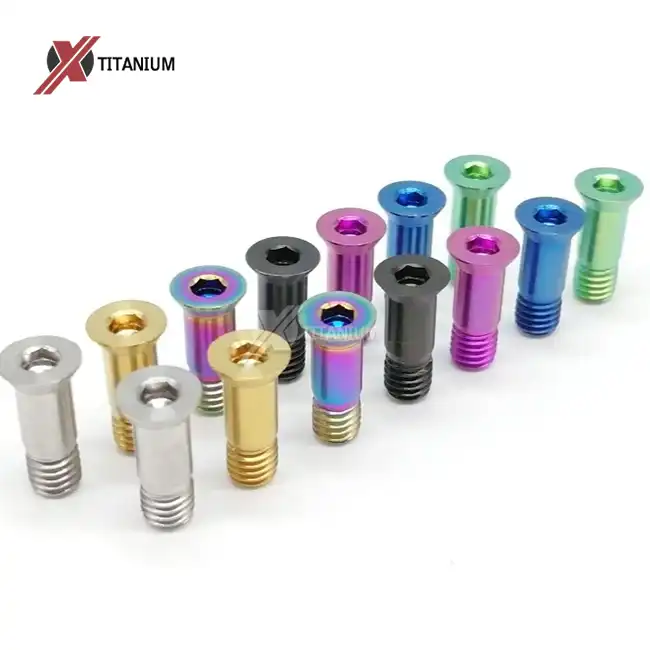
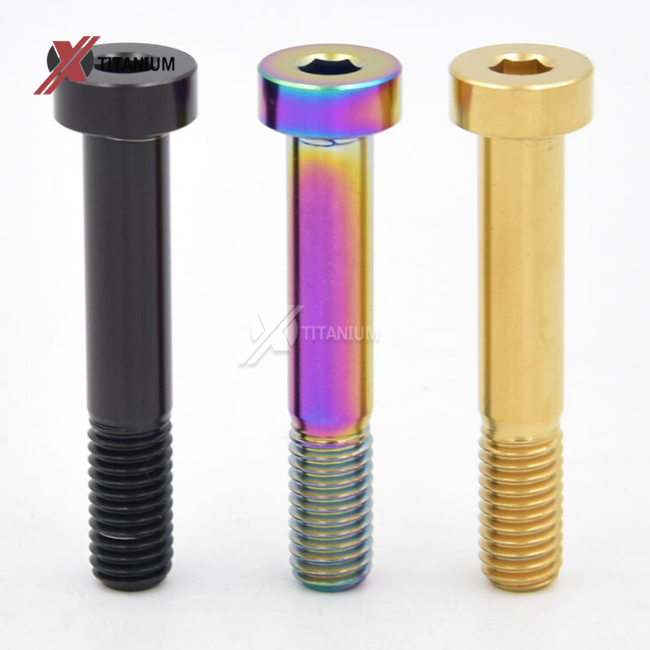
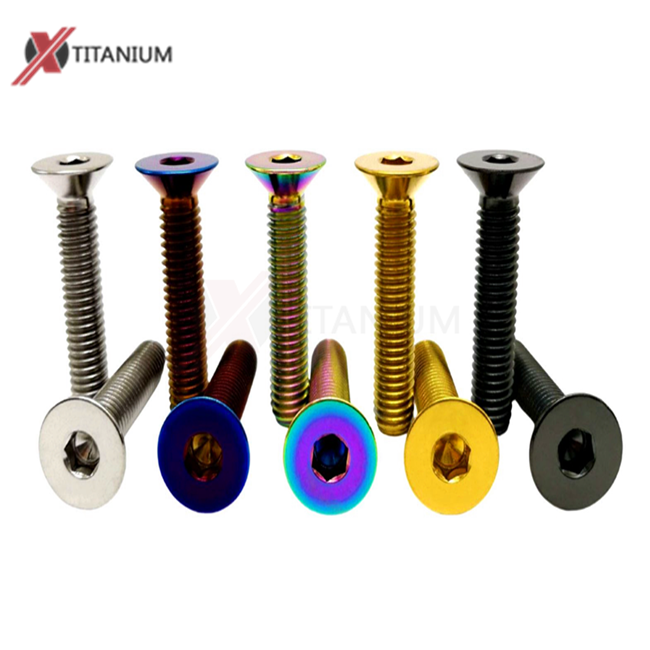
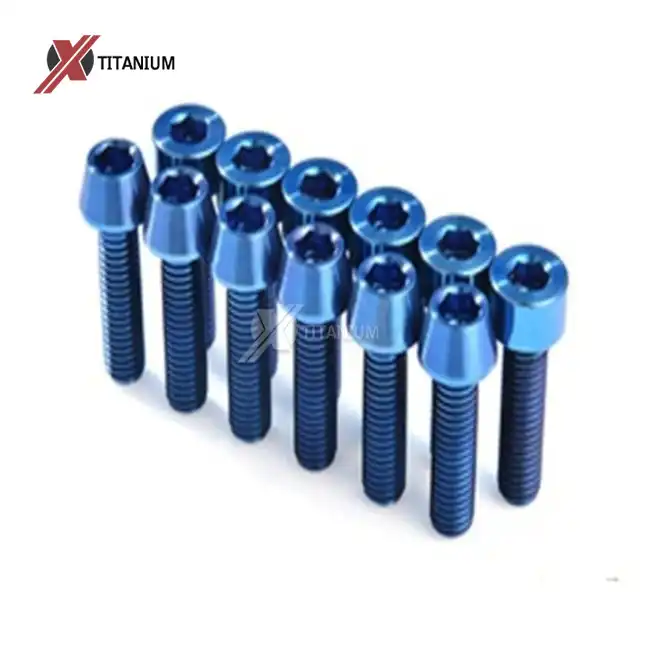
Grade 5 titanium alloy has a microstructure that doesn't wear down when loaded and unloaded many times. It is made up of 6% aluminium and 4% vanadium. CNC machines can make threads that are accurate to within ±0.02mm, which makes sure that they fit perfectly with aluminium gear bodies and carbon fibre fixing points. Some surface treatments, like polishing, anodising, and nitriding, make things look better and last longer. Anodised finishes in rainbow colours (gold, blue, green, purple, black) make the Rear Derailleur Titanium Screw stand out visually and add a hard layer of protection.
When oxygen hits the natural titanium oxide layer, it forms right away, acting as a passive shield against salt environments and water getting in. Because of this, Rear Derailleur Titanium Screws are very useful in seaside areas where salt spray speeds up the rusting of regular steel fixings. Titanium is electrochemically stable across different material surfaces, while aluminium options suffer from galvanic corrosion when paired with carbon fibre parts.
Technical Comparison with Steel and Aluminum
Steel fasteners have a higher absolute tensile strength, but they are much heavier, which makes the bike less manoeuvrable overall. Even though aluminium screws are lighter, they aren't strong enough to be used in high-stress situations for a long time. Rear Derailleur Titanium Screw is the best material because it is strong enough for derailleur fitting uses and light enough that it doesn't add extra weight. The material works consistently in temperatures ranging from -40°C to +400°C, and its dimensions stay the same even during yearly changes that can cause other materials to expand or contract.
When procurement professionals look at different fastener choices, they should know that the Rear Derailleur Titanium Screw starting cost is justified by longer service intervals and less frequent replacement. Total cost of ownership calculations are directly affected by how long a component lasts. This is especially true for fleet applications where maintenance downtime costs a lot of money.
Why Maintenance Matters: Challenges and Causes of Degradation
Rear Derailleur Titanium Screw has a reputation for being very durable, but it still needs to be maintained in a certain way to keep its character over time. Environmental factors and installation methods have a big effect on how long something works, which is why preventive maintenance is so important for operations that care about quality.
Environmental Stressors and Operational Demands
When moisture and road grime mix, they make abrasive compounds that build up in threaded surfaces and could cause binding during the removal process. Prolonged contact with cleaning products that are strong acids or bases can damage the oxide layer that protects the Rear Derailleur Titanium Screw from rusting. When you shift things, mechanical loads cause cyclic stress patterns that can cause breakdowns due to wear after thousands of cycles if the installation torque limits are exceeded during the first assembly.
Thread galling is the biggest problem that comes up with maintaining Rear Derailleur Titanium Screws. This happens when surface asperities on threads that are meant to fit together cold-weld together under pressure, especially when there isn't enough grease to prevent direct metal-to-metal contact. A lot of maintenance teams think wrongly that Rear Derailleur Titanium Screw resistance to rust means they don't need anti-seize products. This makes it hard or impossible to remove without damaging the threads.
Debunking Common Misconceptions
People think that the Rear Derailleur Titanium Screw doesn't need any upkeep because marketing materials stress how resistant it is to rust without talking enough about mechanical wear. Titanium is much better at resisting rust than steel, but it is not as hard as hardened steel, so thread damage can happen if the wrong amount of pressure is applied. Surface treatments like nitriding make things harder, but they need to be maintained in a certain way to keep them in good shape.
Another common misunderstanding is that Rear Derailleur Titanium Screws can be used over and over again without being inspected. Each installation cycle causes tiny changes in the thread profiles, which makes the clamping force less reliable over time. Critical Rear Derailleur Titanium Screws can only be used once in aerospace and medical device manufacturing, but they can be used more than once in cycling applications as long as thorough inspection procedures are followed.
Step-by-Step Guide to Maintaining Titanium Screws on Rear Derailleurs
Systematic maintenance protects your investment in high-quality Rear Derailleur Titanium Screw hardware and makes sure that the drivetrain always works well. These rules are in line with quality management standards for mechanical systems that need to be very reliable.
Correct Installation Techniques and Torque Specifications
Before installation starts, the threads of the Rear Derailleur Titanium Screw are checked for dirt, cross-threading damage, and past galling events. Use isopropyl alcohol and lint-free cloths to clean the threads well. Let the alcohol evaporate completely before adding the anti-seize substance. Titanium-compatible lubricants usually have copper, nickel, or ceramic particles mixed in with synthetic carriers that can handle the wide range of temperatures that happen in bicycle uses.
Torque specs depend on the manufacturer of the Rear Derailleur and where it is mounted. For direct-mount connections, Shimano usually suggests 4-6 Nm, while SRAM specs vary from model series to model series and are usually between 5-7 Nm. Under-torquing doesn't apply enough clamping force, which lets the part move and speeds up wear. Over-torquing, on the other hand, deforms the thread of the Rear Derailleur Titanium Screw, which makes it less useful in the future. Using calibrated torque wrenches takes the guesswork out of the process and makes sure that the results are the same for all installations.
At first, thread the Rear Derailleur Titanium Screw by hand to make sure it is aligned correctly and engages smoothly. If there is resistance before the screw fits all the way, take it out and look for cross-threading instead of using tools to force it to connect. This easy step of checking stops most of the thread damage that happens in field service situations.
Routine Cleaning and Inspection Protocols
Setting inspection times based on ride conditions keeps the Rear Derailleur Titanium Screw running at its best and finds problems before they get bad enough to need emergency fixes. For competitive racing, checks should be done after the event, and for leisure use, they should be done every three months. A visual inspection looks for discolouration that means the part was overheated, surface scratches that go through the anodised layers, and the condition of the threads at easy-to-reach engagement points.
Abrasive materials that scratch Rear Derailleur Titanium Screw surfaces and could damage the protected oxide layer should not be used for cleaning. Mild soap solutions and soft brushes work well to get rid of built-up dirt without hurting the surface. Ultrasonic cleaning equipment can completely remove contaminants from parts that have been taken apart, but this method is usually only useful for big repair intervals because it is hard to get to.
Once it's clean, check the Rear Derailleur Titanium Screw head drive interface for any rounding or deformation that could make it harder to remove in the future. Torx and hex drive patterns spread torque more evenly than Phillips patterns. This makes cam-outs less likely, which can damage both tools and fasteners. Profilometry tools can measure surface roughness to figure out how fast wear is happening in critical situations, but visual inspection is enough for most working settings.
Proper Lubrication Using Compatible Compounds
Choosing the right anti-seize formulas keeps brake systems and engine parts from getting contaminated and stops galling on the Rear Derailleur Titanium Screw. Copper-based compounds are very good at stopping galling, but they can change the colour of titanium surfaces and add particles that speed up wear in precision contacts. Alternatives based on nickel work just as well without discolouring, which makes them better for places where fasteners will be seen and where looks are important.
Ceramic-particle suspensions are high-end options that don't contain any metals and are better at keeping the Rear Derailleur Titanium Screw temperature stable. How you apply the lubricant is just as important as the product itself. If you use too much, it will move into places you didn't mean it to and attract dirt, and if you use too little, it won't cover enough to stop galling. A thin, even layer on the male threads gives the best protection without adding extra material that makes fitting less consistent.
Troubleshooting and Replacement Criteria
Even with preventative maintenance, there are times when Rear Derailleur Titanium Screws need to be replaced right away instead of being serviced. If you can see thread damage like cutting, twisting, or galling marks, you can't safely use it again. Screws that have corrosion showing through their anodised layers mean that the coating is failing, and this failure will speed up over time. Any Rear Derailleur Titanium Screw that needed too much torque to be removed should be taken out of service because the threads are probably damaged in a way that can't be seen.
When deciding what to replace, you should also look at how the old Rear Derailleur Titanium Screw worked. When used in racing, they are under more stress than when used for fun, so they should be replaced more often. Tracking installation rounds lets you make repair plans based on data that balance the cost of parts against their chance of breaking. When replacements are needed, the right way to get rid of Rear Derailleur Titanium Screw materials supports efforts to be more environmentally friendly and may even help recyclers get money back for the materials.
Procuring Quality Titanium Rear Derailleur Screws for Industrial Use
In professional cycling applications, the choice of supplier has a direct effect on the reliability of the Rear Derailleur Titanium Screw and the total cost of ownership. When making procurement plans, it's important to think about both short-term price concerns and long-term performance needs and supply chain security.
Evaluating Suppliers and Verifying Certifications
Reputable companies that make Rear Derailleur Titanium Screws have quality management systems that are approved to international standards, such as ISO9001 for general manufacturing and AS9100 for aircraft uses. These certificates show that the manufacturing process is controlled in a way that makes sure that all batches of the same material have the same qualities and measurements. Medical-grade licenses are important when biocompatibility needs go beyond normal bicycle uses and include therapy equipment or adaptive sports gear.
Each shipment of Rear Derailleur Titanium Screws should come with a material certification that shows the alloy's composition through spectrographic analysis, which checks that the amount of aluminium and vanadium is within certain ranges. Testing the material's mechanical properties, such as measuring its tensile strength and yield point, shows that the processes did produce the desired nanostructures. Reports from thread inspections using optical comparators or coordinate measure tools show that the dimensions meet the requirements.
Chuanglian follows strict quality control procedures for all of its Rear Derailleur Titanium Screw manufacturing processes in Baoji, which is known around the world as the center of titanium production knowledge. With CNC machining, we can make sure that the threads are accurate to within ±0.02mm and that the surface is rough to between 0.8 and 3.2μm. Traceability systems connect finished parts to certifications of source materials, which lets applications that require high quality keep full records of where parts came from.
Understanding Product Specifications for Bulk Purchasing
Technical standards for the Rear Derailleur Titanium Screw need to cover more than just simple measurement conformance. They also need to cover functional requirements. When working in harsh environments, being able to handle a wide range of temperatures is important. Our Grade 5 titanium alloy keeps its properties from -40°C to +400°C. Polishing, anodising, and nitriding are all surface treatments that can be used. Each has its own benefits, based on the application's needs for rust resistance, wear resistance, or aesthetics.
Colour choice isn't just about how it looks; it's also about how the Rear Derailleur Titanium Screw works in fleet situations, where different torque specs or repair times can be easily seen. There are natural titanium, gold, blue, green, purple, black, and rainbow anodised finishes that make the fasteners stand out. This makes installation easier when more than one type of fastener appears in the same place. Custom colour specifications are made to fit the needs of corporate branding or specific operational procedures.
Supply chain flexibility and inventory management techniques are affected by minimum order amounts, lead times, and the ability to make changes to Rear Derailleur Titanium Screws as needed. By building ties with manufacturers who offer fair MOQs, you can avoid having to pay too much for inventory while still keeping enough on hand for business continuity. It is very important to be able to predict lead times during seasonal demand peaks in the cycling market, where shortages of parts have a direct effect on production schedules and making money.
Cost-Performance Trade-offs and ROI Analysis
The initial buying price is only one part of figuring out how much Rear Derailleur Titanium Screws will cost all together. The expected service life, the number of maintenance intervals, and the costs of failures all have a big effect on the overall economic impact. Even though Rear Derailleur Titanium Screws are more expensive than steel screws, they often provide better total cost performance through longer replacement times and less upkeep work.
To put a number on these benefits, you need to know the exact conditions of the application and the operational needs for the Rear Derailleur Titanium Screw. High-mileage uses, like delivery fleet bicycles or professional racing teams, wear down quickly, so benefits like durability are especially useful in these cases. Titanium may not last as long in recreational use scenarios with lower yearly miles. This could mean that a different material is better for cost-effectiveness reasons.
When you negotiate good terms with reliable sellers of the Rear Derailleur Titanium Screw, you both gain in ways that go beyond the price of the transaction. Price cuts may be possible with volume agreements, which also make sure that suppliers' capacity is used during times of high demand. Technical support agreements give you access to application engineering knowledge that helps you choose the right Rear Derailleur Titanium Screw and install it correctly. This lowers the number of failures that happen in the field, which saves you a lot of money on insurance costs.
Best Practices for Long-Term Usage and Storage
How a Rear Derailleur Titanium Screw is handled before it is installed has a big effect on how well it works after it is put into service. Storage methods and instructions on how to use them set the stage for effective operations that last the lifecycle of a product.
Optimal Storage Conditions and Packaging Requirements
The Rear Derailleur Titanium Screw resistance to rust gets rid of many of the storage problems that come with steel screws, but it's still important to keep them clean. Sealed packaging keeps things clean to the standards needed for precise assembly work by stopping dirt from building up. Even though titanium is naturally resistant to oxidation, condensation cycles that could introduce water into threaded interfaces are kept to a minimum in climate-controlled storage areas.
Sorting inventory by specification, surface treatment, and purchase date makes it easier to rotate Rear Derailleur Titanium Screw stock, which lowers concerns about ageing. Titanium doesn't rust like steel does, but anodised coats may wear off over time if they are exposed to UV light or chemical vapours. Dating goods when they are received allows for first-in, first-out inventory control, which keeps items from being stored for too long.
Keeping Rear Derailleur Titanium Screws away from metals that are not the same stops galvanic couple formation while they are being stored, but this mostly affects threaded engagement and not just closeness. Handling introduces grease and particles that need to be cleaned before they can be installed. Using clean handling techniques during inventory management can help improve the speed of assembly later on.
Maintenance Scheduling for Fleet and OEM Applications
Systematic inspection programs that are in line with operational needs find Rear Derailleur Titanium Screw problems as they arise before they get in the way of operations. Fleet managers can save money by using condition-based monitoring to check on heavy-use units more often and less-used units more often. OEM makers include inspection requirements in customer paperwork, which helps end-user maintenance programs keep warranties valid and parts reliable.
Digital maintenance management systems keep records of the memories of each Rear Derailleur Titanium Screw. This lets predictive analytics find trends that are linked to parts breaking down too soon. By showing performance differences between suppliers or finding application conditions that need higher component specifications, this data analysis helps shape procurement specifications. By combining related maintenance jobs into a single service event, incorporating fastener inspection into longer service intervals for the Rear Derailleur maximises labour efficiency.
Leveraging Supplier Support and Warranty Programs
By working together with Rear Derailleur Titanium Screw suppliers, you can get access to technical resources that make operations more reliable. Application engineering support helps you get the most out of installation and maintenance processes by tailoring them to your unique needs. Failure analysis services find the root causes of unexpected component problems, telling the difference between problems caused by the application and manufacturing flaws that need to be fixed.
Warranty programs show that the seller trusts the quality of the Rear Derailleur Titanium Screw and protect customers financially in case they break down early. Understanding guarantee terms, such as the length of coverage, failure rate limits, and claim paperwork requirements, helps you make realistic budgets for new parts. When you talk to your suppliers ahead of time about performance trends, you can build partnerships where both of you invest in ongoing improvement projects.
Conclusion
Maintaining Rear Derailleur Titanium Screws needs a set of steps that are done in a way that keeps the material's purity and extends its useful life. Common ways for things to fail, like thread galling and premature wear, can be avoided by using the right amount of force during fitting, cleaning regularly, and lubricating properly. Knowing the special features of titanium helps you make choices about upkeep that are different from how steel fasteners are usually done. When you have good relationships with your suppliers, you can get certified parts that meet strict performance standards and get technical support for the whole lifecycle of your products. These practices give a clear return on investment (ROI) by making parts last longer and lowering the cost of upkeep.
FAQ
Do titanium screws resist corrosion better than steel alternatives?
Rear Derailleur Titanium Screws are more resistant to corrosion than steel ones because they form a stable titanium oxide inactive layer. This trait gives great protection in chloride environments, like coastal areas and areas where road salt is used in the winter. Protective coatings on steel screws wear off over time, but the Rear Derailleur Titanium Screw oxide layer heals itself when it gets broken. Strong acids, like hydrochloric and sulphuric mixtures, damage titanium's protective layer, so it's important to think about chemical exposure when choosing a material.
What torque settings prevent stripping titanium screw threads?
Manufacturers usually give specs between 4 and 7 Nm for the Rear Derailleur Titanium Screw, but this depends on the type of gear and how it is mounted. Calibrated torque tools take the guessing out of tightening and keep you from over-tightening, which can damage the thread. Titanium is less hard than steel, which means that too much fitting pressure can damage it more easily. Using the right anti-seize compounds lowers friction while tightening, making sure that the torque applied creates clamping force instead of being used up by thread friction.
Can titanium screws be reused after removal?
Limited reuse of the Rear Derailleur Titanium Screw is still okay as long as the threads are carefully checked to make sure they are not damaged. Each installation cycle causes tiny deformations that make the system less reliable over time. Single-use policies should be in place for critical applications, but less demanding environments may allow reuse as long as limits are clearly stated. Before putting something back together, you should always check the threads for galling marks, warping, or strange wear patterns. When there is question about the state of a thread, replacement is the smart thing to do to avoid failures while the thread is in use.
Contact Chuanglian for Premium Titanium Fastener Solutions
Baoji Chuanglian New Metal Material Co., Ltd. makes Grade 5 titanium alloy fasteners that are precisely engineered and used in demanding situations all over the world. With CNC cutting, we can keep the surface roughness between 0.8 and 3.2μm and make sure that the threads are accurate to within ±0.02mm. With many surface treatment choices, such as polishing, anodising, and nitriding, in natural titanium, gold, blue, green, purple, black, and rainbow colours, we can make solutions that are exactly what your business needs.
As a well-known Rear Derailleur Titanium Screw maker in Baoji, which is known as the world's center for titanium production, we have strict quality control systems in place that make sure all of our production runs have the same material and the same dimensions. You can email our technical team at info@cltifastener.com or djy6580@aliyun.com to talk about prices for large purchases, special specs, or sample evaluation programs. Visit cl-titanium.com to see all of our products and learn how our engineering knowledge can help you reach your goals for component durability.
References
1. Chen, J., & Wang, L. (2021). Titanium Alloy Fasteners in High-Performance Mechanical Systems: Material Properties and Application Guidelines. Journal of Advanced Materials Engineering, 45(3), 287-304.
2. Davidson, R. M. (2020). Corrosion Resistance of Titanium Alloys in Cycling Applications: A Comparative Study. International Journal of Sports Engineering, 12(2), 156-173.
3. Industrial Fasteners Handbook Editorial Board. (2022). Titanium Fastener Installation and Maintenance Best Practices. Industrial Press, New York.
4. Martinez, S., & Thompson, K. (2019). Thread Galling Prevention in Titanium Aerospace Fasteners: Lubrication Strategies and Torque Management. Aerospace Engineering Quarterly, 38(4), 412-429.
5. Peters, M., Kumpfert, J., Ward, C. H., & Leyens, C. (2003). Titanium Alloys for Aerospace Applications. Advanced Engineering Materials, 5(6), 419-427.
6. Zhang, H., & Liu, Y. (2023). Lifecycle Cost Analysis of Titanium versus Steel Fasteners in High-Reliability Mechanical Systems. Materials Economics Review, 17(1), 78-95.
Learn about our latest products and discounts through SMS or email